

To measure marketing ROI for service businesses, compare the revenue generated from marketing-attributed leads against the total cost of acquiring and converting those leads. The most accurate approach is to track not just inquiries, but qualified leads, booked appointments, estimates, closed customers, revenue, profit, and customer lifetime value.
For service businesses, ROI is harder to measure than a simple online purchase because many conversions happen through phone calls, consultations, sales conversations, quotes, proposals, or offline bookings. That means a form fill or phone call is only the beginning of the measurement process. The real question is: which marketing investments create profitable customers first, and which investments build long-term growth?
What Is Marketing ROI for Service Businesses?
Marketing ROI is the return a business earns from its marketing investment compared with what it spent. In simple terms, it answers this question: “Did our marketing generate more business value than it cost?” Google Ads defines ROI around profit compared with cost, while NetSuite explains that marketing ROI connects marketing spend to financial outcomes such as revenue and profitability.
For service businesses, marketing ROI should not stop at clicks, impressions, or raw lead volume. A plumbing company, law firm, dental clinic, accounting practice, HVAC company, or consulting firm needs to know whether marketing produced qualified opportunities that became paying customers. One campaign may generate 100 low-quality leads, while another generates 20 serious prospects who book higher-value services. The smaller campaign may produce the better ROI.
This is why service-business ROI should be measured from lead source to closed revenue. A complete ROI view connects the original channel, such as Google Search, local SEO, paid social, email, referral, or Google Business Profile, to later outcomes such as booked appointments, proposals, signed contracts, completed jobs, repeat customers, and revenue.
How Do You Calculate Marketing ROI for a Service Business?
The basic formula is:
Marketing ROI = [(Revenue Attributed to Marketing – Marketing Cost) / Marketing Cost] x 100
NetSuite uses a similar formula: gain from investment minus cost of investment, divided by cost of investment, multiplied by 100. Salesforce also explains marketing ROI as comparing the revenue generated by a campaign with the amount spent on that campaign.
For a service business, “revenue attributed to marketing” should include the money earned from customers who came through trackable marketing sources. That may include closed jobs, retainers, consultations, service appointments, signed contracts, or repeat work from customers originally acquired through marketing.
“Marketing cost” should include more than ad spend. It can include PPC spend, agency fees, landing page development, call tracking tools, CRM software, content production, SEO work, creative assets, email tools, reporting dashboards, and any other cost required to run or measure the campaign.
For example, suppose a service business spends $5,000 on marketing in one month and closes $25,000 in revenue from leads generated by that marketing. The calculation would be:
[($25,000 – $5,000) / $5,000] x 100 = 400% ROI
That means the campaign produced four dollars in net return for every dollar invested. However, this number becomes more useful when the business also knows which channel produced the leads, which leads were qualified, which services were sold, how quickly customers closed, and whether those customers are likely to return.
Why Is Marketing ROI Harder to Measure for Service Businesses?
Marketing ROI is harder for service businesses because the buying journey is rarely a straight line from click to purchase. A potential customer may search on Google, read reviews, visit a service page, call the business, request an estimate, compare providers, wait for approval, and book days or weeks later.
Phone calls are one of the biggest tracking challenges. Google Ads notes that phone call conversion tracking helps businesses understand how ad clicks lead to phone calls, and call reporting can provide details such as call duration, call timing, caller area code, and whether the call connected.
Longer sales cycles also complicate ROI. A campaign may look unprofitable in the same month the spend happened, even though its leads close later. Google Analytics’ attribution paths report is designed to show the different touchpoints users take before completing key events, including time between interactions and conversions.
Lead quality adds another layer. WhatConverts’ service-business ROI article emphasizes that service firms should prioritize qualified leads over sheer lead volume because a smaller pool of well-qualified leads can outperform a larger pool of unqualified prospects.
Offline conversions are another common gap. Many service businesses close deals in a CRM, over the phone, in person, or after a proposal. Google Ads supports offline conversion imports and enhanced conversions for leads, which can help connect later CRM outcomes back to earlier ad interactions.
Which Marketing Metrics Actually Show ROI?
The metrics that best show ROI are the ones tied to qualified opportunities, closed customers, revenue, profit, and lifetime value. Clicks, impressions, traffic, and social engagement can help diagnose performance, but they do not prove ROI on their own.
The most useful metrics for service businesses include cost per lead, cost per qualified lead, cost per booked appointment, cost per estimate, cost per proposal, cost per closed customer, lead-to-sale conversion rate, average job value, customer acquisition cost, customer lifetime value, marketing-attributed revenue, return on ad spend, and payback period.
Return on ad spend, or ROAS, is useful for paid campaigns because it measures revenue generated for every dollar spent on advertising. Amazon Ads describes ROAS as a campaign-level metric that helps advertisers understand whether digital ad campaigns are working effectively or need optimization.
Marketing ROI is broader than ROAS because it includes more costs and business outcomes. ROAS may tell you whether ads generated revenue. Marketing ROI tells you whether the entire marketing investment was profitable after considering the real cost of generating and converting customers.
Which Marketing Investments Usually Pay Off First for Service Businesses?
The marketing investments that usually pay off first are the ones closest to active buyer intent and immediate lead capture. For many service businesses, this includes Google Search Ads, Local Services Ads, conversion-focused landing pages, call tracking, CRM cleanup, review improvements, and better lead follow-up.
Google Local Services Ads are designed to help service providers receive leads directly from potential customers through phone calls and messages. That makes them especially relevant for businesses where the buyer is already searching for help and wants to contact a provider quickly.
Google Search Ads can also produce faster ROI because they capture people searching for specific services. However, paid search only pays off when the full conversion path works. A business can waste high-intent traffic if its landing pages are unclear, calls go unanswered, forms are too long, reviews are weak, or follow-up is slow.
Landing page improvements can pay off quickly because they improve the conversion rate of traffic the business already has. Google Ads states that effective landing pages are key to getting conversions from ad traffic, and it recommends regularly reviewing landing page performance.
Call tracking and CRM cleanup often pay off early because they reveal which campaigns are already producing value. A business may discover that a campaign with a high cost per lead actually has the best close rate, or that a cheaper campaign produces leads that rarely become customers.
Local SEO usually has a slower payback period than paid search, but it can compound over time. Google Business Profile performance reporting can show how people find a profile on Search and Maps and what actions they take, including customer interactions such as clicks.
Content marketing and brand awareness often take longer to show direct ROI. NetSuite notes that not every marketing program produces immediate direct results and that brand-building can contribute to ROI over time by supporting conversion rates, repeat purchases, lifetime value, and profitability.
How Should Service Businesses Prioritize Marketing Investments by ROI Timeline?
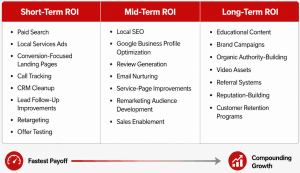
Service businesses should prioritize marketing investments in three ROI timelines: short-term, mid-term, and long-term. This approach helps owners avoid two common mistakes: cutting slow-building channels too early and over-investing in fast channels that stop scaling profitably.
Short-term ROI investments include paid search, Local Services Ads, landing page improvements, call tracking, lead follow-up improvements, retargeting, offer testing, and CRM attribution. These investments work close to the point of demand, so they can often produce useful data quickly.
Mid-term ROI investments include local SEO, Google Business Profile optimization, review generation, email nurturing, service-page improvements, remarketing audience development, and better sales enablement. These efforts may not produce instant revenue, but they can improve visibility, credibility, and conversion quality over time.
Long-term ROI investments include educational content, brand campaigns, organic authority-building, video assets, referral systems, reputation-building, and customer retention programs. These channels may not always show immediate last-click revenue, but they can reduce acquisition costs, increase trust, and support repeat business.
The healthiest plan does not chase only the fastest ROI. A service business needs a balanced portfolio: fast-response channels for immediate demand, mid-term assets that improve conversion efficiency, and long-term investments that make future marketing cheaper and more reliable.
How Do You Track Marketing ROI From Lead to Closed Customer?
The best way to track ROI is to connect every lead source to every meaningful sales outcome. That means tracking the full journey from the first marketing touch to the final revenue event.
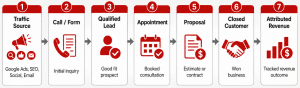
Start by using UTMs, forms, call tracking, landing page data, Google Analytics, Google Ads conversion tracking, and CRM source fields. For phone-heavy service businesses, call tracking is especially important because many high-intent prospects prefer to call instead of filling out a form.
Next, separate raw leads from qualified leads. A raw lead is any inquiry. A qualified lead is a serious prospect who fits the service area, budget, need, timing, and service type. This distinction matters because marketing should be optimized toward customers who can actually buy.
Then track appointment bookings, estimates, consultations, proposals, signed contracts, and completed jobs. The goal is to connect revenue back to the original lead source. Google Ads offline conversion imports and enhanced conversions for leads are built for this type of delayed or CRM-based sales process.
Finally, review ROI by channel, campaign, service line, and lead type. Monthly reviews help identify early waste, while quarterly reviews give longer sales cycles enough time to mature. GA4 attribution path reporting can help businesses understand which touchpoints contributed before a conversion happened.
What Marketing ROI Benchmarks Should Service Businesses Use?
A good marketing ROI depends on margins, service type, sales cycle, close rate, average job value, repeat purchase potential, and business capacity. There is no single universal benchmark that applies to every service business.
Salesforce notes that a 5:1 ROI is often considered very good, but it also clarifies that a “good” ROI depends on industry and business goals.
For a service business, a lower short-term ROI may still be acceptable when the customer has strong lifetime value, repeat-service potential, or referral value. For example, a dental clinic, accounting firm, legal practice, or maintenance-based home service company may profit from customers long after the first appointment.
Customer lifetime value is especially important because it expands ROI analysis beyond the first transaction. NetSuite explains that CLV helps evaluate the long-term impact of marketing by calculating the total value a customer generates over the relationship.
A high ROI percentage can also be misleading if the campaign is too small to scale. A $500 campaign that produces $5,000 in revenue may show excellent ROI, but it may not be enough to grow the business. The goal is not simply the highest ROI percentage. The goal is profitable, scalable growth.
What Mistakes Make Marketing ROI Look Better or Worse Than It Really Is?
The biggest mistake is counting leads instead of customers. Lead volume is useful, but it does not show whether marketing is profitable. A campaign that generates cheap leads can still lose money if those leads do not answer the phone, book appointments, accept estimates, or become paying customers.
Another mistake is ignoring close rate by channel. Two channels may produce the same number of leads, but one may generate better-fit customers with higher average job values. NetSuite notes that two campaigns can drive the same number of leads while producing different ROI if one converts more leads into customers.
Judging campaigns too early is another common issue. A campaign with a 30-day or 60-day sales cycle should not be judged only by same-week revenue. Longer journeys require attribution windows, CRM updates, and time-based reporting.
Missing phone calls or offline sales can also make profitable campaigns look weak. If the business does not track calls, imported closed deals, or CRM revenue, marketing reports may show cost without the revenue that followed. Google Ads call reporting and offline conversion imports are both designed to reduce these gaps.
Service businesses also distort ROI when they ignore lifetime value. Bain & Company research, cited by Harvard Business Review, found that increasing customer retention by 5% can increase profits by 25% to 95%. For repeat-service businesses, first-sale ROI may understate the real value of a customer.
How Can Service Businesses Improve Marketing ROI?
Service businesses can improve ROI by increasing lead quality, improving conversion rates, reducing wasted spend, and connecting marketing data to revenue outcomes. The fastest wins often come from fixing the weak points between the click and the closed sale.
Start with targeting. Campaigns should focus on profitable services, high-intent search terms, realistic service areas, and customers who match the business’s best-fit profile. A campaign that attracts the wrong audience can look active while quietly draining budget.
Improve landing pages next. A good service landing page should make the offer clear, explain the service, show trust signals, include reviews or proof, make contact options obvious, and reduce friction. Google Ads recommends making ads relevant and engaging and using conversion statistics to identify which ads and landing pages generate better results.
Speed also matters. Google Ads says one of the best ways to get better results from mobile ads is improving landing page speed, and it cites retail data showing that a one-second mobile delay can affect mobile conversions by up to 20%.
Lead follow-up is another major ROI lever. Harvard Business Review reported that companies responding to online leads within an hour were nearly seven times as likely to qualify the lead as companies that waited even one additional hour.
Finally, shift budget based on closed revenue, not just lead cost. A higher cost per lead may be worth it if the leads close at a higher rate, buy higher-value services, or stay longer. A lower cost per lead may be wasteful if the sales team spends time chasing poor-fit inquiries.
When Should a Service Business Increase, Reduce, or Reallocate Marketing Spend?
A service business should increase spend when a channel produces profitable closed customers, has enough data to trust the trend, and still has room to scale. The business also needs operational capacity. More leads are not helpful if calls go unanswered, appointments are unavailable, or service quality drops.
A business should reduce spend when a campaign has enough data and still produces poor-fit leads, low close rates, high acquisition costs, or customers that do not meet margin requirements. Before cutting, check whether the issue is the channel or the execution. Sometimes the traffic is good, but the landing page, offer, call handling, or follow-up process is weak.
A business should reallocate spend when one campaign or channel shows stronger revenue quality than another. Reallocation is not always a cut; it is often a smarter shift. For example, a service business may move budget from broad paid social campaigns into high-intent search, or from generic service pages into location-specific landing pages that convert better.
The best budget decisions combine performance data with business context. A campaign should be judged by ROI, payback period, sales capacity, margin, lifetime value, and strategic value—not by surface-level metrics alone.
How Should Service Businesses Build a Simple ROI Dashboard?
A service-business ROI dashboard should show where leads come from, how they move through the sales process, how much revenue they produce, and which channels deserve more investment.
At minimum, the dashboard should include spend by channel, leads by source, qualified leads by source, booked appointments, consultations, estimates, proposals, closed customers, revenue by source, cost per closed customer, ROI by channel, ROAS for paid campaigns, and payback period.
The dashboard should also separate marketing activity from business outcomes. Traffic, impressions, clicks, and form fills belong in the activity layer. Qualified leads, booked calls, closed jobs, revenue, profit, and lifetime value belong in the ROI layer.
Google Business Profile performance data can help local service businesses understand customer actions on Search and Maps, while GA4 attribution paths can help show how different touchpoints contribute before a key event.
A good dashboard should help owners make decisions. It should answer practical questions: Which channels bring serious customers? Which campaigns are wasting sales time? Which services produce the best margins? Which investments pay off quickly? Which investments are building long-term value?
FAQ
What is the easiest way to measure marketing ROI for a service business?
The easiest way is to compare marketing-attributed revenue with total marketing cost. Start with the formula: revenue from marketing minus marketing cost, divided by marketing cost, multiplied by 100. Then improve accuracy by tracking qualified leads, booked appointments, closed customers, and lifetime value.
What is a good marketing ROI for service businesses?
A good marketing ROI depends on margins, service type, sales cycle, and customer lifetime value. A 5:1 ROI is often considered strong, but each business should compare ROI against its own profit margins, capacity, and growth goals.
Should service businesses measure ROI by leads or revenue?
Service businesses should measure ROI by revenue, not just leads. Leads are useful early indicators, but revenue shows whether the marketing investment actually produced business value.
How long should you wait before judging marketing ROI?
The right measurement window depends on the sales cycle. Emergency services may show ROI quickly, while consulting, legal, medical, financial, or B2B services may need several weeks or months for leads to close.
Which marketing channel has the fastest ROI for service businesses?
High-intent paid search, Local Services Ads, landing page improvements, call tracking, and lead follow-up improvements often produce the fastest ROI because they affect prospects who are already close to taking action.
Why do some campaigns generate leads but poor ROI?
Some campaigns generate poor ROI because the leads are unqualified, the offer attracts the wrong audience, the sales team responds too slowly, calls are missed, close rates are low, or the average customer value is too small.
How does customer lifetime value affect marketing ROI?
Customer lifetime value helps service businesses measure the total value of a customer relationship, not just the first sale. This matters for businesses that earn repeat revenue through maintenance, renewals, retainers, or ongoing service.
Can you measure marketing ROI without a CRM?
Yes, but it is harder and less accurate. A spreadsheet can work at first, but a CRM makes it easier to connect source, lead quality, sales stage, closed revenue, and customer lifetime value.
Conclusion
Marketing ROI for service businesses should be measured by revenue quality, not surface-level marketing activity. Clicks, impressions, and leads can help diagnose performance, but they do not prove whether a campaign is profitable.
The strongest ROI plans connect marketing sources to qualified leads, booked appointments, closed customers, revenue, profit, and lifetime value. They also separate fast-payoff investments from longer-term growth channels. Paid search, Local Services Ads, landing page improvements, call tracking, and CRM cleanup may produce earlier returns, while local SEO, content, brand-building, reviews, and retention programs can compound over time.
The key is not to ask, “Which channel gets the cheapest leads?” The better question is, “Which marketing investments produce profitable customers first, and which ones build a stronger pipeline for the future?”
Why QBall Digital is Your Ideal Choice for Marketing ROI for Service Businesses?
QBall Digital helps service businesses look beyond clicks and lead counts so they can understand what their marketing is really producing. Instead of treating every inquiry as equal, QBall Digital focuses on the full path from traffic to qualified lead, booked appointment, closed customer, and measurable revenue. That gives business owners a clearer view of which campaigns deserve more budget and which ones need to be improved or cut.
For service businesses, smart ROI planning requires both marketing knowledge and operational awareness. QBall Digital can help identify tracking gaps, improve conversion paths, strengthen campaign targeting, and build reporting that connects marketing activity to business outcomes. With a clearer ROI framework, service businesses can invest with more confidence and avoid wasting budget on channels that look busy but do not produce profitable growth.
Plan Smarter Marketing Investments With QBall Digital
Ready to see which marketing investments are paying off first and which ones need a stronger strategy? Partner with QBall Digital to build a clearer marketing ROI plan, improve lead quality, and turn your marketing budget into measurable business growth.