

You repurpose one blog post across marketing channels by treating it as a core content asset, not a one-time article. Start with a strong blog that answers a valuable customer question, then extract its main ideas, examples, steps, statistics, and calls to action. From there, reshape those pieces into emails, social posts, short videos, sales talking points, FAQs, and follow-up resources.
A smart content repurposing strategy for small business helps you get more value from the work you have already done. Instead of constantly asking, “What should we post next?” your business can turn one well-written article into a connected system of content that supports visibility, trust, lead nurturing, and sales.
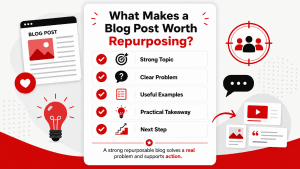
What Makes a Blog Post Worth Repurposing?
A blog post is worth repurposing when it solves a real audience problem and connects naturally to your products or services. The best source articles are not vague opinion pieces. They are practical, useful, and structured around a question your customers already ask.
For example, a service business might write a blog explaining how to choose between SEO and PPC. That article can later become a LinkedIn post about lead generation timelines, an email about budget planning, a sales conversation guide, and a short video about when paid ads make sense. QBall Digital uses this type of strategic thinking in resources like its guide on SEO vs. PPC for small businesses, where one topic can support multiple stages of the buyer journey.
A strong repurposable blog usually includes a clear central point, several supporting ideas, real-world examples, a practical takeaway, and a next step for the reader. Google’s own guidance also emphasizes creating helpful, reliable, people-first content, which supports the idea that your blog should be useful before it is promotional.
How Do You Break One Blog Post Into Reusable Content Assets?
Break one blog post into reusable assets by identifying the smaller pieces already inside it. Most good blog posts contain more content than they appear to at first glance. A heading can become a social media hook. A paragraph can become an email section. A statistic can become a graphic. A step-by-step process can become a carousel or short video.
Start by reviewing the article and pulling out five types of content: the main argument, supporting tips, quotes or strong sentences, examples, and the final call to action. Competitor articles from Elevated Marketing Solutions, Content Colin, and Iconic Digital all use a similar “one blog into many pieces” structure, often focusing on turning a blog into 10–20 smaller social or marketing assets.
For small businesses, the goal is not simply to create more posts. The goal is to create connected content. Each smaller asset should still point back to the same core message, whether the reader finds you through search, social media, email, or a sales conversation.
How Can You Turn a Blog Post Into Email Content?
You can turn a blog post into email content by using the article as the foundation for a short email series or newsletter feature. Instead of sending a generic “new blog is live” email, choose one specific problem from the article and make that the focus of the message.
A simple three-email sequence can work well. The first email introduces the problem and explains why it matters. The second email shares one useful tip, example, or mistake from the blog. The third email connects the lesson to a service, consultation, or next step.
This works because email gives your business a more direct way to educate and nurture readers. A blog helps people discover you, while email helps them stay connected. Competitor content from IU eMagazine and Chicklet Marketing both highlight this small-business advantage: one blog can support email trust-building, customer education, and ongoing visibility.
For a company investing in digital marketing services, this matters because content should not live in separate silos. Blog topics, email messaging, social media, and advertising should all reinforce the same business goals.
How Can You Turn a Blog Post Into Social Media Posts?
You can turn a blog post into social media posts by adapting each key point into a platform-friendly format. A long explanation from the blog can become a short LinkedIn post. A list of tips can become an Instagram carousel. A common mistake can become a short video. A practical quote can become a branded graphic.
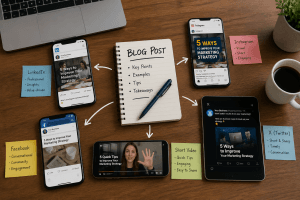
For LinkedIn, focus on business lessons, decision-making, or practical advice. For Facebook, use a more conversational style and invite responses. For Instagram, prioritize visual takeaways, carousels, and short captions. For short-form video, take one idea and explain it in under a minute.
The important point is that repurposing is not copying and pasting the same message everywhere. It is adapting the idea for the way people behave on each platform. One competitor article makes this distinction clearly by explaining that repurposing means reformatting and reframing a core idea for different platforms and audience behaviors.
A business using social media, SEO, PPC, and content creation together can build stronger consistency when each channel supports the same message instead of competing for attention.
How Can Blog Content Support Sales Conversations?
Blog content supports sales conversations by giving your team ready-made explanations for common customer questions. If prospects often ask about pricing, timelines, service differences, or expected results, those answers can become blog sections first and sales enablement content later.
For example, a blog explaining how a marketing strategy works can become a follow-up email after a sales call. A section about common mistakes can become a discovery-call talking point. A comparison article can help a prospect understand which service fits their situation before they commit.
This is especially useful for small businesses because sales teams often repeat the same explanations. Repurposed blog content saves time, keeps messaging consistent, and helps prospects make more confident decisions. QBall Digital’s search engine marketing page is a natural internal resource to support content that discusses PPC, lead generation, conversion tracking, and measurable marketing outcomes.
Google Ads documentation also reinforces the importance of conversion measurement because it helps businesses understand what users do after interacting with ads and how campaigns perform. That same measurement mindset should apply to content: track which repurposed assets help drive clicks, inquiries, calls, and consultations.
How Do You Build a Simple Repurposing Workflow?
You build a simple repurposing workflow by creating a repeatable process for every strong blog post. The workflow does not need to be complicated. It just needs to be consistent enough that your team can use it again.
Start with one blog post per core topic. Then create a spreadsheet with columns for the blog section, repurposed format, platform, owner, status, publish date, and call to action. From one blog, aim to create one email, three to five social posts, one short video idea, one sales talking point, and one FAQ update.
This type of workflow helps small businesses avoid random marketing. It also gives every content piece a job. Some pieces build awareness. Some educate. Some nurture leads. Some support sales. Some point readers to service pages, such as QBall Digital’s Indianapolis digital marketing page for businesses that want stronger local visibility and lead flow.
FAQ
How many pieces of content can one blog post become?
One strong blog post can often become 10 or more smaller content pieces. The exact number depends on the depth of the article, the number of sections, and the platforms your business uses.
Is content repurposing the same as reposting?
No. Reposting repeats the same content. Repurposing reshapes the original idea for a different channel, format, audience behavior, or stage of the buyer journey.
Which channels should a small business prioritize first?
A small business should prioritize the channels where its audience already pays attention. For many businesses, that means starting with the website, email list, one or two social platforms, and sales follow-up content.
How often can you reuse the same blog topic?
You can reuse the same blog topic multiple times if each version adds a new angle, format, or takeaway. A strong topic can be refreshed seasonally, expanded into a new resource, or broken into smaller posts over several months.
A Strong Blog Should Keep Working After You Publish
A blog post should not disappear after one social share. When the idea is useful, it deserves more than one moment of attention. Repurposing helps your business turn that idea into a practical marketing system that reaches people in different places and at different decision stages.
The smartest small businesses are not always the ones creating the most content. They are the ones making their best content work harder. Start with one helpful article, break it into smaller assets, adapt each one for the right channel, and measure what brings people closer to action.
Why Choose QBall Digital for Content Repurposing?
QBall Digital helps small businesses turn scattered marketing into a more connected digital strategy. Their team offers SEO, PPC, social media marketing, content creation, web design, and video services, making them well-positioned to help one strong idea work across multiple channels. QBall Digital’s approach is built around customized strategies, measurable results, and practical marketing support for businesses that need more visibility and stronger conversions.
For small businesses, content repurposing works best when it is connected to a bigger growth plan. QBall Digital focuses on tailored digital marketing solutions, transparent reporting, and strategies designed around each business’s goals. Their Why QBall Digital page highlights their commitment to small businesses, affordability, transparency, and customized support, which makes them a strong fit for companies that want content to support real business outcomes.
Build a Smarter Content System With QBall Digital
Ready to get more value from the content you already create? Contact QBall Digital to build a practical content strategy that connects your blog, email, social media, PPC, SEO, and sales messaging into one stronger growth system.