

To write a case study for a service-based business, start with a real client problem, explain why that problem mattered, show the service or strategy used to solve it, and prove the outcome with measurable results, client quotes, and clear business context. A strong case study should help future clients quickly understand what changed, how the work was done, and why they can trust your business to solve a similar problem.
That is why case study marketing for service businesses is so valuable. Service buyers often cannot see, test, or touch the result before they hire you. They need confidence in your expertise, process, communication, and ability to deliver. A case study gives them that proof through a real story instead of a sales claim.
For service-based companies, case studies are more than website content. They can support PPC landing pages, sales proposals, email follow-ups, retargeting campaigns, consultation pages, and direct sales conversations. According to Content Marketing Institute’s 2025 B2B research, case studies and customer stories were rated one of the most effective B2B content types, behind only video.
What is a marketing case study?
A marketing case study is a real client success story used to show how a business solved a specific problem and created a valuable result. It usually explains the client’s situation, the challenge they faced, the solution provided, the work completed, and the result achieved.
For service businesses, a marketing case study does more than describe a finished project. It shows how the business thinks, solves problems, communicates, and creates value. Salesforce describes a case study as a customer success story that goes beyond a basic testimonial by showing the full journey from challenge to solution to results.
This makes case study marketing for service businesses especially useful because service buyers are usually evaluating trust before they evaluate price. They want to know whether your team understands their problem, whether your process fits their situation, and whether your past results are relevant to their goals.
A good marketing case study should answer three questions quickly: What problem did the client have? What did you do to solve it? What changed because of the work?
Case study vs testimonial: what’s the difference?
A testimonial is a short statement of praise from a client. A case study is a fuller story that explains the client’s problem, the process used to solve it, and the result that followed.
Both are useful, but they work differently. A testimonial can add fast credibility to a website, landing page, or proposal. It usually captures how the client felt about the business, such as “They were responsive, strategic, and easy to work with.”
A case study gives the reader more context. It explains what the client was struggling with before the service, why they chose your business, what work was done, and what results came from that work. This matters for service-based businesses because prospects often need more than a positive quote before they are ready to book a call.
The easiest way to think about it is this: a testimonial says, “This business did a good job.” A case study shows, “Here is exactly how this business solved a real problem.”
Why do service businesses need case studies?
Service businesses need case studies because they sell expertise, judgment, process, and trust — not just a physical product. A prospect cannot always know in advance whether a marketing agency, consultant, designer, developer, accountant, advisor, or professional service provider will deliver the right outcome.
That uncertainty creates hesitation. A potential client may wonder: “Will this work for my business?” “Have they solved this kind of problem before?” “Can they handle the details?” “Is this worth the investment?” A strong case study answers those questions with proof.
Case studies also help service businesses attract better clients. When your case studies clearly show the types of problems you solve, the industries you understand, and the results you create, prospects can self-qualify before reaching out. That means your sales conversations can become more focused, more informed, and more likely to move forward.
Google also emphasizes helpful, reliable, people-first content in search. A well-written case study supports that principle because it gives users practical, experience-based information instead of generic marketing copy.
What should a service business case study include?
A service business case study should include the client background, challenge, stakes, solution, implementation process, results, client quote, and takeaway. These pieces help the reader understand the full story from problem to outcome.
Client background
Start with a short snapshot of the client. Include the industry, business type, audience, or situation that makes the story relevant. This does not need to be long. The goal is to help readers quickly recognize whether the example relates to them.
For example, instead of saying “A client came to us for help,” write something more specific: “A local professional services firm wanted to generate more qualified consultation requests from paid search.”
The challenge
The challenge explains the problem the client needed to solve. This should be written in the client’s terms, not just your internal marketing language.
A weak challenge sounds like this: “The client wanted better marketing.” A stronger challenge sounds like this: “The client was spending on ads but receiving low-quality inquiries that rarely turned into booked consultations.”
The stakes
The stakes explain why the problem mattered. This is where you show what was at risk if the problem continued.
For a service business, the stakes may include wasted ad spend, poor lead quality, missed revenue, slow sales cycles, weak positioning, low website conversion rates, or too much time spent speaking with unqualified prospects.
The solution
The solution explains what your business did. This section should be clear enough for the reader to understand your strategy, but not so technical that it becomes hard to follow.
For example, a digital marketing case study might explain that the team rebuilt the PPC landing page, refined the campaign targeting, improved the offer, added proof sections, and changed the follow-up process.
The implementation
Implementation shows how the work happened. This is especially important for service businesses because prospects are not only buying the final result. They are also buying the experience of working with you.
Include details such as timelines, collaboration, research, strategy sessions, campaign setup, creative development, reporting, or client approvals. This helps readers picture what the process would feel like if they hired you.
The results
Results are the proof. Use measurable outcomes whenever possible, such as increased leads, lower cost per lead, higher conversion rate, more booked calls, stronger lead quality, time saved, or revenue growth.
When exact numbers are unavailable, use approved qualitative proof. For example, you can explain that the client’s sales team received more relevant inquiries, the business owner had more confidence in the campaign, or the internal team saved time through a clearer process.
The client quote
A client quote makes the story more believable because it gives the reader a voice beyond your own. The best quotes are specific. Instead of using a generic quote like “They were great to work with,” ask the client to describe what changed, what they appreciated, or what surprised them.
The takeaway
End the case study by connecting the story back to the reader’s situation. The takeaway should explain why the example matters and what similar businesses can learn from it.
What are examples of case studies for service businesses?
Examples of case studies for service businesses include marketing campaign results, consulting transformations, website redesigns, operational improvements, lead generation campaigns, brand strategy projects, and professional service growth stories.
A service business does not need a famous client name to create a strong case study. The story simply needs to be specific, relevant, and useful to the kind of prospect the business wants to attract.
A digital marketing agency case study
A digital marketing agency might show how it helped a service provider improve lead quality through PPC campaign restructuring and landing page optimization. The case study could explain the original issue, such as poor conversion rates or irrelevant inquiries, then show the strategy used to improve campaign performance.
This type of case study is powerful because paid traffic often needs fast credibility. Google Ads explains that landing page experience depends on factors such as usefulness, relevance, navigation, and whether the page matches what users expected after clicking the ad.
A consultant case study
A consultant case study might show how a client clarified their offer, improved internal decision-making, or increased revenue from a specific service. The proof may include faster sales conversations, stronger pricing confidence, improved team alignment, or a clearer customer journey.
Consulting case studies should focus heavily on the before-and-after transformation because the value is often strategic rather than physical.
A web design or development case study
A web design or development case study might show how a redesigned website improved conversion rates, page clarity, user experience, or consultation bookings. The story should not only show the final design. It should explain what business problem the old website created and how the new version solved it.
For service businesses, this is especially important because a beautiful website is not always the same as a useful sales asset.
A professional services case study
A law firm, accounting firm, financial advisor, recruitment firm, or B2B service provider might use a case study to show how better messaging, clearer positioning, or improved digital marketing helped attract stronger inquiries.
Professional services often depend on credibility. Case studies help turn that credibility into a story future clients can understand.
How do you choose the right client success story for a case study?
The best client success story is one that matches the audience you want to attract and proves the result your future clients care about most.
The right case study is not always the biggest client name. A recognizable client can help, but relevance matters more. A small client story with a clear problem, strong result, and useful buyer insight can be more persuasive than a large brand story with vague details.
Choose a client story based on five factors: audience fit, problem clarity, result strength, proof quality, and client willingness. If the story reflects the kind of work you want more of, it is usually a strong candidate.
A good case study should also support a business goal. For example, if you want more PPC clients, choose a story that shows PPC performance improvement. If you want more consulting clients, choose a story that shows strategic clarity or measurable business improvement. If you want higher-quality leads, choose a story that proves you can attract or convert better-fit prospects.
What questions should you ask clients for a case study?
Case study questions should uncover the client’s original problem, why it mattered, how they chose your business, what the experience was like, and what changed after the work was completed.
The best interviews collect both facts and emotion. Facts give the case study credibility. Emotion helps the reader understand the client’s pressure, doubt, confidence, and relief.
What problem were you trying to solve before working with us?
This question helps establish the before state. Encourage the client to explain the issue in plain language.
Why had this problem become urgent or costly?
This reveals the stakes. It helps you show why the client needed to act instead of waiting.
What made you choose our service over other options?
This question uncovers decision criteria. It may reveal trust factors, positioning strengths, or objections that future prospects also have.
What was the process like from your perspective?
This helps describe the service experience. For service businesses, process matters because buyers want to know what working with you will feel like.
What changed after the project or service was completed?
This captures the after state. Ask the client to describe practical changes in performance, workflow, confidence, sales conversations, or customer response.
What measurable results or improvements did you see?
This question helps collect proof. Ask for numbers, percentages, timeframes, comparisons, or observable changes.
What would you tell another business considering this service?
This often produces the strongest quote because it sounds like one client speaking directly to another.
How do you turn client success stories into marketing case studies?
You turn a client success story into a marketing case study by organizing the story around the client’s problem, your solution, the work completed, and the outcome achieved.
Step 1: Choose a client story with a clear result
Start with a story that proves something meaningful. The result does not always need to be dramatic, but it should be relevant. A 20% improvement in lead quality may be more useful than a flashy vanity metric if your prospects care about better inquiries.
Step 2: Interview the client
Interview the client while the project is still fresh. Ask about the problem, urgency, decision process, service experience, and results. Record the conversation with permission so you can capture the client’s exact language.
Step 3: Collect proof
Gather campaign reports, screenshots, analytics, before-and-after examples, sales data, timelines, quotes, and project notes. Salesforce recommends gathering both specific metrics and story details to make case studies more convincing.
Step 4: Write the story around the client’s transformation
Make the client the hero. Your business should appear as the guide that helped create the change.
A weak case study says, “We used our expert strategy to improve performance.” A stronger case study says, “The client needed more qualified consultation requests, so the campaign was rebuilt around higher-intent searches, clearer landing page messaging, and stronger proof near the lead form.”
Step 5: Add a clear business takeaway
The takeaway helps readers understand why the story matters. It should connect the client’s outcome to a broader lesson, such as the importance of matching PPC traffic with landing page proof or aligning service messaging with buyer intent.
Step 6: Use the case study across marketing and sales
A case study should not live in one place only. Turn it into landing page sections, proposal slides, email snippets, social posts, retargeting ads, sales follow-ups, and downloadable PDFs.
This is where case studies become high-value marketing assets instead of one-time content pieces.
How do you make case study results believable when not every result is easy to measure?
Believable case studies use the strongest available proof, even when exact revenue or ROI numbers are not available.
For service businesses, some outcomes are easy to measure. These may include leads generated, conversion rate, cost per lead, booked calls, revenue growth, search rankings, time saved, project turnaround time, or customer retention.
Other outcomes are more qualitative but still valuable. These may include clearer messaging, better sales conversations, stronger confidence, smoother operations, improved internal alignment, better client communication, or reduced decision-making friction.
When exact results are confidential, use approved alternatives. You can use ranges, percentages, anonymized examples, directional improvements, or before-and-after descriptions. For example, instead of saying the exact revenue amount, you might say the campaign “helped the client generate a measurable increase in qualified consultation requests within the first quarter.”
Honesty matters. A case study becomes less trustworthy when it exaggerates results, removes context, or presents correlation as guaranteed causation.
| Weak case study claim | Stronger case study proof |
| “We improved their marketing.” | “The campaign generated more qualified consultation requests by narrowing targeting and improving the landing page offer.” |
| “The client got better results.” | “The client saw stronger lead quality and fewer irrelevant inquiries after campaign restructuring.” |
| “Our team delivered great service.” | “The client approved the strategy within two weeks and used the reporting dashboard to track weekly progress.” |
How can case studies support PPC campaigns for service businesses?
Case studies support PPC campaigns by giving paid traffic immediate proof that the service can solve a real problem.
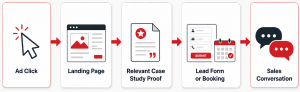
PPC can bring prospects to a page quickly, but attention does not automatically become trust. When someone clicks an ad, they are often comparing providers, checking credibility, and deciding whether the next step feels worth it. A relevant case study can reduce hesitation by showing that your business has solved a similar problem before.
Google Ads recommends that landing pages closely match the ad and keywords, and explains that stronger alignment between the ad and landing page can improve the chance of conversion. For service businesses, that alignment should include proof. If an ad promises more qualified leads, the landing page should not only repeat that promise. It should show a relevant client example that supports it.
Case study marketing for service businesses can improve PPC landing pages, retargeting campaigns, lead nurture emails, and sales follow-up by giving prospects a real example of success. Content Marketing Institute’s 2025 B2B report also found that SEM/PPC was the paid channel B2B marketers most often said produced the best results for content marketing.
Where should service businesses use case studies?
Service businesses should use case studies wherever prospects are comparing options, evaluating risk, or deciding whether to contact the business.
Service pages
Add short case study sections to service pages. These can include the client problem, solution, and result in a compact format. The goal is to support the service claim with proof.
PPC landing pages
Use case study snippets near the CTA, form, or consultation booking section. This helps reassure visitors before they take action.
Sales proposals
Add a case study that matches the prospect’s industry, problem, or goal. This can make the proposal feel more relevant and less generic.
Email nurture campaigns
Share case studies with prospects who are not ready to buy yet. A useful client story can keep your business top of mind while building trust over time.
Retargeting ads
Turn strong case study results into proof-based ad angles. For example: “See how a service business improved lead quality with a clearer PPC landing page strategy.”
Consultation booking pages
Place a short case study near the booking form to reduce hesitation. At this stage, the prospect is close to taking action but may still need reassurance.
What mistakes make service business case studies less effective?
Service business case studies become less effective when they are too vague, too promotional, too focused on the provider, or missing real proof.
Making the business the hero instead of the client
The client should be the center of the story. Your business is the guide that helped them solve the problem.
Using vague claims without numbers or examples
Claims like “better results” or “improved performance” are too broad. Be specific about what improved and why it mattered.
Skipping the client’s original problem
Without the original problem, the result has less meaning. Readers need to understand the before state to appreciate the transformation.
Ignoring the process behind the result
Service buyers care about how the work happens. A case study that skips the process may leave readers unsure about what they are actually buying.
Using metrics without explaining why they matter
Numbers need context. A lower cost per lead is helpful, but it becomes more persuasive when you explain how it affected sales conversations, budget efficiency, or lead quality.
Forgetting to include a next step
A case study should guide the reader toward action. That action may be booking a consultation, viewing a related service, downloading a resource, or contacting the business.
Writing the case study like a press release
A case study should feel useful and specific. If it sounds too polished or self-congratulatory, readers may trust it less.
How often should service businesses create case studies?
Service businesses should create case studies whenever they complete meaningful client work with a clear result, and they should review older case studies at least once a year.
A useful case study library should cover different services, client types, problems, industries, and outcomes. For example, a digital marketing agency may want one case study about PPC, one about SEO, one about landing page conversion, and one about full-funnel strategy.
Older case studies should be updated when results improve, services change, client positioning shifts, or screenshots and visuals become outdated. Salesforce also recommends updating case studies so they continue to show lasting value rather than only short-term wins.
One strong case study can also become many smaller marketing assets. You can turn it into a landing page proof block, LinkedIn post, sales slide, quote graphic, email sequence, short video script, or retargeting ad.
FAQ
How long should a case study be for a service business?
A service business case study is often between 800 and 1,500 words, depending on the complexity of the service and the amount of proof available. Shorter case studies can work well for landing pages, while longer versions are useful for sales enablement, SEO, and detailed buyer research.
How many case studies should a service business have?
A service business should aim to build a small library of case studies that represent its main services, client types, and strongest results. Three to five strong case studies are usually more useful than ten vague ones.
Can a case study be anonymous?
Yes, a case study can be anonymous if the client cannot be named. In that case, describe the client by industry, business type, size, or situation. Use approved metrics, ranges, and quotes to keep the story credible without revealing sensitive details.
Do small service businesses need case studies?
Yes. Small service businesses can benefit from case studies because they often need to build trust without the advantage of a large brand name. A specific client story can make a small business look more credible, experienced, and results-focused.
What makes a case study trustworthy?
A trustworthy case study includes a real problem, clear context, specific actions, believable results, client language, and honest limitations. It should avoid exaggerated claims and explain what actually changed.
Should case studies include numbers?
Yes, case studies should include numbers whenever possible. Useful numbers may include lead volume, conversion rate, cost per lead, revenue, time saved, ranking improvement, project turnaround time, or customer retention. When numbers are unavailable, use qualitative proof and client quotes.
Can case studies help generate better leads?
Yes. Case studies can help generate better leads by showing prospects what problems your business solves best. When readers see examples that match their situation, they can better understand whether your service is the right fit.
Conclusion
A strong service-business case study answers a simple question: “Can this business solve a problem like mine?” It should show the client’s starting problem, why that problem mattered, the service provided, the process used, and the result achieved.
The best case studies are clear, specific, honest, and easy for future clients to connect with. They do not rely on hype. They build trust by showing real client progress in a way that feels practical and believable.
For service businesses, case studies should not be treated as optional content. They are proof-driven sales assets that can support your website, PPC campaigns, proposals, sales follow-ups, and long-term brand credibility.
Why QBall Digital is Your Ideal Choice for Case Study Marketing for Service Businesses?
QBall Digital helps service businesses turn client success stories into marketing assets that build trust, support PPC campaigns, and attract better-fit leads. Instead of treating case studies as simple write-ups, QBall Digital approaches them as conversion tools that can strengthen landing pages, sales conversations, retargeting campaigns, and lead nurturing efforts.
With a strong understanding of digital marketing and buyer behavior, QBall Digital knows how service-based prospects evaluate risk before taking action. The team can help shape your case studies around the proof, messaging, and outcomes your future clients need to see. That means your best client wins can do more than sit on a website — they can help create real marketing momentum.
Turn Client Success Stories Into Better Leads With QBall Digital
Ready to turn your best client results into case studies that build trust and support your marketing strategy? QBall Digital can help you create proof-driven content that strengthens your PPC campaigns, improves your sales process, and gives future clients a clearer reason to choose your business.