
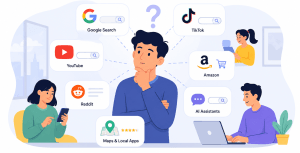
Customers are not limiting themselves to Google because different platforms answer different parts of the buying decision. They may discover an idea on social media, watch a demonstration on YouTube, read candid opinions in a community, ask an AI assistant to compare options, and open Google Maps when they are ready to visit or call.
Search everywhere optimization is the practical response. It helps a business become visible, useful, and credible across the specific places its customers use to research decisions. Not every platform. The right platforms, connected by consistent information and a clear path toward action.
What Has Changed About the Modern Customer Search Journey?
The modern search journey is fragmented and rarely follows a straight line from query to purchase.
Google’s consumer decision-making research describes a “messy middle” in which buyers repeatedly explore possibilities and evaluate alternatives before committing. They move between websites, search engines, social platforms, reviews, videos, and other information sources as they reduce uncertainty.
A customer might see a service in a short video, search the company name, compare reviews, leave, ask an AI tool for alternatives, and return through a paid advertisement days later.
That behavior creates a serious visibility problem. A company can rank well on Google and still lose customers during the earlier moments when preferences and shortlists are being formed.
Where Are Customers Searching Beyond Google?
Customers choose a search environment according to the kind of answer they need. A written explanation may work on a website. A complicated process may be easier to understand through video. A high-risk purchase may require reviews and firsthand experiences.
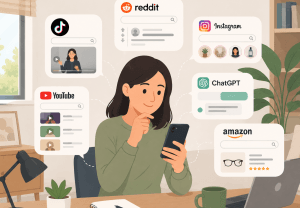
Why Do Customers Use YouTube and Social Platforms?
YouTube helps people search for demonstrations, comparisons, tutorials, interviews, and visual proof. Its search system ranks videos using factors such as relevance, engagement, and quality, while its recommendation system also helps viewers discover subjects and creators they were not actively seeking.
TikTok has similarly developed into a discovery environment. The platform describes search as a way for users to explore topics ranging from recipes and do-it-yourself projects to educational content.
Businesses can respond with coordinated social media marketing and professional video production that answer real buyer questions—not content created merely to fill a posting calendar.
Why Do Buyers Search Reviews and Online Communities?
Reviews and communities offer something a company’s own website cannot fully reproduce: perceived independence.
Customers use these sources to uncover recurring problems, validate marketing claims, compare real experiences, and determine how a company responds when something goes wrong. For expensive or unfamiliar services, that reassurance may matter as much as price.
Why Are Customers Asking AI Assistants?
AI assistants allow users to ask conversational questions, request comparisons, refine criteria, and receive summarized answers without opening numerous tabs. ChatGPT Search, for example, combines web information with linked sources, while Google’s AI-powered search features support follow-up questions, comparisons, and broader research tasks.
This changes the goal from simply earning a blue-link ranking to becoming a clear, trustworthy source that search and AI systems can understand.
When Do Maps and Marketplaces Become Search Engines?
Maps become critical when a search has local or immediate intent. Google confirms that customers can find nearby businesses through both Maps and Search, using business information to surface relevant local results.
Marketplaces play a similar role for products. Customers can compare specifications, availability, prices, delivery options, and reviews without first visiting a brand’s website.
Why Does a Google-Only Strategy Leave Revenue Opportunities Uncovered?
A Google-only strategy concentrates attention on one part of a much larger decision process.
By the time a customer enters a high-intent Google query, another company may have already earned familiarity through videos, social posts, reviews, community discussions, or AI-generated recommendations. The final search may look like the decisive interaction, but earlier touchpoints often determine which names make the shortlist.
This affects paid performance, too. A customer who already recognizes and trusts a brand may respond differently to an advertisement than someone seeing it for the first time.
Ranking first is valuable. Being recognized, validated, and remembered before the final search is even better.
How Does Search Everywhere Optimization Solve the Visibility Problem?
Search everywhere optimization coordinates a company’s content, expertise, reputation signals, and offers across the platforms that influence its customers.
A practical system follows six steps:
- Identify the questions customers ask before contacting the business.
- Determine where customers ask or discuss each question.
- Publish a complete, authoritative answer on the company website.
- Adapt that answer to the format expected on each priority platform.
- Keep claims, business details, branding, and offers consistent.
- Give the customer a relevant next step at every touchpoint.
Traditional search engine optimization remains essential because the website should serve as the primary source of accurate information. A fast, credible, conversion-focused site also gives visitors somewhere useful to go after discovering the brand elsewhere. When that foundation needs improvement, professional website design and hosting can connect visibility with a better user experience.
How Should a Business Decide Which Platforms Deserve Priority?
A search everywhere optimization plan should prioritize platforms using customer evidence rather than popularity.
Evaluate each channel according to five factors:
- Audience presence: Are potential customers actively using it?
- Intent: Are they discovering, learning, comparing, or buying?
- Content fit: Can the company create the format users expect?
- Commercial value: Does the platform influence qualified inquiries?
- Capacity: Can the business maintain a useful presence consistently?
Separate platforms into primary, supporting, and experimental tiers. Primary channels deserve sustained investment. Supporting channels strengthen credibility. Experimental channels receive smaller tests until the data justifies expansion.
“Everywhere” should never mean spreading resources everywhere.
How Can SEO and PPC Support the Same Cross-Platform Journey?
SEO and PPC work best when they share customer insights, messaging, and conversion data.
Search-term data from paid campaigns can reveal high-intent questions worth answering organically. Paid campaigns can test headlines, offers, and landing-page messages before those ideas are expanded across other channels. Retargeting can also reconnect with people who first encountered the brand through a video, article, or social post.
Meanwhile, strong organic resources give paid visitors more evidence when they investigate the company before converting.
QBall Digital’s search engine marketing services can help connect paid demand capture with SEO, social media, web design, and broader digital strategy rather than measuring each channel in isolation.
How Can One Strong Content Idea Work Across Multiple Search Surfaces?
One well-researched idea can support several channels without being copied word for word.
A company can publish the complete answer as a website article, demonstrate it through a video, turn individual points into short social posts, convert common objections into FAQs, and use the strongest benefits in advertisements or landing pages.
The central information stays consistent. The presentation changes according to the platform and customer need.
A documented content repurposing strategy makes this process more efficient, especially for small businesses that cannot produce entirely separate campaigns for every channel.
How Should Cross-Platform Search Performance Be Measured?
Performance should be evaluated through visibility, engagement, assisted behavior, and business outcomes.
Useful indicators include branded search growth, video watch time, social saves and profile visits, review sentiment, local listing actions, returning visitors, assisted conversions, calls, form submissions, booked appointments, and qualified leads.
AI mentions and citations may also be monitored where reliable tools are available.
Reach alone is not the finish line. The strongest reporting connects channel activity to pipeline quality, acquisition cost, and revenue.
FAQ
Is Google Still Important for Customer Acquisition?
Yes. Google remains one of the strongest platforms for capturing existing demand, particularly when customers are actively comparing providers or preparing to act. The mistake is not using Google; it is treating Google as the entire customer journey.
Does Search Everywhere Mean Publishing on Every Platform?
No. Search everywhere optimization means appearing in the places that meaningfully influence your customers. A business should select channels based on audience behavior, buying intent, content fit, and measurable commercial value.
How Is This Different From Omnichannel Marketing?
Omnichannel marketing coordinates the broader customer experience across marketing, sales, service, and commerce. This approach has a narrower objective: improving how a business is discovered, understood, validated, and represented wherever customers conduct research.
Can a Small Business Use This Strategy With a Limited Team?
Yes. Begin with a strong website and one or two additional platforms that already influence customer decisions. Create complete answers first, then repurpose them into smaller channel-specific assets.
What Should Your Business Do First?
List the five questions customers most frequently ask before contacting your business. Search each question on Google, YouTube, social platforms, AI tools, Maps, and relevant communities.
Where do competitors appear? Where is your company absent? More importantly, where are customers finding incomplete or unhelpful answers?
That gap is your starting point.
Which platform is shaping your customers’ decisions before they finally reach your website?
Why QBall Digital is Your Ideal Choice for Search Everywhere Optimization?
QBall Digital brings together the capabilities needed to build a connected search presence. Its full-service digital marketing solutions include SEO, PPC, social media management, content creation, web design, and video production—services that can support customers from initial discovery through conversion.
Rather than directing businesses toward every available platform, QBall Digital can help identify the channels that align with real customer behavior and commercial goals. Its results-focused approach connects visibility with clearer messaging, better conversion paths, and measurable lead generation. Learn more about why businesses choose QBall Digital.
Reach Customers Wherever They Search With QBall Digital
Your customers are already moving between search engines, videos, social platforms, reviews, AI tools, and local listings. Your marketing should make that journey easier.
Contact QBall Digital to identify missed search touchpoints and build a coordinated strategy designed to generate qualified leads.