
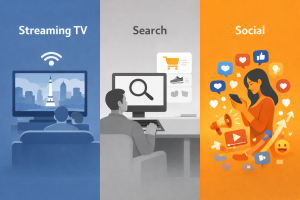
Streaming TV ads in Indianapolis usually beat social and search when your goal is to create demand, build local brand recall, and reach the right households in a premium viewing environment before prospects ever type a query or stop scrolling in a feed. Search is still the stronger channel when buyers already know what they want and are actively looking for it, while social is often better for low-cost creative testing, audience engagement, and faster iteration. The smartest local media plans usually do not treat these channels as interchangeable. They use each one for the job it does best.
What are streaming TV ads, and how are they different from traditional TV ads?
Streaming TV ads are video ads delivered through internet-connected television environments such as smart TVs, streaming devices, set-top boxes, and gaming consoles. Google defines connected TV as a television set used to stream video over the internet, including devices and apps used to access that content.
The biggest difference from traditional TV is not just where the ad appears, but how the campaign is bought, targeted, and measured. Traditional TV typically relies on broader program or network-based audience buying, while connected TV can layer in digital capabilities such as geographic targeting, audience targeting, frequency controls, and more granular reporting. IAB’s current CTV measurement guidance also reflects how much the industry has shifted toward standardized, outcome-oriented measurement rather than simple spot delivery.
That matters for Indianapolis advertisers because the question is no longer “TV or digital?” Streaming TV is digital video on the biggest screen in the house. It combines TV-style storytelling with digital-style targeting and measurement, which is exactly why it can outperform both social and search in the right part of the funnel.
How do streaming TV ads work for Indianapolis advertisers?
Streaming TV campaigns usually begin with audience and geography decisions. Advertisers define who they want to reach, where they want to reach them, and what kind of inventory they want to buy. In Google’s Display & Video 360, for example, advertisers can use location targeting and geography targeting down to cities and ZIP codes, making localized Indianapolis campaigns practical for service areas, multi-location brands, and regional awareness pushes.
From there, the buy moves into inventory and creative execution. A campaign may run across ad-supported streaming apps, live TV streaming environments, YouTube on TV screens, or other CTV inventory sources. Platforms then report on impressions, device breakout, completion-related metrics, reach, and in some cases cross-media or lift measurement. Google also supports TV-focused reporting and planning features in DV360 and Google Ads, which reflects how CTV is increasingly managed as part of a broader media mix rather than as a silo.
For an Indianapolis advertiser, that means a campaign can be built around actual local business goals rather than a generic “run some video” mindset. A healthcare group can focus on specific service-area ZIP codes. A home services brand can concentrate on qualifying households within driving distance. A law firm can prioritize household reach and recall. The mechanics support much tighter planning than legacy TV, even though the creative still benefits from the emotional power of the television screen.
Why are Indianapolis businesses investing in streaming TV ads now?
Businesses are moving budget toward streaming because audience behavior has already moved there. Nielsen reported that streaming reached 44.8% of total television usage in May 2025, surpassing the combined share of broadcast and cable for the first time. Nielsen also reported that streaming usage was up 71% since 2021, which is a major change in how Americans consume TV content.
That shift matters even more to advertisers because ad-supported viewing remains substantial. Nielsen’s Ad Supported Gauge found that 72.4% of total TV viewing in Q1 2025 was ad-supported, with ad-supported streaming making up the largest portion within that ad-supported environment. In other words, this is not just a story about people watching subscription content with no ads. There is meaningful ad-supported inventory where marketers can still reach audiences at scale.
For Indianapolis businesses, the practical takeaway is simple: if your audience spends more of its TV time in streaming environments, your local media plan should reflect that reality. Streaming TV is no longer a niche test channel. It is increasingly the place where brands can buy local reach with better digital controls than old-school linear TV and with more visual impact than search or feed-based social.
When do streaming TV ads beat paid social in Indianapolis?
Streaming TV usually beats paid social in Indianapolis when your campaign needs stronger attention, higher perceived credibility, and more immersive storytelling than a crowded feed can realistically provide. Social platforms are built for fast consumption and constant interruption. CTV places your message inside long-form viewing on the largest screen in the home, which often makes it a better fit for awareness, trust-building, and high-consideration offers. IAB’s recent attention framework exists precisely because attention quality is not identical across channels and placements.
This matters most for businesses that need to persuade before they can convert. A home remodeler, med spa, healthcare provider, personal injury firm, financial planner, or regional retailer often needs more than a quick swipe-stop. They need clear narrative, visual proof, brand presence, and enough screen real estate to communicate value. In those cases, streaming TV often outperforms social as the top-of-funnel channel because it gives the message room to land. That is especially true when the sale involves trust, family decision-making, or a larger purchase. That last point is partly an inference from how CTV household viewing and TV-screen creative work, supported by Google’s CTV documentation and TV planning tools.
Streaming TV also tends to beat social when you care more about local reach quality than about cheap impressions. Meta’s awareness products are built around reach and frequency, which makes them useful, but they still operate inside a feed-first environment. CTV can reach broad local audiences too, while keeping the ad inside premium video viewing rather than between posts, comments, and distractions.
Social still wins in some situations. If the budget is small, the creative is unproven, the offer changes weekly, or the goal is engagement and iterative testing, paid social remains extremely useful. It is usually the faster lab. But when the question is which channel is more likely to make an Indianapolis brand look established, memorable, and credible, streaming TV often has the edge.
When do streaming TV ads beat paid search in Indianapolis?
Streaming TV beats paid search when the core job is to create demand rather than capture it. Google’s own documentation states that Search campaigns are designed to reach people actively searching for your products and services. That is a major strength, but it also defines the limit of search: it works best once a person already has intent.
That is why CTV can outperform search for local advertisers who need to influence the market before a search ever happens. If you are opening a new location, expanding into new service areas, promoting a brand category people do not shop for every day, or trying to become the name prospects remember later, streaming TV can do work that search cannot. Search harvests existing demand. CTV helps create it. Google’s Search Lift and Brand Lift tools exist because upper-funnel video can influence later brand interest and organic search behavior.
This is especially relevant in Indianapolis when the purchase journey is not purely urgent. A family may not search for senior living, orthodontics, higher-end furniture, elective healthcare, legal help, or home renovation services the same day they first become aware of the need. Streaming TV can plant the brand, frame the problem, and make the eventual search more likely to favor the advertiser that showed up earlier on the television screen. That is an inference, but it is supported by Google’s lift-study framework and the basic distinction between demand creation and active query capture.
Search still wins when the query signals immediate intent. Emergency plumbers, urgent legal queries, branded searches, “near me” service terms, and high-conversion bottom-funnel keywords are exactly where search should remain central. The strategic lesson is not that CTV replaces search. It is that search alone can underinvest in the stage where local demand is formed.
Which Indianapolis businesses benefit most from streaming TV ads?
Streaming TV tends to work best for Indianapolis businesses that sell trust, consideration, or visibility rather than impulse alone. Home services brands, healthcare providers, legal practices, senior living communities, higher education institutions, local retailers with higher average order values, and multi-location service businesses all fit this profile. They benefit from the ability to reach local audiences at household scale while telling a fuller story than search text ads or cramped social placements allow. This is an inference based on channel characteristics rather than a single source naming every vertical.
Businesses also benefit when multiple people influence the decision. That can include family purchases, healthcare choices, larger home projects, and major financial or legal services. Because connected TV occurs on a shared screen, it can support broad household awareness better than channels built around one person’s active query or one person’s feed session. Google’s CTV and TV planning resources support that shared-screen, cross-media planning reality even if they do not phrase it in exactly those words.
By contrast, a purely bottom-funnel local advertiser with a tiny budget and immediate-response goals may get more efficient early traction from search, and sometimes from social retargeting. The channel fit improves as the business need shifts from “capture people now” toward “be the brand people remember when they are ready.”
How can you target the right audience with streaming TV ads in Indianapolis?
You can target streaming TV campaigns in Indianapolis through geography, proximity, audience traits, inventory settings, and data integrations. Google’s geography targeting in DV360 supports states, cities, and ZIP codes, while location targeting lets advertisers choose where ads are shown to people currently or regularly in a targeted location. That gives local advertisers meaningful control over service areas and expansion zones.
Audience targeting can then narrow the campaign further based on available platform capabilities and the inventory type being used. Google documents that DV360 offers targeting options based on inventory source and multiple targeting categories, while IAB’s CTV guidance emphasizes the importance of standardization across delivery, targeting, measurement, verification, and brand suitability. Together, those sources show that modern CTV buying is far more nuanced than simply selecting a show or network.
The strategic rule is to match targeting complexity to the goal. If the objective is market-wide awareness across Indianapolis, too much narrowing can choke delivery. If the goal is efficient reach among likely households, tighter audience logic can help. The best campaigns usually balance precision with scale instead of treating every CTV buy like a hyper-niche retargeting exercise. That recommendation is an inference from how digital targeting and reach planning operate, supported by Google’s TV planning and targeting tools.
What streaming platforms and ad environments should Indianapolis brands consider?
Indianapolis brands should think in terms of environments rather than chasing one logo. The main buckets are ad-supported subscription streaming, free ad-supported streaming television, live TV streaming, YouTube on connected TVs, and broader publisher/app inventory available through DSPs. Nielsen’s reporting shows both the scale of streaming overall and the continued growth of FAST environments, while Google’s help resources show how connected TV inventory can be reached across YouTube, Google TV network inventory, and DV360 environments.
The right mix depends on the job. If the goal is mass local awareness, broader reach across multiple environments can make sense. If the goal is tighter audience quality, curated premium inventory or direct deals may be more appropriate. If measurement and cross-media planning matter most, platforms with stronger reporting and planning tools become more attractive. IAB’s standardized measurement guide is useful here because it underscores how buying path and measurement setup affect what advertisers can actually learn from a CTV campaign.
The important thing is not to assume “streaming TV” is one homogenous channel. It is an ecosystem. Indianapolis advertisers usually get better results when they choose environments based on audience behavior, creative fit, and measurement requirements, not just perceived prestige.
How much do streaming TV ads cost in Indianapolis?
Streaming TV ad costs in Indianapolis depend on audience size, targeting tightness, inventory quality, seasonality, buying method, and creative requirements. That is the most honest answer. Google’s campaign and inventory documentation makes clear that campaign setup choices, bidding models, and targeting settings shape delivery and cost outcomes across platforms.
What matters more than raw CPM is whether the campaign is built for the right job. A tightly targeted campaign against premium inventory will usually cost more than a broader buy, but it may still be the better investment if the audience is more relevant and the environment is more valuable. Likewise, an Indianapolis brand may find that a seemingly cheaper social campaign produces weaker recall, while a more expensive streaming impression produces better downstream search behavior and stronger brand memory. The second point is an inference, but it aligns with Google’s Brand Lift and Search Lift frameworks.
Creative costs also matter. Streaming TV works best when the video is actually made for the TV screen, not when a vertical social clip is awkwardly repurposed. Advertisers should budget for production or adaptation, testing, and measurement alongside media. That often makes streaming TV less of a plug-and-play channel than social, but also more capable of delivering premium perception.
What creative makes streaming TV ads work better than social or search?
The best streaming TV creative is clear, visual, and brand-forward from the opening seconds. That is partly because TV-screen viewing gives you room to tell a story, but it also means you cannot rely on tiny text, feed-native cues, or silent-first design habits that often shape social creative. Google supports a range of video ad formats and durations, including CTV-relevant non-skippable formats up to 30 seconds, which makes message structure and pacing especially important.
For local Indianapolis campaigns, the best creative usually does five things well. It identifies the brand early, shows the offer or pain point quickly, uses visuals that feel credible on a large screen, makes the local relevance obvious without sounding forced, and ends with a clean next step. That next step might be a direct visit, a branded search, or a QR code scan. Google now supports QR codes on connected TV for certain campaign types, which gives advertisers another way to bridge the gap between awareness and action.
This is also where streaming TV can beat social and search most visibly. Search text ads are limited by format. Social video often competes against distraction. CTV gives the brand a stage. But it only works when the ad respects the screen, the context, and the viewer’s attention. A weak TV creative will not become strong just because it runs on a better device.
How do you measure whether streaming TV ads are outperforming social and search?
You measure streaming TV performance by looking beyond last-click reporting. IAB’s Standardized Measurement Guide for CTV exists because advertisers need more cohesive ways to evaluate delivery, audience, and outcomes across fragmented TV environments. That already tells you something important: CTV should be judged with the right measurement model, not by forcing every impression through a search-style attribution lens.
In practice, the most useful measures often include reach, frequency, completed views or completion-related signals where available, branded search lift, site traffic changes, assisted conversions, and survey-based brand metrics. Google’s Brand Lift helps measure effects such as ad recall, awareness, consideration, and related brand outcomes, while Search Lift analyzes how ads influence organic searches on YouTube and TV campaigns. Those tools are especially valuable when you want to know whether streaming is creating demand that later shows up in search.
That is why many Indianapolis advertisers misjudge CTV at first. If they only credit the last click, search appears to do all the work. But if they look at whether branded queries rise, direct traffic improves, and assisted conversion paths become stronger after a streaming campaign launches, they often get a more accurate picture of how channels are working together. That is an inference from Google’s lift-study tools and cross-media reporting capabilities.
Can streaming TV ads and search or social work better together?
Yes. In many cases, that is the best setup. Streaming TV creates awareness and memory, search captures active demand, and social reinforces the message through retargeting, repetition, and creative variation. Google’s campaign-type guidance explicitly frames channel choice around business goals and strategy, while its lift and cross-media tools support evaluating how video and TV contribute beyond a single touchpoint.
A practical Indianapolis example would look like this: CTV introduces the brand across targeted local households, paid search captures category and branded intent as it rises, and social stays in-market with testimonials, offers, and remarketing. That mix is often stronger than trying to force one channel to do every job from first impression to final conversion. The specific orchestration is an inference, but it is fully consistent with how Google describes campaign-type roles and measurement options.
This is the real strategic point behind the article’s title. The question is not whether connected TV should replace social and search in every case. It is when connected TV should lead the plan because the business problem is visibility, persuasion, and market education rather than immediate query capture.
How should an Indianapolis business choose the right budget split between streaming TV, social, and search?
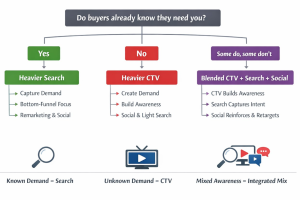
Start with the buying stage, not the channel preference. If the market already knows the category and is actively searching, search deserves a larger share. If the business needs local awareness, premium perception, or better message recall, streaming TV should take a larger role. If the brand needs constant testing, fast offer rotation, or engagement around creative themes, social should stay active. Google’s campaign guidance supports this objective-first way of choosing media.
Next, look at audience size and geography. A broad Indianapolis service area can justify meaningful CTV reach if the goal is local brand presence. A tiny niche audience may be better served with a narrower mix anchored more heavily by search and selective remarketing. Geography and audience tools in DV360 make this kind of calibrated planning possible rather than forcing advertisers into an all-or-nothing buy.
Then look at the creative. If the brand has strong video, real customer proof, and a message worth seeing on a TV screen, CTV becomes more compelling. If the creative is weak or untested, social may be the lower-risk proving ground before larger-screen deployment. That conclusion is an inference, but it aligns with platform differences in creative format and measurement.
For many Indianapolis advertisers, the best answer is not a fixed ratio. It is a phased mix. Let streaming TV lead when you need to shape the market, let search harvest the demand that appears, and let social support testing and reinforcement. That approach usually reflects how buyers actually move from awareness to action.
FAQ
Are streaming TV ads and OTT ads the same thing?
Not exactly. In practice, the terms are often used interchangeably, but connected TV usually refers to the device or TV-screen environment, while OTT more broadly refers to content delivered over the internet instead of through traditional cable or satellite infrastructure. Google’s CTV documentation focuses on the connected device and screen context.
Do streaming TV ads work for small businesses in Indianapolis?
Yes, they can, especially when the business needs local awareness and has a clear service area, strong video creative, and realistic expectations about measurement. They are usually less suitable when the budget only supports bottom-funnel capture and there is no room for upper-funnel investment. That judgment is an inference based on channel characteristics, not a claim that every small business should buy CTV.
Can streaming TV ads target specific ZIP codes or neighborhoods?
ZIP code targeting is supported in Google’s geography targeting for DV360, and proximity-based options are also available. Neighborhood-level availability can vary by platform and buying method, but local geographic control is one of the major advantages of digital TV buying.
How long should a streaming TV ad be?
There is no single correct length, but common CTV-relevant options include short non-skippable formats and longer CTV non-skippable formats up to 30 seconds in Google’s documentation. The best length depends on the message complexity, offer, and campaign objective.
Are streaming TV ads better for brand awareness or lead generation?
They are generally stronger for awareness and demand creation, but they can still support lead generation when paired with the right measurement setup, landing experience, and follow-up channels. Google’s Brand Lift and Search Lift tools show why video/TV campaigns are often judged first on awareness and interest effects rather than direct clicks alone.
Can streaming TV ads drive website traffic and conversions?
Yes, but not always in a clean last-click pattern. They may drive direct visits, branded searches, assisted conversions, QR code scans, and measurable lift in brand metrics or search behavior. That is why lift studies and cross-media reporting matter.
Should Indianapolis brands run streaming TV ads year-round or seasonally?
That depends on category and demand patterns. Brands with long consideration cycles or ongoing category competition often benefit from an always-on presence, while seasonal businesses may concentrate spend around peak windows. The decision should follow business timing, search demand, and budget, not a one-size-fits-all rule. This is strategic guidance rather than a sourced universal benchmark.
Conclusion
Streaming TV ads in Indianapolis beat social and search when the real challenge is not just capturing intent, but creating it. They are especially valuable when a business needs stronger local reach, richer storytelling, and better brand recall than feed-based placements or text ads can typically deliver. At the same time, search remains essential for active demand, and social remains useful for testing and reinforcement.
The smartest strategy is usually not channel loyalty. It is channel fit. When CTV leads because the brand needs visibility and persuasion, and search plus social support the path to action, the overall media mix becomes much more effective.
Why QBall Digital is Your Ideal Choice for Streaming TV Ads in Indianapolis?
QBall Digital is well positioned to help Indianapolis businesses use streaming TV ads strategically instead of treating them like a trendy add-on. The real challenge is rarely just getting a video onto a TV screen. It is knowing when CTV should lead, when search should capture, and when social should reinforce. That kind of channel judgment matters more than buzzwords because it protects budgets from being pushed into the wrong funnel stage.
QBall Digital can also bring a PPC-informed lens to streaming strategy, which is where many local campaigns improve the most. A strong CTV plan should not be judged in isolation. It should be connected to branded search lift, conversion paths, local reach quality, and the broader media mix. That is exactly the kind of integrated thinking businesses need when they want more than generic awareness metrics.
Ready to Build a Smarter Streaming TV Strategy With QBall Digital?
If your Indianapolis business is trying to decide whether streaming TV should outperform social, support search, or anchor a broader media plan, QBall Digital can help you make that call with more precision. The right answer depends on your goals, your audience, your creative, and how much demand already exists in the market.
A smarter plan starts by matching the channel to the job. When that happens, streaming TV becomes more than a branding experiment. It becomes a measurable part of growth.