
For a small business, affordable digital marketing in Indianapolis should mean focused, measurable marketing that fits your goals and budget, not the cheapest possible package. The U.S. Small Business Administration recommends building a marketing plan around your target market, goals, strategy, budget, and tactics, while Harvard Business School Online emphasizes that budgeting should connect directly to business priorities rather than random activity.
That distinction matters because many “affordable” offers sound attractive at first but leave out the things that make marketing work: conversion tracking, local visibility, landing page improvements, and ongoing optimization. If those pieces are missing, a lower fee can still produce wasted spend, weak lead quality, and very little clarity about ROI. Google’s own documentation reinforces this by tying campaign optimization and Smart Bidding performance to accurate conversion data.
For Indianapolis businesses, the smarter question is not “What is the cheapest package available?” It is “What should be included so this budget can actually generate calls, leads, appointments, or sales?” That is the standard QBall Digital should help readers use.
What does affordable digital marketing in Indianapolis really mean?
Affordable digital marketing means the investment is proportional to the opportunity. A local business does not need every channel at once. It needs the channels most likely to reach nearby buyers, move them to action, and produce clear performance data the business can use to improve over time. That aligns with SBA guidance to turn strategy into action through a defined marketing plan instead of scattered tactics.
In practice, affordability is about value, not just price. A lower monthly fee is only affordable if it includes the essentials needed to attract qualified traffic and measure outcomes. A package that excludes tracking, ignores local search, or sends clicks to weak pages may cost less upfront, but it often costs more in missed opportunities and wasted ad spend. Google Ads and Google Analytics both stress that conversion data is foundational to optimizing campaigns and understanding where budget should go.
For most small businesses, affordable also means sustainable. The plan should be simple enough to maintain, clear enough to report on, and targeted enough to avoid paying for broad visibility that does not turn into revenue.
What should an affordable digital marketing package include?
A truly affordable package should include strategy first. Before any ads or SEO tasks begin, the business should know who it is targeting, what service or offer is being promoted, what action counts as a conversion, and which channels deserve the budget. Both SBA and HBS frame marketing as a planned system, not a collection of disconnected tasks.
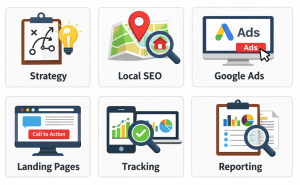
It should also include local SEO fundamentals. Google says local ranking is influenced by relevance, distance, and prominence, and it notes that accurate business information, reviews, and broader web signals all matter. That means an affordable package should cover Google Business Profile optimization, correct business details, category alignment, service descriptions, review support, and local landing page basics.
Website and landing page support should be included as well. Sending paid or organic traffic to a page that is slow, confusing, or poorly aligned with the offer undermines the whole campaign. At minimum, the package should include page recommendations, basic on-page updates, clear calls to action, and form or call tracking setup so visits can be tied to outcomes. Google Search Central’s SEO Starter Guide also emphasizes building pages for users while making content easy for search engines to understand.
Finally, the package should include reporting and optimization. Businesses should not be left guessing whether the work is helping. Monthly reporting, KPI review, next-step recommendations, and active refinement are part of what makes a package truly affordable, because they reduce waste and improve the return on every dollar over time. Google Ads explicitly links optimization tools and budgeting decisions to conversion measurement.
Why is the cheapest digital marketing option often the most expensive in the long run?
The cheapest option often strips out the highest-value work. It may promise “SEO” without meaningful content or profile optimization, or “Google Ads management” without negative keywords, location controls, or conversion tracking. That kind of setup can generate activity without producing useful business outcomes. Google’s own documentation shows that advertisers need conversion tracking for Smart Bidding to work effectively and that negative keywords help prevent ads from showing for irrelevant searches.
Cheap marketing also tends to create rework. When campaigns are launched without tracking, targeting discipline, or landing-page alignment, the business eventually has to pay someone else to audit, rebuild, and clean up the account. The original “savings” disappear because the company paid once for weak execution and again for repair.
There is also an opportunity cost. A small business that spends months on underperforming tactics is not just losing money; it is losing time, leads, market visibility, and momentum. That is why affordability should be judged by useful outcomes and strategic clarity, not by the invoice amount alone.
How much should a small business expect to spend on digital marketing?
A small business should expect digital marketing costs to depend on goals, competition, internal resources, and the number of channels being used. SBA and HBS both frame budgeting as part of broader planning, which is a more reliable approach than chasing one-size-fits-all numbers.
A starter-stage business usually needs a lean setup focused on visibility and demand capture. That often means Google Business Profile work, local SEO basics, one or two strong service pages, simple tracking, and a carefully managed paid campaign if there is enough demand. The budget is lower because the scope is narrower, not because the work is disposable.
A growth-stage business usually needs more depth. That can include recurring SEO improvements, dedicated landing pages, more structured Google Ads management, review generation, and regular content or remarketing support. The budget rises because more expertise, tools, testing, and optimization hours are involved.
A more competitive business, or one targeting multiple services and neighborhoods, generally needs a multi-channel approach. At that point, “affordable” still matters, but it should mean prioritized execution and disciplined measurement rather than trying to force complex growth goals into an unrealistically small budget.
What services matter most for affordable growth in a local market like Indianapolis?
Local SEO is one of the most important services because it helps businesses appear when nearby customers are actively searching. Google explains that local results are shown in Maps and Search, and that businesses should keep information accurate and complete to improve visibility.
Google Ads also matters because it reaches high-intent users at the moment they are searching for a service. Done well, it allows a small business to focus budget on the searches, service areas, and offers most likely to convert. Google’s location targeting tools support this by letting advertisers choose specific cities, regions, radiuses, or business locations to target.
Website conversion improvements are equally important. Affordable marketing does not work well if visitors arrive and cannot easily understand the offer, trust the business, or take the next step. Clear copy, strong contact paths, mobile usability, and conversion tracking often do as much for ROI as adding more traffic.
Review development and reputation signals matter, too. Google notes that review count and review score can influence local ranking, which means reputation work is not just a branding exercise; it can support discoverability.
How does local SEO make digital marketing more affordable over time?
Local SEO can become more cost-efficient over time because it helps a business earn visibility without paying for every click forever. Google’s local ranking guidance makes clear that relevance, distance, and prominence shape local results, and that complete business information, reviews, and broader online signals all contribute. When those assets improve, the business has a better chance of earning recurring exposure in Maps and Search.
That does not mean SEO is free or instant. Google Search Central says SEO can have a noticeable impact, but it is still a process of creating helpful content and making pages easier for search engines to crawl, index, and understand. The advantage is that the work can compound. A well-optimized profile and useful local pages can keep supporting discovery after the initial work is done.
For a small business, that compounding effect is what makes local SEO “affordable” in the best sense. It may not deliver overnight results like ads can, but it can reduce overreliance on paid traffic and improve lead efficiency over time.
What should affordable Google Ads management include?
Affordable Google Ads management should include keyword targeting built around commercial intent, not broad traffic for its own sake. The goal is to show up for searches that are closely related to the services the business actually wants to sell.
It should include location targeting. Google Ads supports targeting by countries, areas within a country, cities, radius, and even business locations, which is critical for local campaigns. A business in Indianapolis should not be paying to show ads broadly outside its service area unless there is a clear reason.
It should include negative keyword management. Google explains that negative keywords prevent ads from serving on unwanted searches, which helps reduce irrelevant clicks. For local service businesses, that means filtering out low-intent, unrelated, or mismatched searches so more budget goes toward qualified demand.
It should include conversion tracking and landing-page alignment. Google states that conversion tracking is required for Smart Bidding to work effectively, and Analytics conversions help marketers understand important actions across channels. If an agency is managing ads without proper conversion setup, the campaign may look active while still being difficult to optimize responsibly.
It should also include budget pacing, search-term review, ad testing, and monthly optimization. Affordable management is not “set it and forget it.” It is active, focused stewardship of a limited budget.
Are monthly reports and KPIs included in truly affordable digital marketing?
Yes, they should be. Reporting is not an optional add-on for premium clients; it is part of responsible marketing management. Google Analytics specifically positions conversions and key events as a way to understand important actions and improve strategy across channels.
At a minimum, a small business should see how many leads or conversions were generated, which channels drove them, how traffic quality changed, and what recommendations come next. Paid campaigns may also track cost per lead, click-through rate, search terms, and geographic performance. Local SEO work may track profile visibility, rankings direction, calls, and form activity.
The point of reporting is not to create pretty dashboards. It is to help the business make better decisions. When reporting is missing, the client is effectively paying for activity without being able to judge whether that activity supports growth.
What hidden costs should small businesses watch for?
One of the most common hidden costs is ad spend being excluded from management pricing without being clearly explained. That is not inherently wrong, but it should be transparent. A low management fee may sound affordable until the business realizes the media budget is separate and significant.
Another common hidden cost is setup work billed separately after the client signs. Tracking, landing pages, analytics configuration, call tracking, creative development, and website edits are often essential to performance. If they are outside scope, the package can become much more expensive than expected. Google’s documentation around conversions and campaign optimization shows why these “extras” are often not optional in practice.
Long contracts with vague deliverables are another red flag. If a provider cannot clearly explain what work will be done each month, what KPIs matter, and how the account will improve over time, the business may be committing budget without accountability.
How can you compare affordable digital marketing providers in Indianapolis?
| Criteria | Provider A | Provider B | Provider C |
|---|---|---|---|
| Deliverables | SEO + PPC | PPC only | SEO + Social |
| Reporting | Monthly | Biweekly | Monthly + dashboard |
| Setup Fees | None | $500 | $250 |
| Ad Spend | $1,000 min | $500 min | Flexible |
| Contract Terms | Month-to-month | 6 months | 3 months |
| Optimization Scope | Ads only | Ads + landing pages | Full campaign support |
A Sample Comparison Table for Difgital Marketing Porviders in Indianapolis
Start by comparing deliverables, not slogans. Ask what is actually included each month: strategy, SEO work, Google Business Profile optimization, campaign management, content support, landing page edits, analytics, reporting, and optimization. A provider that says “full service” but cannot define the work is harder to trust.
Next, compare how they measure success. A strong provider should be able to explain what counts as a conversion, how performance will be tracked, and what metrics matter most for your business model. Google Analytics and Google Ads both place heavy importance on conversion setup because it is the basis for meaningful optimization.
Then compare local relevance. Because Google’s local ranking system uses relevance, distance, and prominence, a provider working with local businesses should understand profile optimization, reviews, service-area targeting, and local page structure.
Finally, compare clarity. Affordable providers should be able to say what is included, what is excluded, how often they report, whether contracts are flexible, and what results a business can reasonably expect. Clarity is often a better predictor of value than a low sticker price.
Is affordable digital marketing enough to compete with larger businesses?
Yes, it can be, especially when the strategy is focused. Small businesses usually do not win by matching larger competitors channel for channel. They win by being more targeted: tighter geography, clearer service pages, better local trust signals, and stronger alignment between search intent and offer.
Google’s tools support that focus. Local results are inherently tied to nearby intent, and Google Ads location targeting allows campaigns to narrow spend to the areas most likely to produce results.
That means a smaller Indianapolis business can compete effectively without a giant budget, provided the messaging is clear, the profile is optimized, the website converts, and the paid budget is tightly controlled. Affordable marketing is not about doing less than larger brands; it is about being more selective and efficient.
When should a business choose an agency instead of doing marketing in-house?
A business should consider an agency when execution starts consuming time the owner or team cannot spare, when performance data is unclear, or when the company needs specialized skills across ads, SEO, analytics, and landing pages. SBA guidance treats marketing as a formal part of business planning, and that planning often becomes harder to execute consistently when a small internal team is stretched thin.
An agency also becomes more valuable when avoiding mistakes matters. Google Ads setup, negative keywords, location targeting, and conversion measurement all affect whether budget is spent efficiently. Those are manageable tasks, but they are not trivial ones.
The right time is usually when the business has enough demand opportunity to justify consistent marketing, but not enough internal bandwidth to manage it well. At that point, outsourcing can be more affordable than paying for slow learning curves and inconsistent execution in-house.
What results should a small business realistically expect from affordable digital marketing?
A small business should expect better visibility, more qualified traffic, and more clarity about where leads are coming from. It should also expect progress, not magic. SEO and local profile work can improve discoverability over time, while paid search can produce faster demand capture if tracking and targeting are set up correctly.
It should also expect improved efficiency. That could mean fewer wasted clicks, stronger lead quality, better local presence, and more confidence in what to scale next. Google’s guidance on conversion measurement and budget optimization supports this idea: when actions are measured consistently, budget decisions get smarter.
What it should not expect is instant domination of every channel. Results depend on market competition, website quality, offer strength, reviews, service-area targeting, and how long the business stays consistent. Affordable marketing can absolutely work, but it works best when expectations are realistic and the plan is disciplined.
FAQ
Is affordable digital marketing worth it for very small businesses?
Yes, when the scope is focused. Very small businesses usually benefit most from a few high-impact essentials: a strong Google Business Profile, a clear website, conversion tracking, and one or two channels that match buyer intent. SBA guidance supports this planning-first approach instead of trying to do everything at once.
Can I do SEO and Google Ads on a limited budget?
Yes, but both need prioritization. SEO should focus on the most important pages and local signals first, while Google Ads should focus on high-intent searches, tight geography, and careful negative keyword use. Google’s documentation supports all three of those priorities.
How long does affordable digital marketing take to show results?
Paid search can begin generating data and leads relatively quickly once campaigns and tracking are set up, while SEO and local visibility usually build over time. Google Search Central describes SEO as capable of noticeable impact, but it is still an ongoing process rather than an instant switch.
What is included in a local digital marketing retainer?
A strong retainer usually includes strategy, local SEO work, Google Business Profile support, reporting, conversion tracking oversight, and ongoing optimization. If paid ads are included, it should also cover keyword management, location targeting, negative keywords, and budget review.
Should ad spend be separate from management fees?
It often is, and that is normal, but the distinction should be fully transparent. What matters is whether the business understands the total monthly investment and what work is included for the management portion.
How do I know whether my current marketing package is missing key services?
If you cannot clearly see conversions, channel performance, deliverables, and next-step recommendations, the package is probably missing essentials. Conversion measurement is central to both Analytics and Google Ads optimization, so a package without that foundation is difficult to trust.
Conclusion
Affordable digital marketing in Indianapolis should include more than low pricing. It should include strategy, local visibility work, conversion tracking, reporting, and ongoing optimization. When those pieces are in place, a small business can spend carefully and still compete effectively.
The real goal is not to buy the cheapest package. It is to invest in the leanest package that can still produce measurable business results. That is the difference between low-cost marketing and genuinely affordable marketing.
Why QBall Digital is Your Ideal Choice for Affordable Digital Marketing?
QBall Digital is well-positioned to help small businesses think about affordability the right way: as a balance of budget discipline, local relevance, and measurable performance. Instead of pushing bloated retainers or vague “full-service” promises, the stronger approach is to build around what the business actually needs to generate leads and grow responsibly. For Indianapolis companies, that means focusing on the channels and deliverables that matter most, then tracking the outcomes clearly.
That is especially valuable for small businesses that cannot afford wasted spend. When a partner understands local SEO, Google Ads targeting, conversion tracking, and practical reporting, the budget works harder. QBall Digital can frame its value around transparency, prioritized execution, and real accountability, which is exactly what businesses should expect from affordable digital marketing.
Ready to Build an Affordable Digital Marketing Plan With QBall Digital?
If your business wants a marketing plan that is lean, clear, and built to produce results, QBall Digital can help you identify what should be included, what can wait, and how to align your budget with growth goals. The right plan is not the cheapest one on paper. It is the one that gives your Indianapolis business the best chance to turn marketing spend into measurable revenue.