
For small businesses in 2026, the videos that convert are not necessarily the most cinematic. They are the ones built around one clear buyer action, a strong opening hook, believable proof, and a next step that feels easy to take. That matters even more now because short-form video remains the most-used media format among marketers, and video-based formats continue to rank among the highest ROI content types.
That shift is why video production services Indianapolis should not be evaluated by camera quality alone. A high-performing video today needs to work across your website, landing pages, paid campaigns, and social distribution. It also needs to fit how real buyers decide: quickly, skeptically, and often on mobile. Wistia’s 2025 video research found that more than 40% of companies create at least one video per week, nearly 60% planned to increase video budgets, and viewers now have higher standards for short-form content.
For QBall Digital, that creates a major opportunity. Small businesses in Indianapolis do not just need “a brand video.” They need a smart mix of conversion videos: homepage explainers, testimonial assets, service-page videos, local credibility footage, and short-form cutdowns that can be repurposed across channels. That is what this guide covers, along with a usable shot list and prompt bank.
What does “high-converting” video production mean for a small business in 2026?
High-converting video production means the video is designed to drive a measurable business action, not just attract passive attention. For a small business, that action could be a booked consultation, a quote request, a call, a form submission, a store visit, or a click into a service page. Video performance still includes views and engagement, but those are supporting signals, not the end goal.
This distinction matters because many marketers still default to visibility metrics first. HubSpot’s 2026 marketing statistics roundup notes that short-form video, long-form video, and live-streaming are among the top ROI-driving content formats, while Wyzowl data cited there shows marketers still track views heavily alongside engagement and leads. In practice, the smartest small businesses treat views as the start of the funnel and conversion actions as the finish line.
A high-converting video also aligns tightly with where it appears. A homepage video should reduce uncertainty fast. A paid social ad should create immediate curiosity. A testimonial should lower perceived risk. A service-page video should help a buyer feel, “Yes, this is the company I should contact.” Good production supports that outcome, but message design is what makes the production convert.
Why are small business videos converting differently in 2026 than they did a few years ago?
They are converting differently because audiences now expect faster relevance and more platform-native execution. Buyers are used to short-form content, quick cuts, concise storytelling, captions, and videos that answer a question almost immediately. HubSpot’s 2026 marketing report highlights short-form video as a major continuing trend, and Wistia’s 2025 findings emphasize that viewers have become more demanding about short-form quality.
At the same time, discoverability has matured. Google can surface videos in main search results, Video mode, Google Images, and Discover, and structured data can influence how those videos are understood and displayed. That means a video is no longer only a social asset; it can also become a search asset when it is embedded and marked up correctly.
The final change is measurement. YouTube’s audience retention tools now make it easier to see where viewers stay engaged and where they drop off, which gives businesses sharper feedback than simple view counts. In other words, the creative bar is higher, the optimization opportunities are better, and the businesses that win are the ones treating video like a conversion system instead of a one-off deliverable.
What types of videos should a small business create first to generate leads?
The best first video is usually a homepage or landing-page explainer that answers three things quickly: what you do, who you help, and why someone should trust you. For many small businesses, this video reduces bounce, clarifies the offer, and improves the odds that a visitor moves deeper into the site.
After that, the next highest-value asset is usually a testimonial or case-study video. Small businesses rarely lose leads because prospects do not understand what they sell. They lose leads because buyers are unsure the result will be worth the risk. A good testimonial addresses that hesitation with specifics: the original problem, why the client chose the company, what changed, and what they would say now.
The third priority is a service-specific video. Instead of talking about the whole company, this one focuses on a single profitable offer. That keeps the message sharper and makes the asset easier to pair with a service page, paid campaign, or retargeting audience.
From there, most small businesses should add a founder or team credibility video and short-form cutdowns for social and paid use. This matches how marketers are investing now: short-form is widely used, but long-form and website-based video still matter when the goal is trust and conversion.
How does professional video production help small businesses convert more than DIY video alone?
DIY video can work, especially for quick updates or lightweight social content. But professional production becomes valuable when the business needs consistency, stronger conversion messaging, multi-use footage, and fewer mistakes during planning and editing. The biggest gap is often not the camera. It is the strategy.
Professionally produced video typically improves audio clarity, pacing, framing, lighting, CTA structure, and edit discipline. Those details shape whether a viewer keeps watching long enough to understand the offer. YouTube’s audience retention reporting exists because small changes in delivery and structure affect whether people stay engaged or leave.
Professional teams also build assets more efficiently. Wistia’s 2025 research shows companies are producing more video and often doing so with faster, more flexible systems. A strong production partner plans for reuse from the start: a primary cut, short clips, testimonial snippets, service-page edits, vertical versions, and possible ad variations. That makes the total ROI of one shoot much higher than a DIY asset created for only one channel.
For local service businesses, professional production can also make the company feel more credible without making it feel overly polished or generic. The sweet spot is clean, confident, and believable.
What messaging framework makes a small business video more persuasive?
The most reliable framework is simple:
Problem → Stakes → Solution → Proof → Offer → CTA
Start with the buyer’s problem. Show the cost of leaving it unresolved. Introduce your service as the answer. Add proof in the form of outcomes, visuals, or testimonials. Present the offer clearly. Then tell the viewer exactly what to do next.
This works because most small business buyers do not need a dramatic narrative arc. They need confidence. The opening seconds should confirm relevance. The middle should build belief. The final beat should reduce friction. That structure also fits how retention is measured on YouTube and how short-form content is consumed across platforms.
For example, a local home services company might open with, “Still waiting days for a contractor to call you back?” That is the problem. The stakes are delay, stress, and uncertainty. The solution is the company’s response process and service quality. Proof comes from real jobs and client comments. The offer is a quote or inspection. The CTA is a simple next step.
The same framework works for dentists, law firms, med spas, contractors, B2B service providers, and nonprofits. What changes is the proof and the tone, not the logic.
How long should a small business marketing video be on each platform?
There is no universal perfect length, but there is a strong pattern: the right length depends on the viewer’s intent and the placement. HubSpot’s 2026 marketing statistics page cites Wyzowl data showing that 51% of people consider 30 to 60 seconds the optimal length for an effective video, and 91% preferred videos under two minutes. That is a useful directional benchmark, especially for social and awareness-stage content.
For a homepage explainer, 45 to 90 seconds is often enough. The goal is not to explain everything. It is to establish trust, clarity, and forward momentum. For service pages, 30 to 75 seconds usually works well because the visitor is already evaluating a specific offer. For testimonials, 45 to 120 seconds is often ideal when the story is concrete and well edited.
Short-form social clips and paid social ads usually need to get to the point far faster. Often the first 1 to 3 seconds determine whether someone stays. That is why hook writing matters so much in 2026. If the first sentence sounds generic, the format will punish it.
Longer videos still have a role when the buyer needs more reassurance or education. The mistake is not making a longer video. The mistake is making a long video without a clear reason for the viewer to keep watching.
Why do local signals matter when creating videos for Indianapolis small businesses?
Local signals matter because buyers trust what feels familiar, relevant, and real. When a small business video includes recognizable local context, it can reduce the distance between the brand and the viewer. That local context might come from neighborhoods, storefront visuals, team footage, service-area references, customer examples, or on-screen copy that reflects the market naturally.
This does not mean forcing “Indianapolis” into every line. In fact, awkward geo-targeting tends to weaken the message. The better approach is to weave location in through credibility. Show the business where it actually operates. Mention the types of customers it serves locally. Include visual evidence that the company is active in the market.
That matters for conversion and for visibility. Video embedded on a relevant service page can strengthen the overall usefulness of the page, and Google’s video documentation makes clear that well-implemented video can be surfaced across multiple search experiences when Google can understand it properly.
For a company targeting video production services Indianapolis, local signals should support trust first and SEO second. When they do, the keyword feels natural rather than forced.
How can video production support local SEO and visibility?
Video supports local SEO best when it is attached to a page with clear intent, not floating on its own without context. For example, a service page, location page, case study, or dedicated watch page can benefit from a relevant embedded video plus supporting text that explains the service, location relevance, and next step.
Google states that adding VideoObject structured data to watch pages can make it easier for Google to find your video and can influence information shown in video results, including thumbnail, description, upload date, and duration. Google also notes that videos can appear in main search, Video mode, Images, and Discover.
For small businesses, the practical takeaway is straightforward: publish video where it helps the page do its job, not just where it “looks nice.” Add transcripts or supporting copy, create descriptive titles and page context, and use structured data where appropriate. If the video includes chapters or distinct sections, Google can also surface key moments when that information is supplied correctly.
This is one reason professional planning matters. When a production team thinks ahead about how a video will live on the site, not just on social media, the asset becomes more useful in search and more likely to support actual lead generation.
What should a high-converting small business video shot list include?
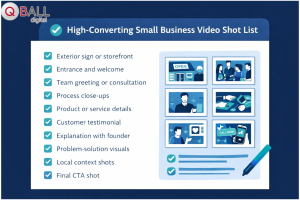
A good shot list should capture trust, clarity, and action. That means it needs more than generic B-roll. It should show what the business does, how it does it, and why a prospect should believe the promise.
A practical shot list usually includes an exterior establishing shot, interior environment footage, team-at-work sequences, process close-ups, customer interaction, direct-to-camera founder clips, testimonial setups, branded details, and a clean CTA ending shot. For local businesses, it should also include at least a few shots that ground the company in its real service environment rather than a generic office montage.
Here is a strong baseline shot list for a small business conversion video:
- Exterior sign or storefront
- Entrance and welcome moment
- Team greeting or consultation
- Process close-ups showing the work being done
- Product, tool, or service detail shots
- Staff interaction that shows professionalism and responsiveness
- Founder or lead expert on camera
- Customer testimonial, ideally in the customer’s own words
- Before-and-after or problem-and-solution visuals
- Local context shots that feel authentic to the market
- Final CTA shot with a clear next step
What makes this convert is the sequence. The opening should establish relevance quickly. The middle should make the business feel competent and trustworthy. The ending should remove friction and guide the viewer to act.
How can AI prompts speed up video planning without making the final result feel generic?
AI is useful when it speeds up ideation and structuring, not when it replaces judgment. Wistia’s 2025 video research points to broader AI adoption in video creation, while HubSpot’s 2026 marketing reporting shows AI is deeply embedded in current content workflows.
For small business video planning, AI works best in six places: generating hook options, shaping interview questions, organizing a shot list, drafting script variations, proposing repurposing cuts, and creating metadata ideas. In each case, the human role is to filter the output based on audience intent, brand voice, and local relevance.
That matters because generic AI writing usually fails in the first few seconds. It sounds polished but vague. A good production team uses AI to explore possibilities faster, then grounds the final version in the client’s real offer, real proof, and real market context.
In other words, AI should reduce blank-page syndrome. It should not become the creative director.
What are the best AI prompts for planning a small business video campaign?
These prompts are built to help QBall Digital or a client move from a broad idea to a tighter conversion plan.
Script prompt
“Write a 60-second website video script for a small business that offers [service]. The target customer is [audience]. The goal is to get [desired action]. Use the structure problem, stakes, solution, proof, offer, CTA. Make it sound clear, confident, and local without keyword stuffing.”
Hook prompt
“Generate 15 opening hooks for a short business video about [service]. Focus on urgency, pain points, and curiosity. Keep each hook under 12 words and avoid hype language.”
Testimonial prompt
“Create 12 customer interview questions for a testimonial video about [service]. The questions should pull out the original problem, why they chose the business, what changed, and what they would say to someone considering the service.”
Shot list prompt
“Build a shot list for a small business video promoting [service]. Organize the list into establishing shots, process shots, people shots, proof shots, and CTA shots. Include both horizontal and vertical-friendly framing ideas.”
B-roll prompt
“Generate B-roll ideas for a local business video in [industry]. Focus on visuals that show professionalism, speed, trust, customer experience, and local credibility.”
Repurposing prompt
“Turn one 90-second business video into 10 short clips for Instagram Reels, YouTube Shorts, paid social ads, and a service-page embed. For each clip, give a hook, key message, ideal length, and CTA.”
CTA prompt
“Write 10 low-friction CTAs for a service business video where the next step is [book a consultation/request a quote/call now]. Keep them direct and natural.”
Local SEO metadata prompt
“Write an SEO-friendly page title, meta description, and video description for a service-page video about [service] in [city]. Keep the language natural and useful, not stuffed.”
These prompts save time because they create starting points quickly. The final creative should still be refined by someone who understands what actually persuades buyers.
How should a small business measure whether a video is actually converting?
A small business should measure video in layers. At the top of the funnel, look at impressions, play rate, hook strength, and early retention. In the middle, look at watch time, completion patterns, clicks, and service-page engagement. At the bottom, look at form fills, calls, quote requests, assisted conversions, and closed revenue where possible.
YouTube’s audience retention reporting is especially useful because it highlights the moments that held attention and the moments where viewers fell off. That helps teams diagnose whether the hook was weak, the pacing dragged, or the content became too generic.
The common mistake is measuring all videos with the same KPI. A homepage explainer should not be judged exactly like a retargeting ad. A testimonial should not be judged exactly like a short awareness clip. The right question is always: what was this video supposed to change in the buyer’s behavior?
For many small businesses, the most practical conversion dashboard is simple: play rate, retention, click-through to the next step, lead volume from the page, and lead quality. That is enough to make useful creative decisions without drowning in analytics.
Is it better to create one polished brand film or multiple smaller conversion videos?
For most small businesses, multiple purpose-built conversion videos outperform one expensive hero film. A single brand film can look impressive, but it often tries to do too many jobs at once. It introduces the company, explains the offer, builds credibility, and asks for action in one package. That usually makes it broader and less focused than it should be.
Multiple smaller videos perform better because each one can match a single audience stage or use case. One video introduces the brand. Another answers service questions. Another showcases proof. Another retargets warm prospects. That modular approach also fits the current market, where marketers continue investing in short-form and channel-specific content.
A hero film still has value in some situations, especially if the brand has a distinctive story, a major launch, or a strong recruitment or reputation goal. But for lead generation, most small businesses get more value from a system of assets than from one flagship piece.
When should a small business hire professional video production services in Indianapolis?
A business should usually hire professional help when the cost of unclear messaging or weak execution is becoming larger than the cost of production. That often happens when the company is spending on ads, improving its website, launching new services, or trying to win trust in a competitive local market.
Another clear signal is when DIY video starts creating bottlenecks. Maybe the team cannot script consistently, audio quality is hurting credibility, or nobody has time to edit and repurpose footage properly. Wistia’s research shows that companies are producing video more frequently, which makes process efficiency more important over time.
For Indianapolis businesses specifically, professional production becomes especially useful when local trust matters. A team that understands how to capture the right proof, the right service visuals, and the right local context can help the final video feel relevant instead of generic.
What should you look for in a video production partner for your small business?
Look for a partner that starts with business goals, not gear talk. The best team will ask what action the viewer should take, where the video will live, which audience segment it targets, and how the footage can be repurposed.
You should also look for a clear process: discovery, scripting, shot planning, filming, editing, revisions, and delivery across formats. Google’s video guidance makes it clear that implementation context matters, so a production partner should understand not only how to film but also how the video will function on the site and across channels.
Finally, choose a team that understands credibility. A small business video does not need to feel inflated. It needs to feel trustworthy, useful, and easy to act on. The right partner knows how to bring out that confidence without turning the message into generic ad copy.
FAQ
What is the best first video for a small business website?
Usually a short homepage explainer or service overview. It should clarify what the business does, who it helps, and why someone should take the next step.
How much should a small business spend on video production?
That depends on complexity, number of deliverables, and repurposing needs. A better question is how many assets the shoot can create and which business outcomes those assets support.
Can short-form videos generate leads for local businesses?
Yes. Short-form works especially well for awareness, retargeting, and trust-building when paired with a clear offer and a relevant landing page. Marketers continue to prioritize short-form because it remains one of the strongest-performing formats.
Do videos help service pages rank better in local search?
A video alone does not guarantee rankings, but a relevant embedded video can make a page more useful and, when implemented correctly, can improve discoverability in Google’s video surfaces. Structured data and strong page context matter.
How often should a small business publish new videos?
As often as the business can maintain quality and consistency. Wistia’s 2025 findings show many companies are producing video weekly, which reflects how central video has become in marketing workflows.
Should I film customer testimonials professionally?
Usually yes, especially if the testimonial is meant to support sales pages, landing pages, or paid campaigns. Good interviewing and editing can make the proof feel much more credible and concise.
Can AI write a good video script for a local business?
AI can generate a strong draft, especially for structure and idea generation. But the best scripts still need human editing for specificity, local nuance, and authentic voice.
What industries benefit most from video production services in Indianapolis?
Nearly any industry that depends on trust, explanation, or proof can benefit. That includes healthcare, legal, home services, manufacturing, real estate, hospitality, education, and B2B services.
Conclusion
The small business videos that convert in 2026 are not winning because they are flashy. They are winning because they are focused. They answer the right question quickly, show believable proof, fit the platform, and make the next step feel obvious.
That is the real shift behind modern video production. Businesses need fewer vague “brand assets” and more intentional videos that support search visibility, sales conversations, service pages, ads, and local credibility. When the strategy is right, one shoot can produce an entire set of conversion tools instead of one isolated deliverable.
Why QBall Digital is Your Ideal Choice for Video Production Services in Indianapolis?
QBall Digital is positioned to deliver more than polished footage. The real value is in building videos around business outcomes: better landing pages, stronger trust signals, cleaner service messaging, and more usable content across your website and campaigns. For a small business, that kind of planning makes the difference between a video that looks good and a video that helps drive leads.
As a local partner, QBall Digital can also create videos that feel grounded in the Indianapolis market instead of generic to any city. That means more relevant visual storytelling, more natural local credibility, and production decisions tied to how buyers actually evaluate local businesses. When the process includes strategy, scripting, shot planning, repurposing, and conversion thinking from the start, the final content works harder long after the shoot ends.
Ready to Create Video Content That Converts With QBall Digital?
If your business is ready to move beyond generic marketing videos, QBall Digital can help you create a smarter system: one built around trust, local relevance, and measurable action. The right video strategy can strengthen your website, improve campaign performance, and give your team reusable content that keeps working across channels.
Connect with QBall Digital to map out the right mix of videos for your business and build a production plan that turns attention into leads.