

Your website should answer the objections that make buyers hesitate before they contact your team: price, trust, fit, timing, risk, proof, process, and comparison. These concerns often appear before a sales conversation ever happens. A visitor may like your offer, need your service, and still leave because the page did not answer the question they were silently asking.
That is why website content for buyer objections matters. It turns your website from a basic service brochure into a pre-sales tool that helps visitors understand your value, reduce uncertainty, and feel confident enough to take the next step.
For PPC campaigns, this is even more important. Google explains that landing page experience is tied to how relevant and useful the page is for people who click an ad, and Quality Score includes landing page experience alongside expected click-through rate and ad relevance. In other words, paid traffic performance depends on more than targeting and bidding; it also depends on whether your landing page gives visitors the information they expected and needed.
The best website content does not wait for prospects to raise objections on a call. It anticipates those concerns, answers them clearly, supports the answer with proof, and places that reassurance where hesitation is most likely to happen.
What Are the Most Common Buyer Objections?
The most common buyer objections are concerns about price, trust, fit, timing, risk, proof, process, and comparison. These objections do not always sound like direct complaints. Online, they often show up as hesitation: abandoned forms, low call-to-action clicks, short sessions on landing pages, repeated pricing questions, or prospects who book a call but arrive unconvinced.
A buyer objection is not always a sign that someone is not interested. In many cases, it means the person is actively considering your offer but needs more clarity before moving forward. A visitor who asks, “How much does this cost?” may be closer to converting than someone who casually reads your homepage. A visitor who wonders, “Can I trust this company?” may only need stronger proof, clearer process details, or better examples of past results.
The most common buyer objections usually fall into these categories:
Price objections ask whether the offer is worth the cost. Trust objections ask whether the company can deliver what it promises. Fit objections ask whether the service is right for the buyer’s specific business, goals, budget, or industry. Timing objections ask whether now is the right time to act. Risk objections ask what happens if the investment does not work. Comparison objections ask why the buyer should choose one provider over another. Process objections ask what happens after the visitor fills out a form, books a call, or signs an agreement.
This matters because modern buyers often do significant research before speaking to sales. HubSpot’s 2025 buyer journey analysis notes that buyers are doing more independent research, often using digital and AI-assisted channels, before entering sales conversations. That makes your website one of the first places where objections are either resolved or reinforced.
A strong website does not treat these objections as afterthoughts. It builds them into the page structure, copy, proof, FAQ content, pricing explanations, and calls to action.
How Do You Overcome Buyer Objections With Website Content?
You overcome buyer objections with website content by turning each concern into a clear answer, supporting it with evidence, and placing that answer where the buyer is most likely to hesitate. The goal is not to pressure visitors into converting. The goal is to help them make a confident decision.
The first step is to collect real objections. Sales calls, discovery notes, contact forms, live chat logs, reviews, customer interviews, PPC search terms, and lost-deal reasons can all reveal what prospects are worried about. If the same question appears repeatedly, it should probably be answered somewhere on your website.
The second step is to rewrite each objection as a buyer-facing question. For example, “This seems expensive” can become “What is included in the service, and how does the investment support long-term ROI?” “I’m not sure this will work for us” can become “Who is this service best suited for?” “We have had a bad agency experience before” can become “How does your process keep campaigns transparent and accountable?”
The third step is to answer directly. Do not hide the answer under vague claims like “we deliver excellent results” or “we are your trusted partner.” A helpful page gives the buyer something concrete: what is included, what affects pricing, what results are realistic, how communication works, what proof exists, and what the next step involves.
Google’s own guidance for helpful content emphasizes content that benefits people, provides complete explanations, and demonstrates experience, expertise, authoritativeness, and trustworthiness. That aligns closely with objection-handling content because the strongest answers are specific, useful, and written for the buyer’s actual decision process.
For QBall Digital’s audience, this has a direct PPC implication. If a paid visitor clicks an ad about improving leads but lands on a page that does not explain cost, process, proof, or fit, that visitor may leave without converting. Objection-handling content gives that click a better chance to become a qualified lead.
What Website Content Helps Overcome Customer Objections?
The website content that helps overcome customer objections includes service pages, sales pages, pricing sections, FAQs, case studies, testimonials, comparison content, process explanations, and PPC landing pages. No single content format answers every objection, so the strongest websites use several formats together.
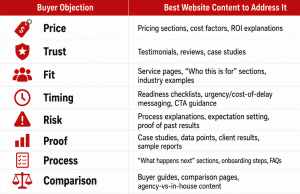
Service pages are ideal for explaining what you do, who it is for, what problems it solves, and what outcomes buyers can expect. They should not simply list features. They should answer the questions a serious buyer has while evaluating whether your service fits their situation.
Pricing sections help reduce cost anxiety. Even when exact pricing is not possible, your website can explain what affects cost, what is included, why pricing varies, and how buyers should think about value. This keeps price from becoming a mystery that blocks action.
Case studies and testimonials answer proof and trust objections. BrightLocal’s 2025 Local Consumer Review Survey found that only 4% of consumers say they never read online business reviews, and 74% use two or more sources when reading reviews before deciding to use a local business. While that research focuses on local businesses, the broader lesson applies to website trust: buyers want independent proof, specific experiences, and details that help them form their own opinion.
Comparison content helps buyers who are evaluating multiple options. This can include “agency vs freelancer vs in-house” content, buyer checklists, competitor-neutral comparison guides, or sections that explain how your approach differs without attacking others.
FAQ content handles final-friction objections. It is especially useful near forms, pricing sections, CTAs, and PPC landing-page conversion points. Nielsen Norman Group’s FAQ research emphasizes that well-crafted FAQs can support customer service, documentation, content strategy, accessibility, SEO, and usability.
PPC landing pages need objection-handling content because paid visitors arrive with a specific expectation. If the ad promises help with lead generation, the page should quickly answer why the service is credible, what makes it relevant, what happens next, and why the visitor should act now.
What Questions Should a Sales Page Answer Before Someone Buys?
A sales page should answer the questions that help a buyer understand the offer, trust the company, justify the cost, reduce risk, and feel confident taking action. The page should make the buying decision easier, not just make the service sound attractive.
The first question is, “What exactly am I getting?” Buyers need to understand the offer quickly. This includes the service, deliverables, scope, process, and expected outcomes. A vague offer creates hesitation because the buyer cannot connect the service to their problem.
The second question is, “Who is this for?” A good sales page makes fit obvious. It should explain the type of customer the service is designed for, the problems it solves best, and the situations where it may not be the right choice. This improves conversion quality because it helps poor-fit visitors self-select out while helping strong-fit visitors feel seen.
The third question is, “Why should I trust you?” Trust should not depend on one testimonial buried near the bottom of the page. Strong sales pages include proof throughout the page: client examples, case studies, reviews, results, credentials, process transparency, and clear explanations of how the company works.
The fourth question is, “What happens after I take action?” Many visitors hesitate because they do not know what will happen after submitting a form. Will they get a sales call? A consultation? A proposal? A quote? A clear next-step section reduces uncertainty and makes the CTA feel safer.
A strong sales page should also answer: “How much does it cost?” “How long does it take?” “What results are realistic?” “How are you different?” “What if we have tried this before?” and “Why should we act now?” These questions belong in the body copy, proof sections, pricing explanations, FAQs, and CTA areas.
How Do You Handle Price Objections on a Website?
You handle price objections on a website by explaining value, scope, outcomes, what is included, and the cost of choosing a cheaper or less effective option. The point is not to make the offer seem cheap. The point is to help buyers understand why the investment makes sense.
Price objections often happen when buyers cannot connect the cost to a clear business outcome. For example, a PPC-focused buyer may not only be asking, “How much does this cost?” They may also be asking, “Will this reduce wasted ad spend?” “Will this improve lead quality?” “Will this help us stop losing paid traffic?” “Will we understand what is happening each month?”
When exact pricing is possible, publishing it can reduce friction. When exact pricing depends on scope, your website can still explain pricing ranges, starting points, cost factors, package differences, or what goes into a custom quote. Avoiding every pricing detail can make serious buyers more anxious because it forces them to contact you before they know whether the service is realistic.
Good price-objection content answers practical questions. What is included? What affects cost? What is not included? What level of support is provided? What makes one solution more expensive than another? What risks come with choosing the lowest-cost option? How should the buyer evaluate return on investment?
For PPC and conversion-focused services, pricing content should connect cost to measurable business impact. That may include lead quality, conversion rate improvement, lower cost per qualified lead, better landing-page relevance, stronger tracking, or reduced waste from poorly matched campaigns. Be careful not to promise results you cannot guarantee. Honest pricing content builds more trust than aggressive claims.
A useful price section might say: “The right investment depends on campaign complexity, landing-page needs, tracking setup, and the level of strategy required. Our goal is to help you understand where your current funnel is losing value and whether improving the page, offer, or PPC structure can produce a stronger return.”
What Content Builds Trust With Hesitant Buyers?
Trust-building content gives hesitant buyers evidence that your company is credible, experienced, transparent, and capable of delivering what it promises. Trust is especially important when buyers are comparing providers, evaluating a higher-ticket service, or arriving from paid ads with no prior relationship to your brand.
The strongest trust content is specific. “We are experts” is weaker than a case study showing the problem, strategy, action, and outcome. “We care about clients” is weaker than a testimonial that explains what the client appreciated about communication, reporting, or results. “We have a proven process” is weaker than showing the actual steps a client experiences after booking a call.
Edelman’s 2025 Trust Barometer surveyed 33,000 respondents across 28 countries, reflecting how seriously businesses continue to measure trust as a commercial and institutional issue. For website content, the practical takeaway is simple: buyers are not just evaluating the offer; they are evaluating whether the company feels credible enough to believe.
Trust-building website content can include case studies, testimonials, reviews, client logos, certifications, team bios, founder stories, sample reports, screenshots, project examples, before-and-after comparisons, process breakdowns, and transparent communication expectations. For service businesses, process content is often underrated because it answers the buyer’s hidden fear: “Will this be confusing, slow, or frustrating?”
Trust signals should appear near high-friction areas. Add proof near CTAs, forms, pricing sections, service claims, and PPC landing-page headlines. If the visitor is about to decide whether to contact you, that is exactly where reassurance belongs.
For hesitant buyers, transparency is also a trust signal. Explain what you can control, what you cannot guarantee, how you measure progress, and how you communicate performance. This makes your offer feel more credible because it shows you are not relying on hype.
How Do You Turn Sales Objections Into Marketing Content?
You turn sales objections into marketing content by collecting real objections from prospects, grouping them by theme, and creating website content that answers those concerns before sales needs to. This turns repeated sales friction into reusable conversion assets.
Start by asking your sales team, account managers, and customer-facing staff what prospects ask before they buy. Look for repeated phrases. “We need to think about it” may point to a timing, price, or trust objection. “We are comparing options” may point to differentiation. “We tried this before” may point to risk and proof.
Next, review digital sources. PPC search terms can reveal whether visitors are looking for pricing, comparisons, agencies, examples, or specific solutions. Contact forms and chat logs show what people ask when they are close to converting. Reviews and testimonials reveal what customers cared about before choosing you.
Then group objections into categories. Price, trust, fit, risk, timing, process, proof, and comparison are usually enough to start. Prioritize the objections that appear often and are most likely to block conversion.
After that, turn each objection into content. A price objection can become a pricing explanation, ROI guide, cost breakdown, or FAQ. A trust objection can become a case study, testimonial module, sample report, or process section. A comparison objection can become a buyer checklist or “how to choose the right provider” guide. A timing objection can become a cost-of-delay section or readiness checklist.
Finally, place the answer where it matters. Do not publish every objection as a blog post and expect buyers to find it. Put pricing answers on pricing or service pages. Put trust proof near CTAs. Put process explanations before forms. Put comparison content on pages where buyers are likely evaluating alternatives.
This approach also supports SEO. Google’s helpful content guidance encourages complete, useful, people-first content rather than content created only to manipulate rankings. Turning real buyer objections into helpful answers gives your content a stronger reason to exist.
How Do You Write FAQ Content That Handles Buyer Objections?
You write FAQ content that handles buyer objections by answering real buyer concerns clearly, honestly, and specifically. Strong FAQ content is not filler. It is a conversion tool that reduces uncertainty at the moment a buyer is deciding whether to act.
Start with actual questions. Use sales calls, chat transcripts, PPC search terms, reviews, customer interviews, and form submissions. Avoid creating FAQs only because a keyword tool shows related questions. Search questions are useful, but the best FAQ content combines search demand with real buyer hesitation.
Each FAQ answer should begin with a direct response. If the question is “How long does it take to see results?” do not start with a long explanation of your philosophy. Start with a clear answer, then explain what affects the timeline. If the question is “How much does this cost?” do not say only “Contact us for a quote.” Give context: what affects pricing, what is included, and how a buyer should think about the investment.
FAQ placement matters. A general FAQ page can be useful, but objection-handling FAQs are often more effective when placed near the specific point of hesitation. Pricing FAQs belong near pricing content. Process FAQs belong near the CTA. PPC landing-page FAQs should answer the concerns most connected to the campaign’s search intent.
For example, a PPC landing page for QBall Digital could include FAQs such as: “What happens after I book a call?” “Can you help if our ads get clicks but few leads?” “Do we need a new website or just a better landing page?” “How do you measure PPC landing-page performance?” These questions reduce friction without distracting from the main conversion goal.
Well-written FAQs also improve usability. Nielsen Norman Group’s FAQ report notes that well-crafted FAQs can support customer service and content strategy, which makes them useful beyond SEO alone.
How Can PPC Landing Pages Use Website Content for Buyer Objections?
PPC landing pages should use website content for buyer objections to match visitor intent, reduce wasted clicks, and make the next action feel relevant and low-risk. Paid traffic often arrives with stronger intent than general organic traffic, but it also arrives with less patience.
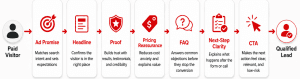
A visitor who clicks an ad after searching for cost-related terms needs pricing reassurance. A visitor who searches for a provider comparison needs differentiation and proof. A visitor who searches for a solution to a specific problem needs immediate relevance, not a generic homepage message.
Google Ads recommends that landing pages be useful, relevant, easy to navigate, and aligned with the expectations created by the ad. Google also treats landing page experience as one of the components used to calculate Quality Score, though Quality Score itself is a diagnostic tool rather than a KPI or direct auction input.
That means objection-handling content should be built into the landing-page structure. The headline should match the ad promise. The opening section should confirm the visitor is in the right place. The proof section should reduce trust concerns. The process section should clarify what happens next. The FAQ should answer the objections most likely to stop the conversion.
For PPC campaigns, avoid sending every click to a broad service page. A focused landing page can answer the exact objections tied to a campaign, audience, or offer. For example, a campaign targeting businesses with poor PPC conversion rates should address wasted spend, low lead quality, unclear reporting, landing-page gaps, and what QBall Digital would evaluate first.
How Do You Measure Whether Objection-Handling Content Is Working?
You measure objection-handling content by tracking conversion rates, CTA clicks, form completions, qualified leads, sales-call quality, and the objections prospects still raise after visiting the site. The goal is not only more leads. The goal is better-informed, more qualified leads.
Start with page-level conversion metrics. Compare landing-page conversion rates before and after adding objection-handling content. Track whether more visitors click CTAs, complete forms, view pricing sections, expand FAQs, watch videos, or engage with case studies.
Then look at lead quality. A page that produces more leads but fewer qualified opportunities may be answering objections too broadly or attracting the wrong audience. A page that produces slightly fewer leads but better-fit prospects may be more valuable, especially for high-ticket services.
Sales feedback is essential. Ask your sales team whether prospects still ask the same basic questions after website updates. If leads arrive already understanding pricing context, process, fit, and expected next steps, the content is doing part of the pre-sales work.
For PPC, measure performance by campaign and intent. A landing page for comparison searches should be judged differently from a landing page for problem-aware searches. Track cost per qualified lead, form completion rate, call quality, booked-call show rate, and lead-to-close rate.
Use testing carefully. Test headlines, proof blocks, FAQ placement, pricing explanations, CTA wording, and process sections. The goal is not to add more copy endlessly. The goal is to answer the right concern at the right moment with the least amount of friction.
FAQ
What are the most common buyer objections?
The most common buyer objections are price, trust, fit, timing, risk, proof, process, and comparison. Buyers want to know whether the offer is worth the cost, whether your company is credible, whether the solution fits their needs, and what happens after they take action.
How do you overcome buyer objections with website content?
You overcome buyer objections with website content by identifying real concerns, turning them into direct questions, answering them clearly, and supporting those answers with proof. The best answers are placed near the moments where visitors hesitate, such as pricing sections, CTAs, service descriptions, and forms.
What website content helps overcome customer objections?
Service pages, pricing sections, case studies, testimonials, FAQs, comparison guides, process explanations, and PPC landing pages all help overcome customer objections. Each format handles a different type of hesitation, so they work best when used together.
How do you write FAQ content that handles buyer objections?
Write FAQ content by using real buyer questions, answering directly in the first sentence, and then adding context, examples, or proof. Avoid vague answers like “Contact us to learn more” when the buyer needs clarity before contacting you.
What questions should a sales page answer before someone buys?
A sales page should answer what the offer is, who it is for, what problem it solves, why the company is credible, what results are realistic, what it costs, what happens next, and how the offer compares to alternatives.
How do you handle price objections on a website?
Handle price objections by explaining what is included, what affects cost, how pricing connects to value, and what risks come with choosing the cheapest option. Even if exact pricing is not listed, the page should give buyers enough context to understand the investment.
How do you turn sales objections into marketing content?
Turn sales objections into marketing content by collecting repeated questions from sales calls, forms, chat logs, reviews, and PPC data. Then group those objections by theme and create content sections, FAQs, case studies, pricing explanations, and comparison pages that answer them.
What content builds trust with hesitant buyers?
Trust-building content includes case studies, testimonials, reviews, client examples, team bios, credentials, sample reports, process details, and transparent explanations of how your company works. The more specific the proof, the more helpful it is for hesitant buyers.
Conclusion
Buyer objections do not begin on a sales call. They often begin the moment someone lands on your website and starts deciding whether your company feels credible, relevant, affordable, and worth contacting.
The most effective websites answer these concerns before the visitor has to ask. They explain price, prove trust, clarify fit, reduce risk, show process, address timing, and help buyers compare options. This is especially valuable for PPC campaigns because every click carries a cost, and every unanswered objection can become a lost lead.
Strong objection-handling content does more than improve copy. It helps your website become a better sales asset. When visitors understand your value, know what happens next, and see proof that you can deliver, they are more likely to take action with confidence.
Why QBall Digital is Your Ideal Choice for Objection-Handling Website Content?
QBall Digital understands that a website should do more than describe your services. It should answer the questions that stop visitors from converting, especially when those visitors come from paid campaigns. By connecting PPC strategy, landing-page messaging, buyer psychology, and conversion-focused content, QBall Digital helps businesses turn more of their traffic into qualified opportunities.
QBall Digital can help identify the objections hidden inside your sales conversations, campaign data, form submissions, and website behavior. From there, those insights can be turned into clearer service pages, stronger landing pages, better FAQs, trust-building proof sections, and CTAs that make the next step feel easier. The result is website content that supports both the buyer’s decision and your company’s growth goals.
Let QBall Digital Turn Buyer Hesitation Into Better Website Conversions
If your website or PPC landing pages are getting traffic but not enough qualified leads, the problem may not be the offer. It may be the unanswered objections standing between the visitor and the next step.
Contact QBall Digital to build website content that answers buyer concerns earlier, improves landing-page clarity, and helps more of the right prospects feel ready to call.