
If you’re doing social media “right,” you shouldn’t have to guess whether it’s working.
The problem is that a lot of local brands end up posting what gets reactions—instead of what creates requests: quote forms, booked calls, showroom visits, “can you help?” DMs, and real pipeline.
This guide is a practical playbook you can use in Indianapolis (or any service-area market) to plan posts that move someone from “interesting” to “I’m ready—what’s next?”
What does “social media marketing Indianapolis” mean if your KPI is leads?
When people search social media marketing Indianapolis, they usually want one of two things:
- They’re a business owner who wants social media to bring in customers.
- They’re trying to figure out what “works” locally instead of copying generic advice.
Lead-focused social media marketing means your content has a job. It should move people from:
“I saw you” → “I trust you” → “I want to talk”
That’s it.
A lead can look like:
- A direct message asking for pricing or availability
- A phone call
- A form filled on your website
- A booked appointment
Platforms like Facebook and Instagram often reward engagement (likes, comments, shares). That’s helpful, but it’s not the same as business growth. Even older industry guidance points out that social works best when it’s planned and measured, not random.
What should you post if you want inquiries from people who are ready to buy?
Post types that consistently drive leads share one trait: they answer decision-stage questions (price, timing, trust, outcomes, fit).
Here’s the highest-ROI “lead post” mix for most Indianapolis businesses:
1) Proof posts
These show that choosing you is the safe move.
- Before/after (with context)
- “What changed” stories
- Review screenshots (with permission)
- Mini case studies (problem → solution → result)
Proof post template (copy/paste):
Hook: “This is what [problem] looks like after 30 days…”
What we did: 2–3 bullets
Outcome: specific result (even if it’s qualitative)
CTA: “Want a quick opinion on your situation? DM ‘INDY’ and I’ll tell you what I’d do next.”
2) Process posts
People hesitate when they don’t know what happens after they reach out.
- “What to expect when you call us”
- “How our estimate works”
- “Timeline from start to finish”
- “What we need from you to get started”
Why this converts: it removes ambiguity—one of the biggest lead-killers.
3) Decision-support posts
These help buyers choose (and position you as the guide).
- “How to choose a [provider]”
- “Questions to ask before you hire”
- “3 red flags / 3 green flags”
- “What affects pricing (and what doesn’t)”
4) Offer posts
This is where leads actually spike—if the offer is low-friction.
- “Free 10-minute audit”
- “Second opinion”
- “Pricing/Planning checklist”
- “Quote readiness guide”
- “Consultation with a clear deliverable”
5) Authority posts
These build trust quickly.
- Myths vs reality
- “Most common mistakes”
- “What we’d do if we were you”
The goal isn’t to post all five every week. The goal is to post enough of the “buying-intent” types that you become the obvious next step.
Why do engagement-heavy posts fail to create consistent leads?
Because engagement isn’t the same thing as intent.
A funny meme, a motivational quote, or a trendy Reel can earn likes from people who will never buy. That’s not “bad”—it’s just not a lead strategy.
What does correlate with leads is:
- Relevance to a current problem
- Specificity (clear scenario, clear outcome)
- Proof (real-world examples)
- A frictionless next step (DM keyword, booking link, quick form)
Also, speed matters more than most teams think: consumer research repeatedly shows people expect brands to respond quickly on social (often within 24 hours or sooner).
If you’re slow to reply, you can “win the post” and still lose the lead.
How do you choose the right platforms for lead generation in Indianapolis?
Choose platforms based on how your buyers behave, not what’s trendy.
A simple decision framework:
If your leads come from local households (home services, healthcare, local retail)
- Facebook + Instagram tend to be the core
- Prioritize: proof posts + Stories + DM CTAs
- Add: local retargeting when you find winners
If your leads come from other businesses (B2B, professional services)
- LinkedIn can outperform everything else
- Prioritize: micro case studies, “how to choose,” authority takes
- Add: employee advocacy and retargeting to your offer page
If trust-building is your bottleneck (high-ticket, complex services)
- YouTube + short clips (Reels/TikTok) are powerful
- Use short video as “distribution,” and longer content for “decision support”
If you can only commit to one platform, pick the one that gives you the shortest path to conversation (often DMs) plus strong proof.
How do you turn Indianapolis context into content that converts without sounding forced?
You don’t need to sprinkle “Indianapolis” into every post.
Instead, localize through relevance signals that feel natural:
- Service-area cues (“north side,” “downtown,” “west side,” “near the airport,” etc.—only if true to your footprint)
- Seasonal triggers (weather shifts, event seasonality, school calendar changes)
- Local proof (projects, partnerships, recognizable patterns in customer needs)
- Real constraints (parking, access, timing windows, permit realities—where relevant)
Local lead hook examples:
- “If you’re trying to solve [problem] before spring/summer hits…”
- “A lot of people run into this when they’re working around tight downtown schedules…”
- “Here’s what we see most often when homeowners/businesses in the metro try to DIY this…”
It reads like lived expertise—not geo-stuffing.
What are the highest-converting post frameworks you can copy-paste?
Here are five frameworks that consistently create qualified DMs and booking clicks:
1) Micro case study
Problem → What we changed → Outcome → Next step
Example caption skeleton:
“Client had [pain]. We found [root cause].
We fixed it by [2–3 steps].
Result: [outcome].
If you’re dealing with something similar, DM ‘FIX’ and I’ll tell you the first step.”
2) “How to choose” buyer guide
3–7 bullets that make the buyer smarter (and position you as the safe choice)
CTA: “Want my checklist? DM ‘CHECKLIST’.”
3) Myth vs reality
Myth: “You need X.”
Reality: “You need Y because…”
CTA: “If you’re deciding between options, DM ‘OPTIONS’ and I’ll point you the right way.”
4) Price factors (without publishing a price list)
Explain what drives cost, timelines, or outcomes in plain language.
CTA: “If you want a ballpark based on your situation, DM ‘BALLPARK’.”
5) “What happens after you contact us”
This is an underrated lead machine.
CTA: “If you want the same plan, book here / DM ‘START’.”
How should each post be written to turn a scroller into a lead?
A reliable lead-post structure:
- Hook (pain, cost of inaction, strong point of view)
- Clarity (what’s really happening / what matters)
- Proof (example, result, review, visual evidence)
- Single CTA (one next step)
Two important rules:
- One post = one job. Don’t mix three offers and six ideas.
- CTA must match intent. If the post is educational, offer a checklist. If it’s proof, offer an audit or consultation.
Also, if you’re using Meta lead capture, know that lead ads and Instant Forms can collect info directly in-platform (name, email, phone, and custom questions). This can work well for low-friction offers—especially when you add qualifying questions for quality.
What should your weekly posting cadence look like if you want leads?
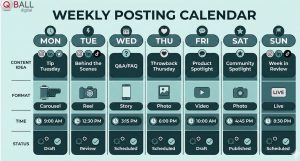
A simple cadence that works for most small teams:
- 2× Proof posts (results, reviews, before/after, mini case studies)
- 2× Decision-support posts (“how to choose,” mistakes, myths, price factors)
- 1× Offer post (audit, checklist, consult, second opinion)
- Stories 3–5×/week (behind-the-scenes + micro-proof + FAQs)
If you can only post 3×/week:
Proof + Decision-support + Offer is the highest-leverage trio.
What to do in Stories:
- “Here’s what we’re working on today” (context + credibility)
- “Common question we got this week” (answer + DM CTA)
- Polls (“Which matters more: speed or cost?”) to start conversations
What offers and lead magnets work best for local lead generation?
The best social offers do two things:
- They feel helpful even if the person doesn’t buy today
- They qualify the lead naturally
High-performing options:
- “10-minute audit” (limited slots)
- “Second opinion” (great for competitive markets)
- Checklist (“Before you hire anyone, use this”)
- Planning guide (“What to do before you request a quote”)
- Diagnostic (“We’ll identify what’s causing X”)
If you use Meta lead ads, consider adding one or two qualifying questions so you don’t drown in low-intent leads. Meta explicitly supports custom questions and different form options to help match business goals.
How do you convert comments, DMs, and profile clicks into booked calls?
Most “social lead gen” fails in the handoff.
Use a two-step conversion path:
Step 1: Permission-based DM
Script:
“Thanks for reaching out—happy to help. Quick question so I point you the right way: are you trying to solve [A] or [B]?”
Step 2: One link, one action
Once they answer, send:
- a booking link or
- a short form or
- a “reply with 3 details” message
Don’t send a menu of options.
Response speed: aim for same-day. Many consumers say they’ll choose a competitor if a brand doesn’t respond on social.
How should paid social support organic social media marketing Indianapolis businesses rely on?
Paid should amplify what’s already proving intent.
A simple setup:
- Identify 2–3 winning organic posts (proof + offer usually win)
- Boost or run ads to the same audience in your real service area
- Retarget people who watched videos, engaged, or visited your offer page
- Optimize for what matters: cost per qualified lead and booked rate
If you’re capturing leads in-platform, Meta lead ads are designed for exactly that: collecting lead info via Instant Forms on Facebook/Instagram.
What should you track to prove ROI from social media?
If you’re serious about lead ROI, you need basic attribution.
1) Use UTMs on every link you control
Google’s Campaign URL Builder (UTM parameters) is the standard way to pass campaign data into Analytics.
Minimum set:
- utm_source (instagram, facebook, linkedin)
- utm_medium (organic, paid, story)
- utm_campaign (offer name or month + offer)
2) Track the conversion points that matter
- Calls (with tracking numbers if possible)
- Form fills
- Booked calls
- Qualified DMs (simple tag in your CRM or a spreadsheet)
3) Run a monthly “double down / fix / kill” review
- Double down on posts that drive qualified conversations
- Fix posts that get attention but no action (usually CTA/path issue)
- Kill topics that bring the wrong audience
FAQ
How long does social media marketing take to generate leads in Indianapolis?
If you already have proof and a clear offer, you can often generate inquiries within weeks. If you’re building trust from scratch, expect 60–90 days of consistent proof + decision-support content before results stabilize.
What should you post if you don’t have case studies yet?
Start with process posts, buyer guides (“how to choose”), and micro-proof: behind-the-scenes, common problems you solve, and anonymized “what we fixed” examples.
Is Instagram or Facebook better for local lead generation?
It depends on your audience, but many local brands see strong DM-based leads from Instagram and strong community discovery on Facebook—then retargeting ties it together.
How often should a small business post to stay consistent?
Three quality posts per week (proof + decision-support + offer) beats seven random posts per week.
Do hashtags matter for local reach anymore?
They can help with categorization, but they usually don’t replace strong hooks, proof, and a clear CTA path. Treat them as an accessory, not the engine.
What’s the best CTA for service businesses on social?
“DM [keyword]” for a checklist/audit is often the fastest path to a conversation. Booking links work best when the post already created strong intent.
Should you boost posts or run lead-form ads?
Boost winners for simple amplification; run lead forms when your offer is low-friction and you can respond fast and qualify leads well.
How do you qualify leads that come in through DMs?
Ask one short question that splits intent (“Are you trying to solve A or B?”), then one detail question (timeline, budget range, location, etc.)—and route them to the right next step.
Conclusion
Lead-driven social isn’t complicated—but it does need to be intentional.
If you want social media to produce inquiries (not just likes), build your plan around: proof, decision-support content, a helpful offer, a frictionless CTA path, fast responses, and basic tracking. Do that consistently, and your socials stop being “content” and start becoming a predictable lead channel.
Why QBall Digital is Your Ideal Choice for Social Media Marketing in Indianapolis?
QBall Digital approaches social like a revenue channel—not a posting schedule. That means building a content plan around buyer intent, designing proof-first creative that reduces risk, and pairing every priority post with a clear conversion path (DM, booking, form, or call). The result is a social presence that earns attention and turns it into real conversations with potential customers.
Just as importantly, QBall Digital treats measurement as part of the service. With UTMs, funnel alignment, and a monthly optimization loop, you don’t have to rely on “it feels like it’s working.” You get visibility into what’s driving qualified leads—so you can double down on what converts and stop wasting time on content that only performs on the surface.
Get More Leads with QBall Digital
If your social feeds look active but your lead flow doesn’t, QBall Digital can help you rebuild your content around conversion.
Book a lead-focused social audit with QBall Digital and we’ll identify what to post, how to structure it, and how to turn engagement into inquiries with a simple weekly plan. Prefer to start lighter? DM “LEADS” and we’ll send a practical checklist you can apply to your next 5 posts.