
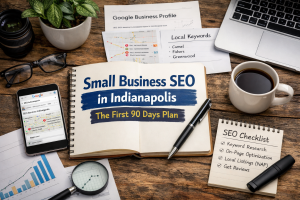
 If you’re a small business in Indy, SEO can feel like a black box: you “do some keywords,” publish a few blogs, and hope Google rewards you. But the businesses that win small business SEO in Indianapolis don’t rely on hope—they follow a tight 90-day system that builds (1) a clean technical foundation, (2) local visibility signals, and (3) high-intent pages that convert.
This plan is built around what consistently shows up in successful Indianapolis SEO approaches: strong local SEO fundamentals like Google Business Profile + NAP consistency + citations + reviews , a structured month-by-month rollout (audit → on-page → analysis/iteration), and ongoing adaptation to competition + algorithm changes.
What “success” looks like by day 90
By the end of your first 90 days, you should reasonably expect:
- A fully optimized Google Business Profile (GBP) and consistent business info across the web (NAP).
- A clear set of service + location pages targeting Indianapolis search intent (not fluffy blog posts).
- A growing flow of calls, direction requests, form fills, and “near me” visibility (especially if your competitors are weak locally).
- The start of meaningful traction—often in the first 3 months—with stronger momentum compounding after that (many campaigns see the most meaningful gains in the 3–6 month window).
Before you start: the 3 things you need in place
- Conversion tracking
- Contact form submissions
- Phone calls (at minimum, click-to-call tracking)
- Direction requests and website clicks from GBP
- A single source of truth for business info
- Name, Address, Phone (NAP)
- Business hours and service area
- Primary categories + services
- A simple reporting view
- Google Search Console + Google Analytics
- A rank tracker (optional early, helpful later)
Agencies often lean on tools like Analytics/Search Console plus paid suites to speed up insights.
The First 90 Days: Week-by-Week SEO Plan
Days 1–15: Audit, research, and quick wins (no guessing)
1) Run a technical + on-page audit
Focus on issues that block ranking and conversion:
- Indexing and crawlability (robots/noindex issues, sitemap)
- Site speed + mobile usability (many local searches happen on mobile, so this matters early)
- Core page templates: titles, headings, internal links, duplicate content
- Broken links, redirect chains, thin pages
Deliverable: a prioritized “Fix Now / Fix Soon / Later” list.
2) Build your keyword map (Indianapolis intent first)
Your seed keyword is small business SEO Indianapolis, but you need supporting intent clusters like:
- “SEO company Indianapolis”
- “SEO services Indianapolis”
- “local SEO Indianapolis”
- Industry modifiers (e.g., “SEO for [your niche] Indianapolis”)
- Suburb intent if relevant (Carmel, Fishers, Greenwood, etc.)
Strong keyword research should directly inform page creation and on-page optimization.
Deliverable: keyword-to-page map (1 primary keyword + 3–6 supporting terms per page).
3) Quick-win on-page improvements (same week)
Update your highest-value pages first (homepage + core service pages):
- Rewrite title tags and meta descriptions for clarity and intent (avoid stuffing; make it readable)
- Improve headers (H1/H2 structure)
- Add internal links between services ↔ supporting content
- Add trust elements: testimonials, awards, guarantees, photos
On-page elements like titles, meta descriptions, and headers are core ranking inputs when done cleanly.
Days 16–30: Local SEO foundation (Map Pack signals)
Local SEO is where many Indy small businesses can win fastest—because competitors often have messy listings, inconsistent citations, and weak review velocity.
4) Optimize your Google Business Profile (GBP)
GBP is repeatedly called out as a critical local SEO lever.
Do this:
- Verify ownership and ensure your primary category matches your main service
- Fill every field: services, service areas, hours, description, attributes
- Upload real photos (team, office, work, signage if applicable)
- Start weekly GBP posts (offers, tips, recent work)
Deliverable: GBP fully completed + posting cadence.
5) Fix NAP consistency + citations
Local citations (online mentions of your business name/address/phone) help credibility and local visibility.
Do this:
- Audit existing listings (Google, Bing, Apple Maps, Yelp, industry directories)
- Correct inconsistencies (suite numbers, old phone numbers, abbreviations)
- Build/clean up top directories first, then niche directories
Deliverable: cleaned core listings + 20–40 consistent citations (varies by niche).
6) Launch a review strategy you can sustain
Reviews influence local rankings and conversion—and many people read reviews before choosing a local business.
Do this:
- Create a review request link + simple script
- Ask every happy customer (text/email)
- Respond to every review (yes, even short ones)
Deliverable: review request process + first “review push” completed.
Days 31–60: Build your “rank + convert” content engine
This is where you stop “blogging” and start publishing assets designed to generate leads.
7) Create or rebuild your core service pages
Most small businesses need strong service pages more than they need 50 random blogs.
Each service page should include:
- Clear service definition + who it’s for
- Indianapolis-specific proof (service area, local work examples)
- Pricing guidance (even ranges help)
- FAQs that match search intent
- Strong CTA (call, quote request, audit)
8) Add Indianapolis relevance without sounding forced
Locally-relevant content helps signal geographic relevance.
Ideas:
- “Service in Indianapolis” sections with real neighborhoods you serve
- Case studies from Indy clients
- Local partnerships, sponsorships, or community involvement (only if real)
9) Publish 2–4 “money” support articles (not fluff)
Use blog posts to support service pages, not replace them.
Examples:
- “How much does SEO cost for small businesses in Indianapolis?”
- “Local SEO vs SEO: what Indianapolis businesses actually need first”
- “How to choose an SEO partner in Indianapolis (checklist)”
A solid content strategy ties keyword research → page structure → conversion intent.
Deliverable: 2–4 support articles internally linked to your primary service pages.
Days 61–90: Authority + iteration (this is where traction accelerates)
10) Build local backlinks (the right way)
Local backlinks are repeatedly emphasized as a key local ranking driver.
Start with:
- Local chambers and business associations
- Sponsorships (local events, youth sports)
- Vendor/partner links
- Local PR (new hires, milestones, community initiatives)
Deliverable: 5–15 quality local links (quality > quantity).
11) Improve UX + conversion rate on top pages
SEO that brings traffic but doesn’t convert is just… expensive content.
Do this:
- Add a sticky call button on mobile
- Shorten forms (name, email/phone, message)
- Add proof blocks above the fold (logos, reviews, results)
12) Analyze, refine, and double down
By month 3, you should be doing structured iteration—many SEO processes explicitly call for review + continued optimization at this stage.
Review:
- Which queries are gaining impressions (Search Console)
- Which pages are rising vs stuck
- Where users drop off (Analytics)
- GBP insights: calls, direction requests, website clicks
Then:
- Refresh titles/meta for CTR
- Expand content where impressions are high but clicks are low
- Strengthen internal linking to pages close to page 1
Agencies emphasize continuous improvement and adaptation as algorithms and competitors shift.
Common mistakes Indianapolis small businesses make in the first 90 days
- Starting with blogs instead of service pages
- Ignoring GBP and citations
- Chasing “more traffic” instead of better leads
- Publishing content with no internal linking plan
- Not tracking calls and form submissions from day one
FAQ: Small Business SEO in Indianapolis
What is small business SEO in Indianapolis?
It’s the process of improving your website and local presence so you show up for searches with local intent (ex: “small businesses in Indianapolis”), typically by combining keyword targeting, content, and local profile optimization (Google Business Profile).
Is Google Business Profile really that important for local SEO?
Yes — multiple competitors position GBP as a core lever for local visibility, and include it explicitly as part of local SEO services/optimization.
What is NAP consistency and why does it matter?
NAP = Name, Address, Phone. Competitors emphasize keeping NAP consistent across platforms so customers (and Google) can trust and find the business more easily.
What matters more first: rankings or leads?
Competitor positioning leans toward SEO being about outcomes—traffic → conversions → revenue, not rankings alone.
What are the core components of an Indianapolis SEO campaign?
Common components called out include: SEO audits, keyword research, technical SEO, on-page SEO, content, local SEO/GBP, mobile optimization, and link building/backlinks.
Do customer reviews affect local SEO?
Yes. Competitor content explicitly highlights reviews as part of local visibility and trust, including encouraging reviews and responding to them.
Do backlinks and citations matter for Indianapolis businesses?
Yes. Competitors call out high-quality backlinks and local citations (often tied to NAP) as part of improving local search visibility.
What should happen in the first month of SEO?
One competitor lays out Month 1 as full website audit + research + strategy development, then moving into implementation and ongoing optimization after that.
Is SEO a one-time project?
No — competitor messaging frames SEO as ongoing, with continuous monitoring and adjustments due to performance data, competitors, and search engine updates.
If you want QBall Digital to run this for you
At QBall Digital, we treat your first 90 days like a launch sequence: technical foundation → local visibility → conversion-led content → authority + iteration. If you want, we can turn this plan into a tailored roadmap based on your niche, your current site, and the Indy competitors you’re up against.