
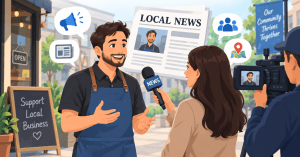
Small businesses can get local news coverage by finding a story that genuinely matters to their community, identifying journalists who already cover that subject, and pitching the story in a concise, useful way. Effective digital PR for small business is not about repeatedly asking reporters to promote a company. It is about giving them a timely story, useful expertise, credible information, or a community angle their audience has a reason to care about.
That opportunity still matters. Pew Research Center found that 66% of U.S. adults follow local news at least somewhat closely. Digital channels are increasingly important too, with about half of adults preferring to get local news through news websites or social media.
The challenge? Giving journalists something worth covering.
What Makes a Small Business Story Newsworthy to Local Media?
A small business story becomes newsworthy when it matters beyond the business itself. A new product may be important internally, for example, but a reporter needs to understand why readers, viewers, or listeners should care.
Strong local angles can include a new location, significant expansion, local job creation, an unusual founder story, original community data, a major anniversary, a charitable initiative, or a response to a problem affecting local residents.
Timeliness can make an ordinary subject much stronger. An HVAC company might offer practical expertise during an extreme heat wave. A cybersecurity firm could explain a scam affecting local companies. A restaurant opening is more interesting when it fills a gap in a neighborhood or introduces something genuinely different.
Use three questions before pitching:
Why now? Why here? Why would local residents care?
That local connection carries real weight. Muck Rack’s 2026 State of Journalism report found that 78% of surveyed journalists said a pitch feels genuinely relevant when it directly affects the community their audience belongs to. Another 45% looked for clear local or cultural context.
Which Local News Outlets and Journalists Should You Target?
Target outlets based on audience and editorial fit, not simply the size of their readership.
Your list may include newspapers, local news websites, television stations, radio programs, business journals, neighborhood publications, newsletters, and specialized publications covering your industry.
Then narrow the list to individual journalists. Look at what they have published recently. Someone who regularly writes about small businesses, economic development, restaurants, real estate, technology, healthcare, or community affairs is usually a better prospect than a generic newsroom inbox.
The same principle applies to marketing more broadly: understand who you are trying to reach before choosing the channel or message. QBall Digital’s guide to how businesses can identify and refine their target audience provides a useful framework for narrowing an audience around real needs and behaviors.
Relevance beats volume. Sending 10 carefully matched pitches can be more useful than distributing the same email to hundreds of unrelated contacts.
How Should You Pitch a Local Journalist?
A good media pitch is short, specific, and centered on the journalist’s audience.
Start with a subject line that tells them what the story actually is. Then explain what is happening, why it matters locally, and why it matters now. Add supporting information such as a meaningful statistic, customer trend, unusual result, or verifiable example.
Next, make reporting the story easy. Offer access to a spokesperson, customer, event, original data, photographs, or other supporting material.
The structure can be simple:
- Subject: State the real news.
- Opening: Explain what is happening.
- Local relevance: Show why the community should care.
- Evidence: Provide facts or examples.
- Access: Offer interviews, visuals, data, or sources.
- Contact: Make the next step simple.
For digital PR for small business, personalization matters more than a clever template. Muck Rack’s 2025 research found that 86% of journalists disregard pitches that are not relevant to their beat.
Avoid exaggerated subject lines, generic compliments, long company histories, and emails that read like advertisements.
What Should You Prepare Before Contacting the Media?
Prepare the information a reporter may need before the first pitch leaves your inbox.
That can include accurate company details, a short spokesperson biography, high-resolution photographs, relevant statistics, interview availability, concise quotes, contact information, and supporting documentation for important claims.
Video can also help when the story involves an event, location, process, demonstration, or visually interesting subject. Businesses that need stronger footage can consider professional video production for marketing and storytelling.
Think like the person writing the story. If a journalist is interested, how many additional emails would they need before they could actually produce it?
Fewer is better.
How Can Small Businesses Build Relationships With Local Reporters?
Media relationships work best when every interaction is not immediately followed by a request for coverage.
Read journalists’ work. Follow the topics they cover. When appropriate, share useful data, expert context, or access to a source without forcing your company into every conversation.
Be responsive when a reporter needs information. If you offer yourself as an expert source, provide clear answers quickly and respect deadlines.
Businesses can also use a consistent social media presence to share expertise, community involvement, original insights, and useful company updates that make it easier for journalists to understand what they do.
Most importantly, respect a “no.” A declined pitch today does not prevent a more relevant story from working later.
When Should You Follow Up After Sending a Media Pitch?
Follow up once if the story is still timely and the journalist has not responded.
Keep the message brief. Refer to the original pitch and add something useful if new information has become available.
Avoid daily reminders or repeated calls. Cision’s 2025 State of the Media findings showed that 62% of reporters recommend following up once, while 30% preferred no follow-up at all.
Silence also does not automatically mean the idea was terrible. Breaking news, deadlines, staffing, timing, or an already crowded editorial calendar can all affect whether a story moves forward.
How Can Local News Coverage Strengthen Your Digital Presence?
Local news coverage can continue creating value after the story itself stops being new.
An online feature may introduce the brand to new customers, generate referral traffic, create searchable brand mentions, provide third-party credibility, and sometimes result in links to the business website.
Links can also help search engines discover and understand pages. Google states that it uses links as one signal for determining page relevance and discovering pages to crawl.
Still, businesses should not treat journalists as a link-building service. Do not demand a backlink or make a link a condition of providing information. Editorial decisions belong to the publication.
Instead, view earned coverage as one part of a broader SEO and authority-building strategy.
How Should You Measure the Results of Local Media Coverage?
Measure what happens after the article, segment, or interview appears.
Useful indicators include referral traffic, branded searches, website inquiries, phone calls, backlinks, online mentions, social engagement, and leads that mention the publication.
Also track less immediate outcomes. Did another journalist discover the company through that story? Did the business become a recurring expert source? Did customers begin mentioning the coverage during sales conversations?
Not every story produces an immediate sale. Measurement helps identify which publications, topics, and story angles create enough value to pursue again.
For businesses building a broader measurement strategy, QBall Digital also publishes digital marketing strategies and practical insights covering search, content, audience behavior, and campaign performance.
FAQ
Can a Small Business Get Local News Coverage for Free?
Yes. Earned media coverage does not normally require paying a publication for placement. A business earns consideration by providing a legitimate story, source, expert perspective, or useful information. Sponsored content and advertising are separate arrangements and should not be confused with editorial coverage.
Do You Need a Press Release to Get Local News Coverage?
No. A focused, personalized email pitch may be enough for many local stories. A press release becomes useful when an announcement contains several dates, facts, quotes, locations, or other details that journalists may need in a consistent format.
What Types of Small Businesses Can Benefit From Local PR?
Almost any locally relevant organization can benefit, including retailers, restaurants, professional service firms, contractors, startups, healthcare businesses, nonprofits, and technology companies. The deciding factor is usually the quality and relevance of the story, not the industry.
How Often Should a Small Business Pitch the Media?
Pitch when you have something genuinely useful or newsworthy to offer. Creating an artificial weekly or monthly pitching quota can encourage weak stories and unnecessary outreach. Quality and timing matter more than frequency.
Is Digital PR Worth It for a Small Business?
Digital PR for small business can be worthwhile when it builds visibility with the right audience, creates credible third-party mentions, generates referral activity, supports search discovery, or develops relationships that lead to future media opportunities. The value should be measured against business objectives rather than press mentions alone.
Turn Local Attention Into Lasting Visibility
Local news coverage usually begins with one strong idea, not a massive publicity campaign.
Look at what is changing inside your business, your industry, and your community. Find the overlap. Then identify the journalists already interested in that subject and give them a clear reason to investigate it.
One useful story can create visibility today. A consistent approach to expertise, relationships, useful content, and community relevance can keep creating opportunities long after the first article appears.
Why Is QBall Digital Your Ideal Choice for Digital PR and Local Visibility?
QBall Digital helps businesses connect visibility with the rest of their digital marketing strategy. Strong media attention has greater potential when the website, content, search presence, and audience strategy are ready to support the people who discover the business afterward. That means thinking beyond a single press mention and considering how each visibility opportunity contributes to awareness, credibility, traffic, and customer acquisition.
QBall Digital brings together SEO, paid media, social media marketing, content strategy, video production, web development, and local visibility services. This integrated approach helps small businesses avoid treating PR, search, advertising, and content as disconnected activities. Instead, each channel can support a clearer and more measurable path from discovery to action.
Build More Local Visibility With QBall Digital
Getting mentioned is only part of the opportunity. The bigger goal is turning attention into lasting digital visibility and qualified customer interest.
QBall Digital can help your business build a coordinated strategy around search, content, social media, paid advertising, and the digital experiences customers encounter after they discover your brand.