
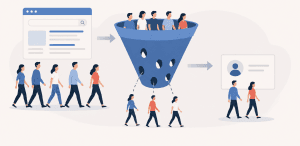
More organic visitors should mean more enquiries, right? Not necessarily. When SEO traffic not converting becomes a recurring problem, the issue is often somewhere between the search query and the action you want the visitor to take.
SEO can successfully increase visibility while attracting visitors who are still researching, sending people to pages that do not match their expectations, or exposing weaknesses in your website’s conversion path. Poor mobile usability, unclear messaging, weak trust signals, difficult forms, and incomplete tracking can all widen the gap.
The answer is not always more traffic. A better starting point is understanding who is arriving, why they searched, what they see after the click, and whether their actions are being measured correctly. That connects SEO strategy with the business outcome that actually matters: qualified opportunities.
How Can You Tell Whether Your SEO Is Attracting the Wrong Traffic?
Start by looking beyond total organic sessions. The important question is whether the visitors reaching your website are people who could realistically need your product or service.
Search intent makes a major difference. Someone searching for “how does commercial HVAC maintenance work?” may be gathering information. Someone searching for “commercial HVAC maintenance company near me” is showing a much stronger signal that they may be evaluating providers.
Informational traffic is not useless. Educational content can introduce a business to potential customers early, answer questions, and build credibility. The problem appears when most organic growth comes from broad research queries while the business expects every visitor to behave like a sales-ready prospect.
Look at the landing pages receiving organic traffic and the searches those pages are built to address. Then compare that audience with your actual customer profile. QBall Digital’s guidance on developing a clearer target audience strategy follows the same principle: stronger marketing starts with knowing who you are trying to reach and what matters to them.
Google Analytics can also help isolate landing-page performance. Its Landing Page report shows where sessions begin and can be combined with traffic-source information to evaluate how visitors enter and interact with a site.
Traffic volume tells you how many people arrived. Traffic quality tells you whether the right people arrived. Big difference.
What On-Page Problems Stop Qualified Visitors From Becoming Leads?
Qualified traffic can still disappear when the page fails to make the value of taking action clear.
First, check whether the page delivers what the search suggested. If someone searches for a specific service and reaches a vague page covering several unrelated offerings, they have to work to determine whether you can actually help them. That uncertainty creates friction.
Then look at the call to action. “Contact us” may technically be a CTA, but it does not explain why someone should make contact or what happens afterward. A stronger conversion path could invite the visitor to request an estimate, schedule a consultation, ask about availability, or receive an assessment. Specific. Relevant. Easy to understand.
Trust matters too. Testimonials, reviews, credentials, real contact information, clear service details, guarantees where appropriate, and evidence of experience can make a business feel less risky. QBall Digital’s guide to website trust signals explores how those elements can support customer confidence.
Finally, inspect the form itself. A visitor who is ready to ask a simple question may abandon a form that immediately demands unnecessary information. Every additional step should have a reason. Good conversion-focused design reduces uncertainty and makes the next action feel proportionate to the visitor’s level of commitment.
Can Website Speed and Mobile Experience Reduce SEO Conversions?
Yes. A visitor can have strong intent and still leave because the website makes completing an action unnecessarily difficult.
A slow page, shifting layout, difficult navigation, tiny buttons, poorly formatted forms, or important content hidden on mobile can interrupt the path from interest to enquiry. Google recommends evaluating page experience as a combination of factors rather than relying on a single signal.
Google’s current Core Web Vitals focus on loading performance, responsiveness, and visual stability. Its recommended “good” thresholds are a Largest Contentful Paint within 2.5 seconds, Interaction to Next Paint of 200 milliseconds or less, and Cumulative Layout Shift of 0.1 or less, assessed at the 75th percentile.
Those metrics are useful diagnostics, but the human experience still matters. Try your own contact process on a phone. Can you understand the offer quickly? Is the CTA visible? Can you complete the form without zooming, hunting, or waiting?
That is why website design and hosting should support both visibility and usability, not simply appearance. QBall Digital’s web design approach specifically emphasizes responsive layouts, speed, navigation, and conversion-focused usability.
How Do You Know Whether Your SEO Conversions Are Being Tracked Correctly?
Before deciding SEO is failing, make sure the leads are actually measurable.
A business might receive phone enquiries, contact forms, consultation requests, quote requests, or other valuable actions. If only one of those actions is tracked, reporting can understate organic performance.
Google Analytics 4 recommends the generate_lead event when a user submits a form or request for information. It also supports additional lead-funnel events for qualification and eventual conversion, which can help businesses measure more than the initial enquiry. Key events can then be used to identify the actions that matter most to the business.
Once tracking is reliable, stop evaluating SEO with rankings and sessions alone. Compare organic landing pages, lead actions, conversion rates, and the quality of the enquiries generated. Over time, you can identify which pages attract visitors and which pages actually contribute to opportunities.
Measurement changes the conversation from “Did traffic increase?” to “What did that traffic produce?”
How Should You Fix SEO Traffic That Is Not Converting?
When SEO traffic not converting is the symptom, fix the journey in a logical order instead of immediately publishing more content.
First, audit traffic quality. Identify which queries and landing pages account for the increase. Separate broad educational visibility from searches that indicate a genuine need for your services.
Next, check landing-page alignment. A commercially focused query should lead to a page that directly addresses that service, explains the value, answers common concerns, and offers a clear next action.
Then strengthen the conversion path. Improve page messaging, proof, CTA placement, form usability, and the explanation of what happens after someone makes contact.
Remove technical friction. Test priority pages across mobile and desktop devices. Look for speed problems, confusing navigation, intrusive elements, broken forms, and anything else that makes taking action harder than it needs to be.
Finally, measure leads rather than assuming traffic equals success. Connect organic landing pages with meaningful actions and, where possible, qualified leads. The same principle applies to Google Ads and search marketing, where QBall Digital aligns search intent, landing pages, conversion rates, and ongoing performance monitoring.
The goal is not to make every visitor convert. It is to make sure the right visitor has a clear, credible, low-friction path forward.
FAQ
Why am I getting organic traffic but no leads?
You may be attracting visitors with weak commercial intent, sending qualified visitors to pages that do not match their needs, or creating too much friction before the conversion. Tracking problems can also make lead generation appear weaker than it really is. Review traffic quality, landing pages, CTAs, forms, user experience, and analytics together.
Does more SEO traffic always mean more leads?
No. Additional traffic only creates more lead opportunities when the visitors are relevant to the business and the website gives them a compelling reason to act. A smaller group of high-intent visitors may be more commercially valuable than a much larger audience of casual researchers.
Should I stop SEO if organic traffic is not converting?
Not immediately. Traffic growth can reveal that visibility is improving while another part of the customer journey needs attention. Diagnose keyword intent, landing-page relevance, website experience, tracking, and lead quality before deciding that the SEO strategy itself should be abandoned.
Ready to Turn More Organic Visits Into Real Opportunities?
Organic traffic is valuable because it creates opportunities to reach people actively searching for information, solutions, or services. But the click is only the beginning.
Look at what happens next. Are the right people arriving? Does the page answer what they searched for? Do they trust the business? Is taking action straightforward? Can you measure what happens afterward?
When those pieces work together, SEO becomes more than a traffic channel. It becomes part of a measurable customer acquisition system.
Why QBall Digital Is Your Ideal Choice for SEO That Converts?
QBall Digital takes a broader view of search performance by connecting visibility with content, website experience, and measurable business outcomes. Its SEO services cover areas including keyword research, technical performance, mobile usability, content strategy, and conversion-focused landing pages. That creates a stronger foundation for businesses that want more than rankings on a report.
The agency also brings SEO together with web design, PPC, and other digital channels, allowing businesses to examine the full path from discovery to action. QBall Digital emphasizes transparent reporting and ongoing access to performance information through its digital marketing approach. Instead of treating traffic as the finish line, the focus can stay where it belongs: attracting relevant prospects and helping more of them take meaningful action.
Let QBall Digital Find What Is Blocking Your SEO Conversions
Getting traffic but not enough enquiries? Contact QBall Digital to evaluate where potential customers may be dropping out of the journey and identify practical opportunities to improve your SEO, website experience, and conversion path.