
If you run a business in Indianapolis, your reputation isn’t just “what people say.” It’s what prospects see right before they decide to call, book, or bounce. The good news: you don’t need a complicated tool stack to improve it—you need a repeatable system your team can run every week.
Below is that system (with templates), plus the rules that keep you compliant and protected.
What does “reputation management” mean for Indianapolis businesses in 2026?
Reputation management is the ongoing practice of shaping what people learn about you at the exact moment they’re deciding. Practically, it means staying on top of your Google Business Profile, earning new reviews at a steady pace, responding in a way that builds trust, and making sure your business information is accurate across the web.
It’s easy to think of reputation management as a defensive move—something you do only when a bad review hits. But the businesses that win treat it as a growth system. They actively create the conditions that produce strong reviews and reduce the conditions that create bad ones. When that’s happening, your online presence becomes a reassurance engine: it helps good prospects feel confident, and it helps uncertain prospects take the next step.
Why do reviews drive so many calls and appointments in local search?
Reviews work because they reduce risk at the moment of choice.
Two practical realities:
- Consumers act differently when reviews are strong. BrightLocal’s 2026 survey found 85% of consumers say positive reviews make them more likely to use a business, and 77% say negative reviews make them less likely to choose one.
- Google explicitly uses “prominence” in local ranking, and Google’s local ranking guidance includes prominence signals like reputation/reviews as part of what helps determine visibility.
In other words: reviews don’t just influence trust—they influence whether you’re seen and whether you’re chosen.
What stops good Indianapolis businesses from earning the 5-star reputation they deserve?
Most of the time, it’s not service quality. It’s system failure:
- No trigger moments: Teams “plan to ask” but don’t tie the request to a predictable point in the customer journey.
- Too much friction: The ask is vague (“leave us a review sometime”) or the link is hard to find.
- No owner: When everyone owns it, no one owns it.
- Inconsistent experience: The same job can feel great or mediocre depending on who shows up, how it’s communicated, and whether expectations were set.
Fixing reputation starts with operational consistency—but you can win fast by installing a review system that captures happy customers while the experience is fresh.
What is the simplest system for more 5-star reviews without being pushy?
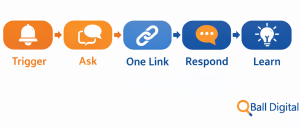
The simplest system is built around a rhythm, not a campaign. Think of it as a loop:
Trigger → Ask → One Link → Respond → Learn → Repeat
“Trigger” is the moment you choose to ask—when satisfaction is naturally highest. “Ask” is a
ort script that feels normal, not salesy. “One link” removes friction so a review can happen in under a minute. “Respond” shows you’re engaged and accountable. “Learn” is where you turn patterns in feedback into improvements. Then you repeat weekly, so results compound.
It works because it respects how people behave. Customers don’t want pressure. They want simplicity. And when you make giving feedback easy at the right time, most satisfied customers are happy to help.
How do you set up the system step-by-step in a way your team will actually follow?
Step 1: Pick your primary review platform (usually Google)
For most Indianapolis SMBs, Google is the priority because it impacts Maps visibility and “near me” discovery. Keep a secondary platform if your industry heavily uses it (healthcare, legal, home services directories, etc.).
Step 2: Create the “one-link” flow
Your goal: a customer can leave a review in under 60 seconds.
- A short URL you can say out loud
- A QR code on a handout / invoice / counter sign
- A saved SMS template for staff
Step 3: Define your trigger moments (2–3 max)
Pick moments that happen naturally:
- Job complete + customer confirms satisfaction
- Milestone delivered (install done, project approved, “go-live”)
- Issue resolved (a complaint handled well can produce strong reviews)
Step 4: Write scripts your team can say without cringing
Short. Human. Clear.
Step 5: Set a response SLA
Decide:
- Who responds?
- How fast?
- What tone?
- What gets escalated?
Consumers increasingly expect speed and accountability; “fast, professional responses” is a consistent best practice across major reputation platforms and research commentary.
Step 6: Install a weekly cadence (15 minutes)
Every week, the owner reviews:
- new reviews (Google + secondary)
- rating trend
- top positive themes to reinforce
- top negative themes to fix
- response time
What should you say when asking for reviews (templates that work)?
In-person (at the trigger moment)
“Thanks again for choosing us. If you feel we earned it today, could you share a quick Google review? It helps other people in Indy find us. I can text you the link—it takes about a minute.”
SMS (best for speed)
“Hi [Name]—thanks again for working with us today. If you have a minute, would you leave an honest Google review here? [link]”
Email (great for professional services)
Subject: Quick favor?
Body: “Hi [Name], thanks again for your trust. If you’re comfortable sharing, we’d appreciate an honest review. It helps others make a confident decision. [link]”
Invoice/receipt follow-up
“Was everything great today? We’d love your feedback: [QR/link]”
Tip: Ask for an honest review, not a “5-star review.” You want authenticity, and you want to stay compliant.
What are the rules for asking for Google reviews (and what can get you penalized)?
Google takes fake and/or incentivized reviews seriously, and it can apply restrictions to a Business Profile if it determines violations of its Fake Engagement policy. Those restrictions can include blocking new reviews, unpublishing existing reviews temporarily, and showing a warning that fake reviews were removed.
Also, Google outlines prohibited/restricted content and looks at patterns of harmful behavior and user actions—not just single events.
Safe rules to follow
- Don’t offer discounts, gifts, or payments for reviews (risk = restrictions).
- Don’t ask employees, friends, or vendors to “stuff” reviews.
- Don’t pressure customers to leave only positive reviews.
- Do make it easy and ask at the right time.
How should you respond to reviews to build trust and reduce damage?
A strong response strategy does two things at once:
- Improves how future customers interpret the review
- Signals that your business is active and accountable
5-star response framework
- Thank them by name (if available)
- Mention 1 specific detail (so it’s not generic)
- Invite them back
Example:
“Thanks, Jamie—really appreciate you calling out our communication during the project. If you ever need help again, we’re here.”
3–4 star response framework
- Thank them
- Acknowledge the feedback
- Mention the improvement step
- Offer an offline follow-up
Example:
“Thanks for the feedback, Chris. We’re reviewing our scheduling communication so it’s clearer upfront. If you’re open to it, we’d love to learn more—please reach us at [email/phone].”
1–2 star response framework
- Stay calm
- Acknowledge experience
- Clarify what you can do
- Move the resolution offline
Example:
“I’m sorry this didn’t meet expectations. We’d like to make it right—please contact [name/role] at [phone/email] so we can review what happened and resolve it.”
Reputation.com explicitly emphasizes that how you respond matters—timeliness and quality can shift perception and mitigate damage.
Can you remove negative reviews, and when is it worth trying?
Sometimes. But only certain reviews are removable (policy violations vs. legitimate experiences).
Use this decision rule:
1) Report it (if it’s a policy violation)
Examples:
- spam
- hateful content
- conflict-of-interest patterns
- content that doesn’t reflect a genuine experience
Google’s policies cover prohibited/restricted content and how it evaluates harmful patterns.
2) Respond + resolve (if it’s a real customer issue)
Own what you can, invite resolution offline, document internally.
3) Ignore (rare)
Only if it’s clearly trolling and responding would amplify it. Even then, consider a short neutral reply.
What should your Google Business Profile look like when reputation management is working?
When your reputation system is running, your Google Business Profile (GBP) stops being a static listing and becomes a conversion asset.
A strong GBP typically has:
- Accurate categories, services, hours
- Fresh photos (real team, real work)
- Prompt review responses
- Consistent business info across the web
Google’s guidance on improving local ranking reinforces the importance of a well-maintained profile as part of local visibility.
How do you turn reviews into better operations so negatives drop over time?
This is the part most businesses skip—and it’s where compounding wins happen.
Build a simple “voice of customer” loop
Each week, tag reviews into themes:
- Communication
- Timeliness
- Pricing clarity
- Cleanliness / professionalism
- Outcome quality
- Staff friendliness
Then do one thing: pick one theme to improve next week.
Examples:
- “Slow communication” → set a 2-hour call-back rule
- “Not clear on pricing” → add a pre-work price confirmation text
- “Late arrivals” → tighten scheduling buffers
Over time, you’re not just improving your reputation—you’re improving the business behind it.
How do you measure ROI from reputation management (not just star rating)?
Track two layers:
Reputation metrics (weekly)
- New reviews (volume)
- Average rating
- Review recency (are you consistently getting new ones?)
- Response time (and % responded)
BrightLocal’s 2026 survey highlights rising expectations around recency and consumer behavior shifts—your tracking needs to match that reality.
Business outcomes (monthly)
- Calls from GBP
- Direction requests
- Form fills / booked appointments
- Close rate by lead source
If you’re running Google Ads, reputation improvements often lift conversion rates because prospects don’t evaluate ads in isolation—they evaluate the business behind the ad.
When should you hire a reputation management partner in Indianapolis?
Hire help when you need consistency and speed you can’t maintain internally, especially if:
- You’re multi-location
- You’re in a high-stakes category (medical, legal, home services)
- You’re getting recurring negatives tied to operational issues
- You want reporting and accountability without adding headcount
Red flags to avoid
- “Guaranteed removals”
- Fake review campaigns
- Incentives-for-reviews tactics (risk = restrictions)
Google explicitly outlines consequences for fake/incentivized activity.
FAQ
How many reviews do I need before it starts impacting lead flow?
Enough to create confidence and recency. In practice, consistency matters more than chasing a specific number.
Is it okay to text customers a Google review link?
Yes—texting the link is common and effective as long as the review request is honest and not incentivized.
Should I respond to every review?
Ideally yes. If you can’t, prioritize negatives and recent positives first.
How fast should I respond to negative reviews?
As quickly as you can while staying calm and factual. Fast responses reduce the window where a prospect sees “unanswered problems.”
What if a customer threatens a bad review to get a refund?
Keep it professional. Don’t negotiate publicly. Ask for details offline, document everything, and respond neutrally if they post.
Can reputation management improve Google Ads performance?
Often, yes—better reviews and response behavior can improve trust and conversion rates even if ad clicks stay the same.
What’s the biggest mistake Indianapolis businesses make with reviews?
Treating reviews like a marketing tactic instead of an operating system (no triggers, no owner, no weekly cadence).
Conclusion
Reputation management in Indianapolis doesn’t have to be complicated. The businesses that win run a simple loop every week:
Trigger → Ask → One Link → Respond → Learn → Repeat
Install the system, keep it compliant, respond quickly, and use feedback to fix what causes negatives in the first place. That’s how you earn more 5-star reviews—and turn them into more calls, bookings, and predictable growth.
Why Qball Digital is Your Ideal Choice for Reputation Management in Indianapolis?
Qball Digital doesn’t approach reputation as a one-time cleanup project. We build a repeatable, team-friendly system that consistently generates authentic reviews, improves response speed, and turns your Google Business Profile into a stronger conversion point for local searchers across Indianapolis.
We also focus on what creates long-term lift: operational feedback loops. If reviews repeatedly mention the same issue—communication gaps, scheduling surprises, unclear expectations—we help you translate that feedback into practical process changes your team can actually implement. The outcome isn’t just a better rating; it’s a better customer experience that produces better reviews naturally.
Get More 5-Star Reviews in Indianapolis with Qball Digital
If you want a system your team can run without guesswork, Qball Digital can set up your review pipeline with:
- A “one-link” review flow (QR + short URL + SMS template)
- Response frameworks for positive and negative reviews
- A 30-day execution plan with weekly reporting checkpoints