
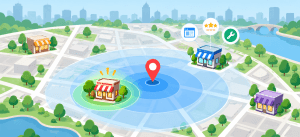
Proximity affects local SEO rankings by influencing which businesses Google displays based on their distance from the searcher. Businesses located closer to potential customers often have an advantage in Google Maps and local search results. However, proximity is not the only ranking factor. Businesses can improve their visibility through accurate Google Business Profiles, relevant website content, authentic customer reviews, and stronger local SEO signals.
A successful proximity SEO ranking strategy focuses on improving the factors you can control rather than trying to change your physical location. Even when competitors operate closer to your target customers, effective optimization can help your business remain competitive.
The challenge is knowing where to focus your efforts.
Why Do Local Search Rankings Change Between Neighborhoods?
Local search rankings change between neighborhoods because Google considers the location associated with each search when determining which businesses to display.
For example, a dental clinic might appear among the top three Google Maps results for someone searching nearby but rank much lower for someone searching from another neighborhood. The clinic has not changed its services or website. Only the search location has changed.
Google also considers the location specified in a search query. Someone searching for “dentist in Carmel” may receive different results from someone searching for “dentist near me” while standing in Indianapolis.
Competition adds another layer. Businesses operating in crowded commercial districts may compete against numerous nearby alternatives, while businesses in less populated areas may face fewer local competitors. This explains why a company can perform well in one neighborhood but struggle to maintain visibility elsewhere.
Which Google Ranking Factors Can Help Businesses Compete Beyond Their Location?
Google primarily evaluates three factors when ranking local businesses: relevance, distance, and prominence. Understanding these factors helps businesses identify opportunities beyond their immediate geographic advantage.
Relevance measures how closely a business matches the searcher’s needs. A roofing contractor with detailed service information may be more relevant to a specific roof repair search than a nearby contractor with an incomplete profile.
Distance measures how far a business is from the location associated with a search. Although businesses cannot directly control where customers search from, they can ensure Google has accurate location information.
Prominence reflects how well-known a business is. Google considers signals such as customer reviews, ratings, and links from other websites.
A farther business can sometimes outrank a closer competitor when its relevance and prominence are stronger. However, Google does not disclose exactly how much weight each factor receives, so no particular optimization guarantees a higher position.
How Can You Optimize Your Google Business Profile for Local Visibility?
Optimizing your Google Business Profile helps Google understand your business and connect it with relevant nearby searches.
Start by verifying that your business name, address, phone number, and operating hours are accurate. Select the primary business category that best represents your core service, then add appropriate secondary categories where relevant.
Complete your service descriptions and upload genuine photographs that help customers understand what your business offers.
Customer reviews also matter. Encourage customers to share honest feedback and respond professionally to reviews, including negative ones. Positive ratings and a strong review history can support local prominence while helping potential customers feel confident about choosing your business.
QBall Digital’s guide to Google Business Profile optimization explains how businesses can strengthen their local presence through more complete and effective profiles.
Remember, an optimized profile improves your opportunity to compete. It does not eliminate geographic distance.
How Can Localized Website Content and Citations Expand Your Visibility?
Localized website content helps businesses demonstrate relevance to customers searching for services in specific communities.
Start with dedicated service pages that answer the questions customers actually ask. If your business serves several cities, location-specific pages can explain the services available in each area, common customer needs, and examples of work completed locally.
Avoid creating nearly identical pages that simply replace one city name with another. Each page should provide useful, distinctive information.
A broader search engine optimization strategy can support this effort through relevant content, effective internal linking, and improvements to website performance.
Local citations also contribute to a consistent online presence. These are mentions of your business information across directories and other websites. Maintaining accurate names, addresses, and phone numbers reduces confusion for customers.
For additional guidance, explore QBall Digital’s article on building local citations.
These activities can support local discoverability and organic website rankings, although they do not directly change the distance Google measures between your business and a searcher.
Can Service-Area Businesses Improve Rankings Without a Physical Storefront?
Yes. Eligible service-area businesses can appear in local results without displaying a public storefront address, provided their Google Business Profiles accurately represent how they operate.
Consider a plumbing company that serves customers at their homes. Google allows qualifying businesses to hide their addresses and specify the areas where they provide services.
However, adding more cities to your service area does not guarantee higher rankings in those locations. Google still considers distance and other ranking factors.
Businesses should avoid using fake addresses, virtual offices, or duplicate profiles to create the appearance of additional locations. These practices can violate Google’s guidelines and risk profile restrictions or suspension.
For businesses operating multiple genuine locations, maintaining accurate individual profiles and helpful location pages can improve discoverability.
The priority should always be representing where your business actually operates rather than attempting to manipulate proximity.
How Can You Identify Where Proximity Is Limiting Your Rankings?
You can identify proximity-related visibility gaps by measuring how your business ranks from multiple locations instead of checking a keyword from one device.
Local rank-tracking tools can display results across a geographic grid, showing where your Google Business Profile appears prominently and where competitors perform better.
For example, an HVAC company might rank in the top three near its office but fall outside those positions several miles away. That information can help the business identify neighborhoods where stronger relevance, content, or competitive analysis may be useful.
A practical assessment should include:
- Tracking important service keywords across multiple locations.
- Comparing competitors’ rankings in weaker areas.
- Reviewing Google Business Profile interactions and website conversions.
- Monitoring changes after implementing improvements.
Rankings alone do not tell the whole story. Calls, inquiries, booked appointments, and qualified leads provide a clearer picture of whether your local SEO investment is delivering business value.
When Should You Use Google Ads to Reach Customers Outside Your Strongest Ranking Areas?
Google Ads can help businesses reach customers in areas where organic local visibility is limited.
Unlike Google Maps rankings, paid advertising allows businesses to configure geographic targeting for eligible locations. A contractor could target specific cities or service areas while directing visitors to relevant landing pages.
Combining local SEO with Google Ads management creates opportunities to reach customers through both organic and paid search results.
However, advertising does not directly improve organic rankings. Campaigns should also be evaluated using conversion rates, cost per qualified lead, and actual customer acquisition rather than clicks alone.
Frequently Asked Questions
Does proximity matter more than customer reviews in local SEO?
Not necessarily. Google considers distance alongside relevance and prominence, which includes review-related signals. A business with stronger reviews may outrank a closer competitor, but outcomes vary by search.
Can businesses rank in Google Maps outside their immediate area?
Yes. Businesses can sometimes rank beyond their immediate surroundings when they offer a strong match for the search and have sufficient prominence. Greater distance generally creates additional challenges.
Does hiding a business address hurt local SEO rankings?
Hiding an address is appropriate for eligible service-area businesses that do not serve customers at their business location. It does not automatically prevent local visibility, although Google still considers the business’s location.
Can adding location keywords improve proximity rankings?
Location keywords can help website content match geographically relevant searches. However, adding city names does not change your physical proximity or guarantee improved Google Maps rankings.
How long does it take to improve local SEO visibility?
There is no guaranteed timeline. Results depend on competition, existing website performance, profile quality, and the improvements made. Monitoring performance consistently helps reveal meaningful progress.
Where Should You Focus Your Local SEO Efforts Next?
Distance will always influence local search visibility, but it should not prevent your business from developing a stronger competitive position.
Focus first on accurate business information, relevant content, authentic reviews, and measurable performance. Then identify which neighborhoods generate valuable inquiries and where additional marketing efforts could make a difference.
The goal is not simply appearing higher on Google Maps. It is helping more relevant customers discover your business and choose your services.
Why QBall Digital Is Your Ideal Choice for Proximity SEO?
QBall Digital helps small businesses strengthen their online presence through search engine optimization, Google Business Profile management, and digital marketing strategies. Its approach combines keyword research, website optimization, local citations, and reputation management to address the factors businesses can improve. With experience serving businesses in Indianapolis, Chattanooga, and surrounding markets, QBall Digital understands the importance of reaching customers in competitive local search environments.
Rather than relying on a single ranking metric, QBall Digital focuses on connecting digital visibility with meaningful business outcomes. Its SEO and paid advertising services offer businesses opportunities to attract relevant traffic while improving their local marketing approach. Through performance monitoring and strategies tailored to individual business needs, QBall Digital helps businesses make more informed marketing decisions.
Ready to Reach More Local Customers with QBall Digital?
Your business does not have to be the closest option to compete for valuable local searches.
Discover opportunities to strengthen your visibility, reach customers in your service area, and generate more qualified inquiries.
Talk with QBall Digital about developing a local SEO strategy that supports your business goals.