
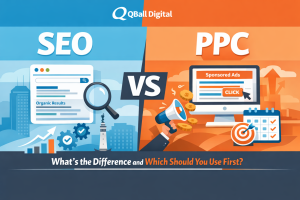
If you’re trying to grow leads in Indianapolis, the real question usually isn’t “SEO or PPC?” It’s: Do you need
demand capture now, or can you afford to build compounding visibility over time? PPC can create lead flow quickly, but only when tracking, targeting, and follow-up are solid. SEO can become your cheapest source of qualified leads—but it takes time and consistent execution.
This guide breaks down exactly when PPC wins, when SEO wins, and when a hybrid approach is the smartest move—with practical decision criteria you can apply to your business today.
What’s the real difference between SEO and PPC, beyond “free vs paid”?
SEO (search engine optimization) is how you earn visibility in organic results by building relevant pages, authority, and technical fundamentals so Google can crawl, understand, and rank your content. Google’s own SEO Starter Guide emphasizes that SEO improvements can help, but it also addresses the reality that impact can take time depending on changes and competition.
PPC (pay-per-click advertising)—often Google Ads—lets you bid to appear for high-intent searches immediately. But PPC isn’t “pay and you win.” Google runs an auction that considers your bid and factors like ad relevance and the expected impact of ad assets (extensions), so strong ads and landing pages can help you compete more efficiently.
Here’s the practical, small-business translation:
- SEO is an asset: it compounds. You invest time/money now to reduce cost per lead later.
- PPC is a lever: it’s controllable and fast. You can turn it up and down—but you keep paying to stay visible.
The trap is thinking channel choice matters more than conversion readiness. If your landing page is weak, your call tracking is broken, or your follow-up is slow, both SEO and PPC will underperform—PPC just reveals the problem faster because you’re paying for the traffic.
How does PPC management work in Indianapolis when someone needs a service now?
PPC management is the system that turns ad spend into measurable business outcomes—qualified calls, forms, bookings, and revenue. At a minimum, it should include:
- Campaign and account structure that matches what you actually sell
- Keyword strategy and match-type control (so you don’t pay for junk traffic)
- Ad copy and assets that raise click-through rate and relevance
- Landing page guidance (or builds) designed to convert
- Conversion tracking and call reporting so you know what’s working
- Ongoing optimization based on search terms, lead quality, and costs
The Indianapolis wrinkle is that many “ready-to-buy” searches are local and mobile. That means calls matter, service areas matter, and the wrong targeting can burn budget quickly.
If there’s one non-negotiable, it’s conversion tracking. Google Ads’ own documentation is clear: conversion measurement exists to measure the valuable actions people take after interacting with your ads, and it’s foundational to optimization.
Without clean tracking, you don’t have “PPC performance.” You have guesswork with a monthly invoice.
When does PPC win over SEO for Indianapolis small businesses?
PPC tends to win when speed and intent matter more than compounding cost reduction.
PPC is the right first move when:
You need leads quickly.
If you’re launching, adding a new service line, expanding into new neighborhoods, or your pipeline slowed, PPC can capture existing demand immediately. SEO can’t reliably do that on a short timeline.
Your customers search with urgency.
If people in Indianapolis are searching because they need help now (repairs, emergency services, last-minute bookings, “open now” problems), PPC can place you in front of them right when intent is highest.
Your unit economics are clear.
PPC is easiest to scale when you know your numbers: average job value, gross margin, close rate, and lifetime value. If the math works, PPC becomes a reliable growth engine.
You want faster learning.
PPC is a powerful testing platform. You can learn which offers, headlines, and service angles convert—then use those insights to shape your SEO pages and even your sales scripts.
One more PPC advantage that’s often overlooked: Google Ads isn’t purely a bidding war. Google’s auction includes relevance and the expected impact of ad assets, which means better alignment between keyword → ad → landing page can improve outcomes and efficiency.
When does SEO beat PPC—even if you can afford ads?
SEO wins when your goal is durable, compounding lead flow—especially when PPC costs are high or lead quality is inconsistent.
SEO is the better bet when:
Your market is click-expensive.
If paid clicks are costly in your category, the “rent” can be hard to sustain—especially if you’re not closing leads at a strong rate. SEO becomes the long-term cost-control strategy.
Trust matters before contact.
Some buyers don’t click the first ad they see. They compare, read, and validate. SEO supports this kind of journey with service pages, comparison content, FAQs, and proof-driven local pages.
You have many services or multiple customer types.
SEO shines when you can build a set of pages that each address a specific need. PPC can target a lot, too—but every additional topic often increases complexity and cost.
You’re building long-term defensibility.
Even if PPC performs well, SEO reduces dependency. It’s the channel that helps you keep lead costs from rising forever.
Google’s SEO documentation explicitly addresses “How long until I see impact in search results?” because time-to-impact varies. That’s exactly why many Indy businesses choose a hybrid: PPC now, SEO compounding alongside it.
How long does SEO take vs PPC, and what’s a realistic timeline for results?
PPC timeline (typical):
- Week 1–2: tracking setup, campaign build, ad assets, landing page alignment
- Weeks 2–6: learning phase and refinements (search terms, negatives, bids, geo/device/time adjustments)
- Months 2–3: clearer winners emerge; scalable structure starts to form
PPC is fast, but it’s not instant perfection. Early performance is often noisy until you’re filtering out irrelevant searches and improving conversion rate.
SEO timeline (typical):
- Month 1: technical and on-page fundamentals; local foundation work
- Months 2–4: content + local relevance + early ranking movement
- Months 4–9+: compounding performance as authority grows
Google’s own SEO guidance makes it clear that impact timing depends on what you change and broader search factors—so the best expectation is “progressive improvement,” not overnight rankings.
A realistic Indianapolis growth plan often looks like this:
- Use PPC to capture bottom-of-funnel demand now
- Build SEO assets that reduce blended cost per lead over time
- Keep whichever channel is converting most efficiently as your “primary,” but don’t ignore the other
What should PPC management Indianapolis cost—and how do you choose a budget that makes sense?
“Cost” has two parts:
- Ad spend (paid to Google)
- Management (paid to the team doing strategy, tracking, optimization, reporting)
The most useful way to choose a budget is backward budgeting:
- What monthly revenue do you want from ads?
- What’s your average job value (or first purchase value)?
- What’s your close rate from qualified leads?
- What’s your maximum cost per lead (CPL) to stay profitable?
Example (simple math):
If you want 10 new jobs/month, close 25% of leads, you need 40 qualified leads. If you can afford $75 per lead, your ad spend target is ~$3,000/month (before management).
This is why “cheap clicks” are a distraction. PPC management should optimize for valuable customer activity, and Google’s conversion tracking documentation exists precisely because measuring those actions is essential for optimization.
How do you decide between SEO and PPC using a simple scorecard?
Use this quick scorecard. Rate each item 1–5 (5 = strongly true).
If your PPC score is higher, start PPC-first. If SEO score is higher, start SEO-first. If close, go hybrid.
PPC-leaning factors
- You need leads in the next 30–60 days
- Your service is urgent/high-intent
- Your margins/LTV are strong
- You can handle calls quickly and consistently
- You can invest in tracking and landing pages
SEO-leaning factors
- PPC clicks are expensive in your niche
- Buyers research heavily before contacting you
- You have multiple services that deserve dedicated pages
- You can commit to consistent content + local authority building
- You want compounding acquisition efficiency
The one rule that prevents wasted spend:
Don’t scale traffic until you can prove what happens after the click—calls, forms, booked jobs. Google’s setup guidance for web conversions exists for a reason.
Visual suggestion (1 of 2): Turn the scorecard above into a one-page downloadable “SEO vs PPC Decision Sheet” (checkbox + simple totals) to increase time on page and conversions.
Can SEO and PPC work together without wasting money?
Yes—and for many Indianapolis small businesses, it’s the highest-ROI approach.
A clean hybrid model looks like this:
PPC handles “buy-now” searches.
You target your highest-intent keywords and build landing pages that convert. You also learn fast: which services, offers, and messages generate qualified leads.
SEO builds the long-term moat.
You create service pages, local trust content, and FAQs so you’re not paying for every future click. As those pages mature, your blended cost per lead drops.
The big mistake is using PPC to “solve” a broken funnel. PPC should amplify what already converts. If your landing pages aren’t clear, your tracking is missing, or your call handling is slow, a hybrid plan just spreads the problem across two channels.
Which option fits best locally: Google Search, Local Services Ads, Performance Max, or Display?
Most Indianapolis service businesses should understand these options before spending:
Google Search Ads
Best for capturing explicit intent (people searching for the service). Often the first place to start because you can control keywords and see search terms.
Local Services Ads (LSAs)
LSAs show prominently for relevant local searches and let customers call/message directly from the unit. Google’s LSA documentation explains that the unit appears in Search for your services in your chosen areas, and customers can contact you straight from the ad.
If you qualify, LSAs can be excellent for lead volume and local trust—but they still require process discipline (lead response, dispute handling, reviews).
Performance Max
Can work well when you already have clean conversion tracking and strong creative/assets. Without that foundation, it can be harder to diagnose what’s driving results.
Display/YouTube
Usually not the first choice for most local lead-gen unless you have strong creative and longer consideration cycles (or you’re running remarketing).
If you’re choosing between Search and LSAs, start with the question: Do you want keyword-level control (Search), or lead-centric local placement with profile-driven interaction (LSAs)? Many winning accounts use both—but only after tracking and lead handling are dialed in.
What mistakes cause wasted spend most often—and how do you prevent them?
These are the patterns that burn budgets fast:
1) Loose targeting without guardrails
Broad targeting and missing negative keywords invite irrelevant clicks.
2) Weak landing pages
If your page doesn’t match the search intent, conversion rate collapses—and your cost per lead spikes.
3) Broken or incomplete conversion tracking
If you’re not measuring calls/forms correctly, you’ll optimize the wrong things. Google’s conversion tracking resources exist because measurement is the prerequisite for improvement.
4) Optimizing for clicks instead of customers
Click-through rate matters, but lead quality matters more.
5) “Set and forget” management
PPC performance changes as competitors, auctions, and search behavior shift. Accounts need ongoing refinement.
What should you expect from a PPC management partner in the first 30–90 days?
A good PPC engagement has a clear ramp:
Days 0–30: Build the foundation
- Conversion tracking + call tracking implemented and tested
- Campaign structure aligned to services and service area
- Initial ad assets and landing page recommendations
- Launch with early safeguards (negatives, match types, geo controls)
Days 30–60: Improve efficiency
- Search term mining and negative keyword expansion
- Ad copy testing and landing page iteration
- Bid/device/time-of-day adjustments based on actual lead quality
- Early reporting that ties performance to leads (not just clicks)
Days 60–90: Scale what works
- Expand winners (new ad groups, new services, better offers)
- Tighten cost per lead and improve lead quality filters
- Build repeatable reporting: CPL trends, lead mix, and conversion rates
Visual suggestion (2 of 2): A simple “First 90 Days of PPC Management” timeline graphic (foundation → optimization → scale) to reinforce trust and reduce sales friction.
FAQ
Is PPC worth it for a small business with a limited budget?
It can be—if you focus on high-intent services, tight targeting, and strong conversion tracking. Limited budgets fail when campaigns are too broad or when lead quality isn’t measured accurately.
What’s a “good” cost per lead for PPC management Indianapolis?
There isn’t one universal number because lead cost depends on industry, urgency, competition, conversion rate, and close rate. A “good” CPL is the one that stays profitable after you factor in close rate and gross margin.
Should I run Local Services Ads or Google Search Ads first?
If you qualify and calls are your main conversion, LSAs can be strong because customers can call/message directly from the LSA unit. Search Ads offer more keyword control and clearer testing. Many businesses run both once tracking and lead handling are consistent.
Do I need dedicated landing pages, or can I use my homepage?
You can use a homepage, but dedicated landing pages usually convert better because they match a specific intent (service + location + proof + CTA). Higher conversion rate lowers your effective cost per lead.
How do I track calls and forms correctly from PPC?
Set up web conversion measurement and ensure your tags and conversion actions are correctly implemented and verified. Google’s guidance on web conversions and conversion tracking is the best starting point.
Can PPC still work if my website is outdated?
Sometimes, but performance is often capped. If the page loads slowly, looks untrustworthy on mobile, or lacks clear CTAs, you’ll pay more per lead. Even basic landing page improvements can unlock major gains.
What’s the biggest sign I should switch from DIY ads to professional management?
If you can’t confidently answer: “Which search terms are driving qualified leads, and what’s my CPL trend by service?” you’re likely flying blind—especially if tracking isn’t set up cleanly.
How do I know whether to invest in SEO first instead?
If you don’t need leads immediately, your category is click-expensive, and you can commit to consistent content and local authority building, SEO-first may be the smarter compounding play.
Conclusion
PPC wins when you need speed, your customers search with urgency, and your margins and tracking support scalable acquisition. SEO wins when you want compounding efficiency, trust-building content, and long-term defensibility against rising ad costs.
For many Indianapolis small businesses, the strongest move is PPC now + SEO alongside it: capture demand today while building an organic foundation that lowers your blended cost per lead over time.
Why QBall Digital is Your Ideal Choice for PPC management Indianapolis?
QBall Digital builds PPC programs around outcomes you can run a business on: qualified calls, booked appointments, and measurable revenue—not vanity metrics. That starts with a tracking-first setup, because optimizing without clean conversion measurement is like driving with fogged-up windows. Google’s own documentation reinforces that conversion measurement is essential to understand what users do after interacting with ads and to optimize performance.
Wasted spend usually comes from predictable issues: loose targeting, missing negative keywords, misaligned landing pages, and unclear lead quality signals. QBall Digital’s approach prioritizes fixing the leak before turning up the faucet—tightening relevance and measurement first, then scaling what’s working with a structured testing cadence. And because Google Ads performance is shaped by auction dynamics and ad relevance—not just bids—QBall Digital focuses on the full chain (keyword → ad → landing page) to improve efficiency and consistency.
Get a PPC Management Plan from QBall Digital
If you’re evaluating PPC management Indianapolis, request a Wasted Spend & Growth Audit from QBall Digital. You’ll get a clear view of what’s limiting performance today (targeting, tracking, landing pages, search terms, or lead handling) and a practical plan to improve lead quality and cost per lead.
Ready to turn ad spend into consistent leads? Reach out to QBall Digital and get a roadmap built around your goals, service area, and margins.