
Small businesses do not need more reports. They need clearer answers.
The problem is that modern marketing platforms make almost everything measurable: clicks, impressions, rankings, likes, followers, sessions, open rates, bounce rates, watch time, form fills, calls, sales, and more. That sounds useful until every number starts competing for attention. For a small business with limited budget, limited staff, and real revenue pressure, the question is not “What can we measure?” It is “Which numbers help us make better decisions?”
That is where marketing KPIs for small business matter. The right KPIs show whether your marketing is generating qualified leads, paying customers, revenue, and profit. The wrong KPIs make campaigns look busy while quietly wasting money.
This guide explains which marketing KPIs small businesses should prioritize, which metrics are useful but secondary, and which ones should usually be ignored when making budget decisions.
What Are Marketing KPIs for Small Business?
Marketing KPIs for small business are measurable indicators that show whether marketing activities are helping the business attract leads, convert customers, and generate profitable revenue.
A KPI is not just any number in a dashboard. A metric becomes a KPI when it is tied to a specific business goal. For example, website traffic is a metric. It becomes more meaningful when the goal is to increase qualified demo requests, booked appointments, ecommerce purchases, or inbound calls.
This distinction matters because small businesses cannot afford to optimize for activity alone. A campaign can get more clicks, more impressions, and more visitors while still producing no profitable customers. A useful KPI helps answer a decision-making question, such as:
- Should we increase this ad budget?
- Is this campaign producing qualified leads?
- Are leads turning into customers?
- Is our cost per customer sustainable?
- Are we making more revenue than we are spending?
A good small-business KPI should be simple enough to understand, reliable enough to review regularly, and connected closely enough to revenue that it can guide action. Google Analytics defines key events as actions that are especially important to business success, which is a helpful way to think about marketing KPIs: the number should reflect something that actually matters to the business, not just something that happened online.
Why Do Small Businesses Need to Track Marketing KPIs?
Small businesses need to track marketing KPIs because limited budgets leave little room for wasted spend, unclear attribution, or campaigns that look active but do not create revenue.
For a large company, an underperforming campaign may be absorbed into a broader marketing budget. For a small business, a few thousand dollars wasted on the wrong keywords, weak landing pages, or low-quality leads can affect cash flow quickly. KPI tracking helps business owners see which channels deserve more investment and which ones need to be fixed or paused.
KPIs also create accountability between marketing and sales. A PPC campaign might generate a high number of leads, but if those leads never answer the phone, cannot afford the service, or are outside the target location, the campaign is not truly successful. Tracking lead quality, lead-to-customer rate, and cost per closed customer gives a more honest view than tracking form submissions alone.
For PPC-heavy small businesses, KPI tracking is especially important because ad platforms often report performance at the click or conversion level. Google Ads conversion tracking can show which campaigns, ads, and keywords drive valuable actions, but the business still needs to define which actions are truly valuable. A lead form submission, booked appointment, phone call, and closed sale should not always be treated as equal outcomes.
Which Marketing KPIs Matter Most for Small Businesses?
The most important marketing KPIs for small businesses are the ones that connect marketing activity to leads, customers, revenue, and profitability.
A small business does not need to track 30 KPIs to make good marketing decisions. In fact, Pipedrive recommends that small B2B businesses focus on three to five marketing KPIs so they can use limited resources more effectively and improve funnel efficiency. The best KPI set depends on the business model, but most small businesses should start with the following core numbers.
Customer Acquisition Cost
Customer Acquisition Cost, or CAC, shows how much it costs to acquire one new customer.
- Customer Acquisition Cost = Total Sales and Marketing Spend ÷ Number of New Customers Acquired
For example, if a business spends $5,000 on marketing and sales in a month and gains 25 new customers, its CAC is $200.
CAC is one of the most important marketing KPIs for small business because it shows whether growth is affordable. A campaign that generates lots of leads can still be unhealthy if the cost to turn those leads into customers is too high.
For PPC campaigns, CAC is often more important than cost per click or cost per lead. A $12 click may be profitable if it turns into a $5,000 customer. A $2 click may be wasteful if it attracts people who never buy.
Conversion Rate
Conversion rate measures the percentage of people who take a desired action.
- Conversion Rate = Conversions ÷ Total Visitors or Clicks × 100
Conversions can include form submissions, calls, purchases, bookings, quote requests, demo requests, or email signups. The right conversion depends on the business goal.
Conversion rate is powerful because improving it can increase results without increasing ad spend. If a landing page receives 1,000 visitors and converts 3%, it produces 30 leads. If the same page converts 6%, it produces 60 leads from the same traffic budget.
This is why small businesses should not judge campaigns only by traffic volume. Traffic creates opportunity, but conversion rate shows whether the website, landing page, offer, and follow-up process are turning that opportunity into action.
Cost Per Lead
Cost per lead, or CPL, shows how much a business pays to generate one lead.
- Cost Per Lead = Campaign Spend ÷ Number of Leads Generated
For a local service business, a lead might be a phone call or quote request. For a B2B company, it might be a consultation request, demo form, or downloadable guide submission. For a professional service provider, it might be a booked appointment.
CPL is useful because it helps compare the efficiency of different channels. However, low CPL is not always good. A campaign that produces $20 leads with no buying intent may be worse than a campaign that produces $150 leads that regularly become customers.
Small businesses should track CPL alongside lead quality and close rate. Otherwise, they may cut the campaign that looks expensive but generates the best customers.
Lead-to-Customer Conversion Rate
Lead-to-customer conversion rate shows what percentage of leads become paying customers.
- Lead-to-Customer Conversion Rate = New Customers ÷ Total Leads × 100
This KPI is critical because it connects marketing performance to sales performance. If a campaign generates 100 leads and only two become customers, the issue may be targeting, offer quality, sales follow-up, pricing, or lead qualification.
For PPC campaigns, lead-to-customer rate often reveals problems that ad dashboards cannot show on their own. A campaign may report a strong conversion rate because people are filling out forms. But if those leads are unqualified, the real business result is weak.
This KPI also helps small businesses compare channels more fairly. Organic search might generate fewer leads than paid ads but close at a higher rate. Paid search might cost more per lead but produce customers faster. Email might have lower volume but stronger conversion from existing contacts.
Marketing ROI
Marketing ROI shows whether marketing revenue is greater than marketing cost.
- Marketing ROI = (Revenue Attributed to Marketing − Marketing Cost) ÷ Marketing Cost × 100
For example, if a campaign generates $20,000 in revenue and costs $5,000, the marketing ROI is 300%.
Marketing ROI is one of the clearest executive-level KPIs because it links marketing to business value. However, it requires accurate revenue attribution. If sales happen offline, over the phone, in a CRM, or after several follow-ups, the business needs a way to connect the original marketing source to the closed sale.
This is where many small businesses struggle. They track the first conversion, such as a form submission, but not the final sale. The result is a partial view of ROI.
Customer Lifetime Value
Customer Lifetime Value, often shortened to CLV or LTV, estimates how much revenue a customer generates over the full relationship with the business.
- Customer Lifetime Value = Average Purchase Value × Purchase Frequency × Customer Lifespan
CLV helps small businesses understand how much they can afford to spend on acquisition. A business with a $300 average customer value cannot spend the same CAC as a business with a $10,000 customer lifetime value.
HubSpot notes that historical CLV often uses average order value, purchase frequency, and customer lifespan, and that this approach can be useful for small businesses with simpler customer journeys or limited data.
CLV is especially important for businesses with repeat purchases, retainers, subscriptions, maintenance plans, memberships, or long-term client relationships. A PPC campaign may look expensive when judged only by first purchase value, but it may be profitable when repeat revenue is included.
Return on Ad Spend
Return on Ad Spend, or ROAS, measures revenue generated for every dollar spent on advertising.
- ROAS = Revenue from Ads ÷ Ad Spend
If a business spends $2,000 on ads and generates $10,000 in revenue, ROAS is 5:1.
ROAS is useful for ecommerce, lead generation, and PPC campaigns where revenue can be attributed to ad spend. However, ROAS does not equal profit. It does not automatically account for product costs, labor, software, fulfillment, overhead, discounts, refunds, or sales commissions.
For small businesses, ROAS should be reviewed with profit margin and CAC. A high ROAS campaign may still be less attractive than a lower ROAS campaign if the second campaign produces customers with higher lifetime value.
Revenue from Marketing-Sourced Leads
Revenue from marketing-sourced leads shows how much closed business came from marketing-generated opportunities.
This KPI is especially valuable for service businesses, B2B companies, contractors, agencies, clinics, consultants, and other businesses where the sale may not happen directly on the website.
To track this properly, the business needs a connection between lead source and sales outcome. That may include CRM source tracking, call tracking, form tracking, UTM parameters, Google Ads conversion tracking, and offline conversion imports. Google Ads supports offline conversion imports so advertisers can measure what happens after an ad click or call results in an offline sale or other downstream action.
This KPI helps answer the question every small-business owner eventually asks: “Which marketing channels are actually bringing in money?”
Which Marketing Metrics Should Small Businesses Track but Not Overvalue?
Some marketing metrics are useful diagnostic signals, but they should not be treated as primary KPIs unless they connect to revenue, leads, or customer growth.
These numbers can help explain performance, but they should not dominate decision-making on their own.
Website Traffic
Website traffic shows how many users visit your site. It is useful for measuring visibility, demand, SEO growth, and channel reach. GA4’s traffic acquisition report helps businesses understand how users arrive across organic, paid, social, email, referral, and other sources.
However, traffic alone does not prove marketing success. A website can gain more visitors while producing fewer leads. For a small business, the better question is not just “Did traffic grow?” but “Did qualified traffic grow, and did that traffic convert?”
Track traffic by source, landing page, campaign, and conversion outcome. That context turns traffic from a vanity number into a useful diagnostic metric.
Click-Through Rate
Click-through rate, or CTR, shows the percentage of people who clicked after seeing an ad, search result, or email link.
CTR is useful for evaluating message relevance. A low CTR may suggest that the ad headline, meta title, email subject line, or offer is not compelling enough. Google Search Console’s performance report includes clicks, impressions, average CTR, and average position, making it helpful for search visibility analysis.
Still, CTR should not be treated as a primary business KPI. A high CTR can attract curiosity clicks that never become leads. A lower CTR can still be profitable if it attracts high-intent prospects.
Impressions
Impressions show how often an ad, search result, or piece of content appeared.
This metric is useful for awareness and visibility. It can show whether campaigns are reaching enough people, whether search demand exists, or whether ad delivery is expanding.
But impressions do not show business impact. They do not prove that people clicked, engaged, converted, or bought. Small businesses should use impressions as a top-of-funnel signal, not as proof of campaign success.
Email Open Rate
Email open rate can help evaluate subject lines, sender trust, and general list engagement.
However, open rate has become less reliable as a performance KPI because of privacy changes, inbox behavior, and automated opens. For business decisions, clicks, replies, conversions, booked calls, purchases, and revenue are more meaningful.
Open rate can still be useful for testing subject lines, but it should not be the final measure of email marketing performance.
Social Engagement
Social engagement includes likes, comments, shares, saves, and reactions.
These numbers can show whether content resonates with an audience. They can also help identify topics that deserve more content, video, or ad testing.
But engagement is not the same as revenue. A post can get many likes from people who will never buy. Small businesses should connect social performance to website visits, leads, messages, consultations, email subscribers, or sales before treating it as a core KPI.
Which Marketing KPIs Should Small Businesses Ignore?
Small businesses should ignore or downgrade KPIs that look impressive but do not help them make profitable marketing decisions.
This does not mean every vanity metric is completely useless. It means those metrics should not guide budget allocation unless they are connected to meaningful outcomes.
Follower count is one of the most common examples. A growing audience can be useful, but followers do not automatically create revenue. A small business with 2,000 engaged local followers may outperform a business with 50,000 broad, unqualified followers.
Raw pageviews are another common distraction. Pageviews can indicate content visibility, but they do not show whether visitors are qualified or interested in buying. A blog post that gets lots of traffic from low-intent searches may produce fewer leads than a smaller landing page targeting a high-intent local service query.
PPC clicks should also be treated carefully. Clicks are necessary, but they are not the end goal. A campaign with cheap clicks can waste money if those clicks do not convert. Google Ads can help advertisers understand how ads lead to valuable customer actions, but the business must still define what counts as valuable.
Other metrics to downgrade include impressions without clicks, email list size without engagement, average ranking position without qualified traffic, and brand awareness numbers without a clear campaign objective.
The simple rule is this: if the metric cannot help you decide what to improve, pause, increase, or change, it should not be treated as a primary KPI.
How Can Small Businesses Choose the Right Marketing KPIs?
Small businesses can choose the right marketing KPIs by starting with a revenue goal, identifying the marketing actions that influence it, and selecting a small number of measurable indicators.
The first step is to define the business goal. For example, the goal might be to increase booked consultations, grow monthly recurring revenue, sell more ecommerce products, generate qualified calls, or improve customer retention.
The second step is to choose the marketing objective that supports that goal. If the business goal is more booked consultations, the marketing objective may be to improve PPC lead generation. If the goal is more repeat purchases, the marketing objective may be to improve email revenue or customer reactivation.
The third step is to identify the funnel stage. Awareness KPIs are different from conversion KPIs. Conversion KPIs are different from retention KPIs. A small business should not use the same KPI for every campaign.
Then choose three to five primary KPIs. This keeps reporting focused. A business can still monitor supporting metrics, but the primary KPIs should be the numbers that drive decisions.
For example:
- Goal: Increase booked consultations
- Marketing objective: Improve PPC lead generation
- Primary KPI: Cost per qualified lead
- Supporting metric: Landing page conversion rate
- Decision: Improve targeting, ad copy, offer, form design, or follow-up process
This approach keeps the KPI connected to action. Without action, reporting becomes decoration.
How Should PPC-Focused Small Businesses Track Marketing KPIs?
PPC-focused small businesses should track KPIs from click to customer, not just from impression to lead.
At the top of the funnel, PPC tracking should include impressions, clicks, CTR, CPC, and campaign spend. These metrics help diagnose reach, ad relevance, competition, and traffic cost. But they are only the beginning.
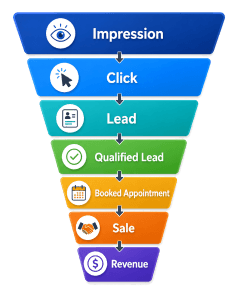
The next layer should track conversions: form submissions, calls, appointment bookings, quote requests, purchases, or other valuable actions. Google Ads conversion measurement helps advertisers identify which campaigns, ads, and keywords are driving valuable actions.
The deeper layer should track lead quality and sales outcomes. This includes qualified leads, booked appointments, sales opportunities, closed customers, revenue, CAC, and ROAS. For lead-generation businesses, this often requires importing offline conversions or connecting Google Ads to a CRM. Google’s offline conversion import feature is designed to help measure what happens after an ad click or call leads to activity outside the website, such as a sale handled offline.
GA4 also plays a role. Google Analytics now distinguishes between events, key events, and Google Ads conversions. An event can be any tracked interaction, a key event is an action important to business success, and a Google Ads conversion can be created from an Analytics key event when it is important for ad optimization and measurement.
For small businesses, this means the strongest PPC KPI setup usually includes:
- Google Ads conversion tracking
- GA4 key events
- Call tracking
- CRM lead source tracking
- Landing page conversion tracking
- Offline conversion imports
- Qualified lead reporting
- Closed revenue reporting
A PPC campaign can look successful in the ad platform while failing at the sales level. That happens when the campaign generates cheap leads that do not close. Tracking from click to customer prevents that mistake.
How Often Should Small Businesses Review Marketing KPIs?
Small businesses should review tactical PPC and campaign KPIs weekly, core marketing performance monthly, and broader customer-value metrics quarterly.
Weekly reviews are best for campaign pacing and early warning signs. For PPC, this may include ad spend, CPC, CTR, CPL, conversion rate, search terms, budget pacing, and obvious tracking issues. Weekly review helps catch waste before it becomes expensive.
Monthly reviews should focus on business performance. This is where the business should review lead quality, CAC, lead-to-customer rate, revenue from marketing-sourced leads, ROAS, and channel performance. Monthly reporting gives enough time for patterns to emerge without reacting too quickly to daily fluctuations.
Quarterly reviews should focus on strategic decisions. This includes CLV, retention, churn, channel mix, offer performance, sales cycle length, and budget allocation. Quarterly analysis helps answer bigger questions: Are we attracting the right customers? Should we increase PPC spend? Is SEO compounding? Are customers staying long enough to justify CAC?
Reviewing too often can create panic. Reviewing too rarely allows waste to continue. The right cadence gives each KPI enough time to become meaningful.
What Tools Can Small Businesses Use to Track Marketing KPIs?
Small businesses can track most marketing KPIs with a mix of free analytics tools, ad platform reports, CRM data, call tracking, and simple dashboards.
Google Analytics 4 is useful for traffic sources, user behavior, events, and key events. Google Search Console helps track organic search queries, impressions, clicks, CTR, and position. Google Ads and Meta Ads Manager help track ad spend, clicks, conversions, and campaign-level performance.
A CRM is important for connecting leads to sales outcomes. Without CRM tracking, many businesses only know where leads came from, not whether those leads became customers. Salesforce’s lead conversion reporting, for example, can visualize lead activity and pipeline stages in terms of leads or revenue.
Call tracking is also valuable for local service businesses and professional services. Many high-intent leads call instead of filling out a form. If those calls are not tracked, the business may underestimate which channels are working.
Looker Studio or a spreadsheet can be enough for a simple dashboard. The goal is not to build the most complex report. The goal is to create one view that helps the business make better decisions.
What Is a Simple Marketing KPI Dashboard for Small Businesses?
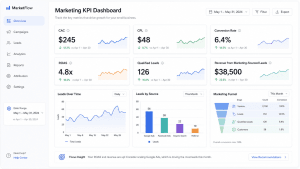
A simple small business marketing KPI dashboard should show the few numbers that explain whether marketing is creating profitable growth.
The dashboard should not include every available metric. It should be built around business questions.
The acquisition section should show where demand is coming from. Useful metrics may include traffic by channel, paid clicks, cost per click, cost per lead, and customer acquisition cost.
The conversion section should show whether prospects are taking action. Useful metrics may include landing page conversion rate, form fills, calls, booked appointments, demo requests, quote requests, and ecommerce purchases.
The sales section should show whether marketing-generated leads are turning into revenue. Useful metrics may include qualified leads, close rate, sales opportunities, average deal value, and revenue from marketing-sourced leads.
The profitability section should show whether growth is sustainable. Useful metrics may include marketing ROI, ROAS, CLV, CAC, and CLV-to-CAC ratio.
The best dashboard is not the one with the most charts. It is the one that helps a business owner quickly understand what is working, what is wasting money, and what needs to change.
What Mistakes Do Small Businesses Make When Tracking Marketing KPIs?
The biggest mistakes are tracking too many metrics, focusing on vanity numbers, ignoring lead quality, and failing to connect marketing data to sales results.
One common mistake is treating clicks as success. Clicks matter because they bring visitors to a page, but they do not prove business impact. A click is only valuable if it has a reasonable chance of becoming a lead, customer, or sale.
Another mistake is measuring leads but not customers. A campaign that generates many low-quality leads can make marketing look strong while frustrating the sales team. Small businesses should separate raw leads from qualified leads, booked appointments, and closed customers.
Ignoring phone calls is another issue. For local services, healthcare, home services, legal, financial, and professional service businesses, phone calls may be the highest-intent conversion action. If calls are not tracked, the data may undervalue the best-performing campaigns.
Small businesses also make the mistake of reviewing reports without deciding what to do next. A KPI should lead to an action. If CPL is high, the business may need to improve targeting, ad copy, landing page relevance, or the offer. If conversion rate is low, it may need better page design, faster load speed, clearer proof, stronger calls to action, or fewer form fields. If lead quality is poor, the issue may be keyword intent, audience targeting, match types, negative keywords, or unclear qualification language.
Another mistake is changing campaigns too quickly. Daily data can be noisy. Small businesses should monitor campaigns regularly but avoid making major decisions before enough data has accumulated.
What Are the Best Marketing KPIs for Different Types of Small Businesses?
The best KPIs depend on the business model, sales cycle, and customer journey.
A local service business should usually prioritize calls, booked appointments, cost per call, cost per booked job, local landing page conversion rate, close rate, and revenue per job. For these businesses, call tracking and location-level reporting are especially important.
An ecommerce business should focus on ROAS, conversion rate, average order value, cart abandonment rate, repeat purchase rate, revenue, gross margin, and customer lifetime value. ROAS is useful, but ecommerce businesses should avoid ignoring margin and repeat purchase behavior.
A B2B service business should track marketing qualified leads, sales qualified leads, cost per qualified lead, lead-to-customer rate, pipeline value, sales cycle length, and revenue from marketing-sourced opportunities. HubSpot describes B2B marketing KPIs as data points that help monitor progress toward long-term marketing goals, while supporting metrics such as CTR or open rate help explain performance along the way.
A subscription business should prioritize CAC, CLV, churn rate, trial-to-paid conversion rate, monthly recurring revenue, retention rate, and payback period. In this model, retention can be just as important as acquisition.
A professional services firm should track consultation requests, cost per consultation, qualified calls, close rate, revenue per client, and referral source. These businesses often have fewer transactions but higher client value, so lead quality matters more than lead volume.
The point is not to copy another business’s dashboard. The point is to choose KPIs that match how your business actually earns revenue.
How Can Small Businesses Turn KPI Data Into Better Marketing Decisions?
KPI data becomes valuable when it leads to a clear decision about budget, targeting, messaging, landing pages, offers, or follow-up.
If CPL is high, the first step is to identify whether the problem is traffic cost or conversion rate. If clicks are expensive but conversion rate is strong, the campaign may need better keyword targeting or bid strategy. If clicks are affordable but conversion rate is weak, the landing page, offer, form, or trust signals may need improvement.
If conversion rate is low, look at the page experience. Is the offer clear? Is the call to action easy to find? Does the page match the ad promise? Are there testimonials, proof points, guarantees, or examples? Is the form too long? Is the page slow on mobile?
If lead quality is poor, review search terms, ad copy, audience targeting, landing page language, and qualification questions. Sometimes adding price ranges, service-area details, industry filters, or “best fit” language can reduce bad leads and improve close rates.
If ROAS looks strong but profit is weak, review margins, fulfillment costs, discounts, refunds, repeat purchase rate, and customer support costs. ROAS can look healthy while actual profit remains thin.
If traffic is growing but leads are flat, the business may be attracting informational visitors instead of high-intent prospects. In that case, the content strategy may need more bottom-of-funnel pages, service pages, comparison content, local landing pages, or stronger calls to action.
If paid ads generate leads but sales do not close, marketing and sales need to review lead source, response time, qualification, follow-up process, and offer fit. Sometimes the campaign is not the issue. Sometimes the follow-up system is.
KPIs are not just scorecards. They are diagnostic tools. The value comes from using them to make better decisions.
FAQ
What are the most important marketing KPIs for small business?
The most important marketing KPIs for small business are customer acquisition cost, conversion rate, cost per lead, lead-to-customer conversion rate, marketing ROI, customer lifetime value, ROAS, and revenue from marketing-sourced leads. These KPIs connect marketing activity to business outcomes rather than surface-level activity.
How many marketing KPIs should a small business track?
Most small businesses should track three to five primary marketing KPIs, supported by secondary diagnostic metrics. This keeps reporting focused and prevents decision-makers from getting distracted by numbers that do not affect revenue or profit.
What is the difference between a marketing KPI and a marketing metric?
A marketing metric is any measurable data point, such as clicks, impressions, traffic, or open rate. A marketing KPI is a metric tied to a specific business goal. For example, traffic is a metric, but qualified leads from organic search can be a KPI if the goal is to increase inbound sales opportunities.
Is website traffic a good KPI for small businesses?
Website traffic can be useful, but it should not usually be a primary KPI unless it is connected to conversions. Traffic matters when it brings qualified visitors who become leads, customers, subscribers, or buyers. Traffic without conversion context can become a vanity metric.
What KPIs should small businesses track for PPC campaigns?
Small businesses running PPC campaigns should track cost per click, conversion rate, cost per lead, cost per qualified lead, cost per booked appointment, customer acquisition cost, lead-to-customer conversion rate, ROAS, and revenue from ad-generated leads. PPC reporting should connect clicks to customers whenever possible.
What marketing KPIs should small businesses ignore?
Small businesses should usually ignore or downgrade vanity metrics such as raw follower count, social likes without lead impact, impressions without action, pageviews without conversion context, email list size without engagement, and PPC clicks that never turn into leads or customers.
How do you calculate marketing ROI for a small business?
Marketing ROI is calculated by subtracting marketing cost from revenue attributed to marketing, dividing that number by marketing cost, and multiplying by 100.
- Marketing ROI = (Revenue Attributed to Marketing − Marketing Cost) ÷ Marketing Cost × 100
This calculation is most useful when the business has reliable lead source and revenue tracking.
How often should small businesses review marketing KPIs?
Small businesses should review tactical campaign KPIs weekly, core marketing and sales KPIs monthly, and broader strategic KPIs quarterly. PPC spend, CPL, and conversion rate may need weekly attention, while CAC, CLV, ROI, and channel strategy are better reviewed over longer periods.
Conclusion
Small businesses do not need to track every marketing number available. They need a focused KPI system that shows whether marketing is generating qualified leads, customers, revenue, and profit.
The best marketing KPIs for small business are not always the flashiest numbers. Clicks, impressions, followers, and traffic can be useful, but they should not drive major budget decisions unless they connect to meaningful business outcomes.
A stronger approach is to track a small group of KPIs that answer practical questions: How much does it cost to acquire a customer? Which channels produce qualified leads? Which campaigns create revenue? Which landing pages convert? Which metrics are only making us feel busy?
When small businesses use KPIs this way, reporting becomes more than a monthly spreadsheet. It becomes a system for making smarter marketing decisions.
Why QBall Digital is Your Ideal Choice for Marketing KPIs for Small Business?
QBall Digital helps small businesses move beyond surface-level reporting and understand what their marketing numbers actually mean. Instead of focusing only on clicks, impressions, or traffic, QBall Digital helps connect campaign performance to leads, sales opportunities, and revenue outcomes. That gives business owners a clearer view of which campaigns are creating real growth and which ones are quietly wasting budget.
For businesses investing in PPC, SEO, and digital campaigns, that clarity matters. QBall Digital can help identify which channels are producing profitable leads, which conversion points need improvement, and which metrics deserve less attention. With a stronger KPI framework, small businesses can stop guessing and start making marketing decisions with confidence.
QBall Digital is especially valuable for businesses that want practical reporting, not just more dashboards. The right tracking setup can show where prospects come from, how they convert, and what happens after the first lead is captured. That level of visibility helps small businesses spend smarter, improve faster, and scale campaigns with less uncertainty.
Track the KPIs That Actually Grow Your Business with QBall Digital
Ready to understand which marketing numbers are helping your business grow and which ones are holding you back? Contact QBall Digital for a marketing performance review, PPC audit, or KPI tracking consultation built around real business outcomes.