
If you serve customers in Indianapolis, the Google “Map Pack” (the three local listings that show under the map) is often the most valuable real estate on the page. These searchers are high-intent: they’re looking for a provider nearby, right now.
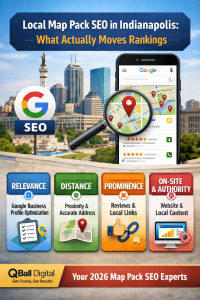
But Map Pack rankings feel unpredictable because they don’t follow the same rules as traditional organic SEO. In 2026, businesses win the Map Pack by aligning with the three forces Google consistently relies on for local results:
- Relevance: How well your business matches the search
- Distance: How close you are to the searcher (or the location included in the query)
- Prominence: How well-known and trusted you appear online
Below is a practical, Indianapolis-specific guide to what actually moves Map Pack rankings in 2026—and what QBall Digital would prioritize first.
What “Map Pack SEO” really is (and what it’s not)
Map Pack SEO is the process of increasing your visibility in the top local results for searches like:
- “local SEO agency Indianapolis”
- “best [service] near me”
- “[service] in Broad Ripple”
- “[service] Fishers”
- “[service] Carmel”
It’s not just “regular SEO but local.” Your Google Business Profile (GBP) plays a major role, and proximity can limit how far you rank—even if your website is excellent.
The 2026 Ranking Levers That Actually Move the Needle in Indianapolis
1) Relevance: Your Google Business Profile must match the search (perfectly)
Relevance is the most controllable ranking factor—and the one most businesses under-optimize.
Here’s what matters most:
Primary category (the big one)
Pick the closest match to your core revenue service. A “broad” category is not always better. If your primary category is slightly off, you’re telling Google you’re not the best match—before your reviews, website, or authority even get considered.
Secondary categories (supporting relevance)
Add only categories you legitimately offer. Avoid category stuffing; it often creates mixed signals and can reduce performance.
Services list (your menu of intent)
Fill this out fully and specifically. Your services should reflect what people actually search, and they should match what’s on your website.
Business description (clarity, not keyword spam)
Use this to explain what you do, who you serve, and what makes you different—without stuffing city names and keywords.
Photos (trust + conversion + legitimacy)
In competitive Indianapolis niches, real photos of your team, storefront, vehicles, and completed work can outperform stock images. Consistent photo activity can also signal an active, legitimate business.
Indianapolis tip: Don’t rely only on “Indianapolis” as your local targeting. People search by neighborhoods and suburbs. Your relevance improves when your website and content reflect how people actually search—think Downtown, Broad Ripple, Irvington, Fountain Square, Carmel, Fishers, Greenwood, and beyond.
2) Distance: Proximity is real, and you can’t “SEO” your way around it
Distance is the factor that frustrates business owners most because it’s partly outside your control. If you’re far from the searcher (or far from the location specified in the query), your visibility will usually drop.
What you can do:
- Make sure your address and map pin are accurate.
- If you’re a service-area business, set your service area correctly and follow Google’s rules (don’t use fake staffed locations).
- If you have multiple legitimate locations, set them up properly with separate profiles and location pages—only when each location is a real, staffed business presence.
What not to do:
Don’t try to “hack” proximity with virtual offices, fake suites, or keyword-stuffed business names. Those tactics are increasingly fragile, and when they get flagged, rankings can collapse.
3) Prominence: Reviews + links + trusted mentions win competitive Map Packs
In Indianapolis, where multiple strong businesses compete for the same 3 slots, prominence is what separates the “always-there” listings from everyone else.
Reviews: the highest ROI prominence signal
In 2026, you don’t just need reviews—you need the right review profile:
- Quantity: enough reviews to compete in your category
- Quality: high average rating (but authenticity matters)
- Velocity: steady new reviews over time (not one big burst per year)
- Relevance: reviews that naturally mention service types, outcomes, and locations
- Responses: replying to reviews improves trust and can lift conversion
A simple goal: create a system that reliably generates reviews every month, not “when you remember.”
Local links: authority from Indianapolis sources
Map Pack prominence responds well to signals that confirm you’re a real business in the city. The best links aren’t random blog links—they’re local credibility.
Examples:
- Local chambers and business associations
- Sponsorships of Indianapolis events or teams
- Partner/vendor “recommended” pages
- Local PR, interviews, or news mentions
- Local nonprofit involvement (when genuine)
Citations: still important as hygiene
Consistency of your Name, Address, Phone (NAP) across major directories is less “exciting” than reviews, but it prevents trust erosion—especially if you’ve moved, rebranded, or changed phone numbers.
Think of citations like plumbing: you don’t notice them when they’re correct, but you feel it when they’re broken.
4) Website signals still support Map Pack rankings (more than most people realize)
Your website influences Map Pack performance because Google uses it to validate relevance, prominence, and legitimacy.
What helps most:
- A strong homepage + service pages that match your GBP services
- A dedicated Indianapolis/location page (if you serve the metro)
- Clear NAP on your site (footer + contact page)
- Strong internal linking: services → proof → contact
- Fast mobile speed and clean UX (Map Pack traffic is heavily mobile)
- Local business schema (structured data) where appropriate
Simple truth: if your GBP says one thing and your website says another, Google gets mixed signals—and rankings suffer.
5) Behavioral signals: rankings don’t exist without conversion
While you can’t directly “optimize” user behavior like a switch, your listing’s performance matters. If users repeatedly choose competitors (more clicks, more calls, more direction requests), you’re less likely to hold top positions over time.
Improve your conversion rate by optimizing:
- Primary category accuracy
- Review quality + recency
- Photo quality
- Strong call-to-action in your GBP
- Real differentiators (hours, service guarantees, specialties, etc.)
A Practical Map Pack Plan for Indianapolis (What QBall Digital Would Do)
Step 1: Foundation (Week 1)
- GBP audit: categories, services, description, hours, photos
- Fix NAP inconsistencies and ensure your listing follows guidelines
- Update website: service alignment + contact clarity + location targeting
- Baseline tracking using a grid rank tracker (not just one zip code)
Step 2: Prominence Growth (Weeks 2–4)
- Launch a review system: email/SMS follow-ups + on-site ask scripts
- Build 2–4 local authority links (associations, sponsorships, partners)
- Clean up top citations and lock down your core listings
Step 3: Expansion (Days 30–90)
- Publish supporting content that matches local intent
- Build service-specific pages and FAQs that reflect real customer questions
- Keep GBP active with new photos, updates, and Q&A monitoring
Content Ideas That Attract Indianapolis Leads (Not Just Traffic)
If you want your Map Pack visibility to turn into revenue, pair this pillar post with cluster content like:
- “Best neighborhoods in Indianapolis for [service] (pricing + timelines)”
- “Carmel vs Fishers vs Downtown: which is best for [service]?”
- “What does [service] cost in Indianapolis? (real ranges + what affects price)”
- “How to choose a [provider] in Indianapolis: 12 questions to ask”
- Case studies: “Before/after: calls and leads from local search”
FAQs: Local Map Pack SEO in Indianapolis
How long does it take to rank in the Map Pack?
If you’re close to the searcher and your profile is already eligible, you can see movement in weeks. In competitive categories, prominence building (reviews + local authority) often takes a few months to become consistent.
Do Google Business Profile posts help rankings?
Posts can help engagement and conversions, but they’re rarely the primary ranking lever. Reviews, category relevance, website alignment, and local authority typically drive bigger shifts.
Should I put keywords in my business name?
Only if it’s your real-world legal business name. Anything else is risky and can lead to edits, suspensions, or long-term instability.
Bottom line: what moves Map Pack rankings most in 2026
In Indianapolis, the businesses that win the Map Pack don’t “do a little local SEO.” They build a defensible presence:
- Relevance through accurate categories + services + aligned website content
- Distance through legitimate location strategy (no shortcuts)
- Prominence through reviews, local authority, and trusted mentions
If you want help applying this to your business (and your exact Indianapolis service area), QBall Digital can build a local SEO plan that prioritizes the levers that actually move rankings—without wasting months on busywork.
Ready to compete for the top 3?
Reach out to QBall Digital for a Map Pack audit and a prioritized action plan.