
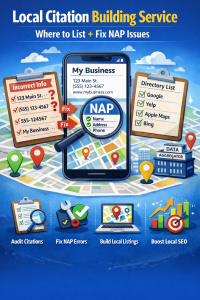
 If your business information is inconsistent across the web—an old address on one site, a wrong phone number on another—Google and customers get conflicting signals. That confusion can lead to lower local visibility, fewer calls, and lost leads.
That’s where local citation building comes in.
In this guide, you’ll learn:
- What local citations are and why they matter
- Where to list your business (the platforms that actually count)
- How to audit and fix NAP issues step-by-step
- When it makes sense to hire a local citation building service
What Are Local Citations?
A local citation is any online mention of your business’s details—usually your Name, Address, and Phone number (NAP)—often alongside your website, hours, categories, and photos.
Citations can appear in:
- Business directories
- Review sites
- Social platforms
- Map apps
- Local blogs, news articles, and chamber websites
Structured vs. Unstructured Citations
Structured citations are listings with standardized fields (like a directory profile).
Unstructured citations are mentioned in articles or pages (like a local news site listing sponsors), where your business info appears in the content.
Both can help—but structured citations are usually the starting point for citation building and cleanup.
Why Citations Matter for Local SEO
Local citations help reinforce trust and consistency. When reputable sites confirm the same business details, it’s easier for search engines to validate your location and legitimacy.
Citations also help real customers:
- Find your correct phone number
- Navigate to the right address
- Confirm your hours
- Compare you to competitors
Bottom line: citations are foundational local SEO. They won’t replace great on-page SEO or reviews, but they remove friction and strengthen your local presence.
What Is NAP (and Why NAP Issues Hurt Rankings)?
NAP stands for:
- Name
- Address
- Phone number
NAP issues usually happen after:
- A business move
- Rebrands or naming changes
- Changing phone providers or using call tracking incorrectly
- Duplicate listings created by data sources or users
- Past agencies submitting inconsistent info
Common NAP inconsistencies
Some small formatting differences are usually fine (like “St.” vs “Street”). The real problems are:
- Wrong phone number
- Wrong address (or missing suite/unit)
- Different business names across platforms
- Duplicate listings with conflicting info
If Google and customers can’t confidently match your citations, your local visibility can suffer.
Where to List Your Business for Citation Building (Priority Order)
Not all directories are worth your time. The goal is accuracy + quality, not “as many listings as possible.”
Tier 1: Must-Have Listings (Start Here)
These platforms are the non-negotiables for most local businesses:
- Google Business Profile
- Apple Maps (Apple Business Connect)
- Bing Places
- Facebook Business Page
- Yelp (market-dependent, but often important)
- Top industry review sites (varies by niche)
These are often the first places customers search—and they’re also the biggest sources of citation “spillover” into smaller directories.
Tier 2: High-Authority Directories & Data Sources
After the core listings are correct, expand into reputable general directories and major data sources that influence the broader local ecosystem.
These often include well-known directory networks and business data providers. If your business has widespread inconsistencies, fixing key data sources early helps prevent old info from reappearing elsewhere.
Tier 3: Niche + Local Citations (Underrated but Powerful)
These citations build relevance and local trust:
- Chamber of Commerce listing
- Local business associations
- Sponsor pages (events, schools, charities)
- Local newspapers and blogs
- Industry-specific directories (your niche matters here)
These listings can send strong “local relevance” signals—and they can also drive real referral traffic.
How to Fix NAP Issues (Step-by-Step Citation Cleanup)
If you want results, the order matters. Here’s the process that avoids “fixing the same problem twice.”
Step 1: Lock in Your Canonical NAP
Before you touch anything, decide the one true version of your business info:
- Business Name (exact)
- Address (exact formatting, including suite/unit)
- Phone number (main business line)
- Website URL (preferred HTTPS version)
- Hours
- Primary category + a few secondary categories
Tip: Be careful with call tracking numbers. If you use them, place them strategically (often on-site only) so you don’t create widespread NAP inconsistency.
Step 2: Run a Citation Audit (Find What Exists)
Track down every place your business appears:
Search Google for:
- “Business Name” + “Phone Number”
- “Business Name” + “Address”
- Old addresses and old phone numbers
- Variations of your business name
Then build a simple sheet with:
- Site/Directory name
- Listing URL
- Current NAP shown
- Claimed? (Yes/No)
- Need an update? (Yes/No)
- Duplicate? (Yes/No)
Step 3: Fix Your Core Profiles First
Correct your Tier 1 listings first (Google, Apple, Bing, Facebook, Yelp). These are the most visible and often the most copied by other sites.
Step 4: Handle Duplicates (Don’t Ignore Them)
Duplicates are a major citation killer. They split trust and cause customers to land on the wrong listing.
For each duplicate:
- Request removal/merge (if the platform supports it)
- If removal isn’t possible, mark it as moved/closed (when available)
- Ensure only one “primary” listing remains accurate
Step 5: Update Remaining Listings by Priority
After core listings and duplicates are handled, work through the rest of your audit list from highest authority to lowest.
Focus on:
- Wrong address or suite
- Wrong phone
- Wrong business name
- Wrong category
- Outdated hours/website
Step 6: Build New Citations (Only After Cleanup)
Once your NAP is consistent, start building missing citations on:
- Reputable general directories
- Strong niche directories
- Local organizations and community sites
This is where citation building turns into growth instead of damage control.
Step 7: Monitor and Maintain
Citations can drift over time—especially if your business:
- Moves
- Adds a second location
- Changes hours seasonally
- Updates phone systems
- Rebrands
A quarterly check helps prevent small issues from snowballing.
Mistakes to Avoid with Local Citation Building
- Building dozens of citations before fixing NAP issues
- Using different phone numbers across major listings
- Keyword-stuffing the business name (can backfire)
- Listing on low-quality spam directories
- Ignoring duplicates because “it’s close enough”
Accuracy and legitimacy beat volume every time.
DIY vs. Hiring a Local Citation Building Service
DIY is fine if:
- You have one location
- You’ve never moved or rebranded
- Your NAP is already consistent
- You only need a handful of core listings
A local citation building service is smarter if:
- You’ve moved, rebranded, or changed phone numbers
- You have duplicates across major platforms
- You’re multi-location
- You want a documented, scalable process
- You don’t want old data resurfacing later
How QBall Digital Helps
At QBall Digital, our citation work is built around two outcomes: NAP consistency and visibility where it matters.
Our citation workflow typically includes:
- Full citation audit + prioritization
- Cleanup of wrong NAP and duplicates
- Claiming/verification support where needed
- New citation building (core + niche + local)
- Reporting with live URLs and before/after tracking
- Optional monitoring to keep listings clean long-term
If you want a faster path to a consistent local presence, a citation audit is the best first step.
FAQ
Do local citations need to include a link to my website?
Not always. Many citations help simply by accurately mentioning your business information—even without a backlink.
Which directories should I start with?
Start with the major platforms your customers use most: Google Business Profile, Apple Maps, Bing Places, and your key review/social profiles.
Are citations enough to rank locally?
Citations are foundational, but most businesses also need strong on-page local SEO, reviews, and authority signals to compete—especially in competitive markets.
How long does citation cleanup take?
It depends on how widespread the inconsistencies are and how many duplicates exist. Some platforms update quickly, while others take longer or require verification steps.
Conclusion
Local citation building is one of the most practical ways to strengthen your local SEO—especially when you focus on NAP consistency, fix duplicates, and prioritize listings that customers (and search engines) trust.
If you’re dealing with messy listings, duplicates, or old addresses floating around, a local citation building service can save time and prevent costly mistakes.
Ready to clean up your citations? QBall Digital can start with an audit and map out the highest-impact fixes first.