
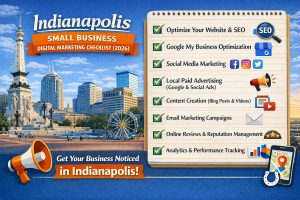
Intro:
Indianapolis is full of fast-growing small businesses—and fierce competition. In 2026, “doing marketing” isn’t enough. You need a measurable system that connects visibility → leads → revenue with clear priorities. This checklist is built to help Indianapolis business owners audit what’s working, fix what’s leaking, and build a strategy that scales.
Quick Checklist: What You’ll Build
- A 90-day marketing strategy tied to a single business goal
- Tracking and KPIs that measure revenue outcomes (not vanity metrics)
- A stronger Google Business Profile and local trust signals
- Local SEO pages that match buyer-intent searches
- A conversion-focused website that turns traffic into leads
- Content, social, email, and paid ads that support one plan
1) Strategy Foundation (Before Tactics)
Before you post, boost, or run ads, lock in the basics:
- Define your #1 business goal for the next 90 days (calls booked, quote requests, store visits, etc.)
- Choose one ideal customer segment (industry, location radius, price point, urgency)
- Write down:
- Top pains
- Top objections
- What “success” looks like to them
- Clarify your positioning: Why should someone choose you in Indianapolis?
- Decide your channel mix (SEO, PPC, social, email) based on how customers actually discover and compare businesses.
Pro tip: If your strategy can’t fit on one page, it’s probably too complicated to execute.
2) Measurement Setup (So You Don’t Waste Spend)
If you can’t measure it, you can’t improve it.
- Define your KPIs (and what counts as a real lead)
- Verify tracking:
- GA4 + Search Console
- Conversion events (forms, calls, bookings)
- Call tracking if phone leads matter
- Build a simple dashboard: Traffic source → Leads → Close rate
3) Local Presence: Google Business Profile + Trust Signals
For most Indianapolis small businesses, local visibility starts here.
- Optimize your Google Business Profile (categories, services, photos, Q&A, posts)
- Ensure NAP consistency (Name/Address/Phone) across directories
- Build a review system:
- Ask consistently
- Respond to every review
- Showcase testimonials on your website
4) Local SEO Plan (Rank for Buyer-Intent Searches)
Local SEO wins when pages match how people search.
- Group keywords by service + Indianapolis (and nearby areas)
- Create or improve:
- One strong service page per core offer
- Local landing pages only for areas you truly serve
- Fix technical basics:
- Site speed
- Indexing/crawl issues
- Title tags + internal linking
5) Website Conversion Checklist (Turn Traffic Into Leads)
Your website should feel like your best salesperson.
- Above the fold: clear offer + proof + CTA
- Mobile-first performance (most local searches are on phones)
- Simple lead capture:
- Short form
- Click-to-call
- Scheduling button
- FAQ section
- Add proof everywhere: reviews, case studies, before/after, logos
6) Content Plan That’s Actually Local (And Actually Useful)
A simple, repeatable plan beats random posting.
Build a 12-week calendar:
- 40% pain → solution posts
- 30% decision posts (cost, comparisons, “best X”)
- 20% proof content (case studies, results breakdowns)
- 10% community/local relevance (events, partnerships, neighborhoods)
7) Social Media: Pick Platforms Intentionally
Don’t spread yourself thin.
- Choose 1–2 primary platforms based on your buyers
- Weekly structure:
- 2–3 value posts
- 1 proof post
- 1 local/community post
- 3–5 short stories/reels (if relevant)
- Track what gets saves/shares and do more of it.
8) Email: Your Cheapest “Second Chance” Channel
Email turns interest into trust.
- Create a welcome series (3–5 emails) for new leads
- Send a monthly newsletter:
- One helpful tip
- One proof/story
- One CTA
- Segment by service interest when possible.
9) Paid Ads (PPC) That Don’t Burn Cash
Start where intent is highest.
- Begin with search + retargeting before broad awareness
- Use Indianapolis geo-targeting and service-based keywords
- Track ROI by calls/forms/bookings, not clicks.
10) If You’re B2B in Indy: Plan for Longer Decision Cycles
B2B decisions typically involve multiple stakeholders.
- Create content for owners/executives, operations, and finance
- Add trust accelerators:
- case studies
- testimonials
- comparison sheets
- “how it works” page
11) Operational Leverage in 2026: Automation + Follow-Up
Speed + consistency is a competitive advantage.
- Automate lead routing and appointment booking
- Standardize follow-up (texts/emails)
- Automate review requests after service delivery
12) 30-Day “Get It Moving” Plan
Week 1: KPIs + tracking + dashboard + GBP cleanup
Week 2: Fix top website conversion blockers + add proof
Week 3: Publish 2 service pages + 2 buyer-intent posts
Week 4: Launch one paid search campaign + retargeting + email welcome series
Where QBall Digital Fits
If you want a strategy-led approach, QBall Digital helps Indianapolis small businesses build measurable systems that connect local visibility + conversion + reporting—so marketing activity turns into revenue.
Want to know what’s holding your growth back? Book a strategy call with QBall Digital.
FAQ
What is the most important marketing channel for Indianapolis small businesses in 2026?
It depends on how customers discover and compare businesses, but most see the fastest impact from a mix of Google Business Profile + local SEO + conversion improvements, then add paid search for high-intent leads.
How long does local SEO take to work in Indianapolis?
You can often see early improvement in 4–8 weeks with GBP optimization, technical fixes, and better service pages, but competitive keywords typically take longer.
Do I need paid ads if I’m already ranking on Google?
Paid ads can still help you capture additional demand, protect your brand, and retarget visitors—but the goal is to track ROI and avoid paying for low-intent clicks.