

To properly audit a competitor’s marketing, review the public signals that show how they attract, persuade, and convert customers, then decide what to learn from, adapt, test, or avoid. A strong competitor marketing audit looks at positioning, ads, landing pages, SEO content, social media, reviews, offers, and calls to action. The goal is not to copy another brand’s voice, visuals, pricing, or funnel. The goal is to understand what may be working in the market, identify what competitors are missing, and build a smarter strategy that fits your audience, offer, budget, and brand.
The biggest mistake is assuming that visible marketing activity means profitable marketing activity. A competitor may be running many ads, publishing often, or ranking for several keywords, but that does not prove those tactics are generating qualified leads. A proper audit looks for patterns, context, and evidence before turning competitor activity into action.
What Should You Define Before Starting a Competitor Marketing Audit?
Before starting a competitor marketing audit, define the purpose of the audit, the business goal behind it, and the criteria you will use to judge competitor activity.
Without a clear goal, competitor research becomes a list of random observations. You may notice that a competitor has a bold homepage, active Google Ads, or a strong blog, but those details only matter if they connect to a business decision. For example, a PPC-focused audit should review ad messaging, landing page structure, offer clarity, and conversion paths. An SEO-focused audit should compare keyword visibility, topic coverage, content depth, and search intent.
You should also define your ideal customer before reviewing competitors. If your audience values transparency, measurable ROI, and practical execution, then a competitor’s flashy design or playful tone may not be relevant. The audit should help answer one main question: “What should we do differently because of what we learned?”
Which Competitors Should You Compare Against Your Business?
You should compare direct competitors, indirect competitors, SERP competitors, and paid search competitors because each one reveals a different opportunity or threat.
Direct competitors sell a similar service to a similar audience. Indirect competitors solve the same customer problem in a different way. SERP competitors are websites ranking for the same search terms, even if they are not direct business competitors. Paid search competitors are brands bidding on similar commercial-intent keywords.
For most businesses, three to five competitors are enough for a focused audit. Include a mix of direct competitors, search competitors, and one aspirational brand if useful. Be careful with aspirational competitors, though. A company with a larger budget, stronger brand awareness, or different sales process may use tactics that do not fit your business.
What Marketing Signals Should You Audit First?
Start with the marketing signals that influence attention, trust, and conversion: positioning, messaging, offers, ads, landing pages, SEO content, social proof, and customer journey.
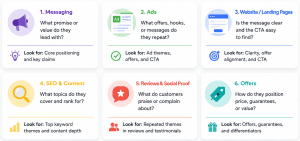
Review each competitor’s homepage headline, service pages, CTAs, and repeated claims. Are they positioning themselves around price, speed, quality, specialization, convenience, or measurable growth? If every competitor says the same thing, that may reveal either a market expectation or an opportunity to stand out with a clearer message.
For PPC, study ad headlines, descriptions, offers, sitelinks, and landing page alignment. A strong ad is only useful if the landing page supports the same promise and gives the visitor a clear next step. For SEO, compare what topics competitors cover, how deeply they answer questions, and whether they use FAQs, comparison sections, visuals, or examples.
Reviews and testimonials are also valuable. They show the language customers use when describing problems, expectations, frustrations, and buying reasons. These insights can help improve your own messaging without copying a competitor’s copy.
How Can You Tell Whether a Competitor’s Tactic Is Actually Working?
A competitor tactic may be worth studying when you see repeated use, strong visibility, relevant engagement, keyword rankings, or clear alignment between message, offer, and buyer intent.
One ad, post, or landing page does not prove success. The competitor may simply be testing something. Look for repeated patterns instead. If the same offer appears across ads, landing pages, service pages, and case studies, it may be central to their strategy.
In PPC, consistent ad messaging can suggest that a theme is worth testing, but you still cannot see the competitor’s actual conversion rate, cost per lead, or profit margin. In SEO, stronger signals may include high rankings, backlinks, content depth, and strong coverage across the buyer journey.
The key is to separate “interesting” from “actionable.” A competitor tactic is interesting when it catches your attention. It becomes actionable only when it fits your audience, your market, your offer, and your business goals.
What Should You Avoid Copying From a Competitor’s Marketing?
Avoid copying a competitor’s exact messaging, visual style, brand tone, pricing model, ad copy, funnel, or channel strategy without understanding why it works and whether it fits your business.
Copying can weaken differentiation. If your website sounds like every competitor’s website, buyers have no clear reason to choose you. It can also attract the wrong audience. A competitor’s low-price offer, aggressive CTA, or broad content strategy may work because their margins, operations, or sales process are completely different from yours.
Instead, copy the lesson, not the execution. If competitors use proof-heavy landing pages, the lesson may be that buyers need more reassurance. Your execution could be stronger case studies, clearer results, or more specific reporting examples. If competitors focus on affordability, the lesson may be that price sensitivity exists. Your response could be better ROI framing instead of lowering your price.
How Do You Turn Competitor Insights Into Better Positioning?
Turn competitor insights into better positioning by identifying what competitors overuse, what buyers still need, and what your brand can credibly own.
Start by mapping competitor claims side by side. List their headlines, promises, CTAs, industries served, proof points, and recurring themes. You may notice that many competitors use broad claims like “data-driven,” “results-focused,” or “full-service.” These may be true, but if everyone says them, they do not create strong differentiation.
QBall Digital can use competitor insights to find clearer positioning. For example, if competitors focus on general marketing services, QBall Digital can emphasize campaign accountability, PPC efficiency, transparent reporting, and strategy tied to measurable business outcomes. Strong positioning should be relevant to the buyer, credible for the business, and distinct enough to make comparison easier.
How Can You Find SEO, Content, and SERP Gaps Competitors Are Missing?
You can find SEO and content gaps by comparing competitor keywords, ranking pages, content formats, funnel coverage, and search result features against your own website.
| Content Opportunity | Competitor A | Competitor B | Competitor C | Your Website |
|---|---|---|---|---|
| Campaign audit page | ✅ | ❌ | ✅ | ❌ |
| Competitor ad analysis | ✅ | ✅ | ❌ | ❌ |
| Landing page optimization | ❌ | ✅ | ✅ | ✅ |
| Case studies | ✅ | ❌ | ❌ | ❌ |
| PPC reporting content | ❌ | ✅ | ❌ | ✅ |
Start with topic gaps. These are subjects competitors cover that your site does not. Then look for keyword gaps, especially terms with buyer intent. For a PPC-focused business, useful gaps may include campaign audits, competitor ad analysis, landing page optimization, paid search strategy, conversion tracking, and marketing performance reporting.
Also review funnel gaps. Some competitors may publish many educational articles but lack decision-stage content such as comparison pages, case studies, service breakdowns, or audit checklists. Others may have strong service pages but weak blog content. Your opportunity is to create more complete, helpful content that supports buyers from early research to vendor selection.
What Tools Can Help You Audit Competitor Marketing Ethically?
Ethical competitor marketing audits use public tools and observable marketing signals. Useful sources include Google Search, Google Trends, Google Ads Transparency Center, Meta Ads Library, LinkedIn Ad Library, SEO platforms, review sites, competitor websites, newsletters, case studies, and public social media profiles.
The ethical boundary is simple: observe what is public, analyze it honestly, and avoid deceptive methods. Do not impersonate customers, misuse private information, or copy confidential materials. Competitor research should help you compete smarter, not compromise trust.
What Should a Final Competitor Audit Report Include?
A final competitor audit report should include an executive summary, competitor categories, channel-by-channel findings, positioning comparisons, PPC and landing page observations, SEO/content gaps, risks, and prioritized recommendations.
The most useful reports separate findings into four categories: adapt, avoid, test, and monitor. Adapt what fits your audience and goals. Avoid tactics that weaken your positioning or attract poor-fit leads. Test promising ideas with your own data. Monitor competitor changes that may affect your market.
FAQ
What is a competitor marketing audit?
A competitor marketing audit is a structured review of how competing brands attract and convert customers through public marketing channels such as ads, SEO, content, landing pages, social media, and reviews.
How many competitors should you include?
Most businesses should start with three to five competitors. This keeps the audit focused while still revealing useful patterns.
Is competitor research useful for PPC campaigns?
Yes. Competitor research can improve PPC messaging, offers, landing pages, and keyword strategy, as long as you do not copy ad copy or mislead users.
What is the biggest mistake in a competitor audit?
The biggest mistake is assuming that a visible tactic is a successful tactic. Competitor activity should inspire hypotheses, not automatic decisions.
Conclusion
A proper competitor marketing audit helps your business understand the market without losing its identity. It shows what competitors are saying, where they are visible, how they structure offers, and where buyers may still be underserved.
The goal is not to copy the competitor with the loudest ads or biggest content library. The goal is to identify useful lessons, avoid weak assumptions, and build a strategy that fits your customers, capabilities, and growth goals.
Why QBall Digital is Your Ideal Choice for Competitor Marketing Audit?
QBall Digital helps businesses turn competitor research into practical marketing decisions. Instead of focusing on surface-level observations, we review the signals that influence buyer behavior, including PPC messaging, landing pages, search intent, conversion paths, content gaps, and positioning.
Our approach helps you decide what to adapt, avoid, test, or monitor. With QBall Digital, your competitor marketing audit becomes more than research—it becomes a clear action plan for better campaigns, stronger positioning, and smarter growth.
Build a Smarter Competitor Marketing Audit With QBall Digital
Ready to understand your competitors without copying the wrong things? Partner with QBall Digital to uncover market gaps, improve your PPC and content strategy, and compete with clarity and confidence.