

You plan a marketing budget by defining your business goals, estimating how many leads or customers you need, choosing the channels most likely to reach them, assigning realistic costs to each activity, and tracking performance so you can adjust spending based on ROI. For small businesses, the smartest approach is not to copy a generic percentage of revenue. It is to build a budget around what the business can afford, what growth realistically costs, and which campaigns can prove their value.
That is why small business marketing budget planning should start with business outcomes, not marketing wish lists. A budget should answer practical questions: How much revenue are we trying to generate? How many customers do we need? What can we afford to spend to acquire each customer? Which channels are already working? Which ones need testing?
Recent industry research shows why this discipline matters. Gartner reported that 2025 marketing budgets remained flat at 7.7% of company revenue, while 59% of CMOs said they lacked enough budget to execute their strategies. The CMO Survey’s 2026 report found that marketing budgets represented 9.0% of company revenues and 9.6% of overall company budgets, their lowest budget share since 2021. Those figures are useful benchmarks, but small businesses need a more grounded plan that protects cash flow and keeps spending tied to measurable results.
What Is a Marketing Budget?
A marketing budget is a plan for how much money your business will spend on marketing over a specific period, usually monthly, quarterly, or annually. It includes the costs required to attract, convert, and retain customers, such as paid advertising, SEO, content, email marketing, website improvements, creative production, software, agency support, and reporting tools.
A strong marketing budget is more than a spending limit. It is a decision-making tool that connects marketing activity to revenue goals, lead targets, profit margins, and business priorities. Without that connection, marketing spend can easily turn into a collection of disconnected tactics: a little money for ads, a little for social media, a new landing page, a few email tools, and no clear way to know what worked.
For a small business, the budget should also act as a cash-flow guardrail. Marketing can drive growth, but it still competes with payroll, inventory, rent, operations, taxes, and other expenses. The goal is not to spend as little as possible. The goal is to spend intentionally enough to create momentum without putting the business under unnecessary financial pressure.
Why Does Marketing Budget Planning Matter for Small Businesses?
Marketing budget planning matters for small businesses because every dollar needs a clear job. Larger companies may have room for brand campaigns, long testing cycles, and expensive tools. Small businesses usually need a tighter connection between spend and outcomes, especially when cash flow is limited or sales cycles are unpredictable.
A good budget helps prevent random spending. Instead of saying yes to every marketing opportunity, the business can prioritize the channels most likely to support near-term revenue, long-term visibility, or customer retention. This makes decisions easier when choosing between PPC, SEO, email, social media, content, events, referrals, or website improvements.
Planning also makes performance conversations more honest. If a campaign was given too little budget to gather meaningful data, the business should know that. If a campaign spent enough but produced poor-quality leads, that should be visible too. A budget gives owners and marketers a shared framework for deciding what to pause, what to improve, and what to scale.
The U.S. Small Business Administration frames marketing as an investment that helps businesses reach new potential customers and drive sales, not simply as an expense to cut whenever margins feel tight. That perspective is important because underinvesting can hurt future pipeline, while careless overspending can strain operations. Smart planning sits between those extremes.
How Much Should a Small Business Spend on Marketing?
A small business should spend what it can afford to invest consistently while still protecting operations, cash flow, and profitability. Percentage benchmarks can provide context, but they should not replace goal-based planning. A business trying to maintain steady local visibility will not need the same budget as a new company trying to break into a crowded market.
One common method is the percentage-of-revenue approach. In this model, the business allocates a set percentage of revenue to marketing. This is simple and easy to communicate, but it has a weakness: it can underfund growth when revenue is low. A new or recovering business may need marketing most when revenue is not yet strong enough to support a comfortable percentage-based budget.
A stronger method for many small businesses is the objective-and-task approach. Start with the goal, define the work required to reach that goal, then estimate the cost. For example, if the goal is to generate more booked consultations, the budget may need to include Google Ads spend, landing page improvements, call tracking, conversion tracking, and campaign management.
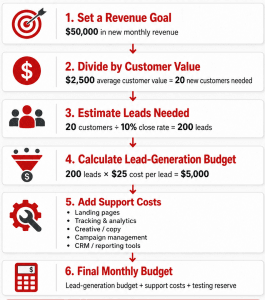
A funnel-based method makes the budget even more practical. Suppose you need 20 new customers, your lead-to-customer conversion rate is 10%, and your expected cost per lead is $25. You would need roughly 200 leads, which creates an estimated lead-generation budget of $5,000. The math will not be perfect, but it forces the budget to connect to customer acquisition rather than guesswork.
How Do You Plan a Marketing Budget Step by Step?
You plan a marketing budget step by step by starting with the business goal, working backward into lead or customer requirements, selecting the right channels, estimating costs, and reviewing performance regularly. This keeps the budget connected to business reality instead of becoming a static spreadsheet.
Step 1: Define Your Business Goal
Start by deciding what the business needs marketing to accomplish. That goal might be more phone calls, more form submissions, booked appointments, ecommerce purchases, local visibility, newsletter growth, repeat purchases, or stronger brand awareness. The more specific the goal, the easier it is to build a realistic budget around it.
A goal like “get more leads” is too vague. A better goal is “generate 60 qualified consultation requests per month at a cost per lead we can afford.” That type of goal gives the budget a measurable purpose and makes it easier to evaluate campaign performance later.
Step 2: Identify the Revenue Target
Connect the marketing goal to a revenue target. If the business wants $50,000 in new monthly revenue and the average customer is worth $2,500, the business needs about 20 new customers. From there, you can estimate how many leads, calls, or appointments are required based on the sales team’s close rate.
This step is where profit margin matters. A company with high margins may be able to afford a higher cost per acquisition. A lower-margin business needs tighter controls because each new customer leaves less room for marketing cost, fulfillment cost, and overhead.
Step 3: Work Backward From Leads or Customers
Once the revenue target is clear, work backward through the funnel. Estimate how many leads are needed, how many website visitors or ad clicks may be required, and what conversion rates are realistic. For newer campaigns, use conservative assumptions until real performance data is available.
For example, a business that needs 30 customers and closes 15% of qualified leads will need about 200 qualified leads. If the landing page converts 8% of visitors into leads, the campaign may need around 2,500 targeted visitors. This type of planning helps prevent budgets from being set too low to reach the desired outcome.
Step 4: Choose the Most Relevant Channels
Choose channels based on where your customers are, how they search, and how quickly you need results. PPC can be useful when buyers are already searching for your service and the business needs measurable demand capture. SEO and content can build compounding visibility over time. Email can support retention, referrals, and repeat purchases. Social media can support awareness, trust, and community engagement.
A small business does not need to be everywhere. In many cases, a focused budget across two or three high-priority channels performs better than a thin budget spread across six or seven platforms.
Step 5: Estimate Channel Costs
Estimate every cost needed to make each channel work. For PPC, include ad spend, landing pages, tracking, creative, copywriting, and campaign management. For SEO, include technical improvements, content creation, keyword research, local SEO, and reporting. For email, include software, list growth, copywriting, design, and automation setup.
This is where many budgets fall short. Businesses often budget for the media spend but forget the assets that make the media spend convert. A Google Ads campaign with no conversion tracking and a weak landing page may spend money quickly without producing useful learning.
Step 6: Separate Fixed Costs From Variable Costs
Separate fixed costs from variable costs so the budget is easier to manage. Fixed costs may include software subscriptions, website hosting, analytics tools, agency retainers, or CRM fees. Variable costs may include ad spend, creative tests, seasonal campaigns, video production, freelance projects, or promotional pushes.
This distinction helps with cash-flow planning. If revenue slows, you may reduce variable spend temporarily while preserving core infrastructure such as tracking, CRM, website maintenance, and essential reporting.
Step 7: Build a Monthly Review Process
Review the budget monthly and evaluate strategy quarterly. Monthly reviews help catch overspending, underperformance, tracking issues, and pacing problems. Quarterly reviews allow enough time to judge larger patterns, especially for SEO, content, and campaigns with longer sales cycles.
Your review should compare planned spend, actual spend, leads, sales, cost per lead, cost per acquisition, conversion rate, and revenue. The purpose is not just to report numbers. The purpose is to make decisions: scale, pause, reallocate, test, or improve.
What Should Be Included in a Small Business Marketing Budget?
A small business marketing budget should include every cost required to attract, convert, and retain customers. That means the budget should cover both visible campaign costs and the behind-the-scenes costs that help campaigns perform.
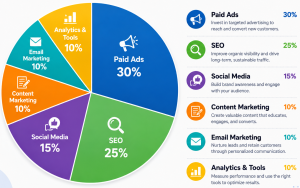
Paid advertising is often one of the clearest categories. This may include Google Ads, Meta Ads, LinkedIn Ads, Local Services Ads, retargeting, display advertising, YouTube ads, or sponsored content. For PPC campaigns, the budget should separate media spend from management, landing page work, creative, and tracking setup.
SEO and content should also have a defined line item. This can include blog writing, service pages, local landing pages, technical SEO fixes, keyword research, internal linking, and content updates. Even if SEO does not require media spend, it still requires time, expertise, and production resources.
Website and conversion assets belong in the budget because traffic only matters if visitors take action. Landing pages, contact forms, booking tools, call tracking, analytics setup, page-speed improvements, and UX changes can all influence campaign ROI. Google Ads conversion measurement, for example, allows businesses to define valuable actions such as purchases, sign-ups, or phone calls and see which ads, keywords, and campaigns drive those actions.
Creative and production costs should not be treated as afterthoughts. Ad graphics, videos, copywriting, photography, email design, and landing page copy can affect click-through rates, conversion rates, and lead quality. Marketing tools also need a place in the budget, including CRM software, email platforms, analytics dashboards, scheduling tools, and reporting systems.
Finally, include agency, freelancer, or consultant fees, plus a testing and contingency reserve. A modest reserve gives the business room to test a new offer, respond to seasonal demand, refresh creative, or support a campaign that starts outperforming expectations.
How Should You Allocate a Marketing Budget Across Channels?
You should allocate a marketing budget based on business goals, customer behavior, channel performance, and how quickly each channel can produce measurable results. The best allocation is not always the one that looks most balanced. It is the one that gives the business the best chance to reach its goals with the least unnecessary waste.
A useful framework is to divide spending into core revenue drivers, growth channels, and experimental channels. Core revenue drivers are the channels already connected to leads or sales. Growth channels show promise but may need more time or optimization. Experimental channels are smaller tests that may become future growth opportunities.
For example, a local service business may allocate most of its near-term budget to Google Ads, local SEO, and conversion-focused landing pages because those channels capture people already looking for help. A B2B service provider may prioritize LinkedIn, SEO, email nurturing, and retargeting because buyers need more education before they convert. An ecommerce business may focus more heavily on shopping campaigns, remarketing, email flows, and product-page optimization.
The 70/20/10 concept can be helpful, but it should not be applied mechanically. A small business might put roughly 70% of spend into proven channels, 20% into promising growth opportunities, and 10% into experiments. The exact split should depend on the company’s risk tolerance, sales cycle, available data, and cash position.
How Do You Build a PPC Budget Without Wasting Money?
You build a PPC budget without wasting money by setting a clear monthly spend limit, dividing that spend into campaign-level daily budgets, tracking meaningful conversions, and reallocating budget away from campaigns that do not produce qualified leads or sales. PPC gives small businesses speed and visibility, but it can also waste money quickly when goals, tracking, targeting, and landing pages are weak.
Google Ads uses average daily budgets, and the monthly spending limit is calculated by multiplying the average daily budget by 30.4, the average number of days in a month. Google notes that spend may be lower on some days and higher on others depending on opportunity, but advertisers will not be billed more than the monthly spending limit for a campaign.
Start with one clear campaign goal. If the business needs booked consultations, optimize around consultation requests, qualified phone calls, or appointment bookings instead of broad website traffic. If the business sells products online, optimize around purchases, revenue, and return on ad spend. Google’s Keyword Planner can help advertisers research keywords and view search and cost estimates, which can make early PPC budgeting more realistic.
Structure the account so the budget is easier to control. Separate branded search, non-branded search, remarketing, and experimental campaigns when the budget allows. This prevents one campaign type from hiding the performance of another. Branded campaigns may produce cheaper conversions, while non-branded campaigns often reveal the real cost of acquiring new demand.
The biggest PPC budget mistake is spending before tracking is reliable. Track form submissions, calls, purchases, booked appointments, and other valuable actions. Google Ads conversion measurement is designed to show which campaigns, keywords, and ads drive valuable customer actions, while phone call conversion tracking helps businesses understand when ads lead to calls.
Do not spread a small PPC budget across too many campaigns. A $1,500 monthly ad budget split across five campaigns may not give any campaign enough data to optimize. A more disciplined approach is to focus on the highest-intent campaign first, prove the offer and landing page, then expand gradually.
How Do You Know Whether Your Marketing Budget Is Working?
Your marketing budget is working when it produces measurable progress toward business goals at a cost the business can sustain. That does not always mean every channel must produce immediate revenue, but each channel should have a clear role and a clear way to evaluate performance.
For PPC, the most important metrics often include cost per lead, cost per acquisition, conversion rate, return on ad spend, impression share, and lead quality. For SEO and content, useful metrics may include organic traffic, keyword visibility, qualified leads, assisted conversions, and growth in high-intent landing page visits. For email, focus on revenue, booked calls, repeat purchases, engagement, list growth, and unsubscribe trends.
The budget should also be measured against sales outcomes, not just marketing platform numbers. A campaign that generates cheap leads may still be a poor investment if those leads do not become customers. A campaign with a higher cost per lead may be more profitable if the leads are qualified, close faster, and generate higher customer lifetime value.
Small businesses should not judge every channel on the same timeline. PPC can often generate useful performance data faster because spend, clicks, and conversions are visible quickly. SEO, content, reputation building, and brand awareness often take longer, but they can reduce dependence on paid traffic over time.
What Marketing Budget Mistakes Should Small Businesses Avoid?
The biggest marketing budget mistake small businesses should avoid is spending without a clear goal, tracking system, or decision rule for what gets scaled, paused, or improved. When the budget is not tied to measurable outcomes, marketing decisions become emotional and reactive.
Copying competitors is another common mistake. A competitor may have different margins, a larger sales team, stronger brand awareness, better website conversion rates, or a longer runway. Their channel mix may look attractive from the outside, but it may not fit your audience, offer, or cash flow.
Spreading the budget too thin is especially risky. Many small businesses try to run Google Ads, SEO, social media, email, influencer campaigns, and events all at once. That can create activity without impact. Focus usually produces better learning because each channel receives enough attention and budget to be evaluated fairly.
Ignoring tracking setup is equally damaging. Without conversion tracking, call tracking, CRM notes, or revenue attribution, it is difficult to know whether marketing is producing real business value. Google Analytics allows businesses to mark important events as key events, and those events can be used for campaign measurement when connected to Google Ads.
Small businesses should also avoid cutting marketing too quickly when sales slow. Some cuts may be necessary, but eliminating all marketing can reduce future pipeline and make the next recovery harder. The better approach is to reduce waste first, protect proven revenue drivers, and pause weaker experiments before cutting the channels most closely tied to customers.
When Should You Increase, Reduce, or Reallocate Your Marketing Budget?
You should increase your marketing budget when a channel is profitable, measurable, and scalable. You should reduce it when spend threatens cash flow or produces poor-quality results. You should reallocate it when another channel or campaign shows stronger potential.
Increase spend when cost per acquisition is profitable, lead quality is strong, conversion rates are stable, and the sales team can handle more volume. In PPC, that may mean a campaign is consistently generating customers below your target acquisition cost. In SEO, it may mean high-intent content is generating qualified organic leads and deserves more investment.
Reduce spend when campaigns lack tracking, acquisition costs exceed customer value, or leads are not converting into real opportunities. Reducing spend does not always mean abandoning a channel. Sometimes it means pausing low-performing ad groups, tightening keyword targeting, improving the landing page, or shifting budget from awareness campaigns into higher-intent campaigns.
Reallocate spend when one channel has reached diminishing returns and another has clearer upside. For example, a business may move money from broad social ads into retargeting, from low-quality display placements into search, or from generic blog content into service pages that match buyer intent. The key is to make budget changes based on evidence, not frustration.
Budget planning should stay flexible because markets change. Customer demand shifts, ad costs fluctuate, competitors increase spend, and seasonal patterns affect performance. A smarter budget gives the business room to adapt without losing discipline.
FAQ
What is the first step in planning a marketing budget?
The first step in planning a marketing budget is defining the business goal. Before choosing channels or assigning dollars, decide what marketing needs to accomplish: more calls, more leads, more purchases, more booked appointments, stronger local visibility, or higher customer retention. Once the goal is clear, you can estimate the budget needed to support it.
What percentage of revenue should a small business spend on marketing?
A small business should use revenue percentages as a benchmark, not a rule. Gartner reported 2025 marketing budgets at 7.7% of company revenue, while The CMO Survey’s 2026 report placed marketing budgets at 9.0% of company revenues. Your actual number should depend on cash flow, margins, business stage, growth goals, and the cost of acquiring customers in your market.
What is the difference between a marketing budget and an advertising budget?
A marketing budget includes all costs related to attracting, converting, and retaining customers. An advertising budget is only one part of that total and usually refers to paid media spend, such as Google Ads, Meta Ads, LinkedIn Ads, display ads, or sponsored placements. Marketing budgets may also include SEO, content, software, website work, creative production, agency fees, and analytics.
How often should a small business review its marketing budget?
A small business should review marketing spend monthly and evaluate strategy quarterly. Monthly reviews help catch overspending, tracking problems, and campaign pacing issues. Quarterly reviews provide a better view of performance trends, especially for SEO, content, and longer sales cycles.
Should small businesses spend more on PPC or SEO?
Small businesses should spend more on PPC when they need faster demand capture and measurable lead flow, and more on SEO when they want to build long-term visibility and reduce dependence on paid traffic. Many businesses benefit from using both. PPC can produce faster learning, while SEO and content can create compounding returns over time.
How do you track marketing budget ROI?
You track marketing budget ROI by comparing marketing spend to the revenue, qualified leads, customers, or pipeline generated from that spend. For PPC, track conversions such as purchases, form submissions, phone calls, and booked appointments. For broader marketing, connect analytics data with CRM and sales data so you can see which channels create real business outcomes.
Conclusion
A smarter marketing budget starts with goals, not guesses. Small businesses need to know what they are trying to achieve, how many customers or leads are required, what those customers are worth, and which channels can realistically help them get there. Benchmarks are useful, but they cannot replace a budget built around cash flow, margins, customer behavior, and measurable performance.
The best budget is not always the biggest one. It is the one that helps the business spend confidently, learn faster, and turn limited resources into growth. When every dollar counts, marketing budget planning should help you focus on what works, stop funding what does not, and keep improving your decisions month after month.
Why QBall Digital Is Your Ideal Choice for Small Business Marketing Budget Planning?
QBall Digital helps small businesses turn marketing budgets into practical growth plans instead of static spreadsheets. The team focuses on aligning campaign spend with business goals, lead quality, conversion tracking, and measurable ROI. That means your budget is built around what your business actually needs: better visibility, stronger leads, cleaner reporting, and more confident decision-making.
For PPC-focused businesses, QBall Digital brings the discipline needed to reduce wasted spend and improve campaign performance. From campaign structure and keyword planning to landing page strategy and conversion tracking, the goal is to make every dollar easier to measure and easier to justify. QBall Digital also helps businesses balance short-term lead generation with long-term digital growth through SEO, content, and smarter channel allocation.
Plan a Smarter Marketing Budget With QBall Digital
Ready to make your marketing budget work harder? QBall Digital can help you build a practical, ROI-focused plan that supports your goals, protects your cash flow, and gives you a clearer path to better campaign performance.