
If you run a local business, you have probably noticed a frustrating pattern: nearly every competitor claims to offer “quality service,” “experienced professionals,” “affordable pricing,” and “customer satisfaction.” The problem is not that those things are bad. The problem is that they are too common to help a buyer choose. A unique value proposition exists to answer a simpler and more important question: why should someone choose you instead of the other nearby options? Competitor guidance from Chamber Plan, Patriot Software, WooCommerce, and Crowdspring all points back to the same core idea: a strong value proposition connects audience, problem, benefit, and difference in a concise statement.
For a local business, that matters even more because your prospects are usually comparing you against similar providers in the same market. They are not evaluating you in isolation. They are deciding between businesses that often sell nearly identical services, operate in the same geography, and use nearly identical language. That is why positioning matters. When competitors all sound the same, the business that clearly expresses a specific, credible advantage is easier to trust, easier to remember, and easier to choose. Harvard’s strategy framework reinforces this by tying value proposition to three decisions: which customers you serve, which needs you meet, and what relative price supports that choice.
What is a Unique Value Proposition for a Local Business?
A unique value proposition for a local business is a clear statement that explains who you help, what result you deliver, and why someone should choose you over nearby alternatives. Patriot Software describes a UVP as a statement that tells customers what you offer, what problem you solve, and how you are different. Chamber Plan similarly frames it as a concise summary of what your business is, how it works, why it matters, and why it is better than the rest.
That means a UVP is not just branding filler for the top of a homepage. It is the clearest expression of your market position. It should help a visitor understand your relevance within seconds. WooCommerce notes that for smaller businesses, a value proposition can be one of the first and most important marketing messages a prospect sees, especially when they are deciding whether your business can solve their problem.
It is also important to separate a UVP from related terms. Crowdspring explains that a mission statement reflects broader organizational goals, while a UVP is product- or service-oriented. A tagline is a short brand phrase, but it is not the same thing as a value proposition. In practice, your UVP should be clearer and more explanatory than a slogan.
Why Do So Many Local Businesses Sound the Same?
Local businesses sound the same because they often describe themselves with category language instead of customer language. Chamber Plan explicitly warns against non-specific claims like “best product” or “best customer service,” because those statements are common and easy to imitate. When everyone reaches for the same adjectives, every homepage starts to blur together.
This happens for a few reasons. First, many businesses write from the inside out. They talk about what they want to say about themselves rather than what a customer is trying to achieve. Second, they choose safe, broad claims because they worry specificity will narrow their audience. Third, they confuse familiarity with effectiveness, so they copy the phrases they see across competitor sites. The result is messaging that sounds professional but does not create preference. WooCommerce’s guidance pushes the opposite approach: focus on benefits, outcomes, and the needs or wants that brought the customer to you in the first place.
Sameness also creates a commercial problem. If your message does not make a meaningful difference clear, buyers fall back on easier comparison points like price, proximity, or first impression. WooCommerce notes that a strong value proposition can reduce price resistance by shifting attention from cheapness to the outcomes you deliver. That is especially useful for local businesses that want to avoid a race to the bottom.
What Makes a Unique Value Proposition Actually Feel Unique?
A UVP feels unique when it is specific enough that a prospect can tell it was written for someone like them, about a problem they care about, with a reason to believe you can solve it better. Patriot’s structure is a good foundation here: benefits, the problem solved, and how your business is different. Harvard’s framework adds another useful lens by forcing you to choose the customer segment and the need you will serve.
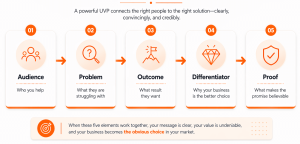
In practical terms, most effective UVPs contain five ingredients. They identify the audience, clarify the pain point, promise an outcome, name a differentiator, and imply or include proof. Without that last part, many UVPs sound polished but fragile. CXL’s examples repeatedly show that the strongest propositions are backed by substance, whether that is a warranty, a distinctive operating model, or a demonstrable product advantage.
This is why “we provide quality service” rarely works. It names no audience, no problem, no specific result, and no distinctive reason to choose you. By contrast, a value proposition like “same-day plumbing repairs with upfront pricing and text updates from arrival to completion” feels more believable because it translates abstract quality into a customer experience that is easier to picture and harder to copy persuasively. That kind of specificity is what makes a UVP feel real.
How Can You Find Real Differentiators When Competitors Offer Similar Services?
You find real differentiators by looking beyond the service category and into the decision criteria buyers actually use. Chamber Plan recommends identifying your target audience, studying competitors, and focusing on the pain points your business alleviates. WooCommerce adds that businesses should clarify who they are selling to and what needs, fears, or concerns drive the purchase.
Start with competitors, but do not stop at their service lists. Review their homepage headlines, subheads, calls to action, guarantees, FAQs, and reviews. You are looking for repeated language and predictable claims. If five businesses all promise reliability, expertise, and fair pricing, that does not mean no one is differentiated. It means no one is expressing it clearly.
Next, mine your own customer feedback. WooCommerce specifically recommends reading customer reviews to see whether people repeat the benefits, outcomes, solutions, and emotions you think you deliver. This is one of the fastest ways to uncover language that is more persuasive than whatever your team would invent in a brainstorming session. Customers often describe your value more concretely than you do.
Then look at your operations. Real differentiation often hides in places businesses take for granted: shorter turnaround times, cleaner communication, clearer pricing, better onboarding, more specialized expertise, stronger follow-through, easier scheduling, or fewer surprises. These may not sound flashy internally, but they can be highly valuable externally because buyers care deeply about convenience, certainty, trust, and reduced friction.
Finally, ask a hard question: what do customers consistently appreciate that competitors are not emphasizing well? That is usually where positioning starts to sharpen. A strong UVP rarely comes from asking, “What sounds impressive?” It usually comes from asking, “What matters most in the buying decision, and where are we genuinely better?”
How Do You Turn Generic Claims Into a Strong Unique Value Proposition?
You turn generic claims into a stronger UVP by replacing adjectives with outcomes, mechanisms, and proof. Chamber Plan advises businesses to avoid popular, non-specific claims and identify features or pain-point solutions that others do not offer. That principle is simple, but the real work is in translation.
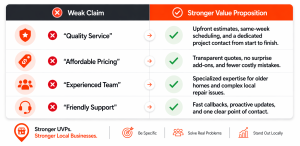
Take “quality service.” On its own, that phrase means almost nothing. To a customer, quality might mean faster appointments, cleaner work, fewer callbacks, more transparent pricing, or more responsive communication. Once you identify the operational reality behind the adjective, you can write something more persuasive. “Upfront estimates, same-week scheduling, and a dedicated project contact from start to finish” communicates a concrete experience. It also signals that your business has a repeatable way of delivering that experience.
The same applies to “affordable pricing.” Cheap is not always compelling, and WooCommerce explicitly warns against reducing the decision to price alone by showing how strong value propositions can reduce price resistance. A better version might emphasize lower total cost, fewer costly mistakes, transparent quotes, or a service model that avoids unnecessary add-ons.
“Experienced team” becomes stronger when it points to a niche, problem type, or environment. “Experienced in handling older homes with aging electrical systems” is more useful than “20 years of experience.” “Friendly service” becomes stronger when it describes a behavior, such as proactive updates, quick callbacks, or a named point of contact. The rule is simple: if a competitor can say the same thing without changing anything about their business, your message is still too generic.
How Do You Write a Unique Value Proposition for a Local Business Step by Step?
The most effective way to write a UVP is to move from strategy to wording in a disciplined order. Patriot suggests starting with three core parts: the benefit of choosing you, the problem you solve, and how you are different. Harvard’s framework reinforces the need to choose the customer and the need you will serve. Put together, those ideas create a practical process.
Begin by defining your ideal customer. Do not write for “everyone in the area.” Write for the segment most likely to value your strengths. Chamber Plan recommends building a clear picture of the target audience and their specific needs before trying to articulate a proposition.
Next, identify the most urgent problem or frustration that drives action. That problem might be cost uncertainty, poor communication, limited availability, lack of trust, slow turnaround, or fear of making the wrong choice. Then define the result the customer actually wants. Not the service itself, but the outcome: a fixed issue, a smoother project, a cleaner home, more predictable legal help, or a better-looking property without hassle.
After that, choose the differentiator that matters most in the buying decision. This is where many businesses go wrong. They lead with what is true rather than what is useful. Your differentiator should be something customers care about and that your business can credibly support. Then add a reason to believe. That could be a guarantee, review theme, process advantage, niche specialization, or proven result.
From there, write two layers. First, create a short headline version that captures the main promise. Second, write a supporting sentence that explains how you deliver it. For example:
Headline: Clear, same-day HVAC repairs without surprise pricing.
Support line: We diagnose quickly, quote upfront, and keep homeowners updated from first call to final fix.
That structure works because it is readable, specific, and benefit-led. Once you have a draft, test it against one brutal question: could three competitors use the same statement with minimal changes? If yes, tighten it again.
What Are the Best Unique Value Proposition Frameworks for Local Businesses?
Frameworks are useful because they force clarity, but they only help if the final message still sounds natural. Patriot and WooCommerce both support concise, benefit-oriented language over vague marketing hype.
A few simple frameworks work especially well for local businesses:
We help [audience] get [result] without [common frustration].
This is effective when customer pain is obvious. For example: “We help busy homeowners keep their homes spotless without juggling unreliable cleaners.”
For [audience] who need [outcome], we provide [service] with [differentiator].
This works well when your service process is a real advantage. Example: “For homeowners who need fast plumbing repairs, we provide same-day service with upfront pricing and live arrival updates.”
Unlike typical [category providers], we [distinct approach] so you can [specific benefit].
This is useful when the market is crowded and you need a contrast statement. Example: “Unlike typical agencies that lead with vanity metrics, we build local PPC campaigns around lead quality and revenue potential.”
These frameworks are not meant to remain in template form forever. Their job is to help you discover the sharpest version of your message. Once the logic is clear, refine the language until it sounds like your business rather than a worksheet.
What Are Good Examples of Unique Value Propositions for Local Businesses?
Examples matter because they show the difference between a technically correct statement and one that actually creates preference. CXL’s example-driven approach is valuable here because it shows that effective propositions are concise, audience-aware, and backed by a meaningful distinction.
A weak HVAC example might say: “Trusted HVAC services at affordable prices.”
A stronger version would say: “Same-day heating and cooling repairs with upfront pricing and no long service windows.”
The stronger version works because it addresses what customers often hate most: uncertainty, waiting, and surprise cost.
A weak dental example might say: “Compassionate dental care for the whole family.”
A stronger version would say: “Family dentistry with evening appointments, transparent treatment plans, and a calm experience for anxious patients.”
This version is more specific, more segment-aware, and more useful in a real comparison.
A weak law firm example might say: “Experienced legal guidance you can trust.”
A stronger version would say: “Family law guidance with direct attorney access, clear next steps, and responsive support during high-stress cases.”
That version shifts from abstract credibility to practical reassurance.
A weak home cleaning example might say: “Reliable house cleaning with excellent customer service.”
A stronger version would say: “Recurring home cleaning with consistent teams, online booking, and text updates before every visit.”
Again, the message moves from vague promise to distinct experience.
The pattern across all of these is the same: the better UVP describes an outcome and a delivery model, not just a flattering adjective.
Are You Confusing a Unique Value Proposition With a USP, Tagline, or Brand Statement?
Many businesses collapse these into one thing, but they serve different jobs. Crowdspring is clear that a mission statement is about organizational goals, while a UVP is about the value of a product or service. A tagline is usually shorter, more brand-oriented, and less explanatory.
A USP, or unique selling proposition, overlaps with a UVP but usually emphasizes the distinctive selling angle more directly. CXL’s examples show that strong USPs are often single-minded and memorable because they spotlight a differentiating promise. In practice, the distinction is less about strict terminology and more about function. Your UVP needs enough clarity to help someone quickly understand why choosing you makes sense.
On a website, the homepage headline may express your UVP, but it is not automatically the whole UVP. Often the headline carries the main promise, and the supporting line explains the differentiator or outcome. That layered structure tends to work better for local businesses because prospects are scanning fast and deciding even faster.
What Mistakes Make a Local Business Value Proposition Weak?
The most common mistake is trying to appeal to everyone. Crowdspring explicitly warns against trying to be the solution for everyone, noting that strong brands naturally exclude people who are not ideal customers. A diluted value proposition may sound safe, but it usually becomes forgettable.
Another mistake is leading with the business instead of the buyer. Statements like “We are a leading provider” or “We are committed to excellence” tell the customer very little about what they gain. WooCommerce’s guidance consistently pulls the focus back to benefits, outcomes, and feelings created by using the product or service.
A third mistake is using language without proof. CXL’s examples repeatedly show that a proposition becomes more persuasive when it is backed by substance. Without a real process, guarantee, specialization, or demonstrable advantage, even a well-written statement can feel hollow.
Finally, many local businesses lean too heavily on price. Price can be part of the equation, but it is rarely the most durable positioning. If your UVP amounts to “we cost less,” you are training the market to compare you on the easiest lever for competitors to challenge. Stronger positioning gives people a better reason to choose you.
How Do You Test Whether Your Unique Value Proposition Is Actually Working?
A UVP is not finished when it sounds good in a meeting. It is finished when customers understand it quickly and respond to it better than your old messaging. Chamber Plan recommends getting feedback and continuing to rework the statement until it is specific and clear. WooCommerce goes further by recommending A/B testing on web pages and even split-testing PPC ads that point to the same landing page.
A simple first test is the five-second test. Show the headline and supporting line to someone unfamiliar with your business and ask what you do, who it is for, and why it matters. If they cannot answer clearly, your message is still too vague.
Next, compare behavior. WooCommerce specifically notes that A/B tests can reveal whether one version results in more conversions, and that ad split tests can show which wording performs better in PPC. For a local business, that means measuring form fills, calls, booked appointments, lead quality, and even close rate after the messaging change.
Review data alongside real conversations. Are leads repeating the language from your UVP on sales calls? Are prospects saying, “That’s exactly what we need”? Are you attracting better-fit customers and fewer price-only shoppers? Those are often the clearest signs that your value proposition is becoming useful rather than decorative.
Where Should a Local Business Use Its Unique Value Proposition?
Your UVP should live anywhere a prospect makes a fast judgment about relevance. Chamber Plan advises displaying the value proposition prominently on your website and promotional materials. For local businesses, that should include more than the homepage.
The homepage hero is usually the first and most important placement because it sets the tone for the rest of the site. Service pages should then adapt the same positioning to the service-specific context. Landing pages for Google Ads or other paid traffic should use a tighter version that mirrors the intent of the ad. WooCommerce’s testing advice is especially useful here because paid landing pages are one of the best environments for validating messaging quickly.
You should also carry the UVP into proposals, sales decks, intake forms, email follow-ups, and appointment-confirmation flows. A good value proposition is not only a headline. It is a positioning backbone. The more consistently it appears in the moments where prospects decide whether to trust you, the more useful it becomes.
Can a Local Business Have More Than One Unique Value Proposition?
Yes, but most local businesses should start with one core value proposition and only create variants when their audiences or services differ in meaningful ways. WooCommerce notes that service-based companies often need just one company-wide unique value proposition, while businesses with very different product categories may need separate ones.
For a local business, that usually means one main brand-level UVP supported by service-level adaptations. A law firm, for example, might have one core proposition around accessibility and clarity, then tailor its wording for family law, estate planning, and business law pages. The same logic applies to home services, healthcare practices, and agencies.
The key is consistency. Your variants should feel like different expressions of the same market position, not unrelated messages stitched together across the site.
FAQ
How long should a unique value proposition be?
It should usually be short enough to understand quickly and strong enough to remember. Chamber Plan recommends getting to a concise statement, even suggesting a very short version as a goal during refinement. In practice, a strong homepage version is often a headline plus one supporting sentence.
Should a local business mention price in its value proposition?
Sometimes, but only if price is truly part of the advantage and you can frame it intelligently. WooCommerce notes that strong value propositions can reduce price resistance by shifting attention to outcomes. That means many businesses are better off emphasizing clarity, total value, or lower friction rather than simply claiming to be cheap.
What is the difference between a unique value proposition and a unique selling proposition?
They overlap heavily. A UVP usually explains the value a customer gets and why it matters, while a USP tends to emphasize the differentiating sales angle more directly. Crowdspring and CXL both help illustrate that these terms are related but not identical.
Can two local businesses have similar value propositions?
Yes, especially in crowded categories. The goal is not to invent a fantasy difference. The goal is to express your real strengths more clearly and more credibly than competitors. Chamber Plan’s guidance on competitive research and pain points supports this idea: differentiation comes from identifying what is genuinely distinct and relevant, not from sounding clever.
How often should a business update its value proposition?
You should revisit it when customer priorities shift, your service model changes, your best-fit audience evolves, or testing shows the message is no longer resonating. WooCommerce’s testing framework supports ongoing refinement rather than treating the UVP as static copy.
Where should a UVP appear on a local business website?
At minimum, it should appear prominently on the homepage and influence key service pages. Chamber Plan also recommends using it across promotional materials, which translates well to landing pages, proposals, and other conversion points.
Conclusion
Most local businesses do not lack value. They lack a clear way to express it. That is why so many competitors sound interchangeable even when the real customer experience is not the same. A strong unique value proposition solves that problem by making your audience, promise, and advantage easier to understand within seconds. It moves your business away from generic claims and toward a clearer reason to choose you.
The best UVPs are not built from slogans. They are built from customer insight, competitive contrast, operational truth, and testing. When your message reflects what buyers actually care about and what your business genuinely does better, positioning becomes easier across SEO, PPC, service pages, and sales conversations. That is when your value proposition stops being copy and starts becoming strategy.
Why QBall Digital is Your Ideal Choice for Local Business Positioning?
QBall Digital is built for the exact challenge this article addresses: helping local businesses stand out when the market is crowded with vague, repetitive messaging. A strong value proposition is not just a branding exercise. It shapes how prospects interpret your offer, how your landing pages convert, and how well your ads attract the right leads. QBall Digital helps turn hidden strengths into visible positioning so your business is easier to trust and easier to choose.
That matters because better positioning improves more than homepage copy. It can strengthen PPC performance, create tighter alignment between ad intent and landing page messaging, improve lead quality, and reduce dependence on price-driven comparisons. Instead of sounding like every other provider in the market, QBall Digital helps you define a clearer promise, communicate it more convincingly, and apply it across the channels that matter most to local growth.
Ready to Clarify What Makes QBall Digital Different?
If your business sounds too similar to competitors, the answer is not louder marketing. It is better positioning. QBall Digital can help you uncover what customers actually value, define a sharper unique value proposition, and translate that message into landing pages, service pages, and campaigns that convert.