
Many small businesses do solid work but struggle to explain that value in a way people instantly understand. Their website sounds vague, their ads feel interchangeable, and their sales conversations rely too much on improvisation. That is usually not a service problem. It is a messaging problem.
Brand messaging for small business is the language system that helps people quickly understand what you do, who you help, why it matters, and why they should believe you. When that language is clear and consistent, it supports everything else: your homepage, your service pages, your Google Ads, your emails, your proposals, and even the way customers talk about you to other people. The U.S. Small Business Administration frames market research and competitive analysis as the basis for finding customers and building a competitive advantage, while Google Ads emphasizes that ads and landing pages perform better when they are relevant, accurate, and aligned with user expectations.
What is brand messaging for small business?
Brand messaging for small business is the set of words and ideas you use to communicate your value clearly and consistently. It includes how you describe your audience, the problem you solve, the outcome you deliver, your differentiators, your proof points, and the tone you use to say it. It is bigger than a tagline and more practical than a broad brand mission on its own. HubSpot describes brand messaging as rooted in knowing your audience and unique value proposition, while Mailchimp’s messaging strategy guidance explains that messaging pillars help reinforce a core message across channels.
For a small business, good messaging acts like a shortcut for trust. It helps people answer a few key questions fast: “Is this for me?” “Do they understand my problem?” and “Why should I choose them instead of someone else?” That speed matters because people make quick judgments online. Nielsen Norman Group notes that users often leave web pages in 10–20 seconds, but pages with a clear value proposition can keep attention longer.
Why does brand messaging matter for small businesses?
Brand messaging matters because small businesses have less room for confusion. Larger brands can sometimes survive weak messaging with brand recognition, larger ad budgets, or sheer repetition. Small businesses usually cannot. They need the website, ad copy, and sales language to do more work, more quickly.
Clear messaging improves discoverability and conversion at the same time. Google Ads states that relevant and engaging ads are more likely to generate results, and that landing page experience is influenced by the usefulness and relevance of the information provided, along with whether the page matches what users expected after clicking. When your messaging is specific, you are not only easier to understand; you are also easier to match to buyer intent.
It also supports trust. Edelman’s 2025 Trust Barometer reports that business remains the most trusted institution among those measured globally. That does not mean every business is automatically trusted. It means buyers are open to trusting businesses that communicate credibly and act consistently. Forrester’s brand research similarly emphasizes that strong brands support awareness, engagement, and business value, and that consistent execution strengthens trust.
What makes small business messaging sound unclear or generic?
Small business messaging usually becomes weak for one of five reasons.
The first is trying to say everything at once. When a homepage attempts to mention every service, every audience, every value, and every aspiration in the first few lines, it often says nothing memorably. NN/g’s homepage guidance stresses that homepages should communicate the organization’s purpose clearly and guide users with precision.
The second is relying on claims that anyone could make. Phrases like “high quality,” “customer-focused,” “innovative,” or “we care” are not useless, but by themselves they are not differentiators. NN/g’s classic guidance on taglines says a strong tagline should explain what the company does and what makes it unique, and offers a useful test: if the same line could work for competitors, it is probably too generic.
The third is focusing too much on the business and not enough on the customer problem. Buyers usually care first about what is going wrong, what outcome they want, and whether you can help them get there. The SBA’s market research guidance is direct on this point: understanding customers and competitors is how a small business identifies its advantage.
The fourth is inconsistency. One page sounds premium, another sounds casual, ads promise speed, and the sales call emphasizes customization. Mailchimp distinguishes voice and tone by explaining that voice stays consistent while tone changes by context. Without that foundation, a small business often sounds like a different company from one touchpoint to the next.
The fifth is using polished language that hides practical meaning. A line may sound impressive internally but still fail the customer test: can someone quickly tell what you do, who it is for, and why it matters?
How do you create brand messaging for a small business?
Start with your audience. Be specific enough to be useful. “Small businesses” may be true, but it is rarely precise enough. “Owner-led local service businesses that rely on referrals and paid search” is more useful because it narrows the problem, the language, and the proof points you need.
Next, define the problem from the customer’s perspective. What is going wrong right now? Are they not getting leads? Are they attracting the wrong leads? Do prospects not understand their offer? Good messaging starts with a real friction point, not just a description of the service.
Then clarify your value proposition. NN/g describes a value proposition as a promise of the value users can expect to receive. In practical terms, this means finishing the sentence: “We help [audience] achieve [outcome] by [approach].”
After that, identify what makes your business meaningfully different. This is not about inventing a gimmick. It is about owning something real: specialization, process, speed, depth, geographic understanding, communication style, pricing model, or service experience. The SBA explicitly links competitive analysis with finding a competitive advantage.
Then define voice and tone. Mailchimp’s style guide offers a simple distinction: voice is the consistent personality of the brand, while tone shifts depending on situation and audience. A small business might keep a voice that is clear, confident, and helpful, while adjusting tone slightly for ads, proposals, or customer support.
Finally, turn strategy into usable messaging assets. That usually includes a primary positioning statement, a homepage headline, a short “what we do” sentence, three to five messaging pillars, proof points, brand descriptors, and sample copy for major channels.
What are the core elements of a strong brand messaging framework?
A useful small-business messaging framework does not need to be bloated. It should include the essentials.
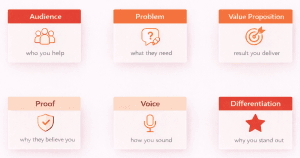
Your audience definition tells you who the message is for. Your problem statement identifies the pain, friction, or goal. Your value proposition explains the result you deliver. Your positioning clarifies how you fit in the market and what space you want to own. Your brand promise captures the standard customers can expect. Your voice and tone guidelines help maintain consistency. Your proof points give credibility. Your message pillars create repeatable themes that support the core message. Mailchimp’s messaging strategy resource specifically highlights messaging pillars as a way to keep communication aligned with the value proposition.
A simple version for a small business might look like this: who you help, what challenge they face, what outcome you deliver, why your approach is better, and what evidence supports the claim. That is often enough to sharpen a homepage, improve ad copy, and make sales conversations more consistent.
How can a small business sound clear in its messaging?
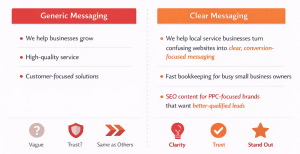
Clarity comes from specificity, structure, and plain language.
Specificity means replacing broad statements with concrete meaning. “We help brands grow” is broad. “We help service businesses turn unclear websites into conversion-focused messaging systems” is clearer because it names the audience, the issue, and the result. NN/g’s homepage research says effective homepages should communicate purpose and guide users with clarity and precision.
Structure means giving buyers the information in the order they need it. On a homepage, that often means starting with what you do, who it is for, and why it matters before moving into process, proof, and calls to action. Google Ads also stresses that landing pages should match the expectations created by the ad. If your ad promises one thing but the page opens with abstract branding language, clarity breaks immediately.
Plain language means saying the obvious thing first. Buyers do not reward businesses for being difficult to understand. They reward businesses that reduce friction. If a sentence needs translation inside your own team, it probably needs rewriting.
A good editing test is this: can a customer repeat your message back to someone else without rephrasing it for you?
How can a small business sound trusted in its messaging?
Trust grows when messaging feels believable, relevant, and supported.
One part of that is accuracy. Google Ads recommends that ads accurately describe what you offer. Trust drops when the promise is inflated or unclear, even if the copy sounds polished.
Another part is proof. Trustworthy messaging includes evidence such as testimonials, case studies, years of experience, certifications, client types, outcomes, or a transparent explanation of process. Edelman’s research shows that trust remains a major factor in how people relate to institutions and brands, which is why unsupported claims are not enough.
Consistency matters too. Forrester notes that trusted brands are built when brand messages align with achievable expectations and the delivered experience. In other words, your message should not promise a level of transformation, speed, or personalization that your operations cannot sustain.
The most trusted small-business messaging usually sounds calm, specific, and grounded. It does not try too hard. It demonstrates understanding and then backs up the promise.
How can a small business sound different without sounding gimmicky?
Differentiation works best when it is rooted in relevance, not theatrics.
Many businesses try to sound different by using unusual phrases, edgy tone, or bold claims. That can grab attention, but attention is not the same as fit. Real differentiation usually comes from one of a few places: a defined niche, a clearer process, a sharper point of view, a measurable outcome, or a better customer experience.
The SBA’s guidance on competitive analysis is useful here because it frames differentiation as something discovered through understanding customers and competitors, not invented in isolation. If customers keep choosing you because you explain things better, move faster, specialize in one category, or connect branding to actual lead generation, those are message-worthy differentiators.
A simple test helps here too: is your difference something buyers care about, or just something you find interesting internally?
What is the difference between brand messaging, brand voice, and brand positioning?
Brand messaging is the actual language you use to communicate value. It is the set of statements, themes, proof points, and phrasing that appear across your website, ads, and customer touchpoints.
Brand voice is how that message sounds. Mailchimp defines voice as the consistent personality of the brand, while tone changes based on context. A voice might be expert, warm, direct, or practical. Tone might shift slightly between a homepage, an FAQ, and a support email.
Brand positioning is the strategic place you want to occupy in the market. It answers the question, “What do we want to be known for, and relative to whom?” Positioning shapes messaging. Messaging expresses positioning. Voice influences how the messaging feels.
When these three line up, a business sounds coherent. When they do not, the brand feels fragmented.
Where should small businesses use their brand messaging?
Brand messaging should show up anywhere a prospect or customer needs to understand, evaluate, or trust the business.
The homepage is usually the most important starting point because NN/g describes it as one of the most valuable pages on a site and often the first or only chance to engage a visitor. Service pages matter because they connect messaging to intent-specific searches. Google Ads and paid social matter because ad relevance influences performance. Landing pages matter because they need to deliver the information users expect after the click.
Messaging also belongs in email nurture sequences, sales decks, proposals, social bios, case studies, and review responses. The SBA notes that marketing planning should account for the channels you use and the customer support that happens after the sale. That is a useful reminder that messaging is not just top-of-funnel copy. It shapes the experience after contact too.
How often should a small business update its brand messaging?
Brand messaging should be reviewed regularly, but not rewritten every few weeks.
A smart rule is to revisit it when your audience changes, your service mix changes, your niche becomes narrower, your market becomes more competitive, or your current copy no longer reflects how customers describe their needs. Messaging should evolve with the business. It should not drift randomly.
If your business has grown but your website still sounds like the version of you from two years ago, a messaging refresh is probably overdue. If you keep attracting unqualified leads, the issue may not be traffic volume at all. It may be the promise your messaging is making.
Can a small business improve brand messaging without a full rebrand?
Yes. Many small businesses do not need a full rebrand. They need clearer language.
A full rebrand changes visual identity, design systems, and often broader brand strategy. A messaging improvement can be much lighter and still make a real difference. You can sharpen the homepage headline, rewrite the core value proposition, clarify the differentiators, add proof, and align your ads and landing pages without changing your logo or color palette.
This is often the more practical move. Google’s ad and landing page guidance shows how much performance depends on relevance and alignment, not just aesthetics. If the business already looks credible but does not explain itself well, messaging is usually the highest-leverage fix.
How do I know if my brand messaging is working?
It is working when the right people quickly understand what you do, why it matters, and why you are different. In practice, that shows up in better-quality leads, fewer clarification questions, stronger conversion paths, and more consistent language from your team and customers. You may also see stronger ad relevance and landing-page alignment over time.
What is the best brand messaging strategy for a small business?
The best strategy is usually the simplest one that is grounded in customer insight: define the audience, state the problem, promise a specific outcome, explain the differentiator, and support it with proof. That approach is more effective than trying to sound clever or cover every service equally.
How long does it take to create brand messaging?
It depends on the amount of research and stakeholder input involved, but it usually takes less time than a full rebrand. The biggest variable is not writing speed. It is clarity of positioning. Businesses that already understand their audience and offer can usually move faster.
Should brand messaging be different on every platform?
The core message should stay consistent, but tone and format can change by channel. Mailchimp’s guidance is useful here: voice remains stable, while tone adapts to context.
What is an example of brand messaging for a small business?
A simple example would be: “We help owner-led service businesses turn unclear websites into messaging that earns trust faster and converts more qualified leads.” That works because it identifies the audience, the problem, and the outcome without fluff.
Do I need a tagline to have strong brand messaging?
No. A tagline can help, but it is not required. Strong brand messaging is about the full system of language, not one line. If you do use a tagline, NN/g recommends making sure it clearly says what you do and what makes you different.
Conclusion
Brand messaging for small business is not about sounding more “brand-like.” It is about making your business easier to understand, easier to trust, and easier to choose. When your message is specific, relevant, and backed by proof, it supports nearly every part of your marketing and sales process.
The goal is not to sound louder than competitors. The goal is to sound clearer than them. In crowded markets, that difference is often what moves a buyer from mild interest to real action.
Why QBall Digital is Your Ideal Choice for Brand Messaging for Small Business?
QBall Digital understands that strong messaging has to do more than read well on a strategy document. It needs to work in the places where small businesses actually compete for attention and trust, including websites, landing pages, paid campaigns, service pages, and sales content. That practical view matters because messaging should improve clarity and conversion at the same time.
QBall Digital can help small businesses turn broad, forgettable language into sharper positioning and customer-facing copy that reflects what buyers actually need to hear. Whether the issue is an unclear homepage, weak differentiation, inconsistent tone, or messaging that does not support lead generation, the work is focused on making the business sound more credible, more relevant, and more memorable.
Ready to Clarify Your Brand Messaging with QBall Digital?
If your business sounds too vague, too similar, or too hard to trust at first glance, QBall Digital can help you fix the message behind the problem. Reach out to build brand messaging that makes your value clearer and your marketing stronger.