

A monthly marketing system is built by choosing one clear goal, planning repeatable weekly marketing actions, assigning ownership, using simple tools, and reviewing performance at the end of every month. For small teams, the purpose is not to do more marketing—it is to make marketing easier to plan, easier to execute, and easier to improve.
Instead of deciding from scratch what to post, email, advertise, or measure, a small business can follow a simple monthly rhythm: plan the focus, create the assets, publish and promote the work, then review what happened. That rhythm turns scattered marketing tasks into a repeatable operating system that supports visibility, leads, and revenue.
What Is a Monthly Marketing System for Small Business?
A monthly marketing system is a repeatable way to plan, execute, measure, and improve marketing every month. It usually includes a monthly goal, target audience focus, content theme, weekly task rhythm, lead follow-up process, and performance review.
This is different from a marketing strategy or a marketing plan. A strategy explains who you are trying to reach, what you want to be known for, and why customers should choose you. A marketing plan turns that strategy into campaigns, channels, budgets, and timelines. A marketing system makes sure the work actually happens every month.
For a small team, the system matters because marketing can easily become reactive. One week the business posts on social media. The next week it sends an email. Then a few weeks pass with no activity because client work, operations, or sales took priority. A system creates consistency without requiring a large department.
A good monthly marketing system for small business should be simple enough to use repeatedly. It should answer basic questions: What are we trying to accomplish this month? Who are we speaking to? What are we publishing? Who owns each task? What will we measure? What will we improve next month?
Why Do Small Teams Need a Monthly Marketing System?
Small teams need a monthly marketing system because inconsistent marketing usually creates inconsistent visibility, leads, and sales opportunities. When marketing depends on spare time, it becomes the first thing that gets delayed.
Many small businesses do not struggle because they lack ideas. They struggle because ideas are not organized into a practical workflow. A business may know it needs content, email, paid ads, local visibility, and reporting, but without a monthly structure, those tasks compete with everything else.
The U.S. Small Business Administration recommends that businesses define their target market, competitive advantage, and sales plan as part of marketing and sales planning. That same logic applies to monthly execution: a small team needs to know who it is trying to reach, what makes its offer valuable, and how marketing activity connects to sales.
A monthly system also reduces decision fatigue. Instead of asking, “What should we do this week?” the team follows a known rhythm. That rhythm creates accountability, protects important marketing tasks, and makes it easier to identify what is working.
What Should Be Included in a Simple Monthly Marketing System?
A simple monthly marketing system should include one goal, one audience focus, one content theme, one weekly execution rhythm, and one reporting loop. These pieces keep the system focused enough for a small team to manage.
A Monthly Goal
Every month should begin with one primary marketing goal. That goal might be increasing consultation requests, promoting a service, improving website conversion rate, growing an email list, increasing local search actions, or supporting a seasonal offer.
The goal should be specific enough to shape the rest of the month. “Get more leads” is too broad. “Generate 20 consultation inquiries for our bookkeeping service” is more useful because it tells the team what offer to promote, what content to create, and what metric to review.
A Target Audience Focus
Small businesses often serve more than one type of customer, but each month should have a clear audience focus. For example, a home services company may focus one month on new homeowners and another month on property managers.
This prevents generic messaging. When the team knows exactly who the month is for, content becomes easier to write, ads become easier to target, and calls to action become more relevant.
A Core Content Theme
A monthly theme gives the team a central topic to build around. The theme should connect the audience’s problem to the business’s offer.
For example, a digital marketing agency might choose “improving lead quality” as the theme for the month. That theme can support a blog post, email campaign, social posts, short videos, ad copy, and sales follow-up messages.
A Weekly Execution Rhythm
The monthly system should break work into weekly stages. One simple structure is:
- Week 1: Plan the campaign and content.
- Week 2: Create and prepare assets.
- Week 3: Publish, promote, and engage.
- Week 4: Review, improve, and prepare for next month.
This rhythm keeps marketing manageable because the team is not trying to plan, create, publish, and analyze everything at once.
A Simple Reporting Loop
The final part of the system is review. Monthly reporting should not just list numbers. It should help the team understand what happened, why it happened, and what to do next.
Think with Google’s modern measurement guidance emphasizes that measurement should help organizations understand and improve the effectiveness of marketing investments. For small teams, that means reporting should lead to decisions, not just dashboards.
How Do You Set Monthly Marketing Goals Without Overcomplicating Them?
Set one primary goal per month and connect it to a measurable business outcome. Small teams usually get better results from one focused goal than from trying to improve every channel at the same time.
A monthly goal should be clear, realistic, and tied to action. For example, if the goal is lead generation, the team may need a landing page, email campaign, paid search campaign, blog post, and follow-up process. If the goal is retention, the team may need customer education emails, loyalty offers, review requests, or reactivation campaigns.
Useful monthly goals may include:
- Generate 20 consultation inquiries.
- Increase Google Business Profile actions.
- Publish four helpful content pieces.
- Grow the email list by 100 subscribers.
- Improve landing page conversion rate by 10%.
- Reduce cost per lead from paid campaigns.
- Reactivate past customers with an email campaign.
The best goal depends on the business stage. A newer business may need visibility. A growing business may need lead quality. A mature small business may need better retention, conversion tracking, or campaign efficiency.
The goal should also determine the reporting. Google Ads recommends using conversion goals to organize actions that matter to advertising objectives, while GA4 defines conversions as important events that help teams measure and optimize marketing performance across platforms.
How Do You Turn One Month of Marketing Into a Repeatable Calendar?
Turn one month of marketing into a repeatable calendar by dividing the work into planning, creation, promotion, and review. This gives the team a predictable operating rhythm.
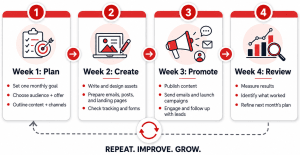
Week 1 — Plan the Campaign and Content
Week 1 is for deciding the month’s direction. The team should choose the goal, audience, offer, content theme, channels, deadlines, and owners.
This does not need to become a long planning meeting. A small team can answer a few questions: What are we promoting? Who needs it most? What problem are we solving? What content do we need? What action do we want people to take?
The output of Week 1 should be a simple monthly plan. It might include one blog topic, one email campaign, several social posts, one landing page update, one ad campaign, and one reporting dashboard.
Week 2 — Create and Prepare Assets
Week 2 is for production. This is when the team writes, designs, records, schedules, and builds the assets needed for the month.
Assets might include a blog post, email sequence, social graphics, short videos, ad copy, landing page updates, lead magnet, case study, or sales follow-up message. The goal is to prepare enough material to support the campaign without overloading the team.
This is also the right time to check tracking. Before a campaign goes live, confirm that forms, phone tracking, conversion events, UTMs, and CRM fields are working.
Week 3 — Publish, Promote, and Engage
Week 3 is when the campaign becomes visible. The team publishes the core content, sends the email, schedules posts, launches or adjusts ads, and monitors early performance.
Engagement matters here. Small teams should respond to comments, reply to inquiries, follow up with leads, and capture common questions. Those questions often become future content ideas.
This is also where paid and organic efforts can support each other. A useful blog post can become social content. A strong email topic can become an ad angle. A customer question can become a short video or FAQ.
Week 4 — Review, Improve, and Plan Next Month
Week 4 is for learning. The team should review the goal, compare results, identify what worked, and decide what to improve.
The review should be simple but honest. Did the campaign generate traffic, leads, calls, appointments, or sales opportunities? Did the right people respond? Which channel performed best? Which task took too much time? What should be repeated next month?
This is where the system becomes stronger. The first month gives the team structure. Each month after that gives the team better data, sharper messaging, and more confidence.
What Weekly Marketing Tasks Should Small Teams Complete Each Month?
Small teams should complete a small number of weekly tasks that support visibility, lead generation, and follow-up. The goal is not to fill every day with marketing work. The goal is to protect the actions that keep marketing from going silent.
A practical weekly task list might include checking campaign performance, publishing or scheduling content, drafting an email, reviewing leads, following up with prospects, responding to comments or messages, updating the content calendar, and checking ad spend.
The exact task list should depend on the monthly goal. If the goal is lead generation, lead follow-up should be protected every week. If the goal is local visibility, the team should review Google Business Profile activity, update business information, add posts or photos when relevant, and monitor customer actions.
Google Business Profile performance data can show how people discover a business on Search and Maps, including views, clicks, and customer interactions. For local businesses, those actions can be useful monthly and weekly signals.
Small teams should also use weekly check-ins to remove friction. If content approvals are slowing the team down, simplify the review process. If reports are confusing, reduce the number of metrics. If social posting takes too long, batch content in advance.
How Can Small Teams Use Content, Email, and Social Media Without Doing Too Much?
Small teams can avoid content overload by creating one strong core asset each month and repurposing it across multiple channels. This approach gives the team more mileage from one idea.
The core asset might be a blog post, guide, webinar, case study, video, checklist, or landing page. Once it exists, the team can turn it into email tips, social posts, short videos, FAQs, sales talking points, ad copy, and newsletter content.
For example, a small business that offers accounting services might publish one blog post about preparing for tax season. That same topic can become a three-email sequence, five social posts, a checklist download, a short explainer video, and a consultation offer.
Ahrefs describes content repurposing as taking parts of existing content and distributing them across other channels, which helps teams reach people in different formats without starting from scratch every time.
This works especially well for small teams because it creates consistency. The audience hears the same useful message in different places. The business stays visible without needing a new idea every day.
Google’s people-first content guidance is also important here. Content should be created to help users, not simply to manipulate search rankings. For a small business, that means answering real customer questions, showing expertise, and making the next step clear.
What Marketing Tools and Automations Make the System Easier?
The best marketing tools are the ones that reduce manual work without making the system harder to manage. A small team does not need a complicated software stack to run a strong monthly marketing system.
Useful tool categories include a project management tool, content calendar, email platform, CRM, social scheduling tool, analytics dashboard, form builder, landing page builder, and automation connector. The right combination depends on the team’s size, budget, channels, and sales process.
Marketing automation is especially useful for repetitive tasks. Mailchimp defines marketing automation as technology that takes over repetitive marketing tasks so people can focus on strategy, including scheduled emails and social media posts.
Simple automations might include a welcome email after someone fills out a form, a reminder to follow up with a lead, a notification when a high-value inquiry arrives, or a monthly report sent to the team. These workflows save time and reduce missed opportunities.
The key is to automate the repeatable parts, not the thinking. A tool can send the email, organize the lead, or display the report. The team still needs to decide the message, offer, audience, and next step.
How Should Small Businesses Track Monthly Marketing Performance?
Small businesses should track a small set of metrics tied to the monthly goal. A simple report is often more useful than a large dashboard filled with numbers no one uses.
The best monthly report should answer three questions: What happened? Why did it happen? What should we do next?

Visibility Metrics
Visibility metrics show whether more people are discovering the business. These can include website traffic, search impressions, Google Business Profile views, social reach, and ad impressions.
Visibility matters when the goal is awareness, local discovery, content growth, or brand recognition. However, visibility alone is not enough. It should eventually connect to engagement, leads, or sales activity.
Engagement Metrics
Engagement metrics show whether people are interacting with the business. These can include email clicks, social comments, video views, page engagement, time on page, and content downloads.
Engagement helps the team understand what topics and messages are resonating. If a topic gets strong engagement but few leads, the call to action may need improvement.
Lead Metrics
Lead metrics show whether marketing is creating potential business opportunities. These can include form submissions, phone calls, booked appointments, quote requests, chat inquiries, email replies, and demo requests.
For many small businesses, this is the most important monthly category. Traffic is useful, but qualified inquiries are usually closer to revenue.
Sales and ROI Metrics
Sales and ROI metrics show whether marketing activity is contributing to business growth. These can include conversion rate, cost per lead, customer acquisition cost, close rate, revenue influenced, and return on ad spend.
Not every small business can track every revenue metric perfectly, especially early on. But every business can improve tracking over time by connecting forms, calls, CRM records, ad platforms, and analytics tools.
HubSpot’s 2026 marketing statistics page reports that website, blog, and SEO remain a top ROI-generating channel according to marketers, and that small businesses are more likely than average to see ROI from blog posts. This supports the value of combining content, search, and reporting in a monthly system.
How Do You Improve the System Month After Month?
Improve the system by reviewing results, identifying patterns, and adjusting one or two things at a time. A monthly marketing system should not be rebuilt every month. It should be refined.
After each month, the team should look for patterns. Which topics generated the most interest? Which channel brought the strongest leads? Which offer converted best? Which audience segment responded? Which tasks took too much time? Which campaign should be repeated?
The team should also look for weak spots. Maybe website traffic increased, but inquiries did not. That may point to a landing page or offer issue. Maybe ads generated leads, but the leads were low quality. That may point to targeting, keywords, messaging, or qualification.
Small improvements compound. One month, the team may improve the landing page headline. The next month, it may test a better offer. The following month, it may refine email follow-up. Over time, the system becomes more efficient because decisions are based on evidence, not guesswork.
The most important mindset is progress over perfection. A small team does not need a flawless marketing machine. It needs a clear enough system to execute consistently, learn quickly, and improve each cycle.
What Does a Simple Monthly Marketing System Look Like in Practice?
A simple monthly marketing system might look like this: a two-person service business wants more consultation calls. The team chooses one service to promote for the month and identifies a common buyer question related to that service.
In Week 1, they plan the campaign. They choose the audience, offer, blog topic, email angle, social content ideas, landing page update, and reporting metrics. The goal is to generate 15 consultation requests.
In Week 2, they create the assets. They write the blog post, prepare one email, draft five social posts, update the landing page, and make sure the contact form and conversion tracking work.
In Week 3, they publish and promote. The blog goes live, the email is sent, social posts are scheduled, and a small paid campaign sends traffic to the service page. The team responds to comments, follows up with leads, and records common questions.
In Week 4, they review performance. They check traffic, email clicks, inquiries, booked calls, lead quality, and sales conversations. If the campaign produced strong leads, they may repeat the theme with a new angle. If results were weak, they adjust the message, offer, or channel before the next month begins.
This is what makes the system practical. It does not require a large team. It requires a clear goal, a simple workflow, and enough discipline to review and improve.
How Can QBall Digital Help Build a Monthly Marketing System?
QBall Digital can help small teams turn scattered marketing activity into a structured monthly operating system. Instead of guessing what to post, advertise, measure, or improve, businesses can follow a clear monthly rhythm built around goals, content, lead generation, reporting, and optimization.
For small businesses, this kind of support can make marketing more manageable. QBall Digital can help organize campaigns, clarify priorities, improve reporting, and connect marketing activity to measurable business outcomes. That is especially valuable for teams that know marketing matters but do not have the internal time or structure to manage every moving part consistently.
FAQ
What is the easiest monthly marketing system for a small business?
The easiest monthly marketing system is one goal, one audience focus, one content theme, weekly execution tasks, and one monthly review. This keeps the system simple enough for a small team to repeat.
How much time should a small team spend on marketing each week?
A small team should start with a realistic weekly block for planning, publishing, follow-up, and reporting. The exact time depends on the business goal, but consistency matters more than trying to do everything at once.
What should be included in a monthly marketing checklist?
A monthly marketing checklist should include goal setting, audience focus, content planning, email marketing, social posting, lead follow-up, website updates, analytics review, and next-month improvements.
Do small businesses need marketing automation?
Small businesses do not need complex automation, but simple automation can help. Welcome emails, lead notifications, follow-up reminders, scheduled posts, and recurring reports can save time and reduce missed opportunities.
What marketing metrics should small businesses review monthly?
Small businesses should review traffic, leads, conversion rate, cost per lead, email engagement, sales opportunities, and revenue influenced. The most important metrics are the ones connected to the month’s goal.
How long does it take for a monthly marketing system to work?
The first month usually builds structure. Stronger results often appear after several monthly cycles because the team has more data, clearer messaging, and a better understanding of what creates qualified leads.
Conclusion
A monthly marketing system helps small teams stop guessing and start executing with consistency. It gives the business a practical rhythm for planning, creating, publishing, promoting, measuring, and improving marketing every month.
The system does not need to be complicated. Start with one goal, one audience, one content theme, one weekly execution rhythm, and one monthly review. From there, improve the process based on what the data and customer response show.
For small businesses, the real advantage is clarity. When marketing becomes repeatable, the team spends less time reacting and more time building visibility, trust, leads, and long-term growth.
Why QBall Digital Is Your Ideal Choice for a Monthly Marketing System for Small Business Growth?
QBall Digital helps small businesses turn marketing from a scattered set of tasks into a clear monthly system. With the right structure, your team can plan campaigns more confidently, publish content more consistently, and understand which activities are actually contributing to leads and growth. That means less wasted effort and more focused execution.
For small teams, QBall Digital brings the marketing operations support needed to keep strategy, content, advertising, reporting, and optimization aligned. Instead of adding unnecessary complexity, QBall Digital helps build a practical system that fits your team’s capacity and business goals. The result is a marketing rhythm that is easier to manage, easier to measure, and easier to improve month after month.
Build Your Monthly Marketing System With QBall Digital
Ready to make marketing more consistent, organized, and results-focused? QBall Digital can help you build a simple monthly system that supports visibility, lead generation, and sustainable growth without overwhelming your team.