
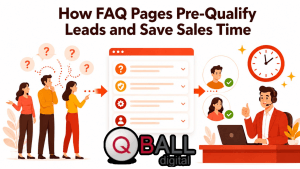
An FAQ page is often treated like a support page, but it can do much more than answer basic questions. When built strategically, it becomes a lead qualification tool that helps prospects understand your offer, compare their needs against your services, and decide whether taking the next step makes sense.
That matters because not every lead is equally valuable. Some visitors are researching casually. Some are not a fit. Others are ready to speak with sales but need reassurance around pricing, process, timelines, or expected results. A strong FAQ page strategy for lead generation helps separate those groups before your team spends time on a call.
For companies investing in PPC, this is especially important. Paid clicks cost money, and Google recommends that landing pages match the ad and keywords, make the desired action easy, and provide useful, original information about what is being advertised. An FAQ section or FAQ page can support all three by answering the questions that usually stop visitors from converting.
What Is an FAQ Page Strategy for Lead Generation?
An FAQ page strategy for lead generation is the intentional use of frequently asked questions to educate visitors, resolve objections, identify buyer readiness, and guide qualified prospects toward a conversion action.
A basic FAQ page answers common questions. A lead-focused FAQ page goes further. It is structured around the buying journey, not just customer convenience. It answers the questions that influence whether someone is a good fit, ready to act, and confident enough to contact your business.
For example, a basic FAQ might answer, “What services do you offer?” A lead-generating FAQ asks, “Which service is best if we need more qualified PPC leads?” That second version does more than provide information. It helps the visitor self-diagnose their problem, understand the solution path, and move toward a more relevant next step.
FAQ pages can also support sales, marketing, and customer support at the same time. Mailchimp describes FAQ pages as resources that help customers learn about products and services without contacting customer service, while also supporting broader sales, marketing, and support goals.
The best FAQ questions usually come from real business conversations. Sales calls, support tickets, chat transcripts, CRM notes, form submissions, and search queries all reveal what prospects actually want to know before buying. When those questions are organized into a page, the FAQ becomes a self-service sales assistant.
How Do FAQ Pages Help Pre-Qualify Leads Before a Sales Conversation?
FAQ pages help pre-qualify leads by allowing visitors to compare their needs, budget, expectations, and urgency against what your business actually provides.
A prospect who reads questions about pricing, fit, process, timelines, deliverables, and requirements is often doing more than browsing. They are testing whether your offer matches their situation. If the answers are clear, they can decide whether to continue, book a call, request a quote, or leave before consuming sales time.
This is where FAQ content becomes a filter. It can clarify who the service is for, who it is not for, what results are realistic, and what a prospect needs to have in place before starting. A visitor who does not meet those criteria may self-disqualify. A better-fit visitor may become more confident because your answers remove uncertainty.
Lead qualification works best when sales and marketing agree on what makes a lead valuable. Salesforce explains that lead qualification evaluates prospects to identify those ready to buy and pass to sales, using both interest and suitability signals. A strategic FAQ page supports that process by making those suitability signals visible before the sales conversation starts.
For example, an agency might include questions such as “What ad budget do we need before hiring a PPC agency?” or “Do we need landing pages before starting paid ads?” These answers help visitors understand whether they are prepared for the service. They also give the sales team a better starting point because the prospect already knows the basics.
Why Do FAQ Pages Save Sales Teams Time?
FAQ pages save sales teams time by answering repetitive questions before a prospect books a call, fills out a form, or requests a proposal.
Most sales teams hear the same questions repeatedly. Prospects ask about cost, timelines, process, reporting, onboarding, guarantees, communication, deliverables, and expected results. Those questions are important, but they can take over discovery calls if they are not answered earlier in the buyer journey.
A well-built FAQ page reduces that repetition. Instead of spending the first 15 minutes explaining how the service works, sales reps can focus on business goals, decision criteria, fit, and next steps. The conversation becomes more strategic because the prospect has already been educated.
FAQ pages also create a reusable sales enablement asset. A rep can send a relevant FAQ answer before a call, after a proposal, or during follow-up. This keeps communication consistent and reduces the risk of different team members explaining the same offer in different ways.
HubSpot notes that when marketing and sales align on what makes a high-quality lead, marketing can vet and hand off better leads to sales, helping reps avoid wasting time identifying leads that marketing has already engaged. FAQ content supports that alignment because it turns common qualification points into public-facing answers.
What Questions Should a Lead-Generating FAQ Page Answer?
A lead-generating FAQ page should answer the questions that affect buying confidence, qualification, urgency, and conversion.
The strongest questions are not always the most general questions. They are the questions that reveal whether someone is serious, ready, and aligned with your offer. For a service business, this often includes questions about budget, timeline, fit, scope, process, proof, and expected outcomes.
Useful FAQ categories include:
| Question Type | Example Question | Lead Qualification Purpose |
| Fit | “Who is this service best for?” | Helps visitors decide whether they match the ideal customer profile. |
| Budget | “How much should we budget?” | Filters out prospects who are not financially ready. |
| Timeline | “How long does it take to see results?” | Sets realistic expectations before a sales call. |
| Process | “What happens after we contact you?” | Reduces uncertainty around next steps. |
| Proof | “How do we know this will work?” | Builds trust with evidence, examples, or case studies. |
| Readiness | “What should we prepare before starting?” | Helps identify prepared, high-intent prospects. |
| Objection | “What if we tried this before and it did not work?” | Addresses hesitation before it blocks conversion. |
| Comparison | “Should we hire an agency or manage this in-house?” | Helps prospects evaluate options more confidently. |
For PPC-focused businesses, FAQ questions should be tied closely to conversion concerns. For example: “Why are our ads getting clicks but not qualified leads?” “Should we improve our landing page before increasing ad spend?” “How do we know which campaigns are producing sales-ready leads?”
These questions do more than educate. They attract prospects who are already thinking about business outcomes, not just surface-level traffic metrics.
How Should You Structure an FAQ Page to Convert More Qualified Leads?
You should structure an FAQ page around buyer intent, so visitors can move from uncertainty to clarity to action.
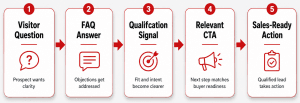
Start with the questions that matter most to conversion. Pricing, fit, process, proof, and next steps should not be buried at the bottom if they are the questions prospects ask before taking action. Group related questions into themes so visitors can quickly find the information that matches their concern.
Each answer should begin with a direct response. Then it should explain the reasoning, add context, and point the reader toward a relevant next step. For example, an answer about PPC budgets might start with a realistic budget range, explain what affects budget needs, and then link to a strategy call or campaign audit.
Usability matters as much as content. Nielsen Norman Group’s FAQ research includes guidelines based on usability testing and analysis of FAQ examples, reinforcing that FAQ strategy and design should make information easy to find and use.
A conversion-focused FAQ structure could follow this order:
- Fit and problem questions
- Service and process questions
- Pricing and timeline questions
- Proof and comparison questions
- Final decision and contact questions
How Can FAQ Pages Support PPC and Paid Lead Generation Campaigns?
FAQ pages support PPC campaigns by reducing hesitation after the click and helping paid visitors make faster, more confident decisions.
When someone clicks a paid ad, they expect the landing page to match what the ad promised. Google Ads recommends close alignment between ads, keywords, landing pages, and calls to action because that connection can improve landing page experience and conversion chances. FAQ content helps create that alignment by answering the concerns tied to the ad’s promise.
For example, if an ad promotes “PPC lead generation for B2B companies,” the landing page should not only describe PPC services. It should answer questions such as “How do you improve lead quality?” “Do you optimize landing pages too?” “How soon can we tell if campaigns are working?” and “What happens if our current campaigns generate too many poor-fit leads?”
FAQ sections can also reduce wasted spend. If visitors do not understand your pricing model, minimum engagement, service scope, or expected timeline, they may submit forms that sales later disqualifies. Clear FAQ answers help prevent some of those poor-fit conversions before they enter the pipeline.
This is especially useful for high-cost keywords. The more expensive the click, the more important it is to answer decision-making questions near the conversion point. A well-placed FAQ section can turn a landing page from a simple pitch into a stronger qualification experience.
How Do You Use FAQ Content to Improve Lead Quality?
You use FAQ content to improve lead quality by setting expectations, clarifying fit, and connecting high-intent answers to the right conversion action.
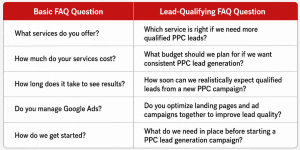
Lead quality improves when visitors understand what your business does, who it helps, and what is required for success before they fill out a form. That means your FAQ page should not avoid difficult questions. Pricing, timelines, limitations, and required client involvement should be answered honestly.
Salesforce’s lead qualification model combines scoring, which reflects engagement, and grading, which reflects fit. It also emphasizes defining qualification criteria with sales and marketing teams. FAQ content can support both sides. A visitor who reads pricing, case study, or process questions may show intent. A visitor who answers form questions about budget, company size, timeline, or goals may show fit.
You can also connect FAQ content with your forms and CRM. For example, if someone clicks from an FAQ answer about “improving PPC lead quality” to a strategy call form, the form can ask about current ad spend, lead volume, conversion rate, and biggest campaign challenge. This creates a smoother handoff because the sales team receives context before the call.
Google Analytics 4 includes recommended lead generation events such as generate_lead, qualify_lead, disqualify_lead, working_lead, and closed-lead outcomes. These events are designed to help measure the lead generation funnel across online and offline activity. That makes it possible to evaluate whether FAQ-assisted leads are becoming qualified opportunities, not just form submissions.
What Are the Best Practices for Writing FAQ Answers That Convert?
The best FAQ answers are direct, honest, specific, and action-oriented.
Start every answer with the clearest possible response. Do not make visitors dig through a long paragraph before understanding the answer. After the direct answer, add context that helps them make a better decision. This could include examples, criteria, use cases, limitations, or links to deeper resources.
Avoid vague claims like “we deliver great results” or “it depends” without explanation. Instead, explain what affects the answer. For example, instead of saying “PPC results vary,” say that results depend on factors such as campaign history, budget, offer strength, landing page quality, conversion tracking, and sales follow-up.
Google’s guidance on helpful content encourages original, substantial, complete, and trustworthy content created for people rather than content designed mainly to manipulate rankings. That standard applies directly to FAQ pages. A thin list of keyword-based questions will not build the same confidence as thoughtful answers based on real prospect concerns.
It is also important not to overpromise SEO benefits from FAQ schema. Google currently says FAQ rich results are available only for well-known, authoritative websites that are government-focused or health-focused. For most commercial websites, FAQ value should come from helpful content, stronger internal linking, better user experience, and improved conversion support—not guaranteed rich results.
How Should You Measure Whether Your FAQ Page Is Generating Better Leads?
You should measure FAQ performance by tracking both engagement and downstream lead quality.
Pageviews alone are not enough. A lead-focused FAQ page should be judged by whether it helps visitors take meaningful action and whether those actions lead to better sales conversations. Useful metrics include FAQ page visits, scroll depth, clicks on specific questions, CTA clicks, form submissions, booked calls, conversion rate, and assisted conversions.
For sales quality, look beyond the form. Track how many FAQ-assisted leads become qualified, disqualified, working leads, opportunities, and customers. GA4’s recommended lead generation events are useful here because they include both lead creation and later qualification or disqualification outcomes.
You can also measure sales efficiency. Compare repeated sales questions before and after publishing the FAQ page. Review average call length, close rate, disqualification reasons, and proposal-to-close rate. If the FAQ page is working, sales calls should become more focused and better informed.
For PPC campaigns, connect FAQ interactions to campaign data. Google Ads conversion measurement allows advertisers to track defined actions after ad clicks and view conversion data by campaigns, ad groups, ads, and keywords. This helps determine whether FAQ-supported landing pages are producing better business outcomes, not just more clicks.
When Should You Update Your FAQ Page Strategy?
You should update your FAQ page strategy whenever your prospects, offer, sales conversations, pricing, campaigns, or market conditions change.
An FAQ page is not a one-time content task. It should evolve as your sales team learns more about objections, buyer expectations, and qualification patterns. If your reps keep answering the same question, that question probably belongs on the FAQ page. If PPC campaigns are producing low-quality leads, your FAQ answers may need to clarify fit, pricing, or requirements earlier.
You should also update FAQ content when you launch a new service, change your pricing model, adjust your onboarding process, introduce a new case study, or notice confusion in form submissions. These updates keep the page aligned with real buying behavior.
HubSpot recommends revisiting lead definitions regularly because businesses, teams, customers, buyer personas, and leads evolve over time. The same principle applies to FAQ strategy. As qualification criteria change, FAQ content should change with it.
A practical review cadence is quarterly. Bring together sales, marketing, and customer-facing team members. Identify repeated questions, new objections, poor-fit lead patterns, and pages where prospects hesitate. Then update the FAQ page so it reflects what buyers need to know now.
FAQ
Can an FAQ page really generate leads?
Yes. An FAQ page can generate leads when it answers decision-making questions and connects those answers to relevant CTAs. It works best when the questions address fit, pricing, process, proof, objections, and next steps.
The page should not simply list general questions. It should help visitors decide whether your offer matches their needs and then guide them toward a specific action, such as booking a consultation, requesting a quote, or viewing a case study.
Should every landing page include FAQs?
Most high-intent landing pages should include at least a short FAQ section. This is especially true for PPC landing pages where visitors may need quick answers before converting.
The FAQ section should be specific to the offer on that page. A generic FAQ copied across every landing page is less useful than targeted answers based on the ad, keyword, audience, and conversion goal.
How many questions should an FAQ page have?
An FAQ page should have enough questions to answer the major concerns that affect conversion, but not so many that the page becomes overwhelming. For many service businesses, 8–15 strong questions can be enough for a dedicated FAQ page or landing page section.
Larger companies, SaaS products, and complex B2B services may need more questions grouped by category. The goal is clarity, not volume.
Should FAQ pages include pricing questions?
Yes. Pricing questions are often some of the strongest lead-qualification questions. Even if you do not publish exact prices, you can explain what affects cost, what budget range is realistic, or what level of investment is usually required.
Avoiding pricing entirely can create unnecessary friction. Clear pricing guidance can reduce poor-fit inquiries and help serious buyers move forward with more confidence.
Can FAQ pages help reduce unqualified leads?
Yes. FAQ pages can reduce unqualified leads by explaining who the service is for, who it is not for, what requirements exist, and what expectations are realistic.
This does not mean discouraging good prospects. It means helping the wrong-fit visitors self-select out while giving right-fit prospects stronger reasons to take action.
Are FAQ pages still useful for SEO?
Yes, FAQ pages can still be useful for SEO when they provide helpful, well-structured answers to real user questions. However, most businesses should not rely on FAQ rich results as the main SEO benefit because Google limits FAQ rich results to specific authoritative government or health websites.
The stronger SEO value comes from satisfying search intent, improving internal linking, supporting topical relevance, and creating helpful content that users trust.
What is the difference between an FAQ page and a knowledge base?
An FAQ page answers the most common questions prospects and customers ask before or during a purchase decision. A knowledge base is usually broader and more detailed, often covering product instructions, troubleshooting, account management, and support documentation.
For lead generation, FAQ pages are usually better suited to conversion. Knowledge bases are usually better suited to customer education and support.
Where should CTAs appear on an FAQ page?
CTAs should appear after high-intent answers and at the end of the page. For example, an answer about pricing could lead to “Request a Quote,” while an answer about strategy could lead to “Book a Consultation.”
Avoid placing the same aggressive CTA after every question. The CTA should match the visitor’s intent at that moment.
Conclusion
An FAQ page can be much more than a basic support resource. When planned around buyer intent, it can answer objections, set expectations, clarify fit, and guide qualified prospects toward the next step.
For sales teams, that means fewer repetitive conversations and more informed calls. For PPC campaigns, it means paid visitors get the clarity they need before converting. For the business as a whole, it means lead generation becomes less focused on volume alone and more focused on attracting the right opportunities.
The strongest FAQ page strategy for lead generation starts with real questions, organizes them around decision-making intent, and connects each answer to a meaningful action.
Why QBall Digital is Your Ideal Choice for FAQ Page Strategy for Lead Generation?
QBall Digital understands that lead generation is not just about increasing traffic, clicks, or form submissions. The real goal is to attract better-fit prospects who understand your offer, trust your process, and are ready for a productive sales conversation. By connecting content strategy with PPC and conversion-focused thinking, QBall Digital helps businesses turn FAQ pages into assets that support both marketing performance and sales efficiency.
A strong FAQ page should reflect the questions your prospects are already asking before they decide to contact you. QBall Digital can help identify those questions, structure them around buyer intent, and connect each answer to the right conversion path. That gives your sales team more prepared leads, reduces wasted time, and creates a smoother journey from paid click to qualified opportunity.
Ready to Turn Your FAQ Page Into a Lead-Qualifying Asset with QBall Digital?
Build an FAQ page that does more than answer questions. Let QBall Digital help you create FAQ content that improves PPC efficiency, pre-qualifies prospects, and gives your sales team more time to focus on serious buyers.