
Small businesses often assume they need more website traffic when what they really need is clearer service pages. A homepage can introduce the business, and a general services page can summarize what the company offers, but neither is usually specific enough to rank for high-intent searches or convert visitors who are actively comparing providers.
A strong service page SEO strategy solves that problem by giving each important offer a focused page with a clear message, helpful information, proof, and a direct next step. Instead of asking visitors to figure out whether your business can help them, a well-built service page answers their questions, matches their intent, and shows them exactly why your solution fits their problem.
For small businesses, this matters because SEO traffic is only valuable when it attracts the right people. Google’s own SEO guidance emphasizes creating pages for users, making content easy to find and understand, and helping search engines crawl, index, and interpret your site effectively. Google also says its ranking systems are designed to reward helpful, reliable, people-first content rather than content created mainly to manipulate rankings.
That is why clear service pages are not just an SEO asset. They are part of your offer strategy, your sales process, and your lead qualification system.
What Is a Service Page SEO Strategy?
A service page SEO strategy is the process of planning, creating, optimizing, and improving dedicated service pages so they can rank for relevant searches and convert the right visitors into leads.
A service page is different from a general “Services” page. A general services page may list everything a business does, but a dedicated service page focuses on one specific offer. For example, a digital marketing agency might have separate pages for SEO, Google Ads management, website design, landing page design, and conversion tracking instead of placing every offer on one broad “Digital Marketing Services” page.
This matters because each service usually has its own audience, search intent, objections, benefits, and conversion path. Someone searching for “Google Ads management for small business” is not necessarily looking for the same information as someone searching for “SEO content strategy” or “website redesign services.” A dedicated service page gives you room to answer the right questions for that specific buyer.
A good strategy connects five core elements: the offer, the audience, the keyword opportunity, the page structure, and the conversion goal. The page should explain what the service is, who it is for, what problem it solves, what makes the provider credible, and what the visitor should do next. Google’s SEO Starter Guide also recommends creating descriptive, helpful content and organizing websites in a way that helps both users and search engines understand the site.
The key is clarity. A service page should not read like a keyword-stuffed brochure. It should feel like a helpful sales conversation that answers the visitor’s real concerns before they ever submit a form, book a call, or request a quote.
Why Do Small Businesses Need Clear Service Pages to Get Better SEO Traffic?
Small businesses need clear service pages because people often search for the exact service they need, not just the name of a company or a broad category. A dedicated page gives Google and potential customers a clearer understanding of what the business offers.
For example, a homeowner is more likely to search “emergency plumber near me” than “home repair company.” A business owner may search “Google Ads management for small businesses” instead of “marketing agency.” A property manager may search “commercial cleaning services” instead of “cleaning company.”
When a business relies only on a homepage or one generic services page, it can be difficult to match those specific searches. The page may be too broad to satisfy any one intent deeply. A clear service page, however, can focus on one problem, one audience, and one solution.
This helps in several ways. First, the page can target a more specific keyword theme. Second, it can include service-specific headings, examples, FAQs, internal links, and proof. Third, it can give visitors the information they need without making them dig through unrelated content.
Clear service pages also help reduce irrelevant traffic. Ranking for a broad keyword may bring more visitors, but those visitors may not be ready to buy or may not need your exact service. Ranking for service-specific terms can attract people who already understand their problem and are closer to taking action.
Google also recommends using unique, accurate titles that help users quickly understand what a page is about. For service pages, this means the page title and main heading should make the offer obvious without sounding mechanical or overloaded with keywords.
Better traffic does not always mean more traffic. For small businesses, better traffic means visitors who are more likely to become qualified leads.
How Do Service Pages Help Attract More Qualified Leads?
Service pages help attract more qualified leads by explaining who the service is for, what the business provides, what results the customer can expect, and what the next step looks like.
A vague page creates vague inquiries. When a page only says “We offer professional marketing services” or “We provide quality home services,” visitors still have to guess whether the business can solve their specific problem. That uncertainty can lead to poor-fit inquiries, price shoppers, confused prospects, or visitors who leave without contacting the business.
A clear service page does the opposite. It filters and educates. It tells the visitor, “This is what we do, this is who we help, this is how the process works, and this is what you can expect.” That information helps the right people move forward and helps the wrong people self-select out.
For example, a company offering SEO, PPC, and website design should not rely on one broad “Digital Marketing Services” page. A visitor looking for PPC support needs to see campaign strategy, landing page relevance, tracking, budget management, reporting, and examples related to paid search. A visitor looking for SEO needs different information, such as keyword strategy, content planning, technical improvements, and organic traffic growth.
Service pages also improve lead quality by addressing common concerns before the sales conversation begins. These may include timelines, deliverables, pricing factors, service scope, process, expected outcomes, and what makes the company different. The more clearly the page explains the offer, the less time the business spends answering basic questions from unqualified prospects.
This is especially important for PPC-focused businesses. When paid clicks land on unclear pages, the business may pay for traffic that does not convert. Google Ads states that landing page experience considers the usefulness and relevance of the page, ease of navigation, and whether the page meets expectations based on the ad clicked.
A service page that works for SEO can also support paid campaigns because both channels benefit from relevance, clarity, and strong conversion paths.
What Should Every High-Performing Service Page Include?
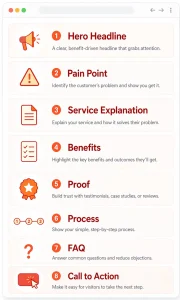
Every high-performing service page should include a clear headline, a specific service explanation, buyer-focused benefits, proof, process details, FAQs, internal links, and a strong call to action.
The goal is not to make the page long for the sake of length. The goal is to make it complete enough to answer the visitor’s questions and confident enough to guide them toward action.
Clear Service Headline
The headline should quickly communicate what the service is and why it matters. A strong headline does not need to be clever. It needs to be clear.
For example, “Google Ads Management That Helps Small Businesses Turn Clicks Into Qualified Leads” is stronger than “Results-Driven Marketing Solutions.” The first headline explains the service, audience, and outcome. The second sounds polished but vague.
A clear headline also supports SEO because it reinforces the page topic. Google’s title-link guidance explains that title links help users understand why a result is relevant to their query, and clear page titles can influence how results appear in search.
Problem and Pain Point Section
After the headline, the page should show that the business understands the visitor’s problem. This section should reflect the real frustrations the customer experiences.
For a service page SEO strategy, pain points might include low-quality traffic, unclear offers, visitors who do not convert, too many generic inquiries, or paid ad clicks going to pages that do not match the campaign.
This section builds trust because it shows the business is not just selling a service. It understands the context behind the buyer’s search.
Service Explanation
The service explanation should define exactly what is included. This is where many small business websites are too thin.
Instead of saying “We provide SEO services,” the page should explain whether the service includes keyword research, technical audits, content strategy, on-page optimization, service page creation, local SEO, reporting, or ongoing improvements. Specificity helps buyers understand the value and helps prevent misaligned expectations.
Benefits and Outcomes
Service pages should explain benefits in business terms, not just features. Features describe what the provider does. Benefits explain why it matters.
For example, “keyword mapping” is a feature. “Helping each service page target the right search intent so more qualified prospects find the right offer” is a benefit. “Conversion tracking setup” is a feature. “Knowing which service pages generate actual leads” is a business outcome.
Small businesses usually care less about technical tasks and more about what those tasks help them achieve: better visibility, stronger leads, more efficient ad spend, and clearer sales conversations.
Proof and Trust Signals
A service page should include proof that reduces doubt. This can include testimonials, reviews, case studies, before-and-after examples, portfolio work, certifications, team expertise, client logos, screenshots, or measurable results.
Google’s guidance on helpful content encourages content creators to consider whether their content demonstrates first-hand expertise and provides substantial value. For service businesses, proof helps show that the company has experience solving the problem it claims to solve.
Proof should be specific whenever possible. “We increased qualified leads from SEO service pages” is more convincing than “We get great results.”
Process Overview
A process section helps visitors understand what happens after they inquire. This is especially useful for services that feel complex, expensive, or unfamiliar.
A simple process might include discovery, audit, strategy, page planning, copywriting, optimization, launch, tracking, and improvement. The goal is not to overwhelm the visitor with every detail. The goal is to make the experience feel organized and low-risk.
FAQ Section
FAQs are valuable because they answer objections and capture long-tail search questions. They can address pricing, timelines, page length, location pages, service scope, revisions, tracking, and whether each service needs its own page.
A good FAQ section is not filler. It should be based on questions customers actually ask during sales calls, emails, forms, and consultations.
Clear Call to Action
Every service page needs a clear next step. The CTA should match the visitor’s level of intent. For example, “Book a Strategy Call,” “Request a Quote,” “Schedule a Consultation,” or “Get a Service Page Audit” are more specific than “Submit.”
The page can include multiple CTAs, but they should support the same conversion goal. HubSpot’s landing page guidance highlights the importance of checking CTA functionality, form behavior, mobile experience, and scannable copy before publishing a page.
How Should Small Businesses Choose Which Services Deserve Their Own SEO Pages?
Small businesses should create dedicated SEO pages for services that customers search for separately, solve distinct problems, support different buyer intent, or represent meaningful revenue opportunities.
Not every small variation needs its own page. Creating too many thin pages can lead to weak, repetitive content. Instead, businesses should prioritize services that are clear enough and valuable enough to stand on their own.
A good service page candidate usually meets at least one of these conditions: people search for it directly, the service has a unique audience, it has a different sales conversation, it has a different process, or it deserves its own CTA. For example, “Local SEO Services,” “Google Ads Management,” and “Website Design” are distinct enough to deserve separate pages for many agencies.
A poor candidate might be a tiny variation that does not change the buyer’s need. For example, creating five nearly identical pages that only swap one phrase or city name can produce low-value content. Google’s helpful content guidance warns against creating content mainly to attract search engine visits rather than serving people.
Small businesses should also consider profitability. A high-margin service with clear demand may deserve a stronger SEO page even if it has lower search volume. A service that attracts many searches but rarely converts into profitable work may not deserve the same investment.
The best service page strategy balances SEO opportunity with business value. The question is not just “Can we rank for this?” It is “Would ranking for this bring the kind of lead we actually want?”
How Does Search Intent Shape a Better Service Page SEO Strategy?
Search intent shapes a better service page SEO strategy because it tells you what the visitor expects to find and what the page must answer.
A person searching for a service may have informational, commercial, transactional, or local intent. Informational intent means they want to understand something. Commercial intent means they are comparing options. Transactional intent means they are ready to take action. Local intent means location matters to the decision.
Most service pages need to satisfy commercial and transactional intent. A visitor is not only asking, “What is this service?” They are also asking, “Can this company help me?” “Do they understand my problem?” “Are they credible?” “What does it cost?” “What happens next?” and “Why should I choose them?”
For example, someone searching “service page SEO strategy” likely wants more than a definition. They want to know how to structure service pages, choose which offers need pages, improve lead quality, align pages with PPC, and measure performance. A strong page or blog post must answer those questions directly.
This is where many small business pages fall short. They describe the company, but they do not satisfy the visitor’s intent. They say what they do, but they do not explain how the service solves the buyer’s problem.
A better approach is to map each page section to a buyer question:
| Buyer Question | Page Section That Answers It |
| What is this service? | Service explanation |
| Is this for my problem? | Pain point section |
| Why should I care? | Benefits and outcomes |
| Can I trust this company? | Proof and testimonials |
| What happens next? | Process section |
| What concerns should I understand? | FAQ section |
| How do I move forward? | CTA |
When a page aligns with intent, it becomes more useful for visitors and easier for search engines to understand.
How Can Local SEO Make Service Pages More Effective?
Local SEO can make service pages more effective by helping them appear for searches where the buyer wants a nearby provider or a company that serves their area.
For many small businesses, location matters. A customer may search for a plumber, electrician, accountant, cleaning company, lawyer, contractor, med spa, or marketing agency with a local or regional preference. Even when the service can be delivered remotely, local proof can still build trust.
Location should be integrated naturally. A service page does not need to repeat a city name in every heading. Forced location stuffing can make the page sound awkward and reduce trust. Instead, the page can mention service areas where relevant, include local testimonials, reference local project examples, connect to a Google Business Profile, and explain how the business works with customers in that area.
Google Business Profile guidance states that service areas help customers understand where a business provides products or services. Google also notes that profiles can include important details such as business name, website, phone number, hours, reviews, and services offered.
Small businesses should also understand the difference between service pages and location pages. A service page focuses on what the business does. A location page focuses on where the business serves. Sometimes a business needs both, but they should not be duplicates.
For example, a marketing agency might have a service page for “Google Ads Management” and separate location pages for key markets only if those location pages include genuinely useful local context. A contractor might have a service page for “Kitchen Remodeling” and a location page for a major service area, but each page should provide unique value.
Local SEO works best when location details support the buyer’s decision instead of calling attention to SEO intent.
How Do Service Pages Support PPC and Paid Lead Generation?
Service pages support PPC and paid lead generation by giving ad traffic a more relevant, focused, and conversion-ready destination.
Sending every paid click to the homepage is a common mistake. A homepage has to serve many purposes at once. It introduces the brand, summarizes services, shares general credibility, and routes visitors to different areas of the site. That can be useful for broad discovery, but it is often too general for paid search campaigns.
A PPC campaign should have message match. If the ad promotes “Google Ads management,” the landing page should explain Google Ads management. If the ad targets “service page SEO strategy,” the page should focus on service page strategy, not general marketing. This makes the visitor feel they landed in the right place.
Google Ads explains that landing page experience is influenced by usefulness, relevance, ease of navigation, and whether the page meets expectations based on the ad clicked. It is also one of the factors that helps determine Quality Score.
This does not mean every SEO service page is automatically the perfect PPC landing page. Some paid campaigns need stripped-down landing pages with fewer distractions. But the strategic foundation is the same: relevance, clarity, proof, and a strong CTA.
Strong service pages also help small businesses make better budget decisions. If one service page consistently converts organic and paid visitors into qualified leads, that service may deserve more ad spend. If another page attracts traffic but poor-fit inquiries, the offer, targeting, or page message may need improvement.
For PPC-focused businesses, service pages are not only SEO content. They are conversion assets that can improve the efficiency of paid campaigns.
What Are Common Service Page SEO Mistakes Small Businesses Should Avoid?
The most common service page SEO mistakes happen when businesses write for themselves instead of the buyer and search intent.
One major mistake is using one generic page for every service. This makes it harder to rank for specific searches and harder for visitors to understand the exact offer. A better approach is to create dedicated pages for core services that have unique demand, value, and buyer questions.
Another mistake is writing thin pages. A service page with only a few sentences, a stock image, and a contact button usually does not provide enough information to build trust. Visitors need context, proof, benefits, process, and answers to objections.
Keyword stuffing is another issue. Repeating the same phrase unnaturally can make the page sound robotic. Google’s helpful content guidance makes it clear that content should be created for people first, not mainly for search engine manipulation.
Small businesses should also avoid copying the same page for every location. Changing only the city name rarely creates meaningful value. If a location page is needed, it should include local proof, specific service-area information, examples, reviews, and content that helps a local buyer make a decision.
Weak CTAs are another common problem. If the page does not make the next step obvious, visitors may leave even if they are interested. A strong CTA should be visible, specific, and aligned with the service.
Other mistakes include hiding pricing context, leaving out testimonials or case studies, ignoring mobile readability, failing to link related service pages, and not tracking conversions by page. Without tracking, a business may know that its website gets traffic but not which service pages produce qualified leads.
The fix is to treat each service page as a measurable business asset, not just a content task.
How Can Small Businesses Measure Whether Their Service Pages Are Working?
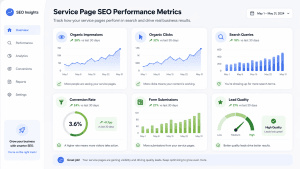
Small businesses can measure service page performance by reviewing qualified traffic, search visibility, engagement, conversions, and lead quality.
Traffic alone is not enough. A service page can attract visitors and still fail if those visitors are not interested in the service or do not become leads. The better question is: “Is this page attracting the right visitors and helping them take the right action?”
Google Search Console is useful for measuring impressions, clicks, and queries. This helps businesses see which searches bring people to each service page. Google’s SEO documentation highlights Search Console as a key tool for understanding and improving search presence.
Conversion tracking is equally important. Small businesses should measure form submissions, calls, booked consultations, quote requests, email clicks, and other meaningful actions. For PPC campaigns, conversion tracking should show which ads, keywords, and landing pages generate actual leads.
Lead quality should also be reviewed manually. A page may produce many inquiries, but if most are not a good fit, the page may need clearer positioning. It may need to better explain who the service is for, what is included, what budget range makes sense, or what problems the business does not solve.
A simple KPI framework can help:
| Metric | Where to Measure It | What It Tells You |
| Organic impressions | Google Search Console | Whether the page is being shown in search |
| Organic clicks | Google Search Console | Whether searchers are choosing the result |
| Search queries | Google Search Console | Which terms the page is attracting |
| Conversion rate | Analytics or CRM | Whether visitors are taking action |
| Form submissions and calls | Forms, call tracking, CRM | How many leads the page generates |
| Lead quality | CRM or sales notes | Whether inquiries match the ideal customer |
| PPC performance | Google Ads | Whether paid traffic converts efficiently |
The best service page strategies improve over time. Reviewing performance monthly or quarterly can reveal which pages need stronger content, clearer CTAs, better proof, improved internal links, or a sharper offer.
How Can QBall Digital Build a Stronger Service Page SEO Strategy for Small Businesses?
QBall Digital can build a stronger service page SEO strategy by helping small businesses clarify their offers, map services to search intent, and turn website pages into conversion-focused assets.
Many businesses have valuable services but unclear messaging. They know what they do, but their website does not explain it in a way that matches how customers search, compare, and decide. QBall Digital can help bridge that gap by identifying which services deserve dedicated pages, what each page should target, and how the content should be structured.
A strong strategy starts with offer clarity. Before writing or optimizing a page, the business needs to define the service, audience, problem, outcome, proof, and next step. From there, keyword and intent mapping can help determine how each service page should be positioned for search.
QBall Digital can also align service pages with PPC campaigns. That means the message in the ad, the keyword being targeted, and the page experience all support the same buyer journey. This is especially important for small businesses that cannot afford to waste paid clicks on unclear or generic pages.
By combining SEO structure, conversion-focused messaging, and performance tracking, QBall Digital can help small businesses turn service pages into stronger lead-generation assets.
FAQ
How long should a service page be for SEO?
A service page should be long enough to fully answer the buyer’s questions and explain the offer clearly. There is no universal word count that guarantees SEO performance. A simple service may need a shorter page, while a complex or high-value service may need more detail.
The better question is whether the page explains the service, benefits, process, proof, FAQs, and CTA in enough depth to help the visitor make a decision. A thin page may struggle because it does not provide enough value. An overly long page may also fail if it is repetitive or unfocused.
Should every service have its own page?
Not every service needs its own page, but every important, distinct, searchable, and revenue-relevant service should be considered for one.
A service deserves its own page when customers search for it separately, it solves a unique problem, it has a different audience, or it needs a different sales message. Similar services can often be grouped together if separating them would create thin or duplicate content.
What is the difference between a service page and a landing page?
A service page is usually part of the main website and is built to explain a specific offer, support SEO, build trust, and generate inquiries over time. A landing page is often created for a specific campaign and may be more focused on one conversion action.
The two can overlap. A strong service page can support organic search and paid traffic, but some PPC campaigns may still need dedicated landing pages with tighter message match and fewer navigation options.
Can service pages help with Google Ads performance?
Yes, service pages can help Google Ads performance when they are relevant to the ad, useful to the visitor, easy to navigate, and aligned with the searcher’s expectations. Google Ads includes landing page experience as one factor in Quality Score, and relevance is part of that experience.
For example, an ad about “Google Ads management” should not send visitors to a broad homepage. It should send them to a page that clearly explains Google Ads management, benefits, proof, process, and the next step.
How many keywords should one service page target?
One service page should focus on one main keyword theme and a small group of closely related supporting terms. Trying to target too many unrelated keywords can make the page unfocused.
For example, a page about “service page SEO strategy” could naturally include related ideas like service page optimization, SEO service pages, service page structure, and qualified leads. It should not also try to rank for unrelated topics like social media marketing, logo design, and email automation.
Should small businesses create location-based service pages?
Small businesses should create location-based service pages only when location is important to the buyer and the page can provide unique local value.
A location page should not simply duplicate a service page and swap in a city name. It should include helpful local context, relevant proof, service-area information, customer examples, and a natural explanation of how the business serves that market.
How often should service pages be updated?
Service pages should be reviewed at least every few months, especially if they support important SEO or PPC campaigns. Updates may be needed when services change, pricing factors shift, new case studies become available, competitors improve their pages, or search performance declines.
Regular updates can also improve conversion performance. Adding better FAQs, stronger proof, clearer CTAs, or more specific service details can help turn more visitors into qualified leads.
Conclusion
A clear service page SEO strategy helps small businesses attract better traffic, explain their offers more effectively, and convert more visitors into qualified leads. Instead of relying on one vague services page, businesses can create focused pages that match how customers search and how they make decisions.
The best service pages work because they connect SEO with sales clarity. They define the service, answer real buyer questions, show proof, explain the process, and make the next step easy. They also help businesses measure which offers are producing meaningful opportunities, not just website visits.
For small businesses investing in SEO or PPC, service pages should be treated as core growth assets. Clearer pages can improve search visibility, paid campaign relevance, lead quality, and sales conversations.
Why QBall Digital is Your Ideal Choice for Service Page SEO Strategy?
QBall Digital understands that small businesses do not just need more traffic. They need the right people finding the right offers and taking the right next step. A strong service page SEO strategy helps make that possible by connecting keyword intent, offer clarity, page structure, and conversion-focused messaging.
With QBall Digital, small businesses can turn unclear or underperforming service pages into focused assets that support both SEO and PPC performance. The team can help identify which services deserve dedicated pages, what each page should say, and how to structure content so visitors quickly understand the value. That means your website can work harder to attract qualified prospects instead of simply collecting passive traffic.
QBall Digital also brings a practical, ROI-focused approach to service page strategy. Rather than chasing rankings alone, the goal is to build pages that help real buyers make confident decisions. From service positioning to CTA strategy and performance tracking, QBall Digital helps small businesses create pages that support measurable growth.
Build Clearer Service Pages with QBall Digital
Your service pages should do more than describe what you offer. They should attract high-intent visitors, answer their questions, build trust, and turn interest into qualified leads.
Contact QBall Digital to build a service page SEO strategy that helps your small business get better traffic, stronger inquiries, and more value from both organic search and paid campaigns.