
Your homepage may look polished, load quickly, and follow modern design trends, but if visitors cannot immediately understand what you do, who you help, and why they should care, the page is still failing at its most important job.
Homepage confusion rarely happens because a business lacks value. It usually happens because that value is buried under vague headlines, generic claims, unclear calls to action, or visuals that do not support the message. For PPC-driven businesses, this problem is even more expensive because every confused visitor may represent a paid click that never becomes a lead.
That is why homepage messaging best practices matter. They help turn a homepage from a digital brochure into a clear, persuasive, conversion-focused experience that gives visitors confidence to take the next step.
What Is Homepage Messaging?
Homepage messaging is the strategic combination of your headline, subheadline, supporting copy, visuals, proof points, navigation labels, and calls to action that tells visitors what you offer, who it is for, why it matters, and what they should do next.
It is bigger than copywriting. Copywriting is the wording on the page. Messaging is the underlying strategy that decides what needs to be said, in what order, and with what level of emphasis. A homepage with good copy but weak messaging may still sound polished while leaving visitors unsure whether the company is relevant to them.
Strong homepage messaging supports UX because it reduces mental effort. Visitors should not have to interpret abstract slogans, decode internal jargon, or scroll through several sections before understanding the offer. Nielsen Norman Group emphasizes that effective homepages should communicate the organization’s purpose, guide users clearly, and prompt action with clarity and precision.
In practical terms, homepage messaging answers four questions quickly: “Where am I?”, “Is this for me?”, “Why should I trust this?”, and “What should I do next?” When those answers are obvious, visitors feel oriented. When they are missing, even strong design cannot fully compensate.
Why Does Homepage Messaging Matter for Conversions?
Homepage messaging matters because visitors decide quickly whether they understand, trust, and want to explore your offer. If they are confused, they are less likely to click, inquire, book a call, or continue deeper into the site.
Confusion creates friction. Visitors may wonder whether they are in the right place, whether your service fits their needs, how you are different from competitors, or whether taking the next step will be worth their time. Each unanswered question adds hesitation, and hesitation lowers conversion intent.
For PPC campaigns, messaging quality has an even clearer business impact. Google Ads describes landing page experience as being influenced by the usefulness and relevance of page information, ease of navigation, the number of links on the page, and how well the page matches expectations from the ad click. It also notes that landing page experience is one factor in Quality Score.
That means homepage messaging is not just a branding issue. It can affect lead generation efficiency, campaign performance, and acquisition cost. When paid search visitors click an ad and land on a homepage that does not clearly continue the promise made in the ad, the experience feels disconnected.
A homepage also serves multiple visitor types at once. Cold prospects may need a clear explanation. Referrals may need reassurance. Returning visitors may need a direct path to conversion. Existing customers, partners, applicants, and investors may also visit the page. Good messaging does not try to say everything to everyone at once; it creates a clear hierarchy that helps each visitor find the right path without diluting the core promise.
What Are the Most Common Homepage Messaging Mistakes?
The most common homepage messaging mistakes are vague headlines, overly clever taglines, jargon-heavy copy, unclear audience targeting, weak CTAs, missing proof, and visuals that do not reinforce the value proposition.
These mistakes are especially damaging because they often appear in the most visible parts of the homepage. A confusing hero section can weaken the rest of the page before visitors ever reach your testimonials, service explanations, or contact form.
Is Your Headline Too Clever to Be Clear?
A clever headline can work when people already know your brand, category, and value. But for many visitors, especially PPC visitors arriving from a search query, cleverness can create unnecessary interpretation work.
A headline like “Growth Without Limits” may sound confident, but it does not explain what the company does. Are you a software platform, a marketing agency, a consulting firm, or a financial service? Visitors should not need to solve a puzzle to understand your offer.
A clearer headline answers the visitor’s first question: “Am I in the right place?” Orbit Media makes a similar point, recommending that homepage headlines quickly tell visitors what the company does and confirm that they are in the right place.
Clarity does not mean boring. A strong homepage headline can still be compelling, confident, and emotionally relevant. The difference is that it starts with comprehension before persuasion.
Are You Explaining Features Before the Visitor Understands the Value?
Many homepages introduce features too early. They list tools, deliverables, technologies, packages, or service categories before explaining the outcome those things create.
Features matter, but they are not always the best opening message. A visitor first wants to know what problem you solve and why your solution matters. Once that value is clear, features become supporting evidence.
For example, “conversion tracking setup, landing page design, and campaign optimization” is useful detail. But a homepage should first make the value obvious: “Turn more paid traffic into qualified leads with clearer campaigns, stronger landing pages, and measurable conversion systems.”
The first version lists activities. The second version connects those activities to a business result.
Are You Trying to Speak to Everyone at Once?
A homepage that tries to appeal to every possible customer often ends up sounding generic. Phrases like “solutions for businesses of all sizes” or “helping brands grow online” may feel inclusive, but they rarely give a visitor a strong reason to believe the company understands their specific problem.
This does not mean your homepage must exclude every secondary audience. It means the top-level message should clearly prioritize the audience and problem that matter most. From there, the page can route different visitors through service sections, industry pages, use cases, or secondary CTAs.
Broad messaging weakens relevance. Specific messaging builds confidence.
Are Your CTAs Asking for Action Before Building Confidence?
A CTA cannot fix unclear messaging. If visitors do not understand the offer, a button that says “Get Started” or “Contact Us” may feel premature.
Strong CTAs work because the surrounding message has already created enough clarity and trust. The visitor understands the value, sees relevance to their problem, and knows what will happen after clicking.
This is why CTA copy should match visitor readiness. A high-intent visitor may be ready for “Book a Strategy Call.” A lower-intent visitor may prefer “View Case Studies” or “See Our Process.” The homepage should support both without overwhelming the visitor with too many competing choices.
Are Your Visuals Making the Message Harder to Understand?
Homepage visuals should make the offer easier to understand. Generic stock photos, abstract illustrations, disconnected animations, and screenshots without context can do the opposite.
A visitor should be able to connect the visual with the headline. If the headline promises clearer PPC performance, the visual might show campaign insights, a conversion flow, a before-and-after homepage example, or a strategic dashboard. If the visual shows smiling people in a meeting with no meaningful connection to the offer, it may add polish but not clarity.
Visuals are not decoration only. They are part of the message.
How Should a Homepage Hero Section Communicate Value?
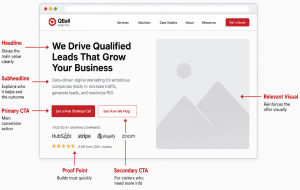
A homepage hero section should quickly explain what the company does, who it helps, what outcome it creates, and what the visitor should do next.
The hero section usually includes the headline, subheadline, primary CTA, secondary CTA, supporting proof, and a relevant visual. Because it appears at the top of the page, it carries a heavy communication burden. Visitors should be able to understand the core offer before scrolling.
A strong hero section typically includes:
- A clear headline: This should communicate the main value, not just the brand personality.
- A clarifying subheadline: This should explain who the offer is for, what the company does, and what result it helps create.
- A primary CTA: This should guide high-intent visitors toward the next conversion step.
- A secondary CTA: This should support visitors who need more information before converting.
- A proof cue: This may be a client logo, review rating, quantified result, certification, or short trust statement.
- A relevant visual: This should reinforce the offer, process, product, or outcome.
The hero section should not be overloaded with temporary announcements, multiple competing offers, long paragraphs, or vague brand slogans. The purpose is not to say everything. It is to create enough clarity for the visitor to continue confidently.
How Do You Write a Clear Homepage Value Proposition?
A clear homepage value proposition names the audience, identifies the problem or goal, explains the solution, and shows why the company is a better choice.
A useful formula is:
Audience + problem or goal + solution + outcome
For example:
Weak: “We provide innovative digital marketing solutions.”
Stronger: “We help service businesses turn paid traffic into qualified leads with clearer landing pages, smarter campaigns, and conversion-focused UX.”
The stronger version works because it gives visitors more information. It identifies the audience, explains the type of work, and connects the work to a measurable business outcome.
The best value propositions avoid empty claims. Words like “innovative,” “world-class,” “cutting-edge,” “full-service,” and “results-driven” are not automatically wrong, but they are often too vague unless supported by specifics. Visitors have seen those phrases everywhere. They need concrete reasons to believe you.
A clear value proposition should also pass the “could any competitor say this?” test. If the answer is yes, the message is not specific enough. Add details about your audience, process, expertise, speed, specialization, proof, or measurable outcomes.
For QBall Digital, homepage messaging should focus on business clarity and conversion impact, not just design or marketing activity. The strongest positioning would connect UX, messaging, PPC performance, and lead quality into one clear promise: helping businesses make their homepage easier to understand and easier to act on.
How Can You Make Homepage Messaging Match Visitor Intent?
Homepage messaging should reflect what visitors already need, fear, compare, and want to accomplish when they land on the site.
A paid search visitor may arrive with a specific problem, such as improving conversion rates, redesigning a homepage, or fixing poor PPC lead quality. An organic visitor may be researching best practices. A referral visitor may already trust the company somewhat but still needs to confirm fit. Each visitor type brings a different level of awareness.
Message match is especially important in PPC. Google says landing page experience includes the expectations users have based on the ad they clicked. If the ad promises help with homepage UX and the homepage opens with a vague agency slogan, the visitor may feel that the page does not match their intent.
To improve intent alignment, use customer and campaign data. Helpful sources include:
- Customer interviews
- Sales call notes
- Form submissions
- Live chat logs
- Search query reports
- PPC ad copy performance
- Heatmaps and session recordings
- Customer reviews and testimonials
- Common objections heard by sales teams
Look for repeated phrases. What exact words do customers use to describe their problem? What outcomes do they ask for? What makes them hesitate? What alternatives are they comparing?
Good homepage messaging often comes from the customer’s language, not the company’s internal terminology. HubSpot’s copywriting guidance also emphasizes that strong copy starts with understanding the audience’s struggles, objectives, and decision-making drivers.
What Homepage Messaging Best Practices Improve UX?
The best UX-focused homepage messaging practices reduce mental effort, use familiar language, organize information predictably, and make the next step obvious.
Homepage UX and homepage messaging are closely connected. A visually clean page can still feel difficult if the message is unclear. A message can be strategically strong but still fail if the layout hides it, fragments it, or presents it in the wrong order.
The most important UX-focused homepage messaging best practices include:
Use the customer’s language. Visitors should recognize their problem and goal in your words. Avoid internal labels that only your team understands.
Keep the top section focused. The hero should communicate the primary value proposition, not every service, announcement, promotion, and brand statement at once.
Create a logical message hierarchy. Start with the core promise, then explain the problem, solution, proof, process, services, objections, and next step.
Avoid competing CTAs too early. Too many equal-weight actions create choice friction. Prioritize the action that best matches your business goal and visitor intent.
Use descriptive navigation labels. Labels like “Services,” “Case Studies,” “Pricing,” and “Contact” are usually more helpful than clever branded terms.
Support claims with evidence. If you say you improve conversions, show case studies, numbers, testimonials, or examples.
Make the mobile version equally clear. Many teams refine desktop messaging but allow the mobile hero to become cramped, cropped, or less readable.
Keep copy scannable without making it shallow. Short sections help readability, but oversimplified messaging can leave high-intent buyers without enough information to trust you.
Nielsen Norman Group’s homepage principles also support this approach, emphasizing simplicity, clear purpose, engaging content, and prompting users to act. Baymard’s UX research database similarly highlights the importance of evidence-backed UX decisions based on large-scale usability testing and best-practice guidelines.
How Should Social Proof Support Homepage Messaging?
Social proof should reinforce the main promise by showing that credible people or companies have trusted the business and achieved relevant outcomes.
Many homepages include proof, but not always in the most persuasive way. A row of logos can build familiarity. A testimonial can create trust. A case study can show results. But proof works best when it appears near the claim it supports.
If your homepage says you improve lead quality, include a testimonial or case study snippet about better lead quality nearby. If your page says you help businesses improve PPC ROI, show a measurable PPC-related result. If your homepage says you specialize in a specific industry, show client logos or examples from that industry.
Effective social proof can include:
- Customer logos
- Testimonials
- Case study snippets
- Review ratings
- Certifications
- Award
- Partner badges
- Before-and-after examples
- Data-backed outcomes
- Recognizable client names
- Industry-specific proof points
Specific proof is stronger than vague praise. A testimonial that says “They were great to work with” is nice, but it does not support a conversion claim. A testimonial that says “QBall Digital helped us clarify our homepage message and increase qualified inquiries from paid traffic” is more relevant because it connects the service to a business outcome.
Social proof should not be treated as a separate design element. It should be part of the messaging system.
How Do CTAs Fit Into Homepage Messaging?
CTAs translate homepage messaging into action by telling visitors what step to take once they understand the value.
A strong CTA is not just a button. It is the logical next step after the page has explained the offer, created relevance, answered objections, and built trust. If the page has not done those things, the CTA may feel abrupt or unclear.
Primary CTAs should usually be direct and conversion-oriented. Examples include:
“Book a Strategy Call”
“Request a Homepage UX Review”
“Get a Conversion Audit”
“Talk to a PPC Strategist”
Secondary CTAs should support visitors who are interested but not ready to convert. Examples include:
“View Case Studies”
“See Our Process”
“Explore Services”
“Learn How It Works”
Generic CTAs like “Submit,” “Click Here,” or “Learn More” can work in some contexts, but they often miss an opportunity to reinforce value. More specific CTA copy reduces uncertainty by telling visitors what they will get after clicking.
The best homepage CTAs are consistent without being repetitive. A homepage can repeat the same primary action in multiple sections, but each placement should feel contextually earned. For example, a CTA after the hero may invite visitors to book a call. A CTA after a proof section may invite them to see similar results. A final CTA may invite them to request a review.
How Do You Audit Your Homepage Messaging?
You audit homepage messaging by checking whether a new visitor can quickly understand the offer, audience, value, proof, and next step.
A useful audit does not start with personal preferences. It starts with clarity, relevance, and evidence. CXL describes conversion research as a systematic search for useful information about customer behavior using quantitative and qualitative methods to build testable hypotheses. That mindset is valuable for homepage messaging because the goal is not just to make the page sound better; it is to identify what is preventing visitors from taking action.
Use these tests:
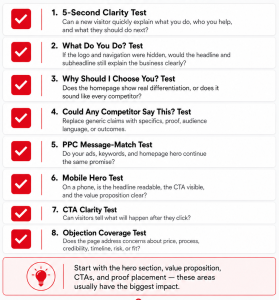
A homepage audit should produce a prioritized list of messaging changes. Start with the hero section, value proposition, CTAs, and proof placement because those areas usually have the biggest impact on clarity.
When Should You Update Your Homepage Messaging?
You should update homepage messaging when your audience, offer, positioning, traffic source, competitive landscape, or conversion performance changes.
Homepage messaging is not something you write once and ignore for years. Your business evolves. Your customers’ expectations change. Competitors adjust their positioning. Your PPC campaigns may start targeting different keywords, industries, or levels of buyer awareness.
Common signs that your homepage messaging needs an update include:
- You launched a new service or product.
- Your paid traffic is not converting efficiently.
- Your sales team says leads are confused.
- Your bounce rate or engagement metrics look weak.
- Your homepage sounds too similar to competitors.
- Your company has repositioned or specialized.
- You are targeting a new industry or buyer type.
- You have stronger proof than what appears on the site.
- Your CTAs no longer match your sales process.
- Your homepage headline does not explain what you do.
Sales feedback is especially useful. If prospects regularly ask questions your homepage should already answer, your messaging may be creating unnecessary work for your sales team.
Analytics can also reveal problems. Low engagement, weak conversion rates, poor scroll depth, and high drop-off from PPC traffic may indicate that visitors are not seeing enough relevance or clarity.
Can Better Homepage Messaging Improve PPC ROI?
Yes. Better homepage messaging can improve PPC ROI by increasing message match, reducing wasted clicks, improving lead quality, and helping visitors understand the offer faster.
PPC traffic is high-stakes because each click has a cost. If a visitor lands on a homepage and cannot quickly understand the offer, the campaign may lose money even if the keyword targeting and ad copy are strong. The landing experience must continue the promise that earned the click.
Google has also emphasized the importance of relevant content and easy-to-navigate landing pages in search ads, stating that improvements to landing page navigability can help users find what they are looking for and help drive long-term value for advertisers.
Dedicated landing pages are often better for tightly focused PPC campaigns, especially when the offer, audience, or keyword intent is specific. But many businesses still send branded search, retargeting, referral, and broad discovery traffic to the homepage. In those cases, homepage messaging becomes part of the paid media funnel.
Better homepage messaging can support PPC in several ways. It can confirm that the visitor is in the right place. It can reinforce the ad promise. It can clarify the business’s value before the visitor compares alternatives. It can route different visitor segments to the right service or offer. It can also improve lead quality by making the company’s positioning clearer before someone fills out a form.
For QBall Digital’s audience, this is the key takeaway: homepage messaging is not just a website improvement. It is a conversion asset. When your homepage explains your value clearly, paid and organic traffic both have a better chance of turning into qualified leads.
FAQ
What is the most important part of homepage messaging?
The most important part of homepage messaging is the value proposition. Visitors need to quickly understand what you offer, who it is for, and why it matters. If the value proposition is unclear, the rest of the page has to work harder to recover visitor confidence.
The hero headline and subheadline usually carry the value proposition. They should be specific enough to communicate the core offer without forcing visitors to scroll, click, or interpret vague brand language.
How long should homepage copy be?
Homepage copy should be long enough to create clarity, trust, and action, but not so long that it overwhelms visitors. There is no universal word count because different businesses require different levels of explanation.
A simple local service may need concise copy and strong proof. A complex B2B solution may need more depth, including use cases, process explanations, testimonials, FAQs, and objection handling. The goal is not short copy or long copy. The goal is useful copy.
Should a homepage headline include the target keyword?
A homepage headline can include the target keyword when it sounds natural and supports clarity. However, the headline’s first job is to help visitors understand the offer. Forcing a keyword into the headline can make the message feel awkward or overly SEO-driven.
For a blog article, using the keyword homepage messaging best practices is appropriate because the article is educational. For an actual business homepage, the best headline should prioritize the company’s offer, audience, and outcome.
What makes a homepage message confusing?
A homepage message becomes confusing when it is vague, overly clever, too broad, filled with jargon, or disconnected from visitor intent. Confusion also happens when the visuals, CTAs, navigation, and proof points do not support the same core message.
A simple way to spot confusion is to ask a new visitor what the company does after viewing the homepage for a few seconds. If their answer is incomplete, inaccurate, or uncertain, the messaging needs work.
How do I know if my homepage messaging is working?
You know homepage messaging is working when visitors can quickly explain what you do, understand why it matters, and take the intended next step. Analytics, user testing, heatmaps, session recordings, conversion rates, and sales feedback can all help validate performance.
Qualitative feedback is especially useful. If better-fit leads start referencing your homepage language in sales calls, that is a strong sign your messaging is connecting.
Should my homepage focus on brand story or conversion?
Your homepage should support both, but clarity and conversion should usually come first. Visitors need to understand the offer before they care deeply about the brand story.
Brand story can strengthen trust once the visitor understands relevance. It may appear lower on the page through founder perspective, mission, values, process, or customer impact. But the top of the homepage should prioritize orientation, value, and action.
How often should homepage messaging be tested?
Homepage messaging should be reviewed whenever there is a meaningful change in your audience, offer, traffic source, competitive positioning, or conversion performance. For active PPC campaigns, messaging should be monitored regularly because paid traffic can reveal clarity problems quickly.
Testing does not always require a full redesign. You can test headlines, subheadlines, CTA copy, proof placement, service descriptions, and page hierarchy before committing to major design changes.
Conclusion
Homepage messaging works when it gives visitors instant clarity, lowers friction, supports the user experience, and guides people toward the right next step. The strongest homepages do not rely on clever slogans or generic claims. They explain the offer clearly, reflect visitor intent, support claims with proof, and make action feel natural.
For businesses investing in PPC, homepage messaging is especially important. Paid traffic magnifies every clarity problem because each confused visitor may represent wasted spend. When your homepage message matches the visitor’s need, explains your value quickly, and builds trust with relevant proof, your website becomes more than a brand asset. It becomes a stronger conversion engine.
Why QBall Digital is Your Ideal Choice for Homepage Messaging Best Practices?
QBall Digital understands that homepage messaging is not just about writing better words. It is about creating a clearer path from visitor attention to qualified lead conversion. By combining UX thinking, PPC awareness, and conversion-focused strategy, QBall Digital helps businesses identify where homepage confusion is costing them opportunities.
A strong homepage should make your offer easy to understand, your proof easy to believe, and your next step easy to take. QBall Digital can help turn vague messaging into a sharper, more persuasive experience that supports both organic visitors and paid traffic. That means your homepage can work harder across campaigns, sales conversations, and customer journeys.
For businesses spending money on PPC, this clarity is critical. Every click should land on a page that continues the promise made in the ad and gives visitors confidence to move forward. QBall Digital helps align homepage messaging with buyer intent, conversion goals, and measurable business outcomes.
Turn More Homepage Visitors Into Leads With QBall Digital
Your homepage should not leave visitors guessing. QBall Digital can help you clarify your message, strengthen your homepage UX, and create a conversion-focused experience that supports better lead generation.
Request a homepage messaging and UX review from QBall Digital to uncover where visitors may be getting confused and how your homepage can convert more of the traffic you already earn.