
Hiring social media management in Indianapolis is one of those decisions that looks simple until you compare proposals and realize two vendors can quote wildly different prices for what sounds like “the same thing.” The fastest way to avoid overpaying (or under-buying) is to treat social management like any other operational service: define scope, demand specific deliverables, and compare proposals with a scorecard instead of vibes.
This guide breaks down realistic pricing ranges, what should be included at each tier, and the red flags that signal you’re about to pay for “posting” instead of outcomes.
What does “social media management” actually include for an Indianapolis business?
At a minimum, “social media management” should include strategy + execution + measurement:
- Strategy: goals, audience positioning, content pillars, platform selection, and a publishing plan
- Execution: content planning, copywriting, creative production, scheduling/posting, and approvals
- Community: monitoring comments/DMs, routing leads, and reputation-aware responses
- Measurement: monthly reporting tied to business goals, plus what will change next month
What’s often extra (and should be labeled clearly): paid social ad management, professional photography/video shoots, influencer/UGC sourcing, advanced social listening, review/reputation management, or multi-location coordination.
Competitor pricing guides highlight that costs rise quickly with platform count, content complexity, and stakeholder approvals—which is why “one number” is never the full story.
How much does social media management in Indianapolis typically cost, and what ranges are actually realistic?
Most small businesses land in a few common brackets, largely depending on scope:
- Small business monthly spend: often cited around $500–$2,500/month (usually 1–2 platforms with basic cadence)
- Retainer tiers many buyers see:
- $750–$1,500/month (basic)
- $1,500–$3,000/month (mid-tier)
- $3,000–$7,000+/month (premium/multi-platform with deeper analytics and often add-ons)
Here’s the buyer reality in Indy: you’re not paying for “posts.” You’re paying for creative time + account management + community coverage + reporting + tools. Even common professional tools can be billed into overhead (or added as line items). For example, Sprout Social lists pricing starting at $199 per month (plan details vary and are typically per user).
What makes quotes jump:
- More platforms + more formats (especially short-form video)
- Higher frequency + more unique creative (not templates)
- Faster approvals + more revisions
- More community management coverage (DMs/comments)
- Better reporting (UTMs, conversion tracking, lead quality feedback)
What pricing model should you choose—monthly retainer, hourly, or project—and when does each make sense?
Monthly retainers are most common because social results compound with consistent testing and iteration. Competitor guides describe retainers as the best fit for ongoing planning, posting, engagement, and reporting.
Hourly works when you need:
- an audit, a strategy build, or cleanup
- overflow coverage during promotions
- training your internal team
Typical published ranges vary by provider type (freelancer vs agency).
Project-based is best for defined outcomes:
- profile setup/optimization
- a content “bank” build (e.g., 30 days of posts)
- a short campaign package
(Just know it won’t include ongoing optimization unless you add it.)
What deliverables should be non-negotiable in any monthly package?
If you pay a monthly fee, insist on a scope that answers: What will you do, how often, and how will we know it’s working?
Non-negotiables:
- Discovery + baseline audit (before posting)
- Goals + KPIs aligned to your sales process
- Content pillars (3–6 themes your audience actually cares about)
- Monthly content calendar with a clear approval workflow
- Creation + publishing cadence (by platform and format)
- Community management standards (what’s monitored, response time expectations, escalation rules)
- Monthly reporting + action plan (not just charts—what changes next month?)
- Asset ownership clarity (you keep your content and access)
Pricing frameworks from agency-focused guides repeatedly call out that deliverables vary based on accounts, client size, and execution complexity—so get it in writing.
How do deliverables change by tier (and what should you expect at $1k, $2.5k, $5k+ per month)?
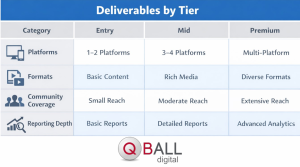
Use tiers as a scope signal, not a promise.
Around $750–$1,500/month (basic)
- 1 platform (sometimes 2), lighter cadence
- templated design is common unless specified
- limited community coverage
- basic reporting
Published retainer tiers commonly place “basic” in this band.
Around $1,500–$3,000/month (mid-tier)
- 2–3 platforms, more unique creative
- clearer strategy time included
- better reporting and iteration
- some light short-form video or higher-effort creatives
$3,000–$7,000+/month (premium)
- multi-platform, more original creative (especially video)
- deeper analytics, testing, and tighter feedback loops
- often includes add-ons or coordination (but confirm!)
Quick sanity check: If a proposal promises premium outcomes but won’t specify deliverables (post count, formats, engagement coverage, reporting cadence), treat it as a risk.
How many posts per week do you actually need to see results for local services?
Most Indianapolis service businesses don’t need “daily posting” to win. They need:
- consistent publishing,
- content that builds trust (proof, process, outcomes),
- and a feedback loop to improve what converts.
A practical starting point for many local/service brands:
- 3–5 posts/week on your primary platform(s)
- Stories or short updates when you have real-time moments (jobs, events, behind-the-scenes)
- 1–2 short-form videos/week if video is part of your growth strategy (or if your category is video-led)
The key is not frequency in isolation—it’s repeating what works and turning audience response into better creative.
Which platforms should an Indianapolis service business prioritize first and which ones can wait?
The best platform choice is the one that matches how your customers decide. If your buyers are local homeowners and families, Facebook and Instagram often matter because that’s where people browse, ask for recommendations, and judge credibility. If you’re B2B or your customers are professionals, LinkedIn can be a lead driver when content is built around expertise and outcomes. YouTube can be an asset if you can commit to producing helpful video consistently, because it compounds differently than purely feed-based platforms.
Pew Research continues to show YouTube and Facebook as the most widely used among U.S. adults, with Instagram also widely used—though platform choice should still be tied to your audience and offer, not usage alone.
How should social media management connect to leads, not just likes?
Social should function like a credibility engine. It’s where someone checks you out after hearing about you, and where someone gets comfortable enough to take the next step. That means your social plan should intentionally produce content that reduces uncertainty—what you do, who you help, what results look like, what it costs (at least in range), how the process works, and what to do next.
When social management is done well, “lead content” isn’t spammy. It’s simply clear. It makes it easy to contact you, easy to trust you, and easy to understand whether you’re the right fit.
What KPIs and reporting should you expect—and what “good reporting” looks like in month 1, 2, and 3?
Month 1 (baseline + early signals)
- reach/impressions trends
- engagement quality (comments, saves, shares—not just likes)
- profile actions (visits, clicks, DMs)
- top content themes and formats
Month 2 (testing + iteration)
- creative testing outcomes (what improved reach, saves, clicks)
- audience and timing insights
- early lead indicators (form starts, calls, booked consults)
Month 3 (directional ROI)
- lead volume and lead quality notes
- conversion path improvements
- next-quarter recommendations
Also: if you use endorsements, creators, or reviews in content, compliance matters. The FTC’s guidance emphasizes clear disclosure of material connections for endorsements/influencers and proper handling of reviews.
What should the first 30 days look like when you hire a social media manager?
If someone says “we’ll start posting next week” with no discovery, that’s a known bad pattern. A red-flag list explicitly calls this out as a sign they haven’t learned your audience, goals, voice, competitors, or content pillars.
A credible first 30 days:
- Week 1: discovery, access, audit, goal/KPI alignment
- Week 2: content pillars, offer mapping, calendar draft, creative direction
- Week 3: build and approve first batch; tracking setup (UTMs, landing page alignment)
- Week 4: publish, monitor, capture learnings, and adjust next month’s plan
What are the biggest red flags in social media proposals—and what you should see instead?
These are the “don’t sign yet” signals (with what to demand instead):
- “We guarantee 10K followers in 3 months.”
Red-flag lists note follower guarantees often imply bots or fake growth. Demand a plan focused on audience-fit content + measurable business outcomes. - No discovery phase, immediate posting.
Demand an onboarding/audit period and documented strategy. - No shared content calendar or approval workflow.
Demand calendar visibility at least a week ahead and clear approval timing. - Reports are vanity metrics only (followers/likes screenshots).
Demand engagement quality, reach, clicks, and lead tracking where possible. - Pricing isn’t transparent; everything becomes an “extra.”
Demand a list of included posts, formats, revisions, community hours, reporting cadence, and exclusions.
What questions should you ask before signing—so you don’t pay for “posting” instead of outcomes?
Bring this checklist to every call:
- Who creates what? (copy, design, video editing—names/roles)
- How many revisions are included and what’s the turnaround time?
- What’s the monthly deliverables list (post count, formats, platforms, stories/reels, etc.)
- How do you handle community management? (hours covered, response expectations, escalation)
- What does reporting include—and what will you change next month based on it?
- How do you connect social to leads? (UTMs, landing pages, call tracking, CRM notes)
- What’s excluded? (photo/video shoots, ads, influencer, reputation management)
- Who owns the assets and the accounts if we end the contract?
When comparing packages, multiple guides emphasize: don’t compare prices, compare value—and demand a breakdown of what’s included.
How do you compare two proposals side-by-side without getting fooled by “more posts”?
Use a simple Proposal Scorecard (rate each 1–5):
Scope clarity
- Deliverables list is specific (counts, formats, platforms)
- Exclusions are explicit
Strategy
- Discovery phase exists
- Content pillars + testing plan included
Creative quality
- Custom design, not templates-by-default
- Video capability (if needed)
Community coverage
- Defined hours + response expectations
Reporting
- Includes reach + engagement quality + traffic/leads
- Includes next-steps plan (not just charts)
Risk control
- Pilot option (90 days) and fair termination terms
- Asset ownership + access documented
Why this works: even competitor guidance on price comparison points out that a higher quote often includes custom creatives, analytics, and ad management—while cheaper options may rely on stock visuals and no tracking.
When does it make sense to hire in-house vs. outsource in Indianapolis?
Outsource when you need consistent output and strategy but don’t have internal bandwidth for:
- creative production
- scheduling and community monitoring
- monthly reporting and iteration
In-house can win when:
- you have constant real-time content opportunities (events, teams in the field)
- approvals must be instant
- the brand voice is highly technical and hard to translate
A hybrid model is common: outsource strategy + production, keep raw content capture and subject-matter input in-house.
What results are realistic in the first 90 days for a local/service business—and what isn’t?
Realistic in 90 days:
- a stable content engine (consistent cadence + approvals)
- clarity on best-performing pillars and formats
- improved engagement quality and profile actions
- early lead indicators (DMs, clicks, calls), especially if tracking is set
Not realistic:
- guaranteed follower spikes
- “viral” as a strategy
- immediate, perfectly attributable ROI without tracking setup and offer alignment
Published pricing and red-flag guides emphasize the need for clear KPIs and accountability windows (often recommending a 90-day pilot rather than locking into long contracts).
FAQ
Is social media management worth it for a local service business in Indianapolis?
Yes—when it’s tied to trust-building content + a lead path (profile → proof → CTA → tracking). If it’s just “posting,” it’s usually not worth it.
What’s a fair monthly minimum if I only need one platform managed?
Many published ranges place small business support in the $500–$2,500/month band depending on cadence and complexity, with “basic” retainers often around $750–$1,500/month for 1–2 platforms.
Should paid social ads be included in social media management pricing?
Not automatically. Ads are often a separate scope (strategy, creative, tracking, optimization). If it’s included, confirm what’s covered (campaign setup, reporting, budget management).
Who owns the content and accounts if we end the contract?
You should. Asset ownership and admin access should be documented up front. If a vendor won’t agree, treat it as a risk.
How can I tell if an agency is using templates across clients?
Ask to see recent work across multiple industries. If everything shares the same layouts/fonts with logos swapped, that matches a common red flag described in agency vetting lists.
What contract terms are reasonable (and which are risky)?
Reasonable: a 90-day pilot or short initial term with a clear scope and termination notice. Risky: long minimum contracts with no performance clauses or vague scopes.
Conclusion: How do you budget confidently for social media management in Indianapolis?
For social media management Indianapolis buyers, the smartest approach is simple: treat every proposal like a scope document. Pricing varies because the work varies—platforms, formats, creative depth, community coverage, and reporting maturity all change the true cost.
If you demand non-negotiable deliverables, avoid the known red flags, and compare offers using a scorecard, you’ll end up with a partner who can build momentum instead of just filling a calendar.
Why is QBall Digital Your Ideal Choice for Social Media Management in Indianapolis?
QBall Digital is built for buyers who want clarity, not confusion. Instead of vague “we’ll handle your socials” promises, you get a defined scope: onboarding that starts with discovery, content pillars tied to what your customers actually care about, and a monthly plan you can review before anything goes live. That structure protects your brand voice and ensures you’re paying for intentional work—not random posting.
Just as important, QBall Digital focuses on outcomes you can feel. That means reporting that goes beyond vanity metrics, a repeatable creative testing process to improve performance over time, and a practical path from attention to action—profile optimization, proof-driven content, and clear CTAs. If you’re hiring to drive leads and trust (not just likes), the process is designed to do exactly that.
Ready to Make Social Media Predictable and Profitable with QBall Digital?
If you’re comparing proposals—or already paying for social media and not sure what you’re getting—QBall Digital can help you tighten scope and expectations fast. Bring your current channels (or a proposal you’re considering), and we’ll identify quick wins, clarify what deliverables matter most, and map a 90-day plan tied to real business goals.