
 If you’re shopping for Google Ads management Indianapolis, you’re not really buying “someone to run ads.” You’re buying a system: strategy, tracking, campaign architecture, ongoing testing, and decision-making that turns ad spend into measurable revenue—while preventing waste that quietly compounds every week.
Below is what a legitimate management engagement usually includes, how agencies price it, and how to tell whether you’re getting value or just activity.
What does “Google Ads management” actually include beyond “running ads”?
At its core, management is the work of translating business goals into an account structure Google can optimize—and then actively steering that structure toward profitable outcomes.
A strong engagement typically covers three layers:
- Media execution: building campaigns, ads, assets, targeting, and budgets.
- Account management: monitoring performance, making controlled changes, and maintaining “hygiene” (like search term reviews and negatives) so waste doesn’t creep in.
- Conversion strategy: ensuring the account is optimizing to the right outcomes with reliable measurement (forms, calls, purchases, qualified leads), not vanity metrics.
The biggest difference between “someone who can launch ads” and “management you pay for” is measurement and iteration. If conversion tracking is weak, optimization becomes guesswork—and automated bidding can chase the wrong signals. Google’s guidance on conversion tracking (via the Google tag or Tag Manager) makes it clear that conversion tags exist to measure what happens after the click, which is the basis for optimization.
What are the main ways agencies price Google Ads management?
There isn’t one universal “right” model. Pricing is usually a reflection of expected time, expertise, and scope.
Common pricing models you’ll see:
- Flat monthly fee: predictable billing, often aligned to a defined scope.
- Percentage of ad spend: fee scales as spend increases; can be simple, but may misalign incentives at higher budgets.
- Hybrid (base + %): common because it covers baseline work while scaling for complexity.
- Hourly / consulting: good for audits, cleanup projects, or coaching an internal team.
- Performance-based: rare because attribution, seasonality, lead quality, and sales process variables can distort what “performance” means.
Clutch’s PPC pricing guide describes these models (flat fee, percent of spend, performance-based, hybrid) and provides a market view of agency rates. Search Engine Journal also emphasizes that “what you should pay” depends heavily on scope and expertise—so comparing proposals requires looking at deliverables, not just the number.
What are you paying for in month 1 compared to month 2+?
Month 1 is build + baseline. You’re paying for the foundational work that determines whether future optimization is efficient or chaotic.
That usually includes:
- account and campaign structure
- keyword and intent mapping
- initial ad copy and extensions/assets
- tracking setup and validation
- budget and bidding approach
- initial launch QA (to catch obvious waste early)
Month 2+ is optimization + compounding gains. This is where consistent management pays off: reducing irrelevant traffic, improving conversion rates, and allocating budget toward what actually produces qualified leads or revenue.
If an offer seems “cheap” because month 1 is essentially a launch with little tracking rigor, you often pay later via:
- inflated cost per lead from low-intent searches
- bad geo targeting that pulls in out-of-area clicks
- bidding strategies optimizing toward wrong or duplicate conversions
- reporting that can’t explain what’s happening
Google’s documentation on bid strategy learning makes a key point: after significant changes, automated strategies may show a learning status while they recalibrate. That’s normal—but it only helps if the conversion signals feeding the system are accurate.
What should a legit Google Ads setup deliverable list look like?
A real setup should feel like a package of tangible deliverables, not a vague promise to “optimize.”
Here’s what a strong setup typically includes:
1) Account and campaign architecture
- Clear separation by intent and business priority (brand vs non-brand, high-intent services vs exploratory)
- Campaign types selected intentionally (e.g., Search for direct intent; Performance Max if assets + tracking support it)
2) Keyword and intent mapping
- A plan for high-intent coverage (the searches most likely to become revenue)
- Guardrails for match types and expansion so you don’t pay for “research” traffic
3) Ad copy frameworks + ad assets
- Multiple angles for testing (price/value, speed, credibility, guarantees, location convenience)
- Proper use of assets to increase relevance and screen real estate
4) Audience strategy
- Remarketing foundations (site visitors, engaged users, customer lists where appropriate)
- Observation vs targeting decisions based on volume
5) Location targeting and exclusions
- A documented plan for city vs metro reach, radius, and exclusion zones
- Checks on “advanced location options” so you don’t accidentally target people merely interested in the area
Google explains advanced location options and the difference between reaching people in a location versus people who show interest in it—something that can drastically change lead quality for local services.
6) Conversion tracking + analytics readiness
- Form submission tracking that fires once (no duplicates)
- Call tracking plan (calls from ads and calls from the website)
- Confirmation that conversions appear correctly in Google Ads
Google’s guidance on using Tag Manager for Google Ads conversions reinforces that conversion tags are meant to measure post-click actions like purchases, sign-ups, or calls.
How do tracking and measurement change what you’re paying for?
Tracking determines whether you’re paying for marketing or gambling.
When tracking is correct, you can:
- optimize toward outcomes (qualified leads, booked calls, purchases)
- segment performance by device, geo pockets, and intent
- use Smart Bidding with more confidence because the system has dependable signals
Google describes Smart Bidding as using auction-time signals and machine learning to optimize for conversions or conversion value. That’s powerful—but it’s only as good as what you define and measure as a “conversion.”
Common measurement failures that inflate costs:
- conversions firing on page loads instead of confirmed actions
- duplicate conversion fires (especially with form plugins)
- calls counted that are too short or spammy
- importing the wrong GA4 events without qualification
What ongoing work are you paying for every month?
This is the work that keeps performance from decaying and steadily improves profitability:
Search term hygiene + negatives
Search terms evolve constantly. Without ongoing reviews and negative keywords, you’ll pay for irrelevant queries that look “close enough” but don’t convert.
Bid strategy management
Smart Bidding can work well, but it needs stable signals and thoughtful changes. Big swings can trigger relearning; careful iteration reduces volatility.
Budget pacing + spend control
You’re paying for someone to prevent wasted spend when lead flow is weak, and to push budget into the campaigns/ad groups that consistently produce quality.
Ad testing that’s real testing
Testing should have a hypothesis (e.g., “credibility-first headlines will improve lead quality”) and a plan for evaluation—not random swaps.
Landing page feedback loop
A good manager flags friction: slow pages, weak above-the-fold clarity, mismatch between ad promise and page content, or forms that are too long.
Reporting that answers “what next?”
A proper report explains what changed, why performance shifted, and what will be tested next—grounded in the data.
What makes Google Ads management cost more or less in Indianapolis?
Local management costs are usually driven by competition and complexity, not just city size.
What can raise the workload:
- Competitive verticals (legal, home services, medical, B2B) where CPCs and lead filtering matter more
- Geo nuance (city vs metro vs radius) and excluding areas that generate low-quality calls
- Lead quality controls like call quality thresholds, scheduling alignment, and spam mitigation
A practical way to think about it: the more money at stake per lead—and the easier it is for junk traffic to slip in—the more “management” becomes a safeguard, not a luxury.
What is a fair management fee for your budget and complexity?
Instead of chasing a universal “fair number,” focus on whether the scope matches your reality.
Market signals you’ll commonly encounter:
- Agencies often structure fees as a flat fee, percent of spend, or hybrid.
- Many industry guides cite management fees frequently landing in the 10–20% of ad spend range for percentage models, with variation by scope.
A practical expectation check:
- If you’re spending enough to require weekly search term reviews, frequent ad testing, and tight geo/lead quality control, “too cheap” often means corners get cut where waste hides.
- If you’re spending at scale, a pure percentage model can become misaligned—hybrid pricing often makes more sense because the workload doesn’t always rise linearly with spend.
What fees should you expect besides management?
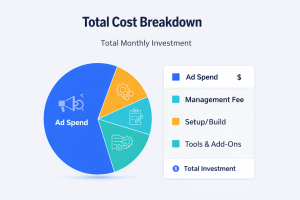
Most total costs fall into four buckets:
- Ad spend (paid to Google)
This is separate from management. - Setup/build fee (sometimes)
Often charged when there’s substantial creation work (new account build, tracking overhaul, landing page alignment). - Tools (as needed)
Call tracking, form tracking enhancements, CRM integrations, reporting dashboards. - Creative production (when applicable)
If you’re running asset-heavy campaign types, you may need images/video.
For example, Google’s guidance on Performance Max image assets shows how important proper creative inputs are to ad quality and delivery in those campaign types.
How can you tell if you’re getting value and not just activity?
Value shows up as better decisions and better outcomes, not busier-looking dashboards.
A few value-focused signals:
- Waste is steadily reduced (irrelevant queries, wrong locations, poor devices/times)
- Conversion rate improves because messaging and landing pages are aligned
- Cost per qualified lead stabilizes and then trends down as learnings compound
- Reporting makes clear what’s being tested and why
For context on how widely costs can vary by industry and how management affects outcomes, WordStream’s cost benchmarks highlight that overall spend and cost per lead differ substantially across businesses, reinforcing why optimization and lead quality matter.
What should monthly reporting include so you can make decisions confidently?
Good reporting is short, blunt, and decision-oriented:
- What changed since last month (campaign structure, bidding, budgets, ads, landing pages)
- What improved and what declined (with segmentation: device, geo pockets, time, intent)
- What we learned (which hypotheses were supported or disproven)
- What we’re doing next (prioritized tests and cleanup)
If reporting can’t answer “where did the waste go?” and “what’s the next lever to pull?” it’s usually not management—it’s status updates.
What are the biggest red flags in Google Ads management offers?
A few red flags reliably correlate with poor outcomes:
- They “own” the account or won’t provide full admin access
- Deliverables are vague (“optimizations”) with no specifics
- There’s no tracking plan or no verification process
- No mention of search term reviews or a negative keyword strategy
- Reporting focuses on impressions/clicks but can’t explain conversion quality
- Big changes are made constantly without acknowledging learning/recalibration effects
How do you compare agencies without getting tricked by pricing pages?
Use a simple comparison approach: scope clarity + measurement confidence + decision cadence.
Ask these questions:
- What are the setup deliverables in writing?
- How will conversions be defined, implemented, and validated?
- How often are search terms reviewed and negatives applied?
- What’s the testing plan for ads and landing pages?
- What does the monthly report look like—and what decisions does it enable?
- How do you handle big changes without destabilizing performance?
If two proposals cost the same but one includes real tracking validation and a testing plan, it’s usually the better buy—even if it feels less “salesy.”
What does a strong 90-day plan look like after you hire a manager?
A real plan balances speed with control.
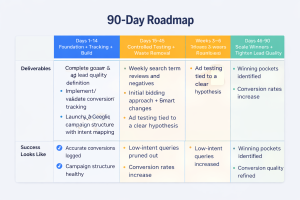
Days 1–14: Foundation + tracking + build
- confirm goals and lead quality definition
- implement/validate conversion tracking
- launch a clean campaign structure with clear intent mapping
Days 15–45: Controlled testing + waste removal
- weekly search term reviews + negatives
- initial bidding approach and measured iteration
- ad testing tied to a clear hypothesis
Days 46–90: Scale winners + tighten lead quality
- allocate budget toward best-performing intent segments
- refine geo targeting and exclusions using real lead data
- improve conversion quality signals so automation can optimize better
FAQ
How much ad spend do I need before hiring a Google Ads manager makes sense?
If you’re spending enough that wasted clicks meaningfully hurt profitability—or you don’t have time to review search terms, adjust budgets, and validate tracking weekly—management often pays for itself through waste reduction and better conversion rates. Many SMBs spend in the low thousands monthly, but “enough” is really about whether you can maintain disciplined iteration and measurement in-house.
Is Performance Max worth it for local Indianapolis businesses?
It can be, but it’s asset- and measurement-dependent. If you have strong creative assets and reliable conversion tracking, Performance Max can extend reach across Google’s inventory; if tracking is weak, it can optimize toward the wrong outcomes. At minimum, you should understand the asset requirements and ensure conversion actions are clean before leaning on it.
Should my management fee drop if my spend drops?
Not always. Some of the most time-intensive work (search term review, lead quality audits, tracking checks, landing page alignment) doesn’t shrink linearly with spend. This is why hybrid pricing is common—baseline work stays covered while complexity can scale.
Who should own my Google Ads account—me or the agency?
You should. Your business should retain access and ownership for continuity, transparency, and portability. Agencies can be admins and manage day-to-day, but you shouldn’t be locked out of your own data and history.
How long until Google Ads performance stabilizes after changes?
Significant changes—especially to automated bidding—can trigger a learning period while strategies recalibrate. Stability depends on conversion volume, change size, and signal quality, so a good manager makes changes deliberately and evaluates impact with discipline.
What you should expect when you pay for Google Ads management
What you’re paying for isn’t the act of turning ads on—it’s a repeatable process that protects your spend, improves decision-making, and compounds results over time. The strongest management relationships are defined by clear deliverables, accurate measurement, disciplined testing, and reporting that tells you exactly what’s happening and what’s next.
If you can’t see the tracking plan, the optimization cadence, and the strategy behind the structure, you’re not looking at management—you’re looking at maintenance.
Why QBall Digital is Your Ideal Choice for Google Ads management Indianapolis?
QBall Digital approaches Google Ads as a revenue system, not a dashboard exercise. That means your campaigns are built around real business outcomes—qualified calls, form leads that match your service area, booked appointments, or purchases—supported by measurement you can trust. When tracking is accurate and the account structure matches intent, optimizations stop being guesses and start becoming predictable improvements.
You’ll also get clarity. Instead of vague “we optimized your account” updates, QBall Digital focuses on decision-grade reporting: what changed, why it changed, and what the next test is—so you always understand where your budget is going and what it’s producing. The goal is simple: reduce waste, increase lead quality, and scale what works with confidence.
Get Started With QBall Digital
QBall Digital PPC Strategy Call: Know What You’re Buying Before You Spend More
If you’re considering management (or you’re not sure your current setup is efficient), book a strategy call with QBall Digital. You’ll walk away with:
- a clear breakdown of where waste typically hides in your account
- the tracking and lead-quality checks that matter most
- a practical 90-day plan to stabilize, improve, and scale performance