
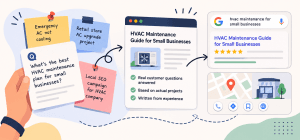
Businesses can create first-hand experience SEO content by documenting what customers ask, how employees solve real problems, which decisions are made during projects, and what happens afterward. Those details can then be organized around a relevant search question and supported by photographs, measurements, quotes, observations, or verified results.
The goal is not simply to write in the first person. It is to publish information that reflects genuine involvement—something a writer could not produce by summarizing the first page of search results. A structured SEO content strategy turns that everyday business knowledge into useful, searchable resources.
What Makes First-Hand Experience SEO Content Credible?
Credible experience-led content contains specific observations, decisions, constraints, and lessons from doing the work. Instead of saying, “We are experts,” it shows what the team encountered, what options were considered, why one approach was selected, and what others can learn from the outcome.
Google’s people-first content guidance asks whether content demonstrates first-hand expertise, provides original information, and leaves readers feeling that they learned enough to achieve their goal. It also encourages publishers to clarify who created the content, how it was produced, and why it exists. However, Google explains that E-E-A-T is not one individual ranking factor. It is a wider concept used when assessing whether content appears helpful and trustworthy.
Detail is what makes the difference. A contractor explaining why a certain material failed under unusual site conditions is more useful than a generic list of materials. A marketer showing how customer language changed an advertising campaign provides more value than repeating broad copywriting advice.
Which Everyday Business Sources Contain the Best Content Ideas?
The best source material is often already inside the business. It appears in customer calls, sales emails, job records, project photographs, support conversations, reviews, proposals, and team meetings.
Start with recurring customer questions. Questions asked before a purchase usually reveal uncertainty, objections, and comparison needs. Questions asked after a purchase may uncover installation problems, maintenance concerns, or gaps in existing instructions.
Next, review job and project records. A useful project story should identify the original problem, starting conditions, available options, action taken, complications encountered, and final recommendation. Even a project without dramatic results can produce a valuable lesson.
Customer reviews also reveal the language people naturally use to describe their needs and experiences. A structured reputation management process can help a business collect and monitor this feedback ethically. Never rewrite a customer’s statement to make the result sound stronger than it was.
How Do You Capture Useful Experience Without Slowing Down Your Team?
Use a short capture process that can be completed immediately after a call, job, or project milestone. The employee does not need to write the article. They only need to preserve the details that a writer would not otherwise know.
Ask six questions:
- What did the customer ask or need?
- What made the situation unusual?
- What options did the team consider?
- What action was taken, and why?
- What happened afterward?
- What would the team recommend next time?
Answers can be collected through a voice note, CRM field, shared form, project interview, or job-completion checklist. Attach relevant photographs, screenshots, diagrams, measurements, or approved customer comments while the details are still fresh.
Keep the process simple. A two-minute voice recording from a technician may contain more original insight than hours of general online research.
How Do You Turn Raw Project Notes Into a Search-Optimized Draft?
Raw experience becomes useful SEO content when it answers a genuine search need. Follow these five steps.
Step 1: Match the experience to a real question
Choose a query the project can answer completely. A home-service company might build an article around a recurring repair question. A professional-services firm might explain a decision customers commonly misunderstand.
Do not force a project into a high-volume keyword that it cannot properly address. Relevance first.
Step 2: Identify the unique lesson
Find the insight that makes the experience worth publishing. It may be an unexpected complication, a diagnostic clue, a cost tradeoff, a failed first attempt, or a situation where the standard recommendation did not apply.
That lesson should become the article’s central promise.
Step 3: Organize the information around the reader
Lead with a direct answer. Then explain the situation, the options, the process, the outcome, and the practical recommendation.
The company may be the source of the experience, but the reader should remain the focus. Avoid turning the article into a long advertisement or company diary.
Step 4: Add evidence
Support the account with available proof: approved project photographs, dates, anonymized quotes, measurements, timelines, screenshots, before-and-after observations, or documented outcomes.
Be precise about what the evidence establishes. One successful project does not prove that every customer will receive the same result.
Step 5: Optimize the useful draft
Once the substance is accurate, improve the title, headings, metadata, internal links, image descriptions, and page structure. Publish it on a fast, readable, mobile-friendly website and connect it to related services and educational marketing resources.
Google’s current guidance recommends creating original, expert-led material that adds value beyond common knowledge rather than recycling information that could easily be generated from existing pages.
How Can You Show Readers That the Experience Is Genuine?
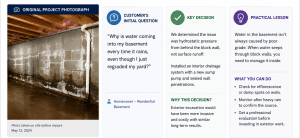
Name the person who performed or reviewed the work when appropriate. Include their role, relevant responsibilities, and connection to the subject. A short author biography can help readers understand why that person is qualified to explain the issue.
Use details that naturally emerge from the project: the conditions, tools, sequence of decisions, alternatives rejected, and limitations encountered. Original photographs and diagrams can strengthen the account, but only when they help explain the work.
Honesty matters too. Mention setbacks, uncertainty, and situations where a different solution may be better. Real projects are rarely perfect. Acknowledging that complexity often makes the guidance more useful and believable.
How Do You Protect Customer Privacy and Keep Project Claims Accurate?
Get written approval before publishing identifiable customer names, photographs, testimonials, addresses, or project details. When identification does not improve the lesson, anonymize the customer and remove sensitive information.
Have the employee involved review technical explanations before publication. Check dates, measurements, prices, and outcomes against original records. Quotes should reflect what the customer or employee actually said—not what would make the article more persuasive.
Businesses using testimonials must also avoid fake, false, or deceptive reviews. The Federal Trade Commission’s Consumer Reviews and Testimonials Rule addresses deceptive review practices and has been in effect since October 21, 2024.
How Should You Measure and Improve Experience-Led Content?
Measure visibility and business value, not rankings alone.
Google Search Console can show the queries that display a page, along with impressions, clicks, click-through rate, and other performance information. Review those queries to see whether the article is reaching the intended audience and whether readers are asking related questions that deserve additional coverage.
Also track calls, forms, bookings, downloads, and assisted conversions. A useful article may influence a customer who later returns through a branded search, advertisement, or direct visit.
Businesses running PPC and Google Ads campaigns can use their search terms report to discover the actual searches that triggered ads. Those terms can expose new objections, service questions, and wording customers use—valuable inputs for future organic content.
Frequently Asked Questions
Does every SEO article need a personal story?
No. Experience should appear when it adds proof, nuance, or practical value. A straightforward definition may need clear sourcing and expert review rather than a full project narrative. Do not add personal anecdotes simply to make a page appear more authentic.
Can AI help create experience-led content?
Yes, but its role should be limited. AI can organize interview notes, identify repeated themes, suggest headings, or improve clarity. It should not invent projects, quotations, customer reactions, test results, or outcomes.
What if a business has no formal case studies?
Start smaller. Choose one recurring customer question and interview the employee who handles it most often. Record a recent example, the options considered, and the recommendation given. That may be enough to create a genuinely useful article.
Should every customer question become a separate article?
Only when the question represents a distinct search need and requires a substantial answer. Closely related questions are usually better combined into one complete resource. Separate them when the search intent, audience, or required solution is meaningfully different.
What Should You Do With Your Next Customer Question?
The next useful article may begin during tomorrow’s sales call, support email, project visit, or team meeting.
Record the question. Capture the context. Save the evidence and ask the employee involved what they would recommend to someone facing the same situation. One carefully documented article based on real work can provide more lasting value than a collection of generic posts that repeat what readers can already find elsewhere.
Why QBall Digital Is Your Ideal Choice for First-Hand SEO Content?
QBall Digital connects customer insight, keyword research, content development, and on-page optimization to measurable business goals. The process begins with understanding what your customers need and what your team genuinely knows—not with filling a publishing calendar with generic topics. That approach helps turn real expertise into resources that are useful, relevant, and aligned with search intent.
Through its SEO services, web design, paid search, and reputation management capabilities, QBall Digital can help businesses build a connected path from discovery to conversion. Its team focuses on customized strategies for small businesses, startups, and nonprofits rather than applying the same formula to every organization. Learn more about why businesses choose QBall Digital.
Ready to Turn Real Work Into Search Visibility With QBall Digital?
Your customer conversations and completed projects already contain valuable marketing insights. QBall Digital can help you capture those insights, shape them into useful search resources, and connect the content to a strategy built to attract qualified customers.
Claim your free website and marketing audit with QBall Digital.