
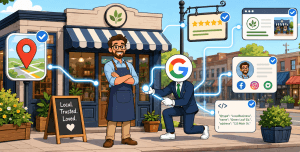
Entity SEO helps search engines recognize a small business as a distinct, trustworthy organization—not simply a website containing relevant keywords. An effective entity SEO for small business strategy connects accurate company information, useful content, structured data, business profiles, reviews, and credible third-party mentions.
Together, these signals help search engines understand who your company is, what it offers, where it operates, and how it relates to the topics customers search for.
Keywords still matter. They show what people are looking for. Entity SEO adds the missing context, allowing search engines to connect those searches with real businesses, services, people, places, and areas of expertise.
How Do Search Engines Recognize Your Business as a Real-World Entity?
Search engines compare information from your website with information found across business profiles, directories, reviews, social platforms, public databases, and third-party websites. Google explains that local business information may come from official websites, licensed data, business owners, users, and other publicly available sources.
Consider a local plumbing company. Its entity is not defined by the phrase “emergency plumber” alone. Search engines may associate the company with its legal name, phone number, service area, technicians, licenses, customer reviews, plumbing services, professional memberships, and the cities it serves.
The clearer and more consistent those relationships become, the easier it is to distinguish that plumber from a similarly named company in another state. No guessing. Just a connected set of facts pointing toward one identifiable business.
Which Signals Help Search Engines Verify and Trust a Small Business?
Search engines gain confidence when important facts about a business are specific, accessible, and supported by more than one reliable source.
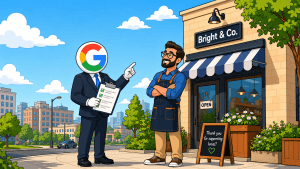
Is your website a clear source of truth?
Your website should clearly state your business name, services, contact information, locations or service areas, leadership, credentials, and company background. Important details should not be hidden in images, vague marketing language, or outdated pages.
An informative About page is especially valuable because it gives customers and search engines a central place to understand the company. Service pages, employee biographies, case studies, and location pages can then reinforce related details.
Do your business profiles confirm the same information?
Your Google Business Profile and other important listings should use accurate information that reflects how the company is represented in the real world. Google specifically recommends maintaining a precise address or service area, choosing focused business categories, and avoiding duplicate profiles.
Review your business name, phone number, website address, opening hours, categories, and service descriptions. Even small inconsistencies can create unnecessary ambiguity. QBall Digital’s guide to how SEO is becoming more locally focused provides additional context on building local relevance.
Are independent sources validating the business?
Third-party evidence can include customer reviews, local news coverage, professional associations, supplier pages, community partnerships, interviews, event sponsorships, and relevant business directories.
These mentions should be earned through genuine business activity. Creating dozens of low-quality listings or publishing artificial reviews does not build meaningful authority. A smaller number of accurate, reputable references is usually more useful than a large collection of unreliable ones.
What Should an Entity SEO for Small Business Checklist Include?
A practical checklist should begin with foundational business information before moving into content, schema, and authority building.
1. Define the business entity clearly
Document the company’s preferred name, business category, services, locations, service areas, leadership, credentials, founding information, contact details, and official social profiles.
This internal reference prevents different employees, agencies, and platforms from publishing conflicting information.
2. Strengthen the website as the entity home
Treat the official website as the primary source of information about the business. Make essential facts easy to locate on the homepage, About page, contact page, service pages, and location pages.
Remove outdated descriptions and explain services in specific language. “Complete property restoration after water damage” communicates more than “quality solutions for every need.”
3. Align external profiles and listings
Claim important profiles, correct outdated details, and resolve duplicates. Begin with Google Business Profile, Bing Places, major social platforms, industry associations, and reputable directories customers actually use.
Google notes that complete and accurate Business Profile information can improve a business’s ability to appear for relevant local searches.
4. Add appropriate structured data
Organization or LocalBusiness structured data can clarify details such as a company’s name, URL, logo, address, contact information, and external profiles. Google recommends using properties that accurately reflect the organization and provide value to users.
Depending on the page, Article, Breadcrumb, Person, Service, or other supported markup may also be appropriate. Schema should describe content that visitors can actually see. It should never be used to make unsupported claims.
QBall Digital’s SEO services can help businesses coordinate structured data with technical SEO, content planning, local optimization, and authority development.
5. Connect related content
Build content around the problems customers need to solve—not a random list of loosely related keywords. A central service guide might connect to pricing explanations, FAQs, case studies, maintenance advice, location pages, and comparisons.
Use descriptive internal links to make those relationships clear. Google uses links to discover pages and as a signal when evaluating relevance, while concise anchor text helps people and crawlers understand the destination.
6. Earn credible corroboration
Request honest customer reviews, participate in relevant local organizations, contribute expert insights, publish original case studies, and build relationships with reputable businesses or publications.
Authority develops through real expertise and recognition. Slowly, in many cases. But with greater long-term value than shortcuts.
How Do Content, Internal Links, and Schema Explain What Your Brand Knows?
Content shows the depth of your knowledge. Internal links show how that knowledge is connected. Structured data makes selected details more explicit in a machine-readable format.
Suppose an HVAC company publishes one generic article about air conditioners. That page offers limited evidence of broader expertise. A connected collection covering installation, repairs, energy efficiency, indoor air quality, common equipment problems, technician qualifications, and local climate considerations creates a much clearer subject relationship.
Internal links should guide readers naturally between these resources. QBall Digital’s on-site SEO tips explain additional page-level practices, while its guide to website design and user experience in SEO shows why clear navigation and accessible content matter.
Schema supports this foundation; it does not replace it. Google uses structured data to understand page content and information about people, organizations, and other identifiable things, but the markup must remain accurate and consistent with the visible page.
How Can Entity SEO Improve Local and AI Search Visibility?
Clear entity signals help search engines evaluate whether a business is relevant, legitimate, geographically connected, and appropriate for a particular query.
For local searches, that may improve the business’s eligibility to appear when customers search for a service, category, or nearby provider. Google states that local results are influenced by relevance, distance, and prominence, while accurate and complete profile details help the platform understand what a business does.
Entity clarity also supports visibility in AI-assisted search experiences. Google’s current guidance for generative AI search continues to emphasize foundational SEO, accessible pages, clear site structure, and unique, helpful, expert-led content.
There are no guaranteed placements. Still, a well-defined business gives search and AI systems stronger material to evaluate, connect, and potentially cite. QBall Digital explores this development further in its guides to AI’s effect on SEO and Google AI Overviews for local service businesses.
How Can You Measure Whether Search Engines Understand Your Brand?
Begin with branded searches. Does the correct company appear? Are the logo, website, profiles, address, services, and contact information accurate? Do unrelated or outdated results create confusion?
Next, use Google Search Console to monitor impressions and clicks for branded, service-related, and local queries. Its performance reports allow businesses to review data by query, page, country, and other dimensions.
Google Business Profile performance can show search terms, views, website clicks, calls, direction requests, messages, and other relevant interactions. Track qualified inquiries and sales alongside these visibility metrics. Rankings without meaningful customer action tell only part of the story.
For a phased implementation model, review QBall Digital’s first 90 days of small-business SEO.
Frequently Asked Questions
Is entity SEO the same as local SEO?
No. Local SEO concentrates on visibility for geographically relevant searches, while entity SEO also addresses brand identity, expertise, people, products, services, and relationships between topics. Local SEO is one important application of broader entity optimization.
Do keywords still matter in entity SEO?
Yes. Keywords reveal the language and questions customers use. Entities provide the context that helps search engines understand what those words represent and how they relate to a particular business.
Does a small business need a Wikipedia page?
No. Most small businesses do not meet Wikipedia’s notability requirements. A clear website, verified profiles, accurate listings, genuine reviews, professional memberships, and credible third-party mentions are more realistic priorities.
How long does it take to strengthen business entity signals?
Technical corrections may be completed quickly, but search engines still need time to recrawl pages and process updated information. Broader recognition and authority can take months because they depend on consistent signals, useful content, and independent validation. Google notes that some search improvements may appear within days, while broader site-level changes can take several months to be recognized.
What Should Your Small Business Do Next?
A practical entity SEO for small business plan begins with clarity. Audit your website, Google Business Profile, major directories, social accounts, search results, and third-party mentions. Correct conflicting facts before investing in advanced markup or large content campaigns.
Then build outward—better service pages, connected resources, accurate schema, customer reviews, and credible local or industry relationships.
When customers and search engines look for your company today, do they receive one clear and trustworthy story—or several conflicting versions?
Why QBall Digital Is Your Ideal Choice for Entity SEO?
QBall Digital helps small businesses build stronger digital foundations through search engine optimization, local visibility, content development, technical improvements, and conversion-focused web design. Rather than treating entity optimization as an isolated technical task, its team can connect business information, website content, profiles, and search strategy. The result is a more coherent online presence designed to attract relevant customers. Practical work tied to measurable business goals.
QBall Digital also understands that visibility must lead somewhere useful. Its broader digital marketing services combine SEO with paid advertising, social media, content, and website solutions to support the complete customer journey. Businesses receive a strategy shaped around their market, resources, and growth priorities. Clear recommendations. Transparent direction. No one-size-fits-all checklist.
Ready to Clarify Your Online Presence with QBall Digital?
Make it easier for search engines—and potential customers—to understand why your business is relevant and trustworthy. Contact QBall Digital to discuss an SEO strategy that strengthens your brand identity, local visibility, content, and long-term search performance.