
Most service businesses do not have a traffic problem first. They have a clarity, trust, and conversion problem.
A potential customer can arrive from Google, a referral, a social media post, or a paid ad and still leave within seconds if your website does not clearly explain what you do, who you help, why you are credible, and what they should do next. That is why website copywriting for service businesses needs to do more than sound professional. It needs to guide real people from interest to action.
For service providers, your website copy acts like a digital sales conversation. It answers buyer questions, reduces uncertainty, explains your value, and helps visitors decide whether to enquire, book a call, request a quote, or keep looking elsewhere. When your copy is clear and conversion-focused, every traffic source becomes more valuable — especially PPC traffic, where every click has a cost.
What Is Website Copywriting for Service Businesses?
Website copywriting for service businesses is the strategic writing used across a service provider’s website to explain the offer, build trust, handle objections, and persuade visitors to take a meaningful next step.
It is different from general content writing. A blog post might educate, inform, or attract search traffic. Website copy has a more direct commercial role. It appears on pages such as your homepage, service pages, landing pages, about page, contact page, and pricing sections. Its job is to help visitors understand whether your service is right for them and encourage them to act.
For a service business, this matters because the customer cannot physically inspect the service before buying. They are buying expertise, time, reliability, process, and expected outcomes. That makes the words on the page more important. Your copy needs to make the invisible feel clear and trustworthy.
Good service business copy usually answers questions such as:
- What problem do you solve?
- Who do you help?
- What exactly is included?
- Why should someone trust you?
- What results can the customer expect?
- How does the process work?
- What happens after they enquire?
- How much might it cost?
- What should they do next?
Search engines also reward pages that are useful to people, not pages written only to manipulate rankings. Google’s guidance emphasizes helpful, reliable, people-first content, which aligns closely with service copy that clearly answers user questions and demonstrates real expertise.
Why Does Website Copy Matter More for Service Businesses Than Product-Based Brands?
Website copy matters more for service businesses because buyers are evaluating trust, fit, expertise, and risk before they ever speak to you.
With a product, the customer can often compare photos, specifications, reviews, dimensions, and prices. With a service, the decision is less tangible. A visitor may wonder whether you understand their situation, whether you can deliver what you promise, whether the process will be smooth, and whether the investment will be worth it.
That uncertainty creates friction. Weak copy makes the friction worse by relying on generic claims such as “professional service,” “trusted experts,” or “high-quality solutions.” These phrases sound safe, but they do not explain why the business is different or why the visitor should believe the claim.
Strong copy reduces uncertainty by being specific. Instead of saying “we provide reliable marketing support,” a stronger version might say, “We help local service businesses improve their website, PPC campaigns, and landing pages so more visitors become qualified enquiries.” That gives the reader a clearer reason to keep reading.
For service businesses, website copy also helps pre-qualify leads. If your copy explains who the service is for, what problems you solve, what the process looks like, and what investment level customers should expect, you are less likely to attract enquiries from people who are not a good fit. That saves time for both the business and the buyer.
How Should Your Homepage Copy Explain What You Do?
Your homepage copy should quickly state who you help, what service you provide, and what result the visitor can expect.
The homepage is often the first impression, but many service businesses make visitors work too hard. They open with broad headlines such as “Helping Your Business Grow” or “Solutions Built Around You.” These lines sound polished, but they do not explain the actual service. A visitor should not need to scroll, guess, or interpret what the company does.
A stronger homepage headline usually combines audience, service, and outcome. For example:
“We help service businesses turn more website visitors into qualified leads.”
That line is simple, but it gives the visitor three important pieces of information. It says who the business helps, what the business improves, and why the visitor should care.
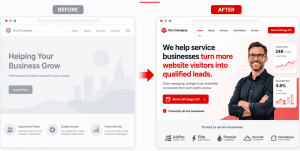
A useful homepage hero section should include a clear headline, a short supporting statement, one primary call to action, and a reason to trust the business. That reason might be a short proof point, a niche focus, a recognizable client type, a case study result, or a clear explanation of the process.
Clarity also improves usability. Nielsen Norman Group’s research has long shown that web users tend to scan pages rather than read every word, and that concise writing, highlighting, and scannable formatting improve usability. For service business websites, that means your most important message should be visible and easy to understand immediately.
This is especially important for PPC visitors. When someone clicks an ad, they expect the page to match the promise of the ad. Google Ads guidance recommends making ads relevant and accurately descriptive, while landing pages should be useful, relevant, and easy to navigate. If your ad promises “website copywriting for service businesses” but your homepage talks vaguely about “digital growth,” the visitor may feel they landed in the wrong place.
How Do You Write Service Page Copy That Converts?
A high-converting service page explains the problem, presents the service clearly, shows the outcome, reduces risk, proves credibility, and guides the visitor to enquire.
Each service page should have one clear job. If you offer multiple services, it is usually better to create separate pages for separate offers rather than forcing every visitor through one general page. Someone searching for website copywriting has different questions than someone looking for PPC management, SEO support, or web design. Separate pages allow you to match the visitor’s intent more precisely.
A strong service page usually follows this structure:
- Problem or need
- Who the service is for
- What the service includes
- Benefits and outcomes
- How the process works
- Proof and credibility
- Pricing guidance or quote expectations
- Frequently asked questions
- Clear call to action
The key is to connect features to meaning. Do not just say, “Includes homepage copy, service page copy, and CTA copy.” Explain why those elements matter. For example, homepage copy helps visitors understand your value quickly, service page copy explains the offer in detail, and CTA copy helps move qualified visitors toward an enquiry.
Service page copy should also reduce perceived risk. Many visitors hesitate because they do not know what happens next. Will they be pressured into a sales call? How long does the process take? Will they need to prepare anything? What does the first conversation involve? The more clearly your page answers these questions, the easier it is for a serious buyer to take action.
The page does not need to be short. It needs to be useful. If the service is complex, expensive, or high-trust, the copy should be deep enough to answer the questions a buyer would naturally ask before contacting you.
What Should Your Website Say to Build Trust Quickly?
Your website should build trust by showing specific proof, relevant experience, clear expectations, and human credibility.
Trust is not created by saying “you can trust us.” It is created by giving visitors reasons to believe you. Specific proof is always stronger than generic reassurance. A testimonial that says “Great service” is fine, but a testimonial that explains the problem, the experience, and the result is much more persuasive.
For example, this is weak:
“Excellent company. Highly recommended.”
This is stronger:
“QBall Digital helped us rewrite our service pages so customers could understand our offer more quickly. Within weeks, we started receiving more relevant enquiries from businesses that already understood what we did.”
The second testimonial gives context. It tells the reader what changed and why it mattered.
Other trust-building elements include case studies, client logos, certifications, industry memberships, team photos, process explanations, response-time expectations, service guarantees, and clear policies. Not every business needs all of these, but every service business needs some form of proof.
Your process is also a trust signal. When visitors understand how you work, the service feels less risky. A simple three- or four-step process can reassure buyers that you are organized and experienced. For example: audit, strategy, copywriting, review, launch. Each step should explain what the client receives and what the business handles.
Trust also comes from honesty. If pricing varies, explain what affects the cost. If the project requires input from the client, say so. If your service is best suited for certain business types, make that clear. Specificity may filter out poor-fit leads, but it increases confidence among the right ones.
How Can You Use Customer Language in Website Copy?
You can use customer language by collecting the words and phrases real customers use in sales calls, reviews, emails, surveys, support questions, and search queries.
Many service businesses write from the expert’s point of view. That often leads to copy filled with internal terminology, industry jargon, and abstract benefits. Customers usually describe their problems in simpler, more direct terms.
A business owner may not say, “We need conversion rate optimisation across our primary acquisition pages.” They may say, “Our website gets traffic, but nobody fills out the form.” Both statements point to the same problem, but the second one sounds more like the customer’s lived experience.
Customer language matters because people feel understood when they recognize their own problem on the page. It also helps your copy align with search intent. Google’s SEO Starter Guide encourages building websites with users in mind and making it easy for people to find and explore content. Using the language your audience actually uses is one practical way to do that.
Good sources of customer language include:
- Sales call notes
- Discovery call transcripts
- Contact form messages
- Google Business Profile reviews
- Customer testimonials
- Email enquiries
- Live chat logs
- Survey responses
- PPC search terms
- Competitor review sections
Once you collect this language, look for repeated patterns. What frustrations appear again and again? What outcomes do customers want? What objections stop them from buying? What words do they use to describe success?
Then use those phrases naturally in your copy. This does not mean copying customers word-for-word in every section. It means translating your expertise into language your buyer already understands.
How Should Calls to Action Be Written for Service Businesses?
Service business calls to action should make the next step clear, relevant, and low-friction.
Many websites rely on vague CTAs such as “Submit,” “Learn More,” or “Contact Us.” These can work in some contexts, but they often fail to explain what the visitor will get or what happens next. A stronger CTA gives the visitor a reason to click and sets a clear expectation.
For example:
- “Book a discovery call”
- “Request a website copy review”
- “Get a quote for your project”
- “Check availability”
- “Ask a question about your service page”
- “Schedule a PPC landing page audit”
The best CTA depends on buyer intent. A visitor reading a high-intent service page may be ready to request a quote. A visitor earlier in the journey may prefer a lower-pressure action, such as asking a question or downloading a guide. That is why service business websites often benefit from one primary CTA and one secondary CTA.
CTA placement matters too. Your primary CTA should appear near the top of key pages, after important proof sections, near pricing guidance, and again at the end of the page. Visitors should never need to hunt for the next step.
Reassurance near the CTA can also improve confidence. A line such as “No pressure — we’ll review your goals and recommend the best next step” can make an enquiry feel safer. For service businesses, the CTA is not only a button. It is part of the trust-building experience.
HubSpot describes CTAs as tools that move visitors toward landing pages and lead generation opportunities, reinforcing their role in turning website engagement into measurable action.
Should Service Businesses Mention Pricing on Their Website?
Yes, most service businesses should mention pricing in some form, even if they do not publish exact prices.
Many service providers avoid pricing because every project is different. That is understandable, but saying nothing about pricing can create friction. Visitors may assume the service is too expensive, too cheap, or not transparent enough. Some will leave instead of enquiring.
Pricing guidance does not have to mean fixed packages. You can use starting prices, typical ranges, “from” pricing, package examples, or a section explaining what affects cost. For example, a website copywriting project might vary based on the number of pages, research depth, SEO requirements, interviews, revisions, and whether landing page copy is included.
Pricing copy can also position value. Instead of simply listing a number, explain what the investment supports. For example, strategic website copy may include research, positioning, page structure, conversion messaging, SEO alignment, and CTA development. That helps the buyer understand they are not paying only for words; they are paying for clarity, strategy, and better conversion potential.
For PPC-driven businesses, pricing guidance can improve lead quality. If ads are driving paid traffic to your site, every unqualified enquiry costs time and budget. Clear pricing signals can help filter visitors before they contact you, which means your sales team spends more time with realistic prospects.
There are cases where exact pricing may not be appropriate, especially for highly customized services. But even then, your website can explain how quotes are calculated and what information is needed to provide an accurate estimate.
How Does Website Copywriting Improve PPC Campaign Performance?
Strong website copy improves PPC performance by making landing pages more relevant, persuasive, and aligned with the visitor’s search intent.
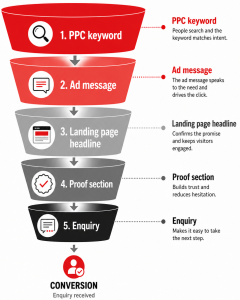
A PPC campaign does not end at the click. The landing page must continue the conversation that started with the keyword and ad. If the user searches for a specific service, clicks an ad about that service, and lands on a page that clearly matches their intent, they are more likely to stay, read, and take action.
Google has emphasized that landing pages should be relevant, useful, and easy to navigate, and that landing page content is part of the overall search ads experience. This makes copywriting a performance factor, not just a branding exercise.
Message match is one of the most important PPC copy principles. The keyword, ad headline, landing page headline, offer, proof, and CTA should all feel connected. If your ad promotes “website copywriting for service businesses,” the landing page should not open with a generic line about “digital solutions.” It should immediately confirm that the visitor has reached the right page.
Good PPC landing page copy should include:
- A headline that matches search intent
- A concise explanation of the offer
- A clear benefit or outcome
- Proof that supports the claim
- Objection-handling sections
- A strong, specific CTA
- Simple navigation or a focused conversion path
- Mobile-friendly formatting
Copy also affects lead quality. A page that promises vague growth may attract broad enquiries. A page that clearly explains the service, ideal client, process, and pricing expectations attracts people who are more likely to be a good fit.
For service businesses running PPC, better copy can help reduce wasted spend because more of the paid visitors understand the offer before they enquire. That can improve not only conversion volume, but also the quality of conversations that follow.
What Website Copywriting Mistakes Stop Visitors From Converting?
The most common copywriting mistakes are vague messaging, business-focused language, weak proof, unclear CTAs, hidden pricing expectations, and pages that do not match visitor intent.
Vague messaging is the biggest problem. If your website could belong to any business in your industry, it is not specific enough. Phrases such as “tailored solutions,” “exceptional service,” and “helping businesses grow” do not tell the visitor what you actually do or why they should choose you.
Another common mistake is talking too much about the business and not enough about the customer. Visitors care about your credentials, but only after they understand that you can solve their problem. Copy should start with the buyer’s needs, then connect those needs to your expertise.
Weak proof also hurts conversions. Claims need support. If you say you improve enquiries, show examples, testimonials, case studies, or a clear process. If you say you specialize in service businesses, explain what that means and why it benefits the client.
Unclear CTAs create another barrier. If the visitor likes what they read but does not know what to do next, the page has failed at the final step. Every key page should have a clear action that matches the visitor’s level of intent.
Poor formatting can also reduce performance. Since users often scan web pages, dense paragraphs, weak headings, and buried information make it harder for visitors to find what they need. NN/g’s research on scanning patterns shows that people scan depending on task, assumptions, layout, and content type, which means copy should be structured for quick comprehension.
SEO-only copy is another issue. A page can include the right keywords and still fail to convert. Keywords help people find the page, but clarity, proof, structure, and persuasion help them act.
How Do You Know If Your Website Copy Is Working?
Website copy is working when more qualified visitors take meaningful actions, such as submitting forms, booking calls, requesting quotes, clicking phone numbers, or spending time on key service pages.
The most obvious metric is conversion rate, but it should not be the only one. A higher number of enquiries is not always better if the leads are poor quality. Service businesses should measure both quantity and quality.
Useful metrics include:
- Form submissions
- Call clicks
- Booking completions
- Quote requests
- CTA clicks
- Scroll depth
- Engagement on service pages
- Bounce or engagement rate
- PPC landing page conversions
- Cost per lead
- Sales-qualified lead rate
- Customer feedback from sales calls
Lead quality feedback is especially important. If your sales team keeps hearing “I thought you did something else” or “I didn’t realize it would cost that much,” your copy is not setting the right expectations. If prospects arrive already understanding the offer, process, and value, your copy is doing its job.
Testing can also help. You can A/B test headlines, CTAs, proof sections, pricing explanations, form copy, and landing page layouts. For PPC campaigns, even small copy changes can produce meaningful differences because the traffic source is controlled and measurable.
The goal is not to change copy randomly. The goal is to identify where visitors hesitate, then improve the page based on evidence. For example, if visitors reach the pricing section but do not enquire, the issue may be value explanation. If they click the CTA but do not complete the form, the form may feel too long or too demanding. If they leave quickly from a PPC landing page, the message may not match the ad closely enough.
How Can Service Businesses Start Improving Their Website Copy Today?
Service businesses can start improving website copy by rewriting unclear headlines, clarifying service pages, adding stronger proof, improving CTAs, and replacing jargon with customer language.
Start with your homepage. Read the first screen of the page and ask whether a new visitor can answer three questions within seconds: What do you do? Who do you help? Why should they care? If the answer is no, rewrite the hero section before changing anything else.
Then review your service pages. Each page should explain one core service clearly. If a page lists several unrelated services, split them into separate pages where appropriate. Add details about who the service is for, what is included, what problem it solves, what the process looks like, and what the visitor should do next.
Next, strengthen your proof. Replace generic testimonials with specific ones. Add short case study summaries where possible. If you do not have formal case studies, use mini proof points such as project examples, client types, years of experience, industries served, or measurable improvements.
Review your CTAs and make them more specific. “Contact Us” may be fine in your navigation, but key page CTAs should be more action-oriented. “Request a website copy review” or “Book a strategy call” tells the visitor what they are doing and why.
Finally, look at your PPC landing pages separately from your main website. Paid traffic often has a more specific intent, so the copy should match the campaign. Do not send every ad to the homepage. Build or improve landing pages around the exact service, audience, or problem the ad promotes.
FAQ
What pages need the strongest copy on a service business website?
The homepage, core service pages, PPC landing pages, about page, and contact page usually need the strongest copy. These pages directly influence whether visitors understand the offer, trust the business, and take action.
The homepage should clarify positioning. Service pages should explain the offer in detail. PPC landing pages should match ad intent and convert paid traffic efficiently. The about page should build credibility, and the contact page should remove friction from the enquiry process.
How long should service page copy be?
Service page copy should be as long as needed to answer the buyer’s key questions clearly. A simple, low-cost service may only need a shorter page, while a complex or high-value service usually needs more detail.
Length is not the main issue. Usefulness is. If the page explains the problem, offer, benefits, process, proof, pricing expectations, FAQs, and next step without unnecessary filler, it is doing its job.
Is SEO copywriting different from conversion copywriting?
Yes, but they should work together. SEO copywriting helps the right people find the page through search. Conversion copywriting helps those people understand the offer and take action once they arrive.
The best website copy for service businesses does both. It uses search intent and relevant keywords naturally while still focusing on clarity, trust, persuasion, and lead generation.
Can better website copy reduce PPC costs?
Better website copy can help improve PPC efficiency by increasing the percentage of paid visitors who take action and by improving lead quality. It does not automatically reduce click costs, but it can reduce wasted spend by making landing pages more relevant and persuasive.
When copy aligns with the keyword and ad message, visitors are more likely to feel they have reached the right page. That can improve the performance of the campaign after the click.
Should every service have its own landing page?
Most important services should have their own dedicated page, especially if people search for them separately or if they are promoted through PPC. Dedicated pages allow you to match copy to the visitor’s exact intent.
A general services page can still be useful as an overview, but it should not replace detailed pages for high-value or high-demand services.
How often should service businesses update website copy?
Service businesses should review website copy at least every six to twelve months, or sooner if services, pricing, positioning, target markets, or PPC campaigns change.
Copy should also be updated when analytics show poor conversion performance, when sales calls reveal repeated misunderstandings, or when new testimonials and case studies become available.
Conclusion
Website copywriting is not just about making a service business sound polished. It is about helping visitors understand what you offer, why it matters, why they should trust you, and what they should do next.
For service businesses, strong copy turns uncertainty into confidence. It explains the service clearly, answers buyer questions, supports SEO, improves PPC landing page relevance, and helps more visitors become qualified leads.
The best website copy is specific, customer-focused, proof-driven, and easy to act on. When your messaging is clear and your pages are built around real buyer intent, every visitor has a better chance of becoming a real business opportunity.
Why QBall Digital is Your Ideal Choice for Website Copywriting for Service Businesses?
QBall Digital understands that service businesses need more than attractive wording. You need website copy that supports visibility, trust, lead generation, and measurable business growth. By combining copywriting strategy with digital marketing insight, QBall Digital helps ensure your website messaging works alongside SEO, PPC, and conversion-focused page design.
For service providers, every website page should have a commercial purpose. QBall Digital can help clarify your positioning, strengthen your service pages, improve landing page relevance, and create copy that speaks directly to the customers you want to attract. The result is a website that does not just explain what you do, but helps turn the right visitors into qualified enquiries.
Turn More Website Visitors Into Leads With QBall Digital
Your website should be one of your strongest sales assets. If your pages are attracting traffic but not generating enough enquiries, QBall Digital can help you improve the message, structure, and conversion path.
Contact QBall Digital to create clearer, stronger, conversion-focused website copy for your service business.