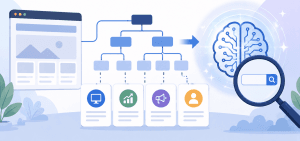
A clear website structure helps search engines and AI systems understand what your business offers, how your services relate to one another, and which pages contain the most important information. Strong website structure for SEO also gives potential customers a more direct path from their initial question to the service that can solve their problem.
Structure goes well beyond your navigation menu. It includes how service pages are grouped, how headings organize information, how internal links connect related topics, how URLs are named, and how supporting content reinforces your core expertise. When these elements work together, your website becomes less like a collection of individual pages and more like an organized map of your business.
What Makes a Website Structure Easy for Search Engines and AI to Interpret?
An understandable website has a clear hierarchy. Broad information leads to more specific information, and important pages are connected through logical, crawlable links.
For example, a digital marketing website might have a main services section that leads to individual pages for SEO, website design, PPC advertising, and other specialized services. Each page then explains one primary subject in enough detail for visitors to understand what is being offered.
Google confirms that links help it find new pages and evaluate relevance. It also recommends that every important page receive a link from at least one other page on the website. Descriptive anchor text helps both visitors and Google understand what they can expect from the destination page.
This is one reason QBall Digital maintains a dedicated Search Engine Optimization service page rather than expecting one general marketing page to explain every SEO service, strategy, and customer need.
How Should Service Pages Be Organized So Your Offerings Are Easy to Understand?
Major services should generally have distinct pages when they solve different problems, address different search intentions, or require substantially different information.
Think about a company offering SEO, web design, and paid search. Someone researching organic rankings needs different information from someone looking to redesign a website or launch a Google Ads campaign. Putting everything on one broad services page can make each offering harder to explain thoroughly.
Dedicated pages create clearer destinations. They provide room to define the service, describe who it helps, explain the problems it solves, answer common questions, and give visitors an appropriate next step.
QBall Digital follows this approach with separate destinations for Website Design and Hosting and PPC Google Search Ads. Different needs. Different pages. A much clearer experience than making users dig through a catch-all marketing page.
Consistency also matters. Service names used in navigation, headings, contextual links, and supporting articles should make sense together. Constantly changing terminology can make the relationship between pages less obvious.
How Do Internal Links Explain the Relationships Between Services, Topics, and Expertise?
Internal links connect individual pages into a broader information network. They can show that one article supports another topic, that a guide relates to a particular service, or that a commercial page is the logical next destination for someone researching a problem.
This is a major part of effective website structure for SEO. A blog post about improving local visibility, for instance, should not simply end after educating the reader. If an SEO service page provides a useful next step, linking to it gives both the reader and search crawler a meaningful path forward.
Google specifically recommends contextual internal links and descriptive anchor text instead of vague wording such as “click here.” The surrounding text matters too because it adds context to the relationship between the pages.
Internal links can also connect broader marketing subjects. A reader exploring how technology affects marketing might benefit from QBall Digital’s guide to the pros and cons of using AI in digital marketing. That connection helps supporting content contribute to a larger topic rather than existing as an isolated blog post.
Why Do Headings, URLs, Breadcrumbs, and Schema Strengthen Page Context?
These elements reinforce what a page is about and where it belongs.
A clear H1 establishes the main subject. H2 and H3 headings divide that subject into understandable questions or subtopics. Descriptive URLs provide another layer of clarity. Google recommends simple, readable URL structures that use understandable words instead of confusing strings of IDs and unnecessary parameters.
Breadcrumbs add location context by showing where a page sits inside the site hierarchy. Google describes breadcrumb trails as a way for users to understand and explore a site’s structure one level at a time.
Structured data can provide additional machine-readable clues. Google describes structured data as a standardized way to provide explicit information about a page and classify its content. It can help Google understand details about businesses, articles, products, and other supported entities. It should not, however, be treated as a shortcut that guarantees rankings or inclusion in AI-generated answers.
How Can Topic Clusters Turn Separate Pages Into a Clear Map of Expertise?
Topic clusters organize related content around a central subject instead of publishing articles with little connection to each other.
A service page can serve as a commercial destination while supporting articles answer narrower questions surrounding that service. Those articles can then link naturally to the main page and to other useful supporting resources.
Consider website design. A core web design service page might be supported by articles about navigation, mobile usability, conversion paths, content organization, and page performance. QBall Digital’s article on elevating a business with website design is an example of content that can support a wider web design topic.
The objective is not simply to create more content. More pages do not automatically create more authority. Each page needs a clear purpose and a logical relationship to the broader subject.
What Website Structure Problems Can Make Important Pages Harder to Find or Understand?
Structural problems often develop gradually as websites grow.
A business launches with five pages. Then comes a new service page, several landing pages, dozens of blog posts, location pages, campaign pages, and older content nobody remembers publishing. Before long, valuable information can become buried or disconnected.
Common warning signs include important services several navigation layers deep, pages with nearly identical purposes, vague menu labels, orphan pages with few or no internal links, blog posts that never point toward relevant services, and inconsistent terminology for the same offering.
Duplicate or very similar pages can create another problem. Google uses canonicalization to determine which URL should represent substantially duplicated content, which makes unnecessary duplication worth reviewing as part of broader site maintenance.
A useful test is simple: can a new visitor quickly determine what you do, find the service relevant to them, and understand what to do next?
If not, the structure may need attention.
How Can You Improve Website Structure Without Rebuilding the Entire Site?
You usually do not need to start from zero.
Begin by inventorying your existing pages and identifying which ones matter most to customer acquisition. Clarify the primary purpose of each important page, then group related pages around understandable services and subjects.
Next, examine the paths connecting them. Add contextual links where another page genuinely helps the reader. Find orphan pages. Review navigation labels. Check whether important information is buried unnecessarily. Make URLs readable where practical, and verify that breadcrumbs and structured data accurately represent the visible site rather than trying to manufacture relevance.
Also look for pages competing for the same purpose. Some may need clearer differentiation. Others may be better consolidated.
For businesses unsure where structural issues exist, QBall Digital offers a free website and marketing audit that reviews areas including website performance, SEO, user experience, and opportunities for improvement.
What Are Common Questions About Website Structure for SEO?
How deep should important pages be within a website?
Important pages should be reasonably easy to reach through normal navigation and internal links. There is no universal number of clicks that guarantees better rankings, but burying a core service unnecessarily can make it harder for both visitors and crawlers to discover.
Does every service need its own webpage?
Not necessarily. A separate page makes the most sense when the service has distinct customer intent, requires substantial explanation, or deserves its own conversion path. Closely related minor offerings may be clearer when grouped together.
Can internal linking improve SEO without adding new content?
Yes. Improving links among existing pages can make valuable content easier to discover and provide clearer context about relationships between topics. It is one practical way to strengthen website structure for SEO without constantly publishing new pages. Google specifically advises linking every page you care about from at least one other page.
Does schema markup help AI understand a website?
Schema provides structured, machine-readable information that can help search systems interpret page content. Google explicitly uses supported structured data to better understand information and enable certain search features. That does not mean adding schema guarantees higher rankings, AI citations, or recommendations.
What Should You Do Next to Make Your Website Easier to Understand?
Treat your website as a connected information system, not a folder of unrelated pages.
Visitors should be able to recognize your services, move between relevant topics, and reach the right next step without hunting for it. Search crawlers should have similarly clear paths through crawlable links, logical URLs, and organized page relationships.
Start with your highest-value services. Follow the paths leading into and out of those pages. The places where those paths become confusing are often the best places to begin improving.
Why QBall Digital is Your Ideal Choice for Website Structure and SEO?
QBall Digital combines website design with search optimization, allowing structure, content, navigation, and visibility to be considered together instead of as disconnected marketing tasks. Its web design approach includes search-friendly site structures, usable navigation, responsive design, and content considerations, while its SEO services focus on improving how websites perform for both search engines and potential customers.
For small and growing businesses, that connected approach matters. A website should not only look professional. It should help the right customers find useful information and move confidently toward contacting the business. QBall Digital emphasizes customized digital marketing strategies rather than forcing every company into the same formula, an approach outlined further on Why Choose QBall Digital.
Ready to Build a Clearer Website With QBall Digital?
If customers have to work too hard to understand your services, search systems may be dealing with some of the same structural confusion.
QBall Digital can review your website, identify gaps in its structure and SEO, and help create clearer paths between your content, services, and conversion opportunities. Contact QBall Digital for a free website and marketing audit and see where your website can become easier to navigate, understand, and use.