
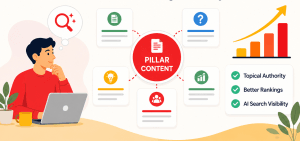
To build an AI search content cluster without keyword cannibalization, assign every page a distinct search intent, target query, reader outcome, and internal-linking role before creating the content. Use AI to identify semantic relationships and potential subtopics, but validate those recommendations against your existing URLs and current search results.
The pillar page should own the broad subject. Supporting pages should answer narrower questions that the pillar introduces but does not fully resolve. That distinction matters because Google’s guidance for generative search features still emphasizes foundational SEO, valuable content, and a clear technical structure. AI may accelerate the process. It does not replace strategy.
What Causes Pages in the Same Cluster to Compete With Each Other?
Pages compete when they target substantially the same search intent and promise readers the same outcome. Two articles may use different titles but still be interchangeable if they answer the same question, cover similar subtopics, and appear for the same group of searches.
Repeated keyword usage alone does not prove cannibalization. Related pages naturally share terminology. The real warning signs include nearly identical titles, overlapping headings, similar search-result competitors, rankings that repeatedly switch between URLs, and a newer page causing an established page to lose visibility.
Some duplicate content is normal and is not automatically a violation of Google’s spam policies. However, unnecessary duplication can create a poor user experience and cause search engines to spend resources on URLs you do not consider important.
How Do You Choose a Pillar Topic That Can Support Distinct Cluster Pages?
Choose a subject that is broad enough to contain several independent questions but focused enough to connect with a defined service, audience, or business objective.
Start with commercial relevance. A cluster should help potential customers understand a problem, evaluate possible solutions, and move closer to taking action. Traffic without strategic relevance can produce impressive reports but few meaningful leads.
Next, examine the topic’s intent depth. Look at search results, customer questions, sales conversations, support requests, and People Also Ask results. A strong pillar may support educational guides, implementation articles, comparisons, troubleshooting resources, case studies, and service-focused pages.
For example, a business investing in SEO content strategy and topic clustering could build supporting pages around intent mapping, content audits, internal links, keyword overlap, and performance measurement. Each topic belongs to the same ecosystem, yet each solves a different problem.
How Can You Use AI to Group Keywords Without Creating Overlapping Pages?
Use AI to organize keywords by search intent and expected reader outcome—not simply by similar wording.
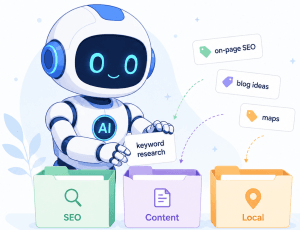
Provide the system with your full keyword list, existing URLs, page titles, target audience, services, buyer stages, and topics that should not be recreated. Without that context, an AI tool may recommend new articles that duplicate content already on the site.
Ask it to identify:
- The main intent behind each query.
- Which queries belong on the same page.
- Which groups require separate URLs.
- Why each proposed page deserves to exist.
- Which existing page would conflict with the recommendation.
Then validate the output manually. Review current search results and confirm whether Google treats the terms as one intent or several. Also evaluate whether the proposed content would offer something useful beyond a rewritten version of what already exists.
Google recommends using generative AI as a tool while still prioritizing accuracy, quality, relevance, and value for users. Scaled production without meaningful oversight can create repetitive or low-value pages.
For a balanced view of automation and human review, see QBall Digital’s guide to the advantages and limitations of AI in digital marketing.
How Do You Create a Keyword Ownership Map for the Entire Cluster?
Create one row for every planned or existing URL. Each row should assign one primary query, one dominant intent, one page role, and one unique reader outcome.
For an AI search content cluster, a practical ownership map should include:
- Proposed or existing URL.
- Primary query.
- Secondary terms.
- Search intent.
- Funnel stage.
- Page type.
- Unique angle.
- Topics the page may summarize.
- Topics the page must not explain fully.
- Parent and sibling links.
- Conversion action.
- Existing content conflicts.
Apply a one-query-owner principle. One URL should be the preferred destination for each core intent, although related terminology may appear naturally throughout the cluster.
Consider this simple structure:
| Page role | Owned topic |
|---|---|
| Pillar page | The complete content-cluster strategy |
| Supporting guide | How to group keywords with AI |
| Diagnostic guide | How to identify keyword cannibalization |
| Comparison page | AI clustering versus manual clustering |
The ownership map prevents writers from making decisions in isolation. It also gives editors a clear standard for approving, combining, or rejecting proposed topics.
How Should the Pillar and Supporting Pages Divide the Topic?
The pillar should explain the complete subject at a strategic level. Supporting pages should solve one narrower problem in greater depth.
Use a “mention versus own” rule. The pillar may introduce keyword mapping in one or two paragraphs, but a supporting article owns the detailed workflow, templates, examples, tools, and troubleshooting advice.
Every cluster page should also remain useful on its own. Readers should not need to return to the pillar to understand the answer. A separate page is justified when it serves a different intent, audience, use case, buying stage, or content format—not when the title merely uses a different keyword variation.
This structure also supports broader changes in discovery. QBall Digital’s overview of how AI is changing SEO explains why content must increasingly address natural-language questions and genuine user needs rather than isolated phrases.
How Do You Build Internal Links That Clarify Each Page’s Role?
Link the pillar to every major supporting resource. Each supporting page should link back to the pillar, while sibling pages should connect only when the next article logically advances the reader’s task.
Use descriptive anchor text that communicates what the destination owns. Avoid using the same vague anchor—such as “learn more”—for several pages. Also avoid pointing identical keyword-rich anchors toward different URLs, which can blur their intended roles.
Google uses links to discover pages and understand relevance. Its guidance recommends crawlable links and concise, relevant anchor text.
Internal links should also connect informational content with appropriate commercial pathways. A strategy article could lead readers to search engine marketing solutions, while a broader guide may point toward full-service digital marketing support.
Plan these connections before drafting. Not afterward.
How Can You Detect and Fix Cannibalization After Publishing?
Use Google Search Console to review which URLs receive impressions and clicks for the same queries. The Performance report allows data to be grouped and filtered by queries and pages, helping you examine whether several URLs are appearing for the same search terms.
Do not assume every shared query requires a fix. First determine whether the pages serve different intents and perform different jobs.
When genuine overlap exists, choose one of four actions:
Differentiate: Rewrite one page around a clearly separate intent, audience, or outcome.
Consolidate: Merge useful material into the strongest URL when both pages answer the same question.
Redirect: Send a redundant URL to the consolidated page with a permanent redirect.
Reinforce: Adjust titles, headings, internal links, and anchor text when the correct page exists but its role is unclear.
Do not use a canonical tag to avoid making a strategic content decision. Canonicals help Google select a representative version from duplicate or highly similar URLs; they are not a substitute for creating meaningfully differentiated pages. Google also treats permanent redirects as a signal that the destination should become canonical.
Frequently Asked Questions
How many pages should a content cluster contain?
There is no universal number. Begin with a pillar and enough supporting pages to answer the most important independent questions. Five valuable pages with distinct purposes are better than twenty repetitive articles created to reach an arbitrary total.
Can two pages target variations of the same keyword?
Yes, when the variations represent different search intents. A definition page and a step-by-step implementation guide may share terminology while serving different reader needs. Separate pages are harder to justify when their answers and outcomes are essentially identical.
Does using the same keyword on several pages cause cannibalization?
Not by itself. Related pages naturally use shared language. Cannibalization becomes a concern when multiple URLs compete to satisfy the same search intent and Google has difficulty determining which page is the most appropriate result.
Should the pillar page be published before its supporting pages?
Publishing the pillar first can establish the cluster’s central destination, but it is not mandatory. What matters is having the page roles and internal-link structure mapped before publication so every new article has a defined place.
How often should content clusters be audited?
Review important clusters after major publishing campaigns and during regular SEO performance reviews. Audit sooner when rankings switch between pages, organic traffic drops after a new article launches, or several URLs begin receiving impressions for the same high-value queries.
What Should You Check Before Publishing the Next Cluster Page?
Before approving another article, ask whether an existing URL already owns the intent. Confirm that the proposed title promises a different outcome, its headings do not duplicate another page, and its internal links are mapped.
The page should add evidence, experience, examples, or practical guidance—not merely more words. Treat the cluster map as a living system. Update it whenever content is created, consolidated, redirected, or repositioned.
For additional planning guidance, QBall Digital’s resource on generative engine optimization for small businesses explains how useful, connected content can support visibility across both traditional and AI-assisted discovery.
Why QBall Digital Is Your Ideal Choice for AI Search Content Clustering
QBall Digital combines keyword research, competitive analysis, content planning, on-page optimization, and internal linking to create a connected search strategy. Rather than publishing isolated articles, the team can organize each AI search content cluster around real audience questions and commercially relevant outcomes. QBall Digital’s SEO services include content marketing, optimized website copy, blogging, and topic clustering designed to improve visibility.
That coordinated approach helps businesses connect informational content with SEO, paid media, landing pages, and conversion opportunities. Clear reporting and ongoing analysis also make it easier to identify overlap before it weakens performance. The result is a more focused content ecosystem—one in which every page has a purpose and every link moves readers toward the next relevant step.
Build a Cleaner Content Strategy With QBall Digital
Do not scale AI-assisted publishing until every important keyword has an owner. Schedule a free marketing consultation with QBall Digital to uncover competing URLs, organize your topics, and build a content structure that supports stronger search visibility and qualified leads.