

Content can survive lower click-through rates by doing two jobs at once: providing a clear answer that search engines can understand and offering deeper value that an AI-generated summary cannot fully replace. That deeper value might be original research, expert analysis, a practical template, a detailed example, or help applying the information to a real business problem.
A successful zero click SEO strategy does not try to force every searcher onto the website. Instead, it makes the brand visible during the initial answer while creating a strong reason for qualified prospects to continue their journey.
Some searchers will leave with the quick answer. Others will need proof, context, comparison, or professional support. Those are the visitors your content should be built to earn.
Why Are AI Search Results Lowering Organic Click-Through Rates?
AI search results lower organic click-through rates because they complete more of the information-gathering process directly on the search results page.
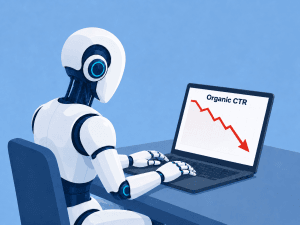
A user who once needed to open three or four pages may now receive a summarized answer, supporting points, definitions, and source links without leaving Google. Featured snippets, knowledge panels, People Also Ask results, local listings, and AI Overviews all contribute to this behavior.
Pew Research Center found that users clicked a traditional search result during 8% of visits when an AI summary appeared, compared with 15% of visits without one. Links within the AI summaries received clicks during only 1% of visits.
Lower CTR, however, does not automatically mean lower business value. A smaller number of visitors may arrive with stronger intent because the basic research has already been completed.
Which Topics Can Still Earn Clicks in a Zero-Click SERP?
Topics continue to earn clicks when the searcher needs more than a short factual response. Complex decisions, customized recommendations, original evidence, professional judgment, and implementation guidance are difficult to compress into a few generated paragraphs.
Strong click opportunities often include:
- Product or service comparisons with several decision criteria
- Problems with multiple possible causes or solutions
- Templates, calculators, checklists, and diagnostic tools
- Original research, surveys, benchmarks, and case studies
- Detailed tutorials with screenshots or demonstrations
- High-intent searches involving pricing, providers, or next steps
Simple definitions, dates, conversions, and basic factual questions are more vulnerable. An AI result can often satisfy those searches completely.
Before choosing a topic, evaluate its business value and its need for further exploration—not only its search volume. A customer insight marketing strategy can help uncover the questions, concerns, and decision factors real customers raise before contacting a business.
How Should You Format Content for AI Extraction and Citation?
Format content in clear, self-contained sections that answer specific questions without sacrificing depth.
Begin each major section with a direct response. Then explain why the answer matters, provide supporting details, and add examples or limitations. A reader—or an AI retrieval system—should be able to understand the section without needing to reconstruct its meaning from several unrelated paragraphs.
A practical structure looks like this:
- Ask a specific question in the heading.
- Answer it in the first one or two sentences.
- Explain the reasoning behind the answer.
- Add evidence, examples, or actionable steps.
- Connect the information to a useful next action.
Use descriptive headings, short paragraphs, meaningful lists, clear author information, and links to original sources. Keep the page crawlable and technically sound through established SEO services and content optimization.
Google’s current guidance says that traditional SEO fundamentals remain relevant to generative search. Pages must still be crawlable, indexed, and eligible to display a search snippet. Google also says businesses do not need special AI markup, an llms.txt file, or artificially fragmented content to appear in its generative features.
Relevant structured data can clarify what a page contains and make it eligible for certain rich results. It does not guarantee that Google will display a special search feature or cite the page in an AI answer.
What Makes Content Worth Clicking After AI Gives the Basic Answer?
Content earns a click when it offers something more useful than a compressed summary.
Think of the page as having two layers. The first is answer value: the concise explanation that helps the content appear, get understood, and possibly receive a citation. The second is visit value: the proof, experience, or resource that makes opening the page worthwhile.
Visit value can come from:
- First-party data that is unavailable elsewhere
- Real campaign examples with outcomes and limitations
- Expert opinions that explain trade-offs
- Downloadable worksheets or templates
- Interactive tools and calculators
- Screenshots showing exactly how to complete a process
- Detailed comparisons based on transparent criteria
- Case studies showing what changed and why
Google recommends creating unique, useful, non-commodity content rather than publishing information that merely repeats what is already available.
Do not hide the basic answer to manufacture curiosity. That frustrates readers and makes the page less useful. Provide the answer openly, then make the application of that answer far more valuable.
How Can You Turn Zero-Click Visibility Into Brand Demand?
Zero-click visibility becomes valuable when searchers remember who provided the information.
Generic advice is easy to summarize without creating a memorable connection to its source. Original frameworks, recognizable terminology, first-party evidence, and a consistent expert viewpoint give readers something they can associate with the brand.
Place the company or author naturally beside proprietary insights. Develop clusters of related content so the brand becomes strongly associated with a topic. A practical generative engine optimization content plan can connect customer questions, evidence, technical clarity, and pages that support action.
Extend useful ideas beyond the original article as well. A focused content repurposing strategy can turn one strong resource into social posts, videos, email content, sales materials, and campaign creative.
More exposure. More recognition. More opportunities for a later branded search.
Which Metrics Prove Your Zero Click SEO Strategy Is Working?
Measure search visibility, brand demand, qualified engagement, and conversions together.
Begin with impressions, clicks, CTR, ranking changes, and search appearance data. Google Search Console’s generative AI performance reporting can also help eligible site owners understand how content is being discovered through Google’s generative search features.
Then examine what happens beyond the initial search:
- Branded search growth
- Direct and returning visitors
- Visits to service or pricing pages
- Form submissions and qualified calls
- Assisted conversions
- Download or tool engagement
- Conversion rate per organic visitor
- Revenue influenced by organic search
Avoid evaluating the entire program through sitewide CTR alone. An article may receive fewer clicks while increasing brand recognition or assisting later conversions.
The same principle applies to paid campaigns. Strong PPC management focuses on qualified outcomes and revenue—not simply the number of people who clicked an ad. Organic search reporting should be held to a similarly useful standard.
Frequently Asked Questions
Is zero-click optimization replacing traditional SEO?
No. It expands the way traditional SEO is measured and applied. Technical accessibility, useful content, authority, search intent, internal linking, and user experience remain important because generative search features still depend on content discovered through search systems.
Should every section begin with a short answer?
Question-led sections usually benefit from an immediate answer, but the pattern should remain natural. A direct opening is helpful when readers need a decision or explanation quickly. Narrative sections, examples, and case studies may require a different structure.
Does schema guarantee that content will appear in AI search results?
No. Schema can help search engines understand page content and establish eligibility for certain rich results, but it does not guarantee ranking, extraction, citation, or a special search appearance. The markup must also accurately represent visible page content.
Can zero-click visibility still generate leads?
Yes. A search appearance can introduce the brand, answer an early question, support a later branded search, or assist a conversion through another channel. For local businesses, listings and profiles may also generate calls, directions, and other actions without a conventional website visit.
What Should You Change First?
Start with pages that have stable or growing impressions but declining CTR. Review their opening answers, headings, supporting evidence, internal links, and next-step resources.
Then ask one hard question: after an AI result summarizes the basic information, does the page still offer a meaningful reason to visit?
Add the missing value. A real example. A useful comparison. A downloadable tool. A clearer service connection. The goal is not to prevent every zero-click interaction; it is to ensure each search appearance either builds recognition or attracts someone who genuinely needs more.
Why QBall Digital is Your Ideal Choice for Zero-Click SEO?
QBall Digital connects content planning with technical SEO, search intent, and conversion strategy. Its approach goes beyond chasing rankings or publishing large volumes of generic articles, focusing instead on useful content that supports visibility and qualified customer action. Through its full-service digital marketing solutions, businesses can align SEO with PPC, content creation, web design, social media, and broader growth goals.
QBall Digital also emphasizes data-driven decision-making and transparent performance measurement. That matters when impressions, traffic, assisted conversions, and lead quality must be evaluated together rather than through one vanity metric. With strategic research and practical execution, QBall Digital can help businesses become easier for AI systems to understand—and more valuable for potential customers to visit.
Make Every Search Impression Work Harder with QBall Digital
AI search is changing how customers discover information, but your content can still influence what they learn, which brands they remember, and where they turn for help.
Ask QBall Digital to review pages with declining CTR, identify opportunities for stronger AI visibility, and develop resources that turn search exposure into qualified demand.