

Yes, small marketing tests can boost business growth because they help small businesses make smarter decisions before committing more budget, time, or effort. Instead of guessing which message, offer, ad, landing page, or channel will work best, testing gives you real feedback from real customers. That makes each campaign easier to improve, measure, and scale.
For small businesses, this matters because every marketing dollar has a job to do. A simple test—such as comparing two Google Ads headlines, testing a new call-to-action, trying a different landing page layout, or offering two versions of a promotion—can reveal what attracts better leads and what wastes spend. Google Ads experiments, for example, let advertisers compare an experiment against the original campaign while sharing campaign traffic and budget, helping teams make more informed ROI decisions.
Small tests do not need to be complicated. The goal is to learn quickly, protect your budget, and keep improving. That is why the best marketing testing ideas for small business campaigns are usually focused, measurable, and tied to a clear business outcome.
What are small marketing tests?
Small marketing tests are controlled changes made to one part of a campaign so you can compare performance and learn what works better. That change might involve your ad copy, landing page headline, offer, audience, budget split, email subject line, keyword strategy, or creative design.
A strong test starts with a simple question: “Will this change improve the result we care about?” For example, a local service business might ask, “Will a ‘Free Estimate’ CTA bring in more qualified leads than a ‘Contact Us’ CTA?” An ecommerce brand might ask, “Will a bundle offer produce a higher average order value than a discount?”
The key is to avoid changing too many things at once. If you test a new headline, new image, new offer, and new audience all at the same time, you may get a result—but you will not know what caused it. This is why controlled testing is so valuable. It gives you cleaner insight and helps you build a repeatable optimization process.
How do small businesses choose what to test first?
Small businesses should test the areas closest to revenue first. That usually means testing landing pages, ad messaging, offers, calls-to-action, keywords, and audience targeting before testing minor design details.

A good starting point is market research. The U.S. Small Business Administration explains that market research helps businesses find customers, while competitive analysis helps businesses identify what makes them unique. Together, they help small businesses reduce risk and find a stronger market advantage.
Start by reviewing where prospects are dropping off. Are people clicking your ads but not submitting forms? Test the landing page. Are impressions high but clicks low? Test the headline or offer. Are leads coming in but sales are weak? Test your audience, keyword intent, or qualification message.
This is where a full-funnel partner can help. QBall Digital’s digital marketing services are built around tailored strategies, analytics, and real-time insights, which makes testing easier to connect to actual business growth.
How can PPC campaigns be tested without wasting budget?
PPC campaigns can be tested safely by setting a clear hypothesis, limiting the test variable, tracking conversions correctly, and using budget controls. In Google Ads, experiments are designed to help advertisers test changes to campaign settings, reach more customers, and improve campaign performance more efficiently.
For example, a small business could test two ad messages: one focused on price and another focused on quality. If the quality-focused ad produces fewer clicks but more qualified leads, that may be the better campaign direction. Click volume alone is not always the best signal.
You can also test bidding strategies, match types, landing pages, geographic targeting, and negative keyword lists. The important part is to judge the test by business metrics, not vanity metrics. A campaign with a lower click-through rate may still win if it produces cheaper booked appointments or higher-value customers.
QBall Digital’s PPC Google Search Ads service focuses on measurable outcomes, real-time performance tracking, and adjustments that help improve advertising ROI. For small businesses, that kind of structure can prevent “learning by burning.”
What landing page elements should small businesses test?
Small businesses should test landing page headlines, calls-to-action, form length, proof points, page speed, mobile layout, and offer clarity. These elements directly affect whether a visitor understands the value and takes action.
A landing page test might compare “Schedule Your Free Consultation” against “Get a Free Marketing Audit.” Another test might compare a short form with three fields against a longer form that asks qualifying questions. The short form may generate more leads, but the longer form may generate better leads.
Page experience also matters. QBall Digital’s website design and hosting page emphasizes mobile-optimized design, fast-loading pages, better usability, and conversion-focused design. Those are exactly the kinds of elements worth testing because they influence both user trust and campaign performance.
For SEO-driven campaigns, landing page testing can also support long-term growth. QBall Digital’s SEO services include keyword research, technical SEO, content strategy, and performance tracking—useful foundations for testing which pages attract and convert the right visitors.
Why does offer testing matter for business growth?
Offer testing matters because customers often respond more to the way an offer is framed than to the product or service itself. A small change in wording can shift perceived value.
For example, a home service company might test “$50 Off First Service” against “Free Same-Day Estimate.” A professional service firm might test “Book a Consultation” against “Get a Custom Growth Plan.” Both offers may lead to the same sales conversation, but one may feel more useful or lower-risk to the customer.
Shopify’s business validation guidance makes a similar point: testing an idea before investing heavily helps confirm demand, reduce risk, and improve the final offer before launch. For small businesses, offer testing is not just about promotions. It is about understanding what customers value enough to act on.
How can social media and display campaigns be tested?
Social media and display campaigns can be tested by comparing creative formats, audience segments, hooks, visuals, and retargeting messages. These channels are especially useful for testing awareness and interest before asking people to convert.
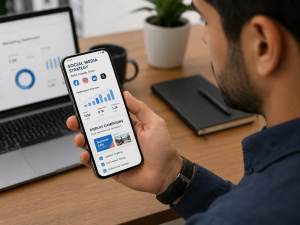
A small business could test a customer testimonial video against a service explainer graphic. Another could test a local audience against a behavior-based audience. If one audience clicks more but the other converts better, the business can adjust spend toward the audience with stronger commercial intent.
Shutterstock’s small business marketing guide highlights the value of tracking what works and testing different platforms, creatives, audiences, and keywords so businesses can refine their approach over time.
QBall Digital’s targeted display advertising services include retargeting, contextual targeting, keyword targeting, and geo-fencing, all of which can support small, focused tests. Their social media marketing services also emphasize targeted campaigns, engagement, paid advertising, and reporting.
How do you measure whether a test worked?
A test worked if it improved the metric tied to your business goal. That might be cost per lead, conversion rate, booked calls, qualified inquiries, sales, average order value, or return on ad spend.
Before launching a test, define the success metric. “More traffic” is not specific enough. “Lower cost per qualified lead” is better. “More booked consultations from local prospects” is even stronger.
Also, avoid ending tests too early. A test needs enough traffic, conversions, and time to produce a useful pattern. If the first day looks promising but the next week reverses the result, the early read may have been misleading.
Good testing creates a learning library. Even a “losing” test can be useful if it tells you what your audience does not care about. Over time, those lessons make every campaign sharper.
Are small marketing tests worth it for limited budgets?
Yes, small marketing tests are especially worth it for limited budgets because they reduce waste before scaling. When the budget is tight, every assumption is expensive. Testing helps businesses spend more only after they have evidence.
A small business does not need a huge campaign to start. It can test one ad group, one offer, one landing page section, or one follow-up email. The important thing is to make the test specific enough to learn from.
This is also why internal tracking matters. If form submissions, calls, booked appointments, and lead quality are not measured correctly, the business may optimize for the wrong result. QBall Digital’s article on lowering cost per lead and stopping wasted PPC spend highlights the importance of intent segmentation, tracking integrity, and waste-resistant campaign structure.
FAQ
What is the easiest marketing test for a small business?
The easiest test is usually a call-to-action test. Try comparing two CTAs on a landing page, ad, or email, such as “Get a Free Quote” versus “Schedule a Consultation.”
How long should a small marketing test run?
A small test should run long enough to collect meaningful data. For low-traffic businesses, that may require several weeks. Ending too early can lead to decisions based on random variation.
Should small businesses test one thing at a time?
Yes. Testing one main variable at a time makes the result easier to understand. If you change too many elements, you may not know what caused the improvement or decline.
Can marketing tests improve SEO?
Yes, indirectly. Testing headlines, page structure, content depth, and calls-to-action can improve engagement and conversions from organic traffic. SEO tests should be handled carefully so pages remain helpful and aligned with search intent.
A smarter way to grow with less guesswork
Small marketing tests help businesses move from opinion-based marketing to evidence-based growth. They show which messages attract attention, which offers create action, which pages convert, and which campaigns deserve more budget.
The best part is that testing does not require a massive team or complicated system. Start with one clear question, one measurable goal, and one campaign area that affects revenue. Then use what you learn to improve the next move.
Why QBall Digital is Your Ideal Choice for Campaign Optimization?
QBall Digital is a strong choice for campaign optimization because the team focuses on measurable growth, not surface-level marketing activity. Their services connect PPC, SEO, web design, social media, and targeted display into one practical strategy, helping small businesses test smarter across the full customer journey.
For small businesses, this matters because a campaign rarely succeeds from one isolated tactic. The ad, landing page, audience, offer, tracking, and follow-up all need to work together. QBall Digital helps identify where performance is leaking, then uses data-driven improvements to turn marketing tests into better leads, stronger campaigns, and more confident decisions.
Test Smarter With QBall Digital
Ready to find out which campaigns, offers, and pages are actually helping your business grow? Contact QBall Digital to claim a free website and marketing audit and start turning small tests into smarter growth.