

You update old content and generate more leads by choosing pages with proven demand, improving them around current search intent, strengthening the offer, adding better internal links, and measuring whether the refreshed page attracts more qualified visitors. A strong content refresh strategy for small business is not just about changing the publish date or adding a few keywords. It is about making an existing page more useful, more accurate, and more conversion-focused than it was before.
For small businesses, this can be one of the most practical ways to improve marketing performance. You already invested time or money into the page. Instead of starting from zero, you improve what is already indexed, already ranking, or already getting impressions. Google’s own guidance emphasizes helpful, complete, people-first content and warns against changing dates without making substantial updates.
What Makes Old Content Stop Converting?
Old content stops converting when it no longer matches what your audience needs, what search engines are rewarding, or what your business currently sells. A blog post that worked two years ago may now have outdated examples, weak calls to action, missing internal links, or a search intent mismatch.
For example, a page may still bring traffic but attract visitors who are too early in the buying journey. Another page may rank for the right keyword but fail to explain next steps clearly. In both cases, the issue is not just traffic. The issue is lead quality.
Competitor content on this topic consistently points to the same problem: old content decays when competitors publish better answers, data becomes outdated, and search intent changes. Content Harmony recommends checking whether the content still matches intent before expanding or rewriting it, while Apricot Studio emphasizes deciding whether a page needs a light refresh, full rewrite, or pruning.
Which Pages Should You Refresh First?
You should refresh pages that already show signs of demand but are not producing enough value. Start with pages that have impressions, declining clicks, rankings near page one, or traffic that does not convert.
Google Search Console is the best starting point because it shows clicks, impressions, CTR, and average position for your pages in Google Search. These metrics help you see whether a page has visibility, whether people are clicking, and whether the page is close enough to improve with focused updates.
Prioritize these page types:
- Pages with high impressions but low CTR
- Pages ranking between positions 5 and 20
- Pages with declining organic traffic
- Pages that attract traffic but few leads
- Pages with outdated services, examples, pricing, or screenshots
For small businesses, the best refresh candidates are usually service-related blogs, local SEO pages, comparison guides, and educational articles tied to buyer questions. These pages can support organic visibility while guiding readers toward services like Search Engine Optimization, Website Design and Hosting, or PPC Google Search Ads.
How Do You Build a Content Refresh Strategy for Small Business?
A content refresh strategy starts with a simple audit. Export your top pages from Google Search Console, review organic traffic in analytics, and sort pages by business value. A page with modest traffic but strong buying intent may be more valuable than a high-traffic article that attracts general readers.
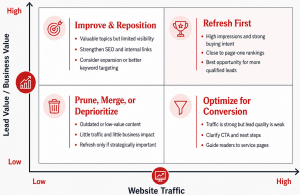
Next, review the current search results for the target keyword. Look at the headings, formats, examples, and questions competitors answer. This does not mean copying them. It means identifying what searchers now expect and then creating a clearer, more useful version.
Then decide the refresh level. A light refresh may only need updated examples, stronger headings, better metadata, and internal links. A medium refresh may need new sections, FAQs, visuals, and clearer calls to action. A full rewrite is better when the page targets the wrong audience, has thin content, or no longer reflects your services.
Google’s helpful content guidance recommends evaluating whether content provides original value, complete explanations, clear sourcing, and a satisfying experience. That makes the refresh process more strategic than simply adding words.
What Should You Update to Improve Lead Quality?
To improve lead quality, update the parts of the page that influence trust, relevance, and next action. Start with the title tag and meta description. If the page appears in search results but earns a weak CTR, the promise may not be clear enough.
Then rewrite the introduction so it answers the main question immediately. This helps readers confirm they are in the right place and gives search engines a clearer understanding of the page. After that, improve the body content by removing outdated advice, adding current examples, answering missing questions, and clarifying who the content is for.
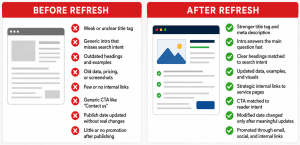
Internal linking is especially important. A refreshed blog should guide readers toward the most relevant next step. For example, a section about improving organic visibility can point to QBall Digital’s SEO services. A section about site performance or design can point to Website Design and Hosting. A section about faster traffic acquisition can point to PPC Google Search Ads. QBall Digital’s own service pages emphasize SEO, web design, PPC, social media, and conversion-focused digital marketing support for small businesses.
Also improve the call to action. Instead of ending with a generic “contact us,” match the CTA to the reader’s intent. A reader learning how to refresh old content may need an SEO audit, content review, or consultation. That is where a direct link to Contact QBall Digital becomes useful.
How Can You Republish and Promote Refreshed Content?
You should republish refreshed content only after meaningful updates are complete. Keep the same URL when the page already has backlinks, rankings, or historical value. Changing the URL without a strong reason can create unnecessary SEO risk.
After updating the page, revise the publish or modified date only if the content has substantially changed. Google specifically warns against changing dates to make pages seem fresh when the content itself has not been meaningfully updated.
Promotion matters too. Share the refreshed post through email, social media, sales follow-ups, and relevant internal pages. If the topic supports a service campaign, use it as a landing resource for paid traffic or retargeting. For example, a refreshed lead-generation guide could support both SEO and paid campaigns, while a short excerpt can be reused through Social Media Marketing.
How Do You Measure Whether the Refresh Brought Better Leads?
Measure success by looking beyond rankings. Rankings matter, but the goal is better leads. Track impressions, clicks, CTR, average position, organic sessions, form submissions, phone calls, and assisted conversions.
Compare performance before and after the refresh using a clean time period, such as 30, 60, or 90 days. In Search Console, clicks and impressions show whether search visibility improved. CTR shows whether the refreshed title and description are attracting more searchers. Average position shows whether the page is becoming more competitive.
In analytics or CRM data, look for lead quality signals. Did the page produce more calls? Did visitors move from the blog to service pages? Did the page assist conversions even if it was not the final touchpoint? These questions help you decide whether the refresh is truly helping the business.
FAQ
How often should small businesses refresh website content?
Small businesses should review important website content at least once or twice a year. High-value pages tied to services, local SEO, or lead generation may need quarterly checks, especially if competitors update their content often or search intent changes.
Should I delete old blog posts that no longer perform?
You should not delete old blog posts automatically. First, decide whether the post can be refreshed, merged with a stronger page, redirected, or removed. Pages with no traffic, no backlinks, outdated information, and no business relevance are better pruning candidates.
Is changing the publish date enough for SEO?
No. Changing the publish date alone is not enough and can be misleading if the content has not been substantially improved. A real refresh should update the information, structure, examples, links, and conversion path.
Can refreshing content improve leads without increasing traffic?
Yes. A refresh can improve leads even if traffic stays similar. Better intent alignment, stronger CTAs, clearer service links, and more persuasive examples can help the same number of visitors convert at a higher rate.
Conclusion
Refreshing old website content helps small businesses get more value from pages they already own. The best results come from choosing pages with demand, updating them around current search intent, improving their usefulness, and connecting them to the right service pages.
A content refresh should never be treated as cosmetic. When done well, it strengthens SEO, improves user experience, and gives visitors a clearer path from research to action.
Why QBall Digital is Your Ideal Choice for Content Refresh Strategy?
QBall Digital understands that small business marketing needs to produce measurable results, not just more website activity. Their SEO approach includes keyword research, on-page optimization, technical improvements, content strategy, and performance tracking, all of which are essential for refreshing old content effectively.
QBall Digital also brings together web design, SEO, PPC, social media, and digital strategy, which matters because content refreshes rarely work in isolation. A page may need stronger copy, faster performance, better internal links, and a clearer paid or organic traffic plan. That broader view helps small businesses turn stale website content into a more reliable source of qualified leads.
Refresh Your Website Content with QBall Digital
Ready to turn outdated pages into stronger lead-generation assets? Contact QBall Digital to review your current website content and identify the pages with the best opportunity for growth.