

To identify and refine your ideal target audience, start by reviewing your best existing customers, then group similar buyers by their needs, behaviors, buying intent, location, and profitability. From there, choose the segments most likely to convert, shape your message around their specific problems, and use campaign data to keep improving your targeting over time.
For small businesses, this process is not just a branding exercise. It directly affects lead quality, ad performance, website conversions, and marketing ROI. A strong target audience strategy for small business helps you stop trying to reach everyone and start focusing on the people most likely to value, trust, and buy from your company. Adobe defines a target audience as the specific group most likely to be interested in and benefit from your product, service, or message.
What Are the Signs Your Target Audience Is Too Broad?
Your target audience is too broad when your marketing gets attention but does not consistently attract qualified leads, sales conversations, or profitable customers.
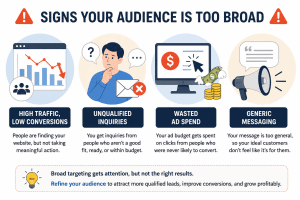
One common sign is high website traffic with low conversion rates. People may be finding your business, but they are not taking meaningful action. Another sign is a steady flow of inquiries from people who are not ready, not local, not within budget, or not looking for the services you actually provide.
Broad targeting also creates problems in paid advertising. If your ads reach too many low-intent users, your budget can disappear on clicks that were never likely to convert. Google Ads notes that online advertising can target the types of customers you want and filter out those you do not, which is why refinement matters so much in PPC campaigns.
The message itself may also feel generic. If your content says “we help businesses grow” but never addresses a specific pain point, industry, location, budget concern, or buying trigger, your ideal customers may not recognize that you are speaking to them.
What Customer Data Should a Small Business Review First?
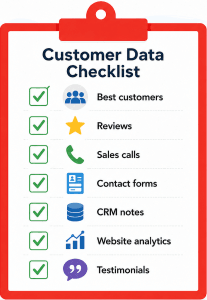
A small business should begin with real customer data before making assumptions about its ideal audience.
Start by reviewing your best existing customers. These are not always the customers who bought once or spent the most upfront. Look for customers who are profitable, easy to serve, likely to return, and likely to refer others. Then compare what they have in common: location, industry, purchase motivation, urgency, service needs, budget, or communication style.
You can also gather insight from reviews, testimonials, sales calls, contact forms, customer service questions, CRM notes, and website analytics. The University of Houston SBDC recommends researching current customers through surveys, interviews, focus groups, reviews, social media comments, and analytics to understand behaviors, buying habits, challenges, and online activity.
This is where strategy becomes practical. When QBall Digital reviews digital marketing services for small businesses, the goal is not simply to collect data. The goal is to turn that data into better SEO, PPC, social media, website, and content decisions.
How Can You Segment Your Audience Into Better-Fit Groups?
You can segment your audience into better-fit groups by organizing customers around the traits that influence how and why they buy.
Basic demographics can help, but they are rarely enough on their own. Age, income, job title, household type, and location are useful starting points. Stronger segmentation also looks at behavior, buying frequency, urgency, preferred channels, pain points, and the specific problem your product or service solves. Business.gov.au recommends dividing a target market into smaller customer groups based on characteristics and buying habits so marketing can be better targeted.
For example, a home service business might serve homeowners, landlords, and property managers. Those groups may buy the same service, but they care about different outcomes. A homeowner may want fast, trustworthy help. A landlord may care about cost control and tenant satisfaction. A property manager may need reliability across multiple jobs.
Segmenting helps your business avoid one-size-fits-all marketing. The Small Business Charter explains that segmentation helps clarify who buys from you, why they buy, and how to tailor marketing messages to each group.
How Do You Choose the Most Valuable Audience Segment?
The most valuable audience segment is not always the biggest group. It is the group most likely to need your offer, trust your message, convert efficiently, and generate profitable revenue.
To choose the right segment, score each group by fit, urgency, profitability, accessibility, and long-term value. A segment with high need but low ability to pay may not be the best first priority. A segment with strong budget but low urgency may require a longer sales cycle. A segment with clear pain, strong local demand, and high search intent may be a better near-term opportunity.
This matters because small businesses usually have limited marketing budgets. Trying to reach every possible customer spreads that budget thin. Microsoft Advertising connects audience targeting with higher ROI, clearer communication, and reduced waste from trying to cater to the general population.
A practical scoring model can help: rate each audience segment from 1 to 5 for urgency, profit potential, ease of reaching, service fit, and repeat value. The highest-scoring segment becomes your primary audience. Other groups can still matter, but they should not dilute your core message.
How Can You Turn Audience Insights Into Clearer Messaging?
Audience insights become useful when they shape what you say, what problem you lead with, and why your business is the right choice.
Instead of broad messaging like “quality service you can trust,” speak to the specific situation your best customer is facing. A local contractor might say, “Fast scheduling and clear estimates for homeowners who need repairs handled before small issues become expensive.” That message is more specific because it reflects urgency, audience type, and desired outcome.
Use customer language wherever possible. Reviews, emails, phone calls, and FAQs often reveal the exact words people use when they describe their problems. Those phrases can shape headlines, service pages, ad copy, blog content, and calls to action.
Your website should also reflect this clarity. QBall Digital’s website design and hosting service focuses on building websites that attract and convert customers, which is exactly why refined audience messaging matters on landing pages, service pages, and contact forms.
How Should Your Target Audience Strategy Shape SEO, PPC, and Social Media?
Your target audience strategy should guide which keywords you target, which ads you run, which platforms you use, and what content you create.
For SEO, audience refinement helps you focus on search terms that signal real buying intent. QBall Digital’s SEO services emphasize high-intent keyword research, competitor analysis, long-tail keywords, metadata, headings, and content structure to attract valuable traffic.
For PPC, audience strategy helps reduce wasted spend by improving keyword selection, location targeting, ad copy, negative keywords, and landing page relevance. Google Ads allows advertisers to use keywords, location, language, time of day, age, interests, and site behavior depending on campaign type. That makes PPC Google Search Ads more effective when they are built around a clearly defined buyer.
For social media, audience clarity helps you choose the right platform and message. QBall Digital’s social media marketing service focuses on platform optimization, targeted campaigns, reputation management, paid advertising, and strategies tailored to business goals.
When Should You Refine Your Target Audience Again?
You should refine your target audience whenever your leads, sales, traffic quality, campaign costs, or customer mix show that your current marketing is no longer focused enough.
A quarterly review is a smart rhythm for most small businesses. Review which keywords generated leads, which ads produced qualified inquiries, which service pages converted, and which customer types became the best accounts. You should also revisit your audience after launching a new offer, entering a new service area, changing prices, or noticing a drop in lead quality.
Audience refinement is not a one-time decision. Markets shift, competitors change, customer expectations evolve, and digital platforms reward relevance. The more often you compare your assumptions against real performance data, the easier it becomes to keep your marketing focused.
FAQ
What is the difference between a target market and a target audience?
A target market is the broader group your business wants to sell to, while a target audience is the more specific group your marketing message is designed to reach. Adobe explains that a target audience is usually a narrower segment within the broader target market.
How narrow should a small business target audience be?
Your audience should be narrow enough to guide messaging, offers, channels, and campaign decisions, but not so narrow that there are too few customers to support growth. The goal is focus, not restriction.
Can a small business have more than one target audience?
Yes. A small business can serve multiple audiences, but each one should have a clear message, offer, and campaign strategy. If every audience receives the same message, segmentation is not being used effectively.
Why does a broad target audience waste marketing budget?
A broad target audience wastes budget because it often reaches people who are not ready, not qualified, or not interested. This is especially costly in PPC, where irrelevant clicks can consume ad spend without producing leads.
How often should a small business update its audience strategy?
A small business should review its audience strategy at least quarterly. It should also update the strategy whenever lead quality, conversion rates, ad costs, service demand, or customer behavior changes.
Conclusion
Refining your target audience is not about excluding people randomly. It is about focusing your time, budget, and message on the customers most likely to value what your business offers. When you understand who your best customers are, what they need, how they search, and why they choose you, every part of your marketing becomes stronger.
A focused audience strategy improves SEO, PPC, social media, website messaging, and lead quality. More importantly, it helps your small business market with confidence instead of guessing.
Why QBall Digital is Your Ideal Choice for Target Audience Strategy?
QBall Digital is an ideal choice for small businesses that want audience strategy connected to real marketing outcomes. The agency specializes in SEO, Google Ads, web design, targeted ads, local SEO, social media, and digital marketing services designed to help small businesses rank higher, attract customers, and maximize their marketing budgets.
QBall Digital does not approach audience refinement as a generic branding task. Its services are built around practical execution: reaching the right audience, improving search visibility, building stronger websites, running targeted campaigns, and helping businesses convert more of the right customers. Its digital marketing page also emphasizes tailored strategies that help businesses reach, engage, and convert their target audience.
Build a Smarter Marketing Strategy with QBall Digital
If your marketing feels too broad, your next step is to identify where your audience, message, and campaigns are losing focus. QBall Digital can help you review your current strategy, uncover better-fit customer segments, and build a more effective path toward qualified leads.
Start with a free website and marketing audit from QBall Digital to identify gaps, opportunities, and practical ways to improve traffic, conversions, and campaign performance.