

Customer feedback can shape a stronger marketing strategy by revealing what customers truly need, expect, question, and value before they decide to buy. Instead of building campaigns around assumptions, businesses can use reviews, surveys, sales conversations, support tickets, website behavior, and social media comments to create messaging, offers, content, and ads that match real customer intent. A strong customer insight marketing strategy turns feedback into better decisions across targeting, positioning, PPC, SEO, content, and conversion optimization.
This matters because modern customers expect relevance. They compare brands quickly, notice vague messaging, and leave when a website or ad does not answer their concern. For small businesses especially, feedback helps marketing budgets work harder because every insight can guide more accurate audience targeting, stronger creative, and more persuasive conversion paths.
What Is Customer Feedback in a Marketing Strategy?
Customer feedback in a marketing strategy is the use of customer opinions, behaviors, questions, and experiences to guide how a business attracts, engages, and converts its audience. It can come from direct sources, such as surveys and interviews, or indirect sources, such as online reviews, customer service logs, website analytics, and social media comments.
The key is turning raw feedback into insight. A single complaint may be only one opinion, but repeated comments about pricing confusion, unclear service benefits, poor mobile experience, or missing trust signals can reveal a larger marketing problem. HubSpot describes customer feedback loops as a way to collect, analyze, act on, and follow up on feedback so businesses can improve the customer experience over time.
For businesses building a broader growth plan, feedback should connect directly to market research, audience segmentation, campaign planning, and conversion strategy. That is where partners offering full-service digital marketing services can help connect customer insight with practical execution across SEO, PPC, web design, content, and social media.
How Does Customer Feedback Become a Customer Insight Marketing Strategy?
Customer feedback becomes a customer insight marketing strategy when it is collected consistently, organized into themes, validated with data, and applied to specific marketing decisions. The process is simple in theory: listen to customers, find patterns, decide what those patterns mean, and use them to improve campaigns.
For example, if several leads say they are unsure what makes your service different, that is a positioning insight. If reviews repeatedly mention speed, responsiveness, or reliability, those phrases can become stronger ad copy and landing page headlines. If support conversations show that customers ask the same questions before buying, those questions can become FAQ content, blog topics, or sales enablement material.
A practical framework looks like this:
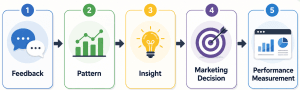
The insight only becomes valuable when it changes something measurable, such as a landing page headline, a PPC offer, an email nurture sequence, or an SEO content plan.
Why Is Customer Feedback Important for Stronger Marketing Decisions?
Customer feedback is important because it helps marketers understand what customers actually think, not just what internal teams assume. Many businesses describe their products or services from their own point of view, but customers often care about different outcomes: saving time, reducing risk, getting expert help, avoiding wasted money, or feeling confident before they commit.
This makes feedback especially useful for campaign planning. It can show why people choose one provider over another, what objections slow them down, what benefits matter most, and what proof they need before converting. Google Ads also emphasizes relevance in ad performance; responsive search ads, for example, test different headline and description combinations to better match potential customers’ search terms.
For paid campaigns, this is critical. A business may be targeting the right keyword but using the wrong message. Customer feedback can reveal whether the audience needs reassurance, clearer pricing, proof of results, a stronger offer, or a better landing page experience.
How Can Customer Feedback Improve Audience Segmentation?
Customer feedback improves audience segmentation by showing the differences between customer groups based on needs, motivations, buying triggers, and objections. Instead of segmenting only by age, location, or business size, marketers can segment by what customers are trying to solve.
For example, one audience segment may care most about affordability. Another may care about speed. Another may need education before they trust the solution. These differences should influence ad copy, landing page structure, email campaigns, blog content, and sales follow-up.
This is especially valuable for PPC Google Search Ads, where intent changes from one keyword to another. A person searching for “affordable marketing agency” may need cost clarity, while someone searching for “Google Ads management” may want proof of expertise and performance tracking. Better segmentation helps campaigns speak to each audience with more precision.
How Can Customer Feedback Strengthen Marketing Messaging?
Customer feedback strengthens marketing messaging by giving businesses the exact words customers use to describe their problems, goals, and concerns. This “voice of customer” language can make headlines, ad copy, website content, email subject lines, and calls to action feel more specific and persuasive.
Reviews are especially useful because they often contain natural, emotionally honest language. A customer may not say, “I valued operational efficiency.” They may say, “They saved me hours every week.” That second phrase is more human, more memorable, and often more effective in marketing copy.
Negative feedback can also improve messaging. If prospects often say they are worried about long contracts, unclear pricing, or poor communication, marketing can address those objections directly. That does not mean becoming defensive. It means adding clarity, trust signals, process explanations, testimonials, and stronger FAQ answers where they matter most.
How Does Customer Feedback Help Improve PPC and Paid Media Campaigns?
Customer feedback helps improve PPC by making ads more relevant, landing pages more persuasive, and offers more aligned with buyer intent. In paid search, even small message improvements can matter because every click has a cost. Feedback helps marketers understand what users expected when they clicked, what made them hesitate, and what convinced them to convert.
For example, if converted leads often mention “fast response” as the reason they chose your business, that benefit can be tested in ad headlines. If non-converting leads say the service page was unclear, the landing page may need a stronger explanation, clearer CTA, or better trust-building content. Google’s best practices for responsive search ads recommend improving relevance so ads can connect with more customers and drive more conversions.
Customer feedback also helps improve lead quality. A campaign that generates many low-fit leads may need better qualifying language, more specific offers, or landing page copy that sets clearer expectations. This is where QBall Digital’s focus on search intent, optimized landing pages, and real-time campaign tracking can support more efficient paid media decisions.
How Can Customer Feedback Improve SEO and Content Marketing?
Customer feedback improves SEO and content marketing by revealing the questions customers ask before they buy. Those questions can become blog posts, FAQ sections, comparison pages, service page updates, and educational resources that match real search intent.
This is useful because keyword research alone does not always explain the reason behind a search. Feedback adds context. It shows whether customers are confused, comparing options, looking for proof, concerned about cost, or trying to understand the process. QBall Digital’s search engine optimization services include keyword research, content strategy, on-page optimization, technical SEO, and performance tracking, which are all stronger when informed by customer questions and behavior.
Customer feedback can also improve website content. If users ask the same question repeatedly, that answer should not stay hidden in sales calls. It should appear on the service page, landing page, blog, or FAQ section where future customers can find it easily.
How Can Feedback Reveal Gaps in the Customer Journey?
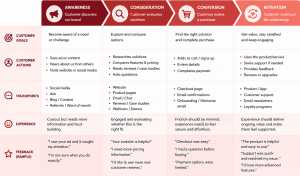
Feedback reveals customer journey gaps by showing where people become confused, uncertain, or unconvinced. At the awareness stage, customers may not fully understand their problem. At the consideration stage, they may need comparisons, proof, or examples. At the conversion stage, they may abandon a form because the offer is unclear or the page does not build enough trust.
Website experience is often part of this journey. QBall Digital’s website design and hosting services emphasize responsive design, usability, speed, navigation, content quality, and conversion-focused structure. These elements matter because even strong ads can underperform when the page after the click does not answer customer concerns.
Feedback can also reveal reputation gaps. If customers mention that reviews influenced their decision, or prospects hesitate because they cannot find enough proof, then reputation management becomes part of the marketing strategy rather than a separate activity.
What Are the Best Ways to Collect Customer Feedback for Marketing Insights?
The best ways to collect customer feedback include surveys, interviews, reviews, support tickets, sales call notes, live chat transcripts, social comments, website analytics, and post-purchase follow-ups. The strongest insights usually come from combining qualitative and quantitative sources.
Qualitative feedback explains why people feel a certain way. Quantitative data shows how often something happens. For example, analytics may show that users leave a landing page quickly, while survey responses or session feedback may explain that the offer was unclear. Market researchers often recommend using multiple feedback channels because isolated comments can be misleading when they are not compared against broader patterns.
Social platforms can also reveal customer interests, objections, and sentiment. A thoughtful social media marketing strategy can help businesses listen to audience conversations, test content themes, and identify which messages create engagement.
How Should Marketers Analyze Customer Feedback?
Marketers should analyze customer feedback by grouping recurring themes, identifying sentiment, comparing comments with behavior, and prioritizing insights by business impact. Useful categories include pricing, trust, product fit, service quality, communication, speed, usability, competitor comparisons, and buying objections.
The most important feedback is not always the loudest. A single angry review may deserve attention, but a repeated pattern across reviews, calls, surveys, and analytics deserves strategic action. Marketers should ask: Does this issue affect conversions? Does it influence lead quality? Does it reveal a stronger message? Does it expose a gap in the funnel?
Once themes are prioritized, each insight should be assigned to an action. That action may be rewriting ad copy, adding proof to a landing page, creating a comparison article, improving a form, adjusting targeting, or updating a service page.
What Mistakes Should Businesses Avoid When Using Customer Feedback?
Businesses should avoid collecting feedback without a goal, treating all opinions equally, relying on one feedback source, ignoring negative patterns, and failing to act on what they learn. Feedback is only valuable when it improves decisions.
Another common mistake is keeping insights trapped in one department. Sales may hear objections that marketing never sees. Customer service may know common complaints that never reach the website team. Marketing may see campaign data that product or operations teams never review. A stronger system shares insights across teams so the business can improve both the customer experience and the marketing strategy.
FAQ
What is the difference between customer feedback and customer insight?
Customer feedback is what customers say or do. Customer insight is the meaning behind those patterns and how the business uses them to make better decisions.
Can customer feedback improve PPC performance?
Yes. Customer feedback can improve PPC by helping marketers write more relevant ads, refine offers, address objections, and improve landing pages.
How often should businesses review customer feedback?
Businesses should review customer feedback regularly, especially before launching new campaigns, updating landing pages, changing offers, or planning content.
What feedback is most useful for marketing?
The most useful feedback explains customer motivations, objections, decision triggers, pain points, expectations, and reasons for choosing or rejecting a business.
Conclusion
Customer feedback shapes stronger marketing by turning real customer experiences into clearer strategy. It helps businesses understand what their audience values, what questions they ask, what objections hold them back, and what messages make them more likely to act.
A strong customer insight marketing strategy uses feedback to improve segmentation, messaging, PPC campaigns, SEO content, landing pages, customer journeys, and retention. The businesses that listen carefully and act strategically are better positioned to create marketing that feels relevant, trustworthy, and profitable.
Why QBall Digital is Your Ideal Choice for Customer Insight Marketing Strategy?
QBall Digital helps small businesses turn customer behavior, search intent, and campaign performance into smarter marketing decisions. Their approach connects SEO, PPC, web design, social media, and content into a practical strategy designed to attract customers and improve conversions. With data-driven planning and customized execution, QBall Digital helps businesses move beyond guesswork and build marketing around what their audience actually needs.
QBall Digital is especially valuable for businesses that want marketing to feel clearer, more measurable, and more connected to real growth. From campaign tracking to website optimization, their team focuses on helping businesses reach the right customers with the right message at the right time. For brands that want feedback-informed marketing without managing every channel alone, QBall Digital offers a reliable partner for building stronger digital performance.
Build a Smarter Strategy With QBall Digital
Ready to turn customer feedback into clearer campaigns, stronger messaging, and better conversion opportunities? Contact QBall Digital to start building a customer insight marketing strategy that supports measurable growth.