

Outsourced marketing for small business is the practice of hiring external marketing experts, freelancers, consultants, or agencies to manage part or all of a company’s marketing instead of building every capability in-house.
For many small businesses, this is not just a cost-saving decision. It is a way to access specialized skills, launch campaigns faster, improve reporting, and create a more consistent path to growth. Marketing now involves many connected disciplines, including paid ads, SEO, content, analytics, landing pages, email, creative, automation, and conversion tracking. Few small teams have the time or budget to master all of these internally.
The best outsourcing model depends on the business’s stage, goals, budget, and internal capacity. Some companies should keep brand and customer knowledge in-house while outsourcing specialist execution. Others need a freelancer for a defined project. Businesses that rely on leads, paid traffic, or multi-channel growth often benefit from an agency partner that can connect strategy, execution, and performance measurement.
What does outsourced marketing for small business include?
Outsourced marketing for small business can include strategy, execution, reporting, or a combination of all three. A business might outsource one task, such as blog writing or PPC management, or it might bring in an agency to manage a broader marketing program across multiple channels.
Common outsourced marketing services include PPC advertising, SEO, content marketing, email marketing, social media management, landing page creation, website optimization, marketing automation, creative design, analytics, and performance reporting. Google’s own SEO guidance emphasizes that basic SEO knowledge can have a noticeable impact, which is one reason many small businesses seek outside expertise when they do not have that knowledge internally.
Outsourced marketing does not always mean hiring a full-service agency. It can mean working with a freelance copywriter, a paid search specialist, a fractional marketing strategist, a web designer, or a full outsourced team. The right structure depends on whether the business needs a single skill, a defined project, ongoing execution, or a complete growth system.
For example, a local service business might keep customer communication and brand approvals in-house while outsourcing Google Ads, landing page testing, and reporting. A growing B2B company might outsource SEO strategy, content production, and LinkedIn campaign management while keeping sales enablement and product messaging internal. A startup with no marketing department might need an agency to create the foundation: positioning, tracking, paid campaigns, website improvements, and monthly reporting.
Why do small businesses outsource marketing?
Small businesses outsource marketing because they need expert execution, better consistency, and measurable growth without the cost or complexity of hiring a full internal team. Marketing requires time, tools, strategy, and specialized experience. When owners or small teams try to handle everything themselves, important work often becomes inconsistent.
Time is one of the biggest reasons. Small business owners are often responsible for operations, sales, customer service, hiring, finance, and delivery. Marketing can become reactive: a few social posts, an occasional email, an ad campaign launched without enough testing, or a blog strategy that stops after three articles. Outsourcing helps create a steady operating rhythm.
Skill gaps are another major driver. Paid search, SEO, analytics, conversion tracking, copywriting, creative, and automation each require different expertise. Google Ads conversion tracking, for example, is designed to show which user actions happen after someone interacts with an ad, giving businesses insight into user behavior and campaign performance. Without that setup, a small business may spend money on ads without knowing which campaigns actually produce valuable actions.
Cost also matters. Hiring an experienced marketing manager can be expensive. In the United States, the median annual wage for marketing managers was $161,030 in May 2024, according to the U.S. Bureau of Labor Statistics. That figure does not include payroll taxes, benefits, software, creative resources, or specialist support.
Outsourcing gives small businesses more flexibility. Instead of hiring every role internally, a company can pay for the level of support it needs now, then adjust as campaigns mature. That flexibility is especially useful for businesses testing new markets, launching offers, improving lead generation, or trying to turn paid advertising into a more predictable revenue channel.
When should a small business keep marketing in-house?
A small business should keep marketing in-house when the work requires daily brand knowledge, fast internal collaboration, direct customer insight, or close coordination with sales and operations. Not every marketing function should be outsourced automatically.
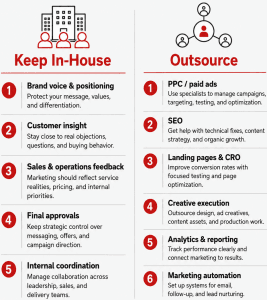
In-house support is especially useful for brand ownership. Someone inside the company should understand the customer deeply, know what makes the business different, and protect the voice, values, and promises of the brand. This person does not need to execute every campaign, but they should guide direction and approve important messaging.
In-house marketing also makes sense for work that requires frequent internal context. Sales team feedback, customer objections, product updates, pricing changes, event details, service availability, and operational limitations often move quickly. A person inside the business can translate that context into clearer marketing direction.
The strongest in-house roles are often strategic coordinators rather than one-person marketing departments. For example, an internal marketing lead can own goals, approve content, gather customer insights, manage the relationship with an agency or freelancers, and make sure marketing supports sales. This keeps the business in control without forcing one employee to become an expert in every channel.
A small business should consider hiring in-house when the workload is steady, central to growth, and large enough to justify the fixed cost. If the company needs daily marketing leadership, constant cross-functional collaboration, and long-term brand development, an internal role may be worth the investment.
When should a small business hire freelance marketing support?
A small business should hire freelance marketing support when it needs a specific skill, a defined project, or flexible execution without committing to a full-time employee or agency retainer. Freelancers are often a smart fit when the business already knows what needs to be done.
Freelancers work well for tasks such as blog writing, graphic design, email copy, landing page copy, short-term SEO cleanup, paid ad creative, website updates, and campaign-specific support. They can also help during busy seasons, launches, or one-time projects when an internal team needs extra capacity.
Cost flexibility is a major advantage. Upwork’s digital marketer rate guide lists a median hourly rate of $25, with typical rates ranging from $15 to $45 on the platform, though actual rates vary based on experience, location, specialization, and project complexity.
The limitation is that freelancers usually need direction. A freelance writer can create strong content, but someone still needs to define the audience, offer, keyword target, funnel role, call to action, and success metric. A freelance designer can create ads, but someone still needs to decide which messages to test and how performance will be measured.
Freelance support is best when the business has a clear brief, a defined deliverable, and someone responsible for managing quality. If the business needs strategy, coordination across multiple channels, performance reporting, and ongoing optimization, freelance support alone may not be enough.
When should a small business hire an outsourced marketing agency?
A small business should hire an outsourced marketing agency when it needs strategy, execution, reporting, and multiple specialists working together toward measurable growth. Agencies are usually the better fit when marketing has become too complex for one person or one freelancer to manage.
Agency support is especially valuable when a business needs PPC, SEO, content, creative, landing pages, analytics, and conversion strategy to work together. Paid campaigns are a clear example. Google explains that Ad Rank considers factors such as ad quality, landing page usefulness, landing page relevance, expectations set by the ad creative, and ease of navigation. That means PPC performance is not only about bids; it is also about message match, landing page quality, and user experience.
A business should consider an agency when there is ad spend but no clear return, traffic but few leads, leads but poor quality, inconsistent reporting, or no structured optimization process. These are signs that marketing needs more than task completion. It needs diagnosis, prioritization, testing, and accountability.
An agency can also reduce management burden. Instead of hiring and coordinating separate freelancers for ads, SEO, design, copy, analytics, and landing pages, the business works with one partner responsible for connecting the pieces. This can be particularly useful for owners and lean teams that do not have time to manage multiple specialists.
The tradeoff is that agency relationships require trust, communication, and clear expectations. A good agency should not simply “do marketing.” It should explain what it is doing, why it matters, how performance is measured, and what the business should expect over time.
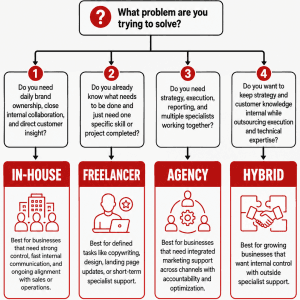
How does in-house, freelance, and agency marketing support compare?
In-house, freelance, and agency marketing support each solve a different business problem. The best choice depends on whether the company needs control, flexibility, specialization, or integrated growth.
| Support Type | Best For | Main Strength | Main Limitation |
| In-house | Brand ownership, daily coordination, customer insight | Control and internal alignment | Higher fixed cost and limited specialization |
| Freelance | Specific projects or specialist tasks | Flexibility and focused skill | Requires direction and management |
| Agency | Multi-channel strategy, execution, and reporting | Integrated expertise and accountability | Requires clear goals and trust |
| Hybrid | Growing businesses with internal and external needs | Balance of control and expertise | Needs strong coordination |
A hybrid model is often the most practical structure for small businesses. The company keeps strategic ownership internally, then outsources specialized or time-consuming work. For example, an internal coordinator may manage business priorities while an agency handles PPC, SEO, landing page testing, and analytics. This keeps the business close to its customers while still benefiting from outside expertise.
The decision should not start with “Which option is cheapest?” It should start with “What problem are we trying to solve?” If the problem is lack of time, freelance or agency support may help. If the problem is lack of strategy, an agency or fractional strategist may be better. If the problem is lack of brand consistency, the business may need stronger internal ownership.
How much does outsourced marketing for small business cost?
Outsourced marketing costs depend on scope, channels, campaign complexity, ad spend, deliverables, and the level of strategy required. A small business outsourcing one blog per month will pay very differently from a company outsourcing PPC, SEO, landing page optimization, creative, and reporting.
The biggest cost drivers are the number of channels, the amount of content needed, the competitiveness of the market, the size of the ad budget, the complexity of tracking, and the level of senior strategy involved. A freelancer may be cost-effective for a narrow task, while an agency may cost more because it includes strategy, coordination, multiple specialists, and reporting.
Marketing budget benchmarks can provide context, but they should not be treated as universal rules. Gartner reported that 2025 marketing budgets remained flat at 7.7% of overall company revenue among surveyed CMOs, mostly reflecting larger-company marketing leadership rather than a strict small-business formula.
For small businesses, the better approach is to reverse-engineer the budget from goals. If the business wants more leads, it should define how many leads it needs, what a qualified lead is worth, what conversion rate is realistic, and how much it can afford to pay to acquire a customer. This is especially important for PPC, where ad spend, landing page performance, sales follow-up, and lead quality all affect profitability.
Cost should also be judged against opportunity cost. A cheaper provider is not cheaper if poor tracking wastes ad spend, weak landing pages lower conversion rates, or unclear reporting prevents good decisions. The right outsourced partner should help the business understand what budget is needed, what can be done now, and what should wait.
How can small businesses outsource PPC without wasting ad spend?
Small businesses can outsource PPC effectively by setting clear goals, defining qualified leads, installing conversion tracking, improving landing pages, and reviewing performance reports regularly. PPC can produce fast visibility, but it can also waste money quickly when campaigns are launched without the right foundation.
The first step is to define the business outcome. A campaign should not simply aim for clicks. It should aim for phone calls, quote requests, bookings, purchases, demos, consultations, or another action tied to revenue. In Google Analytics, key events are actions that are important to business success, and they can help evaluate marketing performance across channels.
The second step is conversion tracking. Google Ads conversion measurement helps businesses understand what users do after interacting with an ad, which is essential for campaign optimization. Without tracking, the business cannot confidently identify which keywords, ads, audiences, or landing pages are driving valuable outcomes.
The third step is landing page alignment. The promise in the ad should match the page visitors land on. The page should be relevant, easy to navigate, fast enough for users, and focused on a clear action. Google notes that landing page usefulness, relevance, navigation, and the expectations created by the ad are part of how ad quality is assessed.
The fourth step is lead quality review. A low cost per lead is not useful if those leads do not buy. The outsourced PPC partner should review search terms, form submissions, phone call quality, lead-to-sale rate, and customer acquisition cost. WordStream’s PPC benchmarks can help businesses compare metrics such as cost per click, conversion rate, and cost per lead by industry, but each company still needs to judge performance against its own margins and sales process.
How do you choose the right outsourced marketing partner?
Choose the right outsourced marketing partner by evaluating their strategy process, channel expertise, reporting standards, communication style, and ability to connect marketing activity to business outcomes. A good partner should ask about revenue before tactics.
The discovery process matters. Before recommending ads, blogs, SEO, or social content, the partner should ask about target customers, sales cycle, margins, best-selling services, geographic focus, lead quality, current conversion rates, and past campaign performance. If a partner recommends a package before understanding the business, that is a warning sign.
The partner should also be transparent about measurement. For PPC, this includes conversion tracking, cost per lead, lead quality, landing page performance, and sales feedback. For SEO, it includes rankings, traffic quality, content performance, technical improvements, and conversions from organic search. Google Search Central’s SEO Starter Guide frames SEO around helping search engines crawl, index, and understand content while keeping users in mind.
Communication is just as important as technical skill. Small businesses need clarity, not dashboards full of unexplained numbers. A strong partner should explain what happened, why it happened, what is being tested next, and how results connect to the business’s goals.
Ownership should be clarified before work begins. The business should know who owns ad accounts, analytics accounts, landing pages, creative assets, website access, and reporting data. This protects the company and makes future transitions easier.
What mistakes should small businesses avoid when outsourcing marketing?
Small businesses should avoid outsourcing marketing without clear goals, tracking, ownership, communication, or expectations. Outsourcing works best when the business knows what outcome it wants and gives the partner enough information to make smart decisions.
One common mistake is hiring before defining goals. “We need more marketing” is too vague. “We need 30 qualified consultation requests per month from homeowners within our service area” gives an outsourced partner something measurable to build around.
Another mistake is choosing the cheapest provider without understanding what is included. Low-cost support may be enough for a simple task, but it may not include strategy, tracking, reporting, testing, or performance analysis. This is risky for PPC because poorly structured campaigns can spend budget without producing profitable leads.
Small businesses should also avoid outsourcing everything without internal ownership. Even the best external partner needs access to customer insight, sales feedback, service details, and business priorities. The company should still own its strategy, positioning, and customer understanding.
A final mistake is measuring the wrong things. Traffic, impressions, likes, and clicks can be useful indicators, but they are not the same as revenue. For lead-generation businesses, the most important questions are usually: Are we getting qualified leads? Are they converting into customers? Is the cost acceptable? Can we scale without reducing quality?
How do you measure whether outsourced marketing is working?
Outsourced marketing is working when it improves measurable outcomes such as qualified leads, conversion rates, customer acquisition cost, pipeline quality, and revenue contribution. The right KPIs depend on the channel and the business model.
For PPC, important metrics include cost per click, conversion rate, cost per lead, lead quality, cost per acquisition, return on ad spend, impression share, and landing page conversion rate. For SEO, useful metrics include rankings, organic traffic quality, indexed pages, content engagement, organic conversions, and assisted revenue. For email, businesses should track open rate, click rate, conversion rate, unsubscribe rate, and revenue or leads generated.
Analytics setup is essential. Google Analytics key events allow businesses to measure actions that matter to success and evaluate marketing performance across channels.
Small businesses should also connect marketing reports to sales outcomes. A campaign that generates 100 form fills may look strong, but if only five are qualified, the strategy needs refinement. Sales feedback helps marketing teams improve targeting, ad copy, landing page messaging, forms, and offers.
Reporting should lead to decisions. A useful report does not only describe what happened. It should answer what changed, what was learned, what needs improvement, and what the next action is. This is where outsourced marketing becomes a growth system rather than a task list.
Visual Content Suggestion: Add a simple KPI dashboard mockup showing traffic, leads, qualified leads, cost per lead, conversion rate, and revenue influenced by marketing.
Is outsourced marketing right for every small business?
Outsourced marketing is not right for every small business, but it is often a strong fit when the business has clear goals, a defined budget, and a need for specialized expertise. Some businesses need to clarify their offer, audience, or sales process before they invest heavily in marketing.
Very early businesses may need foundational work first. If the company does not know who it serves, what problem it solves, or why customers choose it, outsourcing PPC or SEO may not fix the deeper issue. In that case, the first outsourced engagement should focus on positioning, customer research, and offer clarity.
Businesses with very small budgets may need to start with a focused approach. Instead of outsourcing everything, they might begin with one high-impact area, such as conversion tracking, local SEO foundations, a landing page, or a small PPC test. The goal is to create enough clarity to invest more confidently later.
Companies with strong internal teams may not need full outsourced management. They may only need specialist support for technical SEO, paid media, analytics, creative testing, or campaign strategy. The right model is the one that fills the real gap without duplicating what the internal team already does well.
Outsourced marketing is most effective when the business treats the provider as a partner, not a vendor hidden outside the company. The more clearly goals, customer insights, sales feedback, and performance data are shared, the more useful the outsourced team can become.
FAQ
What is outsourced marketing for small business?
Outsourced marketing for small business means hiring outside experts to manage some or all marketing activities. This can include PPC, SEO, content, email, social media, website optimization, analytics, strategy, or reporting.
Is it better to hire in-house or outsource marketing?
It is better to hire in-house when the work requires daily brand ownership, internal coordination, and deep customer knowledge. It is better to outsource when the business needs specialized skills, faster execution, or multi-channel support without building a full internal team.
Should a small business hire a freelancer or marketing agency?
A small business should hire a freelancer for defined tasks or projects, such as writing, design, or a one-time campaign asset. It should hire an agency when it needs strategy, execution, reporting, and several specialists working together.
What marketing tasks should small businesses outsource first?
Small businesses should usually outsource tasks that require specialized skill or are directly tied to growth. PPC management, conversion tracking, SEO audits, landing page optimization, content strategy, and analytics reporting are often strong starting points.
Can outsourced marketing help with PPC advertising?
Yes, outsourced marketing can help with PPC advertising when the partner understands campaign structure, targeting, keyword intent, ad copy, landing pages, conversion tracking, and lead quality. PPC should be measured by business outcomes, not just clicks.
How long does outsourced marketing take to show results?
The timeline depends on the channel. PPC can generate data quickly once campaigns and tracking are live, while SEO and content usually require more time to build visibility and authority. Google notes that SEO changes can take time to show impact in search results.
How do I know if my outsourced marketing partner is performing well?
Your outsourced marketing partner is performing well if reporting is clear, goals are measurable, communication is consistent, and marketing activity is improving lead quality, conversion rates, acquisition cost, or revenue contribution.
Conclusion
Outsourced marketing for small business gives owners and lean teams access to expertise, structure, and execution without forcing them to build a full marketing department too early. It can help a business launch campaigns faster, improve reporting, reduce guesswork, and focus internal time on customers, sales, and operations.
The smartest decision is not simply whether to outsource. It is what to outsource, when to outsource it, and which support model fits the business. Keep marketing in-house when brand ownership, customer knowledge, and daily coordination matter most. Use freelancers for defined specialist tasks. Choose an agency when growth requires strategy, execution, tracking, and accountability across multiple channels.
For many small businesses, the strongest model is hybrid. Internal leaders keep control of the business direction, while outsourced specialists handle technical, creative, and performance-driven work. That balance gives the company both control and capability.
Why QBall Digital is Your Ideal Choice for Outsourced Marketing for Small Business?
QBall Digital is an ideal choice for small businesses that want outsourced marketing support tied to real business outcomes. Instead of treating marketing as a collection of disconnected tasks, QBall Digital helps connect strategy, PPC execution, landing page performance, analytics, and conversion-focused decision-making. That matters because small businesses do not have budget to waste on campaigns that generate clicks without qualified leads.
QBall Digital understands that outsourced marketing should make growth clearer, not more confusing. From campaign planning to performance review, the goal is to help small businesses understand what is working, what needs improvement, and where the next opportunity is. With the right structure, QBall Digital can serve as an extension of your team while giving you access to the focused expertise needed to compete more confidently.
Grow Smarter With QBall Digital
If your business is spending time or ad budget without a clear path to measurable growth, QBall Digital can help you make the next move with confidence. Partner with QBall Digital to review your current marketing, identify the highest-impact opportunities, and build an outsourced marketing strategy designed around qualified leads, stronger campaigns, and better ROI.