

The best lead magnet is not always the longest PDF, the flashiest interactive tool, or the asset your competitor just published. The best lead generation content offers are the ones that match what your buyer needs at that exact moment: education, action, or proof.
That is where many businesses waste budget. They build a downloadable guide when their audience really needs a quick checklist. They promote a checklist when buyers are actually looking for cost justification. Or they invest in a calculator before they have enough traffic, data, or follow-up systems to turn those submissions into revenue.
For PPC campaigns, this decision matters even more. Paid traffic carries a direct cost, so every click needs a clear reason to convert. A strong downloadable asset gives visitors value before they are ready to book a call, request a quote, or speak with sales.
What Are Lead Generation Content Offers?
Lead generation content offers are valuable assets a business provides in exchange for a prospect’s contact information. They can include downloadable guides, checklists, templates, calculators, webinars, reports, case studies, assessments, or other gated resources. HubSpot defines lead generation forms as forms that gather information from potential customers in exchange for an offer or piece of content, such as an ebook, case study, research report, or webinar.
The key difference between a regular blog post and a lead generation offer is the value exchange. A blog post is usually open-access content designed to attract, educate, and build trust. A content offer asks the visitor to take one more step by sharing information, usually through a form, because the asset promises deeper, more practical, or more personalized value.
A strong content offer should not feel like a thin sales brochure. It should solve a specific problem, help the reader make progress, and create a logical next step toward your product or service. For example, a PPC agency might offer a “Google Ads Account Audit Checklist” to help prospects identify wasted spend, while a SaaS company might offer an ROI calculator to help buyers estimate potential savings.
The goal is not simply to collect emails. The goal is to create a conversion point that attracts the right people, captures useful context, and gives your sales or marketing team a reason to follow up with relevance.
How Do Downloadable Assets Help Turn PPC Traffic Into Leads?
Downloadable assets help PPC campaigns convert because they give paid visitors a lower-friction action than “book a consultation” or “request a proposal.” Many people who click an ad are interested, but not ready to talk to sales. A guide, checklist, or calculator gives them a valuable next step while allowing your business to capture the lead.
This matters because the lead journey is not usually simple. Google notes that consumers often read reviews, watch videos, and compare options across multiple touchpoints before filling out a lead form. A content offer fits into that research process by giving the visitor something useful while keeping your brand involved in the decision.
For PPC specifically, content offers can improve the usefulness of landing pages, support remarketing audiences, segment prospects by interest, and give sales teams insight into what the lead cares about. Someone who downloads a beginner’s guide may need education. Someone who completes a calculator may be closer to budget discussion. Someone who uses a checklist may be preparing to take action soon.
Google also recommends that landing pages closely match the ad and keywords, including mirroring the call to action in the ad copy. That means a PPC ad promising a checklist should lead to a page focused on that checklist, not a generic service page.
What Is the Difference Between a Guide, Checklist, and Calculator?
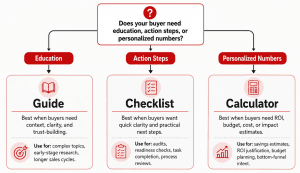
A guide teaches the buyer how to understand or solve a broader problem. A checklist helps the buyer complete, review, or evaluate a specific task. A calculator helps the buyer estimate a number, such as cost, savings, ROI, budget, lead volume, or timeline.
These formats work differently because they match different types of buyer intent. A guide is best when the reader is still learning. A checklist is best when the reader wants clarity and action. A calculator is best when the reader wants personalized proof or decision support.
| Format | Best For | Typical Funnel Stage | Buyer Mindset | Sales Value |
| Guide | Education and trust-building | Top to middle funnel | “Help me understand this.” | Shows topic interest and pain point |
| Checklist | Action and evaluation | Middle funnel | “Help me do this correctly.” | Shows readiness and task urgency |
| Calculator | Numbers and justification | Middle to bottom funnel | “Help me estimate the impact.” | Reveals budget, goals, volume, and urgency |
A guide may generate broader interest, but some leads will be early-stage. A checklist may convert well because it is practical and easy to consume. A calculator may produce fewer submissions, but those leads often provide richer context because the user is applying the offer to their own business situation.
When Should Your Business Offer a Guide?
Your business should offer a guide when buyers need education before they can confidently take action. Guides work well when the topic is complex, the purchase is expensive, the sales cycle is longer, or the audience needs help understanding risks, options, and next steps.
A guide is especially useful for early-stage PPC traffic. Someone searching for “how to reduce wasted ad spend” may not be ready to hire an agency today, but they are aware of a problem. A well-written guide can help that person understand where budget is leaking, what to review, and why expert support may be valuable.
Guides also build credibility. A business that explains a complicated problem clearly demonstrates expertise before asking for a meeting. This is important in B2B journeys, where buyers often rely heavily on self-directed research. Gartner reports that many B2B buyers prefer rep-free buying experiences, making digital education a critical part of building confidence before sales involvement.
Examples of guide-style offers include “The Business Owner’s Guide to Reducing Wasted Google Ads Spend,” “The Complete Guide to Choosing a PPC Agency,” or “A Founder’s Guide to Building a Paid Media Funnel That Converts.” These titles work because they promise clarity, not just information.
When Should Your Business Offer a Checklist?
Your business should offer a checklist when your audience wants quick clarity, a practical next step, or a simple way to evaluate readiness. Checklists are effective because they reduce complexity. Instead of asking the reader to absorb a full strategy, they help the reader complete a focused task.
Checklists work particularly well for busy decision-makers. A marketing manager may not have time to read a 30-page guide before launching a campaign, but they may download a two-page “Landing Page Launch Checklist” to confirm that the essentials are covered. That creates a useful lead capture moment with less friction.
They are also strong for audit-based and readiness-based campaigns. A “Google Ads Account Audit Checklist” can help a prospect uncover problems, while a “Paid Media Readiness Checklist” can help a business decide whether it has the right tracking, landing pages, budget, and follow-up process in place.
Demand Gen Report’s 2024 Content Preferences Benchmark Survey found that buyers complained about too much content, generic content, boring content, sales-heavy content, and too many steps to access content. That supports the case for concise, useful offers that solve a specific problem without overwhelming the reader.
When Should Your Business Offer a Calculator?
Your business should offer a calculator when prospects are trying to quantify cost, ROI, savings, budget, or potential impact. A calculator is strongest when the buyer’s real question is not “what is this?” but “what could this mean for my business?”
Calculators can attract higher-intent leads because the user is applying numbers to their own situation. A person who uses a PPC ROI calculator may enter current ad spend, conversion rate, cost per lead, close rate, and average deal value. That information can help your team understand whether the lead has budget, urgency, and a measurable business case.
Calculators also create stronger sales conversations. Instead of following up with a generic “Did you enjoy the download?” message, your team can reference the user’s estimate, assumptions, or gap. For example, “Based on your calculator results, improving landing page conversion from 3% to 5% could significantly change your cost per lead. Want us to review where that lift might come from?”
Gartner notes that interactive tools such as cost calculators, product selection tools, visualizers, ratings, and reviews can help buyers validate decisions and feel more confident. This makes calculators especially useful for bottom-funnel PPC campaigns where prospects need proof before taking the next step.
How Do You Choose the Right Lead Generation Content Offer for Your Funnel Stage?
Choose your content offer by matching the format to the buyer’s stage in the funnel. At the top of the funnel, guides and simple checklists usually work best because buyers are still learning. In the middle of the funnel, checklists, templates, comparison tools, and assessments can help prospects evaluate options. Near the bottom of the funnel, calculators, audits, demos, and consultations are stronger because the buyer is closer to making a decision.
For broad informational PPC campaigns, a guide can be the safest choice. These campaigns usually reach people who are problem-aware but not yet vendor-ready. A guide gives them enough depth to understand the issue and trust your perspective.
For problem-aware campaigns, a checklist may perform better. These users often know what they need to fix and want practical help. A checklist gives them momentum and makes the conversion feel easy.
For high-intent campaigns around cost, ROI, budget, savings, or performance benchmarks, a calculator is often the strongest fit. It gives the user personalized value and gives your business more useful lead data than a basic PDF download.
How Do You Match Content Offers to Buyer Intent?
Match content offers to buyer intent by studying the language people use before they click. Search queries often reveal whether someone wants education, action, comparison, or calculation.
Queries with phrases like “what is,” “how does,” “guide,” “examples,” or “strategy” usually suggest educational intent. These users are better aligned with guides. Queries with words like “checklist,” “steps,” “audit,” “requirements,” or “process” suggest action intent, which makes checklists a natural fit. Queries with “cost,” “ROI,” “budget,” “estimate,” “savings,” or “calculator” suggest number-driven intent.
SEO tools commonly classify keyword intent into categories such as informational, commercial, navigational, and transactional. Semrush describes these categories as reflecting the general purpose behind a user’s search. For PPC, the same logic applies: the offer should satisfy the reason the person clicked.
This is where many landing pages fail. The ad targets one intent, but the offer answers another. A person searching “PPC ROI calculator” should not land on a generic ebook. A person searching “how to improve lead quality from Google Ads” may need a practical guide before they are ready for a calculator.
How Should You Build a High-Converting Landing Page for a Downloadable Asset?
A high-converting landing page should make the value of the asset obvious within seconds. The headline should match the ad promise, the body copy should explain what the visitor will get, and the form should feel appropriate for the value of the offer.
The page should include a clear title, short benefit-driven copy, a preview of what is inside, trust signals, a simple form, and one strong call to action. For a guide, the copy should emphasize insight and clarity. For a checklist, it should emphasize speed and practicality. For a calculator, it should emphasize personalized results.
The landing page should sell the offer, not overload the visitor with every detail about your company. There is room for credibility, but the main message should answer the visitor’s question: “Why is this worth my information?”
Google’s landing page guidance reinforces the importance of relevance between ad, keyword, and page. The stronger the connection between what the ad promises and what the page delivers, the better the chance of conversion.
What Form Fields Should You Ask for When Offering a Guide, Checklist, or Calculator?
The number of form fields should match the value of the offer and the level of intent. A simple checklist should ask for very little information, often just name and email. A guide can justify one or two additional qualifying fields if the content is substantial. A calculator can usually ask for more information because the user expects to enter details to receive a personalized result.
This is a balance between conversion volume and lead quality. Shorter forms often reduce friction, but they may give your team less context. Longer forms can qualify leads better, but they may lower submission rates if the value of the offer does not justify the effort.
HubSpot’s analysis of more than 40,000 landing pages found that form length is a balancing act between user experience and business needs, and that conversion rates tend to decrease as the number of form fields increases. That does not mean every form should be as short as possible. It means every field should earn its place.
For a checklist, ask only what you need to deliver the asset and follow up. For a guide, consider asking about role, company size, or primary challenge. For a calculator, fields like monthly ad spend, average lead value, conversion rate, or target cost per lead may be part of the value exchange itself.
How Do You Promote Lead Generation Content Offers Through PPC?
Promote content offers through PPC by aligning the campaign, keyword, ad copy, landing page, and follow-up sequence around the same promise. A mismatch at any point can weaken performance.
For Google Search campaigns, match the offer to the query. Educational keywords can promote a guide. Audit or readiness keywords can promote a checklist. Cost, ROI, and budget keywords can promote a calculator. This creates a cleaner experience because the visitor sees the same idea from search query to ad to landing page.
For LinkedIn, Meta, and other paid social campaigns, the offer should match the audience’s level of awareness. Cold audiences may respond better to a useful guide or checklist. Retargeting audiences may be ready for a calculator, audit, or consultation. TikTok notes that instant forms can reduce friction, pre-populate fields, and sync leads with a CRM, which shows why native lead capture can be useful when the goal is speed and low friction.
The CTA should be specific. “Download the Checklist,” “Get the Guide,” and “Calculate Your PPC ROI” are clearer than “Submit” or “Learn More.” PPC traffic should never have to guess what happens after the click.
How Do You Measure Whether a Content Offer Is Actually Working?
A content offer is working when it produces qualified pipeline, not just downloads. Form submissions are useful, but they are only the first layer of performance.
Measure landing page conversion rate, cost per lead, lead quality, marketing-qualified leads, sales-qualified leads, booked calls, pipeline created, close rate, revenue influenced, and payback period. For PPC, also review performance by keyword, audience, campaign, ad variation, device, and landing page.
Google Ads supports lead funnel reporting with stages such as leads, qualified leads, and converted leads when businesses use appropriate offline conversion data. This is important because ad platforms need better feedback than “form submitted” to optimize for real business outcomes.
A checklist may produce cheaper leads because it is quick and easy to download. A calculator may produce fewer leads but stronger sales conversations. A guide may generate early-stage leads that require nurturing before they become sales-ready. The right offer is not always the one with the lowest cost per lead; it is the one with the best relationship between acquisition cost, lead quality, and revenue potential.
Can One Business Use More Than One Type of Content Offer?
Yes, one business can and often should use more than one type of content offer. Guides, checklists, and calculators serve different buyer moments, so they can work together as a content offer ecosystem.
A guide can educate early-stage prospects. A checklist can help those prospects take action or evaluate readiness. A calculator can help more serious buyers quantify the value of solving the problem. Used together, these assets support different levels of intent instead of forcing every visitor into the same conversion path.
For example, a PPC agency could start with a guide on reducing wasted ad spend, follow up with a Google Ads audit checklist, and later invite the prospect to use a PPC ROI calculator. Each offer gives the buyer a useful next step while giving the business more context.
This approach also supports remarketing. Someone who downloaded a guide may later see an ad for a checklist. Someone who completed the checklist may later see an ad for a calculator or consultation. The result is a more intentional funnel rather than a single lead magnet doing all the work.
What Mistakes Should You Avoid When Creating Lead Generation Content Offers?
The first mistake is creating an offer that is too generic. “The Ultimate Marketing Guide” is less compelling than “The PPC Landing Page Checklist for Reducing Cost Per Lead.” Specificity makes the value easier to understand.
The second mistake is asking for too much information too soon. A short checklist does not usually justify a long form. A calculator may justify more fields, but only when those fields improve the result for the user.
The third mistake is making the asset overly promotional. Demand Gen Report found that buyers identified sales-heavy content as a major content consumption problem. Your asset can support sales, but it should first help the reader solve a problem.
The fourth mistake is measuring only downloads. A content offer that generates cheap leads but no qualified opportunities is not a win. A smaller number of better-fit leads may be more valuable than a large list of contacts who never engage again.
The fifth mistake is failing to connect the form to CRM, email nurturing, and sales follow-up. A content offer should not end at the thank-you page. It should trigger a clear next step based on what the person downloaded, submitted, or calculated.
How Can You Decide Between a Guide, Checklist, or Calculator?
Choose a guide when your audience needs education. Choose a checklist when your audience needs action. Choose a calculator when your audience needs proof, numbers, or justification.
A guide is usually the best starting point when the topic is complex and the buyer needs context. A checklist is usually the best choice when the buyer already understands the problem and wants a practical way to move forward. A calculator is usually the best option when the buyer is comparing value, budget, or expected return.
The decision should come from the buyer’s immediate question. Are they asking, “What should I know?” Build a guide. Are they asking, “What should I do?” Build a checklist. Are they asking, “What could this be worth?” Build a calculator.
The best lead generation content offers are not created because they sound impressive. They are created because they match buyer intent, support PPC campaign goals, and help your team turn interest into qualified sales conversations.
FAQ
What are the best lead generation content offers for B2B companies?
The best B2B lead generation content offers are usually guides, checklists, templates, webinars, reports, assessments, calculators, and comparison tools. The right choice depends on the buyer’s intent and funnel stage. A guide works well for education, a checklist works well for action, and a calculator works well for cost or ROI justification.
Are guides still effective for lead generation?
Yes, guides are still effective when the buyer needs education before taking action. They work best for complex topics, high-value services, and longer sales cycles. A guide should be specific, practical, and genuinely useful rather than a broad overview filled with sales messaging.
Do checklists generate high-quality leads?
Checklists can generate high-quality leads when they are tied to a specific task, audit, or buying milestone. A generic checklist may attract casual downloads, but a focused checklist such as a PPC audit checklist can attract prospects who are actively evaluating a problem.
Are calculators better than downloadable PDFs?
Calculators are not automatically better than PDFs. They are better when the buyer needs personalized numbers, ROI estimates, cost projections, or budget guidance. Guides and checklists may be better when the buyer needs education or a quick action framework.
Should content offers be gated or ungated?
Content offers should be gated when the asset provides enough value to justify a form and when the business has a clear follow-up plan. Some content should remain ungated to build trust and attract organic traffic. A good strategy often uses ungated educational content to lead readers toward higher-value gated assets.
How many form fields should a lead generation offer have?
A lead generation form should ask only for the information needed to deliver the offer and support relevant follow-up. Simple checklists should usually have fewer fields. Calculators and higher-value offers can ask for more information when those fields improve the result or help qualify the lead.
What is the best content offer for PPC campaigns?
The best content offer for PPC campaigns depends on keyword intent. Educational searches often fit guides. Audit, process, or readiness searches often fit checklists. Cost, ROI, budget, and savings searches often fit calculators.
How often should a business update its downloadable assets?
A business should update downloadable assets whenever the information becomes outdated, the offer stops converting well, the sales team receives repeated objections, or the campaign strategy changes. PPC-related assets should be reviewed regularly because ad platforms, benchmarks, buyer behavior, and conversion paths evolve over time.
Conclusion
Guides, checklists, and calculators are not interchangeable lead magnets. Each one solves a different buyer problem. A guide educates, a checklist simplifies action, and a calculator helps prospects quantify value.
For PPC campaigns, the choice matters because every click has a cost. The wrong offer may generate form fills without meaningful pipeline. The right offer gives visitors a relevant reason to convert and gives your business better context for follow-up.
The key takeaway is simple: do not create downloadable assets just to collect emails. Create lead generation content offers that match buyer intent, support funnel stage, and move qualified prospects closer to a confident decision.
Why QBall Digital is Your Ideal Choice for Lead Generation Content Offers?
QBall Digital helps businesses create lead generation strategies that are built around real conversion goals, not vanity metrics. Instead of treating a guide, checklist, or calculator as a standalone asset, QBall Digital connects the offer to your PPC campaigns, landing pages, forms, tracking, and follow-up process. That gives your business a stronger path from click to lead to qualified opportunity.
With QBall Digital, your content offers are designed to attract the right prospects, not just more prospects. The team can help identify which offer format fits your audience, build messaging around buyer intent, and optimize campaigns based on lead quality and pipeline value. That means your downloadable assets work harder across paid search, paid social, remarketing, and nurture campaigns.
Build Better Lead Generation Content Offers With QBall Digital
Ready to turn PPC traffic into qualified leads? QBall Digital can help you choose, create, and promote the right content offer for your audience, whether that means a practical checklist, a high-value guide, or an ROI-focused calculator.
Talk to QBall Digital today and start building content offers that convert clicks into real opportunities.