
Small business content often starts with good intentions but little structure. One month, you publish a blog because a customer asked a question. The next month, you write about a seasonal promotion. Later, you add a few SEO articles because a keyword tool suggested them. Over time, your website may have plenty of content, but not enough connection between pages, services, search intent, and business goals.
A topic cluster strategy for small business solves that problem by turning scattered content into an organized system. Instead of treating every blog post as a separate SEO opportunity, you build a group of related pages around one central topic. This helps search engines understand what your business is knowledgeable about and helps visitors move from broad questions to specific answers.
This approach is especially useful for small businesses because it does not require publishing hundreds of pages. It requires choosing the right topics, answering customer questions clearly, linking related pages together, and building content around the services or solutions that matter most to your business.
Google’s own guidance emphasizes creating helpful, reliable, people-first content rather than content made only to manipulate rankings. A topic cluster strategy supports that idea when it is built around real audience needs, clear expertise, and useful navigation.
What Is a Topic Cluster Strategy for Small Business?
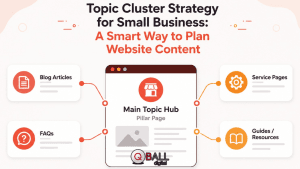
A topic cluster strategy for small business is a content planning model where one main page covers a broad topic, while several related supporting pages answer more specific questions connected to that topic. The main page is usually called a pillar page, and the supporting pages are called cluster pages.
Think of the pillar page as the central hub. It gives readers a complete overview of an important topic, but it does not need to explain every subtopic in extreme detail. Instead, it links to focused cluster pages that go deeper into specific questions, problems, comparisons, or steps.
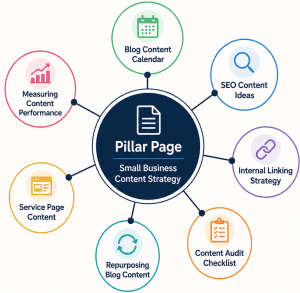
For example, a small business website focused on content strategy might create a pillar page called “Small Business Content Strategy.” That page could link to supporting articles such as “How to Create a Blog Calendar,” “SEO Content Ideas for Local Businesses,” “How to Repurpose Blog Content,” and “Website Content Audit Checklist.” Each page has its own purpose, but together they form a stronger content system.
Ahrefs describes topic clusters, content hubs, pillar pages, and hub-and-spoke models as closely related concepts built around three core parts: a main topic page, related subtopic pages, and internal links between them.
For small businesses, the value is simple: your website becomes easier to understand. Customers can find related answers without jumping around randomly, and search engines can see how your pages connect to one broader area of expertise.
Why Do Small Business Websites Need a Topic Cluster Strategy?
Small business websites need a topic cluster strategy because they usually cannot compete by publishing at enterprise scale. Larger competitors may have bigger teams, more content, stronger domain history, and larger budgets. A small business needs a smarter way to make each page count.
A topic cluster strategy helps by giving every content piece a role. Instead of asking, “What should we blog about this week?” you ask, “Which page will support this core topic, answer a real customer question, and help visitors move closer to a decision?” That shift makes content planning more strategic.
This is important because random content often creates weak SEO signals. You may have several posts that mention the same topic, but none that fully answers the searcher’s question. You may also create overlapping pages that compete with each other. Topic clusters reduce that risk by organizing content around clear search intent.
They also improve the user experience. A visitor who lands on one article can easily find related resources, service pages, or next-step guides. That matters for small business websites because organic traffic alone is not the goal. The goal is to attract qualified visitors, build trust, and turn interest into inquiries, appointments, purchases, or consultations.
HubSpot’s topic cluster model is built around the idea that related content should be linked under a broader topic structure, helping websites organize pages around topic-based SEO rather than isolated keywords.
How Does a Topic Cluster Strategy Improve SEO?
A topic cluster strategy improves SEO by helping search engines understand the relationship between pages. When your website has one strong pillar page and several useful cluster pages linked together, it sends a clearer signal about the depth and relevance of your content.
Search engines no longer evaluate pages only by exact-match keywords. They also look at meaning, context, usefulness, and how well a page satisfies search intent. A topic cluster helps you cover a topic from multiple angles without forcing every keyword onto one page.
For example, a small accounting firm could create one pillar page about “Small Business Tax Planning.” Supporting cluster pages might cover quarterly tax payments, deductible expenses, tax planning checklists, payroll tax basics, and when to hire a tax professional. Each page answers a specific question, but the full cluster shows broader topical depth.
Internal links are also a major part of the SEO value. When the pillar page links to cluster pages, and each cluster page links back to the pillar, search engines can crawl the relationship more easily. Users also have a clearer path to related information. Google’s SEO documentation includes internal links as part of helping Google and users understand site structure and discover pages.
A strong topic cluster can help your website rank for broader pillar terms and longer-tail cluster terms. The pillar may target a more competitive topic, while cluster pages capture more specific questions. For small businesses, those long-tail searches are often valuable because they reflect clearer intent.
How Do You Choose the Right Pillar Topic for a Small Business Website?
Choose a pillar topic that is broad enough to support multiple related pages, specific enough to match your services, and important enough to connect to real customer demand. The best pillar topics sit at the intersection of what your audience searches for and what your business actually provides.
Start with your core services or products. A home remodeling company might consider topics like “Kitchen Remodeling Planning,” “Bathroom Renovation Costs,” or “Home Addition Design.” A digital marketing agency might consider “Content Strategy for Small Businesses,” “Local SEO Strategy,” or “Website Conversion Optimization.”
The topic should not be so broad that it becomes impossible to cover meaningfully. “Marketing” is too broad for most small businesses. “Content Strategy for Small Businesses” is more focused. “Website Content Strategy for Local Service Businesses” is even more targeted and easier to connect to specific services.
A good pillar topic should also create room for supporting articles. Before choosing it, ask whether you can identify at least five related questions your customers ask. If you cannot, the topic may be too narrow. If you can identify 30 or 40 possible subtopics, the topic may need to be divided into smaller pillars.
Revenue relevance matters too. Some topics may bring traffic but not business value. A small business should prioritize topics that connect to services, products, consultations, quotes, demos, bookings, or other meaningful conversions. Search visibility is useful only when it supports the business model.
How Do You Find Cluster Topics That Support the Pillar Page?
You find cluster topics by breaking the main pillar into smaller questions, problems, comparisons, and action steps your audience searches for before they are ready to buy. The goal is to cover the journey from early research to decision-making.
Start with customer conversations. Sales calls, contact form submissions, emails, live chats, reviews, and consultation notes often reveal better content ideas than keyword tools alone. If multiple customers ask the same question, that question may deserve its own cluster page.
Next, review search behavior. Google autocomplete, People Also Ask results, related searches, and SEO tools can help you identify how people phrase their questions. Look for patterns around definitions, costs, comparisons, steps, mistakes, checklists, and local intent.
Group cluster topics by intent. Educational topics explain basics. Problem-aware topics address pain points. Comparison topics help users evaluate options. Local or service-specific topics connect the broader subject to a real buying situation. Conversion-supporting topics help visitors decide whether to contact your business.
For a pillar on topic cluster strategy for small business, possible cluster pages could include:
What Is a Content Pillar?
This page would explain the role of a pillar page and how it differs from a regular blog post or service page.
How Do You Build a Content Calendar for a Small Business?
This page would show how to schedule content around business goals, seasonal demand, and available resources.
What Blog Topics Should Small Business Websites Prioritize?
This page would help small business owners choose topics based on search intent, customer questions, and revenue relevance.
How Does Internal Linking Help SEO?
This page would explain how internal links connect related pages and guide users through the website.
How Do You Audit Existing Website Content?
This page would show how to review old pages, find gaps, update weak content, and identify cluster opportunities.
The most important rule is to avoid creating multiple pages for the same intent. If two article ideas answer the same question for the same audience, they should probably be combined or clearly differentiated.
How Should Small Businesses Structure Pillar Pages and Cluster Pages?
Small businesses should structure pillar pages as broad, useful guides and cluster pages as focused resources that go deeper into one specific subtopic. Each page should be helpful on its own, but stronger as part of the larger cluster.
A pillar page should introduce the main topic, explain key concepts, answer the most important high-level questions, and link to related cluster pages. It should feel like a guide, not a thin directory of links. Readers should be able to understand the subject from the pillar page, then choose deeper resources based on their needs.
A cluster page should focus on one clear question or search intent. It should not try to cover the entire pillar topic again. Instead, it should answer a specific question thoroughly, provide examples, and link back to the pillar page using descriptive anchor text.
For example, a pillar page about “Small Business Content Strategy” might briefly explain content calendars. A cluster page about “How to Create a Content Calendar for a Small Business” would go deeper into planning cadence, assigning topics, choosing formats, aligning with campaigns, and measuring performance.
Small businesses should avoid building huge clusters immediately. A practical starting point is one pillar page supported by five to eight strong cluster pages. That is enough to create structure without overwhelming the team.
This approach also aligns with Google’s people-first content guidance. The purpose is not to create pages only because a keyword exists. The purpose is to create useful pages that answer real questions and make the website easier to navigate.
How Can Small Businesses Use Existing Content to Build Topic Clusters?
Small businesses can often build topic clusters faster by auditing existing blogs, service pages, FAQs, and guides instead of starting from scratch. Many websites already have the raw material for a cluster; it is just not organized yet.
Start by listing every relevant page on your website. Include blog posts, service pages, landing pages, resource pages, FAQs, case studies, and guides. Then group them by topic. You may quickly see that several pages already belong to the same cluster.
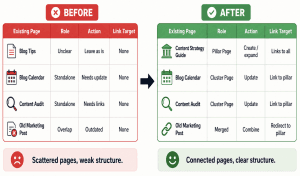
Next, assign each page a role. Some pages may become pillar pages. Others may become cluster pages. Some may need to be merged, updated, redirected, or removed. Thin pages that do not answer a clear question should be improved or consolidated.
This process is especially useful for small businesses that have been blogging for years without a formal strategy. You may discover that you have five posts about similar topics, but none that fully addresses the main search intent. Instead of publishing another article, you may get better results by combining and improving what already exists.
After organizing the pages, add internal links. The pillar page should link to each major cluster page. Each cluster page should link back to the pillar. Related cluster pages should link to each other when it helps the reader.
How Do Internal Links Make Topic Clusters Work?
Internal links make topic clusters work by showing search engines and users how each page relates to the broader topic. Without internal links, a cluster is just a collection of separate pages.
The pillar page should link to the most important cluster pages. These links help readers find deeper information and help search engines discover related content. Cluster pages should link back to the pillar page so the broader topic remains clear.
Descriptive anchor text is important. Instead of using vague phrases like “click here” or “read more,” use natural anchor text that tells readers what they will find. For example, “small business content calendar” is more useful than “this article.”
Internal linking also helps distribute attention across your site. A strong pillar page may attract more backlinks, branded searches, or direct visits. By linking from that page to relevant cluster pages, you help users and crawlers reach deeper resources.
Good internal links should feel helpful, not forced. Add links where they naturally support the reader’s next question. A cluster page about content calendars might link to a page about blog topic research, but it probably does not need to link to every page on the website.
Google’s Search Central documentation gives site owners guidance on improving visibility in Google Search, and clear site structure is part of making content easier to discover and understand.
What Are Common Topic Cluster Mistakes Small Businesses Should Avoid?
The most common topic cluster mistakes are choosing topics that are too broad, creating overlapping pages, publishing too much low-quality content, and forgetting to maintain the cluster after launch.
One major mistake is building clusters around topics that do not connect to the business. A topic may have high search volume, but if it does not attract potential customers, it may not be worth prioritizing. Small businesses should focus on topics that support visibility and revenue.
Another mistake is creating too many pages too quickly. A cluster with 20 weak articles is not better than a cluster with six genuinely useful pages. Quality matters more than volume, especially for small teams with limited time.
Keyword cannibalization is another risk. This happens when multiple pages target the same or very similar intent. Search engines may struggle to decide which page is most relevant, and users may find repetitive content. A clear content map helps prevent this.
Some businesses also treat the pillar page like a sales page only. A pillar page can include calls to action, but it should primarily help the reader understand the topic. If the page is too promotional, it may fail to satisfy informational search intent.
Another common mistake is ignoring maintenance. Topic clusters are not one-time projects. Pages need updates as services change, search behavior shifts, competitors improve their content, and new customer questions emerge.
Google’s guidance encourages creators to evaluate whether their content provides original, helpful value and whether visitors would leave feeling satisfied. That is a useful standard for reviewing topic clusters over time.
How Do You Measure Whether a Topic Cluster Strategy Is Working?
Measure a topic cluster strategy by tracking organic traffic, keyword visibility, impressions, clicks, engagement, conversions, and leads across the entire cluster. Do not judge success by one page alone.
Start with Google Search Console. Review impressions, clicks, average position, and queries for both pillar and cluster pages. Search Console is designed to help site owners understand and improve their performance in Google Search.
Look at cluster-level growth. A pillar page may take longer to rank for competitive terms, while cluster pages may start attracting long-tail traffic earlier. Together, they can show whether the topic is gaining visibility.
Engagement metrics also matter. Are visitors reading multiple pages in the cluster? Are they clicking internal links? Are they spending time with the content? Are they moving from informational pages to service pages, contact forms, pricing pages, or booking pages?
Conversions are the most important business signal. A topic cluster should not only increase traffic; it should help attract better-fit visitors. Track form submissions, calls, consultations, demo requests, quote requests, email signups, or other actions that matter to the business.
You should also monitor content gaps. Search queries may reveal new questions that your current pages do not fully answer. Those gaps can become future cluster pages or updates to existing content.
Topic clusters are a long-term SEO strategy. They may not produce instant results, but they can become more valuable as the content becomes deeper, better linked, and more aligned with customer intent.
How Can a Small Business Start a Topic Cluster Strategy Without a Big Budget?
A small business can start a topic cluster strategy without a big budget by choosing one revenue-relevant topic, improving or creating one pillar page, and building a few high-quality cluster pages before expanding.
Do not start with every service, product, or audience segment at once. Choose one topic that matters to your business. It should connect to a profitable service, common customer problem, or high-value search journey.
Then audit existing content. You may already have blog posts, FAQs, service page sections, videos, emails, or sales materials that can be repurposed. Turning existing knowledge into structured content is often more efficient than starting from a blank page.
Create a simple spreadsheet with columns for pillar topic, cluster topic, target audience, search intent, page URL, status, and internal links. This basic system is enough for many small businesses to plan and maintain their first cluster.
Prioritize high-intent topics first. For example, a service business may benefit more from answering “how to choose a content strategy agency” than from writing a broad article about “what is marketing.” The first topic is closer to a buying decision.
Publish gradually. A strong cluster can start with one pillar page and three to five cluster pages. Add more pages only when there is a clear reason. Update older content quarterly or semiannually to keep the cluster accurate and useful.
A topic cluster strategy for small business works best when it stays practical. The goal is not to copy enterprise SEO systems. The goal is to create a content structure your team can actually maintain.
FAQ
What is a topic cluster in SEO?
A topic cluster in SEO is a group of related pages organized around one main topic. The main pillar page covers the broad subject, while cluster pages answer more specific questions. Internal links connect the pages so users and search engines can understand how the content fits together.
How many pages should a small business topic cluster have?
A small business topic cluster can start with one pillar page and five to eight supporting cluster pages. The exact number depends on the topic, search demand, and available resources. It is better to build a smaller cluster with useful pages than a large cluster with thin or repetitive content.
Is a topic cluster strategy better than writing individual blog posts?
A topic cluster strategy is usually better than writing individual blog posts without a plan because it gives each article a clear role. Individual posts can still work, but they are stronger when connected to a broader topic, internal linking structure, and business goal.
Can topic clusters help local SEO?
Yes, topic clusters can help local SEO when they connect broader topics to local service intent. For example, a local contractor might create a pillar page about bathroom remodeling and cluster pages about permits, costs, timelines, materials, and neighborhood-specific considerations. The content should still feel natural and helpful, not like forced location stuffing.
How long does it take for topic clusters to improve rankings?
Topic clusters often take several months to show meaningful SEO results, depending on competition, website authority, content quality, technical SEO, and publishing consistency. Some long-tail cluster pages may gain traction earlier, while broader pillar pages usually take longer.
Should every small business website have pillar pages?
Most small business websites can benefit from at least one pillar page if they have a topic that supports multiple related questions. However, not every topic needs a pillar page. Very narrow services or simple websites may only need strong service pages, FAQs, and a few supporting articles.
What is the difference between a pillar page and a cluster page?
A pillar page covers a broad topic and links to related subtopic pages. A cluster page focuses on one specific question or subtopic and links back to the pillar page. The pillar provides structure, while the cluster pages provide depth.
Can I build topic clusters from old blog posts?
Yes, old blog posts are often a great starting point. You can audit existing content, group related posts, update outdated information, merge overlapping articles, add missing internal links, and create a pillar page to connect the cluster.
Conclusion
A topic cluster strategy gives small business websites a smarter way to plan content. Instead of publishing disconnected blog posts, you create an organized system of pillar and cluster pages that helps customers find answers and helps search engines understand your expertise.
The real value is not just better rankings. It is better content direction. Every page has a purpose, every topic supports a larger goal, and every internal link helps guide visitors through the website. For small businesses with limited time and budget, that structure can make content marketing more focused and more effective.
A strong topic cluster strategy for small business should begin with one important topic, a clear pillar page, a manageable set of supporting pages, and a commitment to keeping the content useful over time. Done well, it turns your website from a collection of pages into a connected resource that builds trust and supports growth.
Why QBall Digital is Your Ideal Choice for Topic Cluster Strategy?
QBall Digital helps small businesses turn scattered content ideas into organized, search-focused content systems. Instead of treating SEO as a collection of isolated blog posts, QBall Digital builds topic strategies around your services, audience questions, and conversion goals so every page has a clear role.
With a practical approach to content planning, internal linking, and long-term SEO growth, QBall Digital can help your website become easier for both customers and search engines to understand. Whether you need to audit existing content, create a pillar page, or build a full cluster plan, QBall Digital focuses on strategies that support visibility, trust, and measurable business growth.
QBall Digital also understands that small businesses need strategy without unnecessary complexity. The goal is not to overwhelm your team with endless content tasks, but to create a realistic plan that improves your website over time and helps your best-fit customers find you.
Build a Smarter Content Strategy with QBall Digital
Ready to turn scattered blog ideas into a connected SEO content plan? QBall Digital can help you identify the right pillar topics, map high-value cluster pages, improve your internal linking, and build a content strategy that supports long-term business growth.
Contact QBall Digital today to start planning a smarter topic cluster strategy for your small business website.