
SMS marketing for service businesses works best when it feels useful, timely, and expected. For most service brands, texting is not about blasting promotions all day. It is about helping customers take the next step faster: confirm an appointment, prepare for a visit, respond to a question, leave a review, or come back when service is due again. That is why SMS can be such a strong channel for businesses like HVAC companies, med spas, dentists, salons, auto shops, law firms, and home service providers. When the message matches the moment, text is one of the quickest ways to move a customer from interest to action.
Service businesses also have a different messaging rhythm than ecommerce brands. Their customer journey is usually built around inquiries, scheduling, reminders, service delivery, follow-up, and repeat bookings. That makes SMS especially valuable for appointment reminders, day-of updates, and post-service reactivation. Twilio specifically highlights appointment reminders as a practical use case for businesses ranging from doctors to car repair shops because they help reduce no-shows and prepare customers in advance.
What is SMS marketing for service businesses?
SMS marketing for service businesses is permission-based business texting used to support both revenue and customer experience. In practice, that includes promotional messages, appointment reminders, scheduling updates, follow-ups, review requests, and reactivation campaigns sent to customers who have agreed to receive them. The “service business” angle matters because the goal is usually not browsing or impulse buying. It is booking, showing up, completing service, and staying engaged over time.
A strong service-business SMS program usually blends two types of communication: informational texts and promotional texts. The FCC draws an important distinction here: commercial texts require written consent, while informational texts may rely on a different consent standard. That means a business should not treat every text the same internally. A reminder about tomorrow’s appointment and a discount offer for spring maintenance may both be useful, but they do not carry the same compliance implications.
Why does SMS marketing work so well for service businesses?
SMS works well for service businesses because most service decisions are time-sensitive and action-oriented. Customers often need a quick confirmation, a reminder, a reschedule link, an arrival update, or a fast answer to a practical question. In those moments, text is easier to notice and faster to act on than a long email. That is why SMS often performs best when the customer needs clarity now, not a newsletter later.
It also fits the emotional reality of local services. When someone books a cleaning, dental visit, consultation, repair, or installation, they usually want reassurance that the business is organized and responsive. A clear text can reduce uncertainty before the appointment, lower friction on the day of service, and keep the relationship warm afterward. That makes SMS useful not just for marketing, but for trust-building.
When should a service business send text messages?
A service business should send text messages when the customer benefits from speed, clarity, or convenience. The best timing is usually tied to a real stage in the customer lifecycle rather than an arbitrary campaign calendar. In other words, send texts when they help the customer do something, remember something, or decide something.
When should you text before an appointment?
Text before an appointment when the goal is confirmation and preparation. A confirmation text shortly after booking helps lock in the appointment and sets expectations. A reminder text closer to the appointment helps reduce no-shows and gives the customer a chance to reschedule if needed. For service businesses, this is often the highest-value SMS use case because it protects booked revenue and improves operational efficiency.
A strong pre-appointment text should tell the customer exactly what is happening next. That usually means the date, time, business name, and one clear action such as “reply to confirm” or “call us if you need to reschedule.” If there is any prep involved, such as forms, arrival instructions, or access details, include only the most important point and link out if needed.
When should you text on the day of service?
Text on the day of service when the customer needs a practical update. This is the right moment for arrival windows, technician-on-the-way notices, parking instructions, or a quick reminder to have something ready. Day-of texts work because they reduce confusion and prevent missed handoffs.
For service businesses, day-of messages should lean operational, not promotional. Customers waiting for a home service visit or heading to an appointment are usually not in the mood for an upsell. They want accuracy, not extra copy. Keep the message direct and immediately useful.
When should you text after a completed job?
Text after the job when the next goal is feedback, review generation, follow-up care, or rebooking. This is a strong time to ask for a review because the service is still fresh in the customer’s mind. It is also a smart window for aftercare instructions, satisfaction check-ins, or a simple “reach out if anything comes up.”
Post-service texts also help service businesses extend value beyond one transaction. A thank-you message followed by a well-timed reminder for maintenance, refill, checkup, or repeat service can increase lifetime value without feeling pushy, as long as the timing is tied to the service cycle.
When should you text to reactivate past customers?
Text past customers when there is a logical reason to return. The best reactivation messages are connected to time, season, service interval, or prior behavior. A pest control company can text before peak season. A med spa can text when a recurring treatment window is approaching. A dentist can text when a routine visit is due. Relevance matters more than volume.
This is where segmentation becomes important. Mailchimp’s current SMS guidance emphasizes segmentation, list quality, and matching content to audience needs. For service businesses, that means grouping customers by service type, lifecycle stage, urgency, geography, or last appointment date rather than treating the whole list as one audience.
When should you text for seasonal or limited-time promotions?
Text for promotions when the offer is timely and easy to act on. Seasonal offers, open calendar slots, weather-related demand spikes, and limited-time service bundles can all work well by SMS because they create a natural reason to engage now. The key is that the message should feel relevant to the recipient’s likely need, not just the business’s desire to fill pipeline.
Promotional SMS should be used more selectively than operational texts. The more often a business sends generic offers, the faster text messages start to feel intrusive. SMS earns attention because it is personal and immediate. Overuse weakens that advantage.
What types of SMS messages should service businesses send?
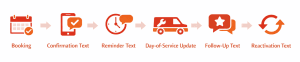
Service businesses should focus on five core message types: confirmation texts, reminder texts, day-of-service updates, follow-up or review texts, and targeted promotional texts. That mix covers the full customer journey without turning SMS into noise.
What should appointment reminder texts say?
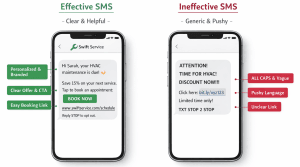
Appointment reminder texts should say who is reaching out, when the appointment is, and what the customer should do next. They work best when they remove uncertainty in one glance. Example:
“QBall Digital: Reminder of your HVAC service tomorrow at 2:00 PM. Reply C to confirm or call us if you need to reschedule.”
That format is strong because it is short, branded, and action-oriented. It also respects the limited attention span people bring to text messages.
What should confirmation and scheduling texts say?
Confirmation and scheduling texts should reinforce that the booking is real and provide the next step. Example:
“QBall Digital: You’re booked for carpet cleaning on Friday, April 24 at 10:00 AM. We’ll text you when the technician is on the way.”
This kind of message is especially helpful for service businesses because it reduces inbound calls asking, “Did my appointment go through?”
What should follow-up and review request texts say?
Follow-up and review request texts should be simple, polite, and tied to the completed service. Example:
“Thanks for choosing QBall Digital for your website consultation today. If you have a minute, we’d love your feedback: [review link]”
A good follow-up text does not over-explain. It keeps the ask clear and uses the goodwill created by a recent completed experience.
What should promotional texts say?
Promotional texts should highlight one relevant offer and one clear next step. Example:
“QBall Digital: Need more booked calls this quarter? We’re offering a limited PPC + SMS strategy audit this month. Claim your spot here: [link]”
For service businesses, promotional texts work best when the offer solves a near-term problem or creates a low-friction opportunity, such as a seasonal tune-up, limited consultation slots, or a service package upgrade.
What should customer service and two-way conversation texts say?
Customer service texts should sound human, helpful, and specific. Example:
“Hi Sarah, this is QBall Digital. Our specialist is running 15 minutes behind. New ETA is 3:20 PM. Thanks for your patience.”
Two-way texting is especially valuable in service businesses because customers often have practical questions that do not need a phone call but do need a quick answer. That creates a better experience and can keep jobs moving smoothly.
How long should a service business text message be?
A service-business text should usually be short enough to understand instantly. SMS is strongest when it communicates one idea, one action, and one next step. Mailchimp’s current best-practices guidance emphasizes concise messaging with effective calls to action, which is especially important for local service brands where customers are often multitasking.
The easiest way to write better service-business texts is to remove anything that is not essential. Keep the business name, the purpose of the message, the key detail, and the action. If the message needs more explanation, use a landing page, portal, or short follow-up sequence instead of forcing too much into one text.
How can service businesses personalize SMS without sounding invasive?
Service businesses can personalize SMS effectively by using details the customer expects you to know: their first name, appointment date, service type, location, or technician name. That makes the text feel relevant without crossing the line. In a service context, personalization should improve clarity, not prove how much data you have.
Good personalization sounds like this: “Hi James, your AC tune-up with QBall Digital is confirmed for Tuesday at 11:00 AM.” Bad personalization sounds like an overreach, especially if it references obscure past behavior or details the customer did not realize were being tracked. The standard should always be: would this feel helpful to a reasonable customer?
What should service businesses avoid in SMS marketing?
Service businesses should avoid anything that makes their texts feel unexpected, excessive, vague, or hard to stop. SMS depends on trust. The same qualities that make it powerful also make it easy to misuse.
What happens when you text too often?
When a business texts too often, the channel loses its value. Customers start ignoring messages, opting out, or mentally classifying the business as spam. Mailchimp’s current guidance specifically flags frequency as something marketers must manage carefully, and CTIA’s standards are built around protecting consumers from unwanted messages.
For service businesses, the practical rule is simple: operational messages can be frequent when they are tied to active service, but promotional messages should be more selective. A company with a live appointment may need several texts in a short window. A company without a current transaction usually does not.
Why should you avoid vague or context-free texts?
Vague texts get ignored because the customer cannot tell whether they matter. A message like “Call us back” or “We have an update for you” creates friction, not clarity. Good service-business SMS should stand on its own and tell the recipient why the message matters right now.
Context also matters for trust. The FTC warns consumers that unexpected texts, especially those pushing links or requesting personal information, can be signs of scams. Legitimate service businesses should write texts that look unmistakably legitimate: identifiable sender, clear purpose, and no suspicious pressure tactics.
Why are aggressive promotions risky for service brands?
Aggressive promotions can cheapen a service brand, especially in categories where trust is part of the sale. Emergency plumbing, legal services, healthcare-adjacent appointments, premium home services, and personal care businesses all rely on credibility. Constant discount texts can make the business feel transactional when the customer wants reassurance and professionalism.
Promotional texts also carry stricter compliance expectations. The FCC states that commercial texts require written consent, and the FCC’s one-to-one consent rule means that consent for marketing messages must be tied to a specific seller rather than treated as a blanket pass across multiple brands. That makes list hygiene and consent records more important than ever.
Why should you avoid texting without clear consent?
You should avoid texting without clear consent because it creates legal, deliverability, and trust problems at the same time. The FCC’s guidance on robotexts says commercial texts require written consent, and CTIA’s messaging principles expect message senders to obtain consumer consent before sending non-consumer messages.
Consent should also be documented in a way that matches your actual campaign. Carrier and provider guidance for 10DLC campaigns requires the first message to identify the brand, describe the program, disclose message frequency, mention that message and data rates may apply, and explain how to get help and opt out. That means “consent” is not just a box to check. It is part of the full messaging experience you are expected to operate clearly.
Why is sending the wrong message at the wrong stage a problem?
Sending the wrong message at the wrong stage weakens both conversion and customer experience. A discount offer before a prospect has even booked may be less effective than a fast answer or reminder. A promotional upsell during an active service issue may feel tone-deaf. A review request before the job is complete feels sloppy. Great service-business SMS depends on matching the message to the lifecycle stage.
Is SMS better than email for service businesses?
SMS is better than email for urgent, short, action-based communication. Email is better for longer explanations, education, proposals, newsletters, and content that someone may want to revisit later. For service businesses, the strongest strategy is usually not choosing one over the other. It is assigning each channel a job.
A simple split works well: use email for richer information and nurture content, and use SMS for reminders, confirmations, updates, and time-sensitive offers. That approach keeps texting useful and prevents it from carrying more weight than it should.
How can service businesses build an SMS list the right way?
Service businesses should build an SMS list through clear opt-ins at natural customer touchpoints: booking forms, website contact forms, inbound lead forms, checkout pages, and post-service follow-up flows. Mailchimp’s current guidance emphasizes list quality over list size, which is exactly right for local service brands. A smaller, cleaner list of people who genuinely expect your texts will usually outperform a bigger, messier list.
The opt-in flow should tell people what they are signing up for. Under current U.S. business messaging expectations, that means being clear about the sender, message purpose, frequency, rates disclosure, and how to stop or get help. For recurring campaigns, provider guidance for 10DLC requires those elements in the first message, and CTIA’s handbook says consumer opt-ins should be confirmed in that first message as well.
How do you create an SMS marketing strategy for a service business?
Start with the business goal. For a service company, that usually means one of four outcomes: reduce no-shows, increase booked jobs, improve review volume, or reactivate past customers. Once the goal is clear, the rest of the SMS strategy gets easier because timing, segmentation, and message type naturally follow.
Next, segment your audience by real service logic. New leads need a different text flow than booked customers. One-time buyers need different follow-up than recurring maintenance customers. High-urgency categories need faster, simpler messaging than lower-urgency categories. Mailchimp’s current SMS guidance specifically highlights segmentation and testing, both of which matter more when the customer journey is operational rather than purely promotional.
Then map each text to a moment. Confirmation after booking. Reminder before appointment. Update on service day. Review ask after completion. Reactivation when the next likely need appears. This kind of lifecycle approach usually outperforms random campaigns because every message has an obvious reason to exist.
Finally, measure SMS by business outcomes, not vanity alone. Response rate matters, but so do show rate, reschedule rate, review conversion, booked job rate, and repeat booking rate. The best SMS strategy for a service business is the one that improves operations and revenue at the same time.
What are examples of effective SMS messages for service businesses?
Here are simple examples a service business can adapt:
Confirmation text
“QBall Digital: You’re booked for Tuesday, April 21 at 1:00 PM. Reply YES to confirm or call us to reschedule.”
Reminder text
“Reminder from QBall Digital: Your consultation is tomorrow at 10:30 AM. Need to make a change? Reply here.”
On-the-way text
“QBall Digital update: Your technician is on the way and should arrive in about 20 minutes.”
Review request text
“Thanks for working with QBall Digital today. We’d love your feedback if you have a minute: [link]”
Reactivation text
“It’s been 6 months since your last service with QBall Digital. Ready for your next check-in? Book here: [link]”
Seasonal promotion text
“Spring is here. QBall Digital is offering limited strategy reviews this month. Reserve your spot: [link]”
These examples work because they are branded, specific, and tied to one clear next action. They also fit the expectations carriers and providers place on business messaging programs, including brand identification and opt-out handling.
Can SMS marketing help service businesses get more repeat bookings?
Yes. SMS can help service businesses get more repeat bookings when it is tied to service cycles, follow-up timing, and customer intent. The strongest repeat-booking texts do not feel like random promotions. They feel like useful reminders that arrive when the customer is likely to need the service again.
This is especially true for businesses with recurring demand: maintenance plans, seasonal services, wellness appointments, routine cleanings, recurring consultations, and ongoing support relationships. When a text saves the customer from having to remember the schedule themselves, it creates convenience and drives return business at the same time.
FAQ
How often should a service business send marketing texts?
There is no single perfect number, but marketing texts should be infrequent enough to stay welcome and frequent enough to stay useful. Active-service messages can cluster around a booking or appointment, while promotional texts should be more selective and segmented. Over-texting raises the risk of opt-outs and complaint behavior.
Do appointment reminders count as SMS marketing?
They can fall into a different category than promotional texts depending on content and consent, which is why businesses should not lump all texts together operationally or legally. The FCC distinguishes commercial texts from informational texts, and that distinction matters for consent practices.
Should service businesses use SMS and email together?
Yes. SMS is ideal for immediate action, while email is better for richer education, proposals, onboarding details, and longer-form follow-up. Used together, the channels complement each other rather than compete.
What is the best time of day to send a service business text?
The best time is when the message is most relevant to the customer’s next step. For reminders, that usually means soon after booking and again near the appointment. For promotions, send only when the offer is timely and the customer has a reason to care now. Relevance matters more than generic timing rules.
What types of offers work best in SMS for service businesses?
The strongest offers are easy to understand and easy to act on: seasonal services, limited appointment availability, maintenance reminders, follow-up packages, and clear first-step offers. Generic discount blasts are usually weaker than relevant, context-driven offers.
Can small local service businesses benefit from SMS marketing?
Yes. In many cases, local service businesses benefit more than large general brands because they rely on booked appointments, quick responses, and repeat business. SMS is especially valuable when every scheduled job and every review matters.
Conclusion
SMS marketing for service businesses works best when it is tied to customer needs, not just campaign goals. The right texts arrive at the right moments: after booking, before service, during active delivery, after completion, and when the next likely need appears. The wrong texts are too frequent, too generic, too promotional, or too careless with consent.
For service brands, the real advantage of SMS is not simply that people read texts quickly. It is that text can reduce friction throughout the customer journey. It can help more people show up, respond faster, trust the process, leave reviews, and come back again. When that happens, SMS stops being just another marketing channel and becomes a real operational growth tool.
Why QBall Digital is Your Ideal Choice for SMS Marketing for Service Businesses?
QBall Digital is well-positioned to help service businesses turn SMS into a measurable growth channel instead of a disconnected tactic. The real challenge with business texting is not sending messages. It is building the right strategy behind them: when each text should fire, which customers should receive it, what the message should say, and how SMS should work alongside PPC, landing pages, CRM workflows, and follow-up systems. That is where a performance-focused partner adds real value.
For service businesses, timing and intent matter just as much as copy. QBall Digital can help shape SMS around the moments that move revenue: confirming booked leads, reducing no-shows, reactivating past customers, increasing review volume, and supporting higher customer lifetime value. Rather than treating SMS as a generic blast channel, QBall Digital can align messaging with the actual service journey so every text has a purpose.
Just as importantly, service businesses need marketing systems that protect trust while improving conversion. SMS must feel clear, branded, expected, and easy to act on. QBall Digital can help businesses build that kind of messaging framework while integrating it into a broader lead-generation strategy that supports stronger ROI from every campaign.
Ready to Build a Smarter SMS Strategy With QBall Digital?
If your service business wants more booked jobs, fewer no-shows, and better follow-up without overwhelming customers, QBall Digital can help you build an SMS strategy that is timely, useful, and conversion-focused. The right approach is not more texting. It is better texting, built around the moments that matter most.