
The best email newsletter strategy for small business growth is one that treats the newsletter as a retention system, not just a promotional blast. For small businesses that want more repeat customers, the goal is to send relevant, useful emails tied to real customer behavior, buying cycles, and next steps so subscribers have a reason to come back, book again, reorder, or stay engaged with the brand.
That approach matters because repeat-customer growth rarely comes from one great subject line alone. It comes from consistent communication, better segmentation, lifecycle timing, smart automation, and careful measurement. A newsletter can support loyalty, education, reactivation, and revenue at the same time when it is built around the customer journey instead of a random content calendar.
What is an Email Newsletter Strategy for a Small Business?
An email newsletter strategy for a small business is the plan behind what you send, who you send it to, why you send it, and what business result you expect. It includes audience segments, content themes, timing, calls to action, automations, list-growth methods, and performance metrics. Without that structure, a newsletter is just a recurring email.
For small businesses, strategy matters even more because resources are limited. A local service brand, online shop, clinic, restaurant, or B2B company usually cannot afford to send lots of low-value emails. Each send should support a clear goal such as rebooking, reordering, upselling, referral generation, review collection, or simple brand recall before the next purchase decision.
A strong strategy also separates newsletters from one-off campaigns. Campaigns may promote a sale or announcement, but the newsletter strategy creates ongoing momentum. It helps the business stay useful and visible between transactions so customers do not forget the brand after the first purchase.
Why Does an Email Newsletter Strategy Matter for Repeat Customers?
An email newsletter strategy matters for repeat customers because it keeps the relationship active after the first conversion. Many businesses put most of their effort into acquisition, but retention depends on what happens after someone buys, books, or signs up. A newsletter gives the business a reliable way to reinforce value, answer questions, recommend next steps, and create another reason to return.
This is especially important for businesses with natural gaps between purchases. A customer may love the experience and still not think about the business again until weeks or months later. Well-timed newsletters reduce that gap by staying top of mind with content that matches where the customer is in the lifecycle, from welcome and onboarding to education, replenishment, or reactivation.
Retention-focused newsletters also create compounding value. A second purchase is not just another sale. It usually signals greater trust, better familiarity, and a stronger chance of future revenue. That is why an effective newsletter strategy should be judged partly by repeat purchase rate, rebooking, and revenue per email, not by opens alone.
How Does a Small Business Set Goals for an Email Newsletter Strategy?
A small business should start by choosing one primary business goal and two or three supporting email goals. The primary goal might be repeat purchases, more booked appointments, higher average order value, improved retention, or more referrals. Supporting goals can include better click-through rates, lower unsubscribe rates, more review requests completed, or stronger engagement from past customers.
The goal should match the business model. An ecommerce shop may prioritize second-order rate, replenishment, or cross-sells. A dentist or salon may prioritize rebooking frequency. A B2B service firm may focus on nurturing clients toward upsells, renewals, or consultations. A restaurant may focus on seasonal return visits, loyalty offers, and event-driven traffic.
Once the goal is clear, every newsletter decision becomes easier. Content, segmentation, send frequency, automation, and CTAs should all support that goal. If the main objective is repeat business, the newsletter should not read like a generic company update. It should move readers toward the next logical action.
Who Should a Small Business Send Newsletter Emails To?
A small business should not send the same newsletter to every contact. At a minimum, the audience should be separated into recent buyers, active customers, leads who have not purchased yet, inactive subscribers, and high-value or loyal customers. Different groups have different motivations, and sending identical content to all of them usually weakens results.
Past customers are often the highest-priority newsletter audience when repeat revenue is the goal. They already know the business, so the newsletter can focus less on basic brand introduction and more on reminders, education, upgrades, seasonal relevance, and return incentives. Leads, by contrast, may still need trust-building content and clearer proof before they convert once.
Inactive subscribers deserve special treatment too. They should usually receive fewer emails or a dedicated re-engagement sequence instead of the same cadence as active readers. That protects engagement quality and helps preserve deliverability over time.
How Should a Small Business Segment Its Newsletter Audience for Better Repeat Sales?
A small business should segment its newsletter audience using data that reflects customer behavior and buying readiness. The most practical starting points are purchase history, recency, engagement level, interests, product or service category, location, and lifecycle stage. These inputs are enough to make a newsletter feel relevant without creating an unmanageable system.
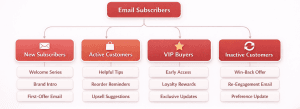
For example, a salon could separate first-time visitors, regular clients, and lapsed clients. A home services company could segment by service type and last appointment date. An ecommerce store could segment first-time buyers, repeat buyers, VIPs, and customers who purchased from a specific category. A B2B business could segment by industry, service package, or stage in the account relationship.
This kind of segmentation improves repeat sales because it changes the message from general to timely. A recent customer may need usage tips or a review request. A customer nearing a natural reorder window may need a reminder or replenishment offer. A highly engaged VIP may respond better to early access, insider content, or loyalty perks.
The key is to begin simply. Many small businesses delay segmentation because they imagine a complex enterprise setup. In reality, even three or four smart segments can outperform a single all-subscriber list by making the newsletter more useful.
What Content Should a Small Business Include in a Newsletter to Keep Customers Coming Back?
A small business newsletter should include content that helps the customer succeed, not just content that helps the business advertise. The most effective mix usually includes educational tips, reminders, curated offers, new product or service highlights, customer stories, FAQs, seasonal recommendations, and one clear next action.
Useful content earns future attention. When subscribers regularly get something practical, they are more likely to open later emails that include promotions or direct sales messages. That is why a repeat-customer newsletter should balance value and conversion instead of pushing discounts in every send.
The best content also aligns with the purchase cycle. A skincare business can send product education and usage routines. A clinic can send care reminders and service timing guidance. A restaurant can send seasonal menu highlights and event announcements. A marketing agency can share practical insights, small wins, and service expansion opportunities.
Which Types of Newsletter Emails Drive the Most Repeat Customer Engagement?
The newsletter emails that drive the most repeat engagement are the ones matched to customer timing. Welcome emails perform an early retention role by setting expectations and helping the new subscriber understand what they will receive. Post-purchase emails keep momentum going after the first transaction and can reinforce value, answer common questions, and encourage the next step.
Educational newsletters work well when customers need guidance before they reorder, rebook, or get the full value of what they bought. Seasonal newsletters work well when needs change throughout the year. Loyalty or VIP newsletters can strengthen repeat behavior by rewarding people who already engage often. Re-engagement newsletters can help recover dormant customers before they unsubscribe mentally, even if they remain on the list.
The strongest strategy usually combines recurring newsletters with triggered automations. The recurring newsletter maintains a consistent brand presence, while automated emails respond to behavior and timing. Together, they create a more complete retention engine than either approach alone.
How Often Should a Small Business Send Newsletter Emails?
A small business should send newsletter emails as often as it can deliver consistent value. For many companies, that means weekly, biweekly, or monthly. There is no universal best frequency because ideal cadence depends on how often customers buy, how much relevant content the business can create, and how engaged the list is.
Consistency matters more than aggressive frequency. A predictable cadence helps subscribers know what to expect and gives the business enough data to evaluate performance over time. Sporadic sending often leads to weaker recognition and less reliable engagement, while over-sending can increase unsubscribes, spam complaints, and fatigue.
A good rule is to let customer behavior guide the decision. If the business has short purchase cycles, more frequent emails may make sense. If the business has longer cycles, a lower-frequency newsletter supported by trigger-based automations is often more effective than forcing weekly sends.
When is the Best Time to Send a Small Business Newsletter?
The best time to send a small business newsletter is the time your audience is most likely to notice and act on it, and that can only be confirmed through testing. General benchmarks can be helpful as a starting point, but they are not strategy. Different audiences respond differently based on industry, geography, routine, and email purpose.
Instead of chasing myths about the perfect weekday, small businesses should compare results across a few controlled tests. Look at opens, clicks, conversions, and downstream revenue, not just the top-line open rate. The best send time for a promotional push may be different from the best send time for an educational or reactivation email.
This is another reason segmentation matters. Your VIP buyers, local customers, new leads, and inactive subscribers may not behave the same way. A smart strategy tests timing by segment instead of assuming the whole list acts alike.
How Should a Small Business Design a Newsletter That People Actually Read?
A small business should design its newsletter for fast scanning, especially on mobile devices. That means clear hierarchy, short sections, strong headings, enough white space, one primary CTA, and visuals that support the message rather than compete with it. Since many subscribers skim first, layout matters almost as much as copy.
Good newsletter design also protects trust. Emails should be recognizable, branded, and easy to understand at a glance. The sender name, subject line, preview text, and body content should feel aligned so the email delivers what it promised. Misalignment may win a click once, but it weakens long-term engagement.
For small businesses, simple usually wins. A clean design with one main message and one clear action is easier to produce consistently and easier for readers to process. A crowded newsletter often looks like multiple competing campaigns forced into one email.
What Makes a Small Business Newsletter Feel Personal Instead of Generic?
A newsletter feels personal when relevance is built into the message. Using a first name can help, but true personalization comes from using data such as past purchases, service history, interests, preferences, location, or lifecycle stage to shape what the subscriber sees.
That can be simple. A subscriber who purchased a beginner product can get educational guidance, while a repeat buyer sees advanced tips or a bundled offer. A local customer can receive seasonal advice that fits the region. A loyal client can receive early access or a thank-you note that acknowledges the relationship.
A preferences center can also make personalization more sustainable. Mailchimp notes that contacts can use a preferences center to update profile details, choose interest groups, and even select how often they want to hear from a brand, which can reduce unsubscribes. That is especially useful for small businesses trying to keep lists healthy while learning what subscribers actually want.
How Can a Small Business Grow Its Newsletter List Without Attracting the Wrong Subscribers?
A small business should grow its list by attracting people who genuinely want ongoing communication, not by chasing subscriber volume alone. Effective list-growth methods include website signup forms, checkout opt-ins, lead magnets, in-store or in-person signups, QR codes, event registrations, and social promotion tied to a clear value exchange.
Permission quality matters. Double opt-in can help confirm subscriber intent and improve list quality because it asks people to verify that they want to receive emails. Mailchimp explains that double opt-in helps confirm subscribers and can support a better audience over time.
Small businesses should also avoid acquiring subscribers who only want one-time freebies with no real interest in the brand. The best list-growth offers are closely connected to the business itself, such as maintenance tips, reorder reminders, booking benefits, local updates, member-only offers, or useful educational content.
How Can Automation Improve an Email Newsletter Strategy for a Small Business?
Automation improves a newsletter strategy by making it more timely, more relevant, and easier to maintain consistently. Instead of relying only on manually scheduled campaigns, a small business can trigger emails when someone subscribes, purchases, books, becomes inactive, or reaches a milestone.
This matters because triggered emails align more closely with intent. A welcome sequence can introduce the brand and expectations. A post-purchase flow can educate and reassure. A replenishment reminder can arrive near the moment a customer is likely to need another order. A reactivation flow can try to win back disengaged customers before the relationship fades completely.
Automation does not replace the newsletter. It strengthens it. The newsletter keeps the ongoing relationship warm, while automations respond to specific signals. That blend is often the most practical setup for a small business that wants repeat-customer growth without building an overly complex system.
Which Metrics Should a Small Business Track to Know If Its Newsletter Strategy Is Working?
A small business should track metrics in layers. The first layer includes delivery, bounce, spam report, unsubscribe, open, and click data. HubSpot’s email reporting and delivery documentation emphasizes monitoring both engagement and delivery trends over time, including hard and soft bounces, spam reports, and unsubscribe rates.
The second layer is business impact. That includes conversion rate, repeat purchase rate, rebooking rate, revenue per email, average order value from email-driven customers, and reactivation performance for lapsed segments. These metrics are more useful than vanity engagement when the goal is long-term customer value.
It is also important to read metrics in context. A lower open rate on a highly targeted segment may still be excellent if the conversions are strong. Likewise, a newsletter with high opens but no downstream action may need stronger offers, clearer CTAs, or better audience alignment.
What Common Email Newsletter Mistakes Prevent Small Businesses From Getting Repeat Customers?
One common mistake is sending the same email to everyone. Generic newsletters usually underperform because they ignore differences in lifecycle stage, purchase history, and interests. Even simple segmentation can make a major difference in relevance and response.
Another mistake is over-focusing on promotions. Constant discounting can train subscribers to ignore non-sale emails and reduce the perceived value of the brand. A better approach is to combine promotional content with education, proof, reminders, and useful guidance.
Inconsistency is another problem. Some businesses disappear for months and then send a sudden blast. Others send too often without enough value. Both patterns hurt trust and engagement. A healthy strategy balances cadence, usefulness, and expectations.
Deliverability and compliance issues can also undermine results. Google’s sender guidance for Gmail emphasizes authentication and easy unsubscription, while the FTC’s CAN-SPAM guidance requires truthful header information, non-deceptive subject lines, clear opt-out mechanisms, and prompt opt-out processing. If those basics are ignored, even good content can fail.
What Does a Simple Email Newsletter Strategy Look Like for Different Types of Small Businesses?
For a local service business, a simple strategy could include one monthly newsletter, a welcome email, an appointment reminder flow, and a reactivation series for customers who have not booked within the expected timeframe. The newsletter itself can focus on seasonal tips, common questions, local credibility, and a booking CTA.
For an ecommerce brand, the foundation could be a biweekly newsletter plus automated flows for welcome, post-purchase, replenishment, browse or cart follow-up, and VIP loyalty. The newsletter can mix product education, category-specific recommendations, social proof, and carefully timed offers.
For a restaurant or hospitality business, the strategy might center on weekly or biweekly emails with seasonal menu updates, events, reservation prompts, loyalty offers, and special-date reminders. For a B2B service provider, a monthly insight-led newsletter supported by onboarding, upsell, and renewal-related automations may be more effective than frequent promotional sends.
How Can a Small Business Create a 90-Day Email Newsletter Strategy?
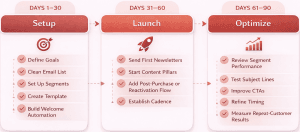
In the first 30 days, define the goal, clean the list, choose a sending platform, confirm opt-in practices, and set up the core segments. This is also the time to create a repeatable newsletter template, a welcome automation, and a measurement dashboard. If the business is sending commercial email, compliance basics and sender requirements should be handled at the start, not later.
In days 31 to 60, launch the regular cadence and publish the first few newsletters around clear content pillars. Examples include education, customer success, timely reminders, product or service discovery, and selective offers. At the same time, add one behavior-based automation such as post-purchase follow-up or reactivation.
In days 61 to 90, review performance by segment and refine what is not working. Test subject lines, send times, content blocks, and CTAs. Look beyond top-line opens and ask whether the newsletter is creating actual return behavior. By the end of 90 days, the business should have a working cadence, early performance data, and a clearer view of which messages move customers toward a second or third purchase.
FAQ
Is a newsletter different from email marketing?
Yes. A newsletter is one type of email marketing, but email marketing also includes automated flows, promotions, transactional support, lifecycle campaigns, and re-engagement emails. A strong strategy uses newsletters as one part of a broader customer communication system.
Can a small business send newsletters without a big email list?
Yes. A smaller, permission-based list of engaged subscribers is usually more valuable than a larger list of low-interest contacts. Quality, relevance, and timing matter more than raw list size.
How long should a small business newsletter be?
It should be only as long as needed to deliver one clear message well. Some newsletters work best as short updates with one CTA, while others need more educational depth. The right length depends on audience intent and how easy the email is to scan on mobile.
Should every newsletter include a promotion?
No. Many of the best retention newsletters earn engagement by being useful first. Promotions can work well, but not every email should ask for a sale immediately. A healthy mix of education, reminders, trust-building, and offers usually performs better over time.
What is a good newsletter frequency for local businesses?
For many local businesses, monthly or biweekly is a practical starting point, with automations covering welcome, booking reminders, and reactivation. The best cadence depends on how often customers realistically need the service and how much relevant value the business can provide.
Do small businesses need separate campaigns for new leads and past customers?
Yes, in most cases. New leads often need trust, proof, and education before the first purchase, while past customers respond better to reminders, upgrades, and relationship-based messaging. Treating them the same usually leaves revenue on the table.
How long does it take for a newsletter strategy to improve repeat sales?
It depends on purchase cycle and execution quality, but many businesses can gather useful directional data within 60 to 90 days if they send consistently and track both engagement and conversion outcomes. Longer buying cycles may require more time to show clear repeat-revenue lift.
Conclusion
The best email newsletter strategy for small business success is not about sending more emails. It is about sending more relevant emails. When a small business aligns its newsletter with customer segments, lifecycle timing, useful content, and clear business goals, the newsletter becomes more than a marketing task. It becomes a repeat-customer engine.
That shift changes everything. Instead of hoping that occasional promotions bring people back, the business builds a predictable communication system that keeps customers informed, engaged, and ready for the next step. Over time, that is what turns first-time buyers into loyal customers.
Why QBall Digital Is Your Ideal Choice for Email Newsletter Strategy for Small Business?
QBall Digital is an ideal partner for small businesses that want their newsletter to do more than fill inboxes. A real retention-focused email strategy requires clear positioning, practical segmentation, persuasive messaging, and performance tracking that ties content back to revenue. That is where strategy matters most, and where a specialized team can make the difference between “we send emails” and “our emails drive repeat business.”
QBall Digital can help small businesses build newsletter systems that fit the way real customers buy. That means aligning content with lifecycle stages, improving list quality, creating automations that support the customer journey, and refining campaigns based on meaningful results instead of vanity metrics. For businesses that want a smarter path to loyalty, stronger retention, and more value from every subscriber, QBall Digital brings the structure and focus needed to make email marketing work as a growth channel.
Ready to Build a Smarter Email Newsletter Strategy With QBall Digital?
If your business wants more repeat customers, stronger retention, and better results from every send, QBall Digital can help you build a newsletter strategy that is structured around action, not guesswork. A smart email system can improve how you welcome subscribers, nurture customers, trigger return visits, and measure what is actually driving revenue.
Now is the right time to turn your newsletter from a routine task into a retention asset. Connect with QBall Digital to create an email newsletter strategy built for long-term customer value, stronger engagement, and sustainable growth.