
Marketing attribution for local service businesses is the process of assigning credit for leads, booked appointments, sold jobs, and revenue to the marketing touchpoints that influenced them. In practice, that means looking beyond the final click and asking what helped create demand, what captured it, and what finally pushed the customer to contact or hire you. Google Analytics defines attribution as assigning credit across the path to a key event, and Google Ads supports both phone call conversion tracking and offline conversion imports, which makes this especially relevant for service businesses that close work offline.
For local service companies, attribution is harder than it sounds because the customer journey is rarely clean. A homeowner might click a Google ad on Monday, read reviews on Wednesday, visit your Google Business Profile on Friday, call from the map listing, and approve an estimate the following week. If your reporting only gives credit to the last step, you can easily underinvest in the channels that actually created the opportunity. That is why “what deserves credit” is the right question.
What is marketing attribution for local service businesses?
For a local service business, attribution should not stop at web leads. It should connect marketing to the outcomes that matter operationally: calls answered, estimates booked, jobs sold, and revenue collected. Google’s attribution guidance centers on meaningful actions, not just traffic, and Google Ads explicitly supports measuring both phone leads and offline outcomes after an ad interaction.
That distinction matters because local service businesses do not behave like pure ecommerce brands. Many conversions happen over the phone, through a CRM, or after a salesperson or office manager qualifies the lead. A campaign that generates fewer form fills may still deserve more credit if it produces better jobs, higher close rates, or larger ticket sizes. That last point is an inference from how Google’s offline conversion tools work: the platform is built to measure post-click outcomes beyond the initial lead, which only makes sense if advertisers care about downstream business value, not just top-of-funnel submissions.
Why is attribution harder for local service businesses than for other companies?
Attribution gets messy in local service marketing because the path to conversion often crosses channels, devices, and offline steps. Google Business Profile performance data shows that customers interact with a business through Search and Maps, including clicks and other customer actions, while Google Ads separately tracks calls from ads and calls from numbers on your site. That means the same buyer may leave signals in multiple systems before ever becoming a booked job.
It is also common for local buyers to switch from discovery to validation to action. They may find you through non-branded search, come back later through branded search, compare your reviews, click into your profile, and finally call. When that happens, last-click reporting tends to overcredit the final branded or profile interaction and undercredit the channel that introduced the customer in the first place. GA4’s attribution documentation addresses this exact problem by explaining that the last clicked ad is not always solely responsible for the conversion.
Service-area geography adds another layer. A plumbing company may perform differently by ZIP code, job type, or branch location, so “which channel works” is often the wrong first question. A better question is which channel works for which service, in which area, and with what close rate. That is not stated verbatim in Google’s docs, but it follows directly from Google Business Profile’s location-based performance reporting and from the need to connect ad interactions to offline revenue outcomes.
What touchpoints should actually get credit before a local customer books?
The touchpoints that usually deserve some level of credit are the ones that either created demand or captured it. For local service businesses, that commonly includes Google Ads, Local Services Ads, SEO, Google Business Profile, remarketing, email and SMS follow-up, referrals, and in some cases direct mail or other offline campaigns. A Business Profile can generate customer actions from Search and Maps, while Google Ads can drive calls directly from ads or from your website after a click.
The mistake is to assume only the final touch matters. A branded search click or a map listing call often reflects demand that was created earlier by a non-branded ad, a local SEO page, or repeated brand exposure. In other words, the “closer” deserves credit, but the “introducer” often deserves it too. GA4’s data-driven attribution model is designed to assign fractional credit across touchpoints rather than giving everything to the last interaction.
How do local customers usually move from first click to booked job?
A very typical path looks like this: a homeowner searches for a service, clicks a paid search ad, browses your site, leaves, later searches your brand name, checks your reviews or Business Profile, and then calls to schedule an estimate. Another common path starts with SEO instead of paid search, then moves through retargeting or a follow-up email before the customer finally books. Google’s documentation across Analytics, Ads, and Business Profile supports this multi-touch reality because each product measures different parts of the path: site engagement, ad-driven calls, and Search/Maps interactions.
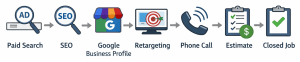
That is why local businesses should stop asking which single channel “caused” the sale. In many cases, several channels contributed, but in different ways. One built awareness, one captured intent, and one made it easy to contact you at the right moment. Attribution becomes more useful when you reflect those different roles instead of forcing every conversion into a one-channel story.
Which attribution model makes the most sense for local service businesses?
There is no single model that fits every local service company, but there is a practical answer: use more than one lens. GA4 supports attribution reporting and allows advertisers to choose attribution settings for reporting, including data-driven attribution, which algorithmically assigns fractional credit based on how touchpoints affect the probability of a key event.
Last-click is still useful for simple directional reporting. It is easy to explain, quick to pull, and often good enough for monitoring which source captured the final lead. But it is weak at measuring demand creation because it tends to give full credit to the last branded search, direct visit, or profile interaction. Google’s own attribution explanation highlights that the final clicked ad is often not the only factor behind a conversion.
First-click is useful when your goal is to understand which channels are introducing new prospects. That can matter when you are deciding whether non-branded search, local SEO, or awareness campaigns are doing enough to keep your pipeline healthy. It is less useful as a standalone budgeting model because it can undercredit the channels that actually help people convert.
Data-driven or multi-touch approaches usually make more sense once a business has enough lead volume, multiple active channels, and reliable CRM follow-through. If you are running several campaigns, getting calls and forms from different sources, and closing work offline, a fractional-credit model is usually closer to reality than a winner-take-all model. That is exactly the problem GA4’s data-driven attribution is built to solve.
Does last-click attribution give too much credit to Google Business Profile, branded search, and direct traffic?
Yes, very often it does. Google Business Profile sits near the bottom of the funnel because people commonly use it after they already know your brand or have narrowed their options. Business Profile performance data shows that it measures how customers find and interact with your profile on Search and Maps, but it does not by itself explain which earlier channels created the interest that led them there.
The same issue applies to branded search and direct traffic. Those channels can absolutely be valuable, but they often represent the point where existing intent gets expressed, not where it originated. If you treat them as the full source of truth, you can accidentally cut the campaigns that drove the first visit or kept your brand visible until the customer was ready. That is one of the clearest reasons local service businesses should review first-touch, last-touch, and assisted patterns together rather than relying on one report.
How should local service businesses track phone calls, forms, chats, and offline sales together?
Start by treating calls, forms, chats, booked appointments, and closed sales as separate stages, not as one undifferentiated “conversion.” Google Ads supports several phone call conversion types, including calls from ads and calls to a phone number on your website, and it also supports offline conversion imports for what happens after the lead is created.
Next, connect those stages to your CRM. A good attribution setup does not end when the phone rings. It records whether the call was qualified, whether an estimate was booked, whether the job sold, and what revenue came from it. Google recommends enhanced conversions for leads as an upgrade to offline conversion import because it can improve accuracy and bidding performance by connecting hashed first-party data and imported offline events back to ad interactions.
This is where many local service businesses leave money on the table. They optimize campaigns around raw lead counts even when half of those leads are poor fits, duplicate callers, or low-value jobs. Once you import qualified leads or closed sales back into ad platforms, your optimization decisions can start reflecting revenue quality instead of front-end volume alone.
What data should be captured before you trust your attribution reports?
Before you trust any attribution dashboard, capture the minimum fields needed to connect marketing to outcomes. That usually includes source and medium, landing page, campaign, keyword where available, call status, service type, location, new versus repeat customer status, lead status, booked value, and closed revenue. Google’s enhanced conversions for leads implementation guidance also recommends using unique conversion actions for offline events such as qualified lead or converted lead, which reinforces the need for distinct stages instead of one catch-all conversion.
You should also separate lead attribution from revenue attribution. A channel can be excellent at generating leads but mediocre at generating profitable work. Another channel may drive fewer total inquiries but produce better close rates or higher average job values. That distinction is not a platform quirk; it is a business reality, and it is the main reason offline conversion tracking exists.
How can you connect marketing attribution to actual revenue instead of just leads?
The simplest way is to stop treating all conversions as equal. A booked inspection, an emergency service call, and a high-ticket installation opportunity should not carry the same value in reporting if they do not carry the same value in the business. Google Ads allows offline conversion imports precisely so advertisers can measure what happens after the click or call, not just whether a lead form was submitted.
In practice, that means evaluating channels by qualified lead rate, booking rate, close rate, average ticket, and revenue per lead or per booked appointment. Once you do that, attribution starts becoming a budgeting tool instead of a vanity report. A source with fewer leads may deserve more investment if it produces the kinds of jobs your team actually wants. That last conclusion is an inference, but it is directly supported by the purpose of offline conversion measurement and enhanced conversions for leads.
Are Google Ads, SEO, and Google Business Profile supposed to support each other in attribution?
Yes. They are often parts of the same customer journey, not isolated competitors fighting for credit. Google Business Profile performance exists because people interact with businesses through Search and Maps, while Google Ads and GA4 exist to measure ad and site interactions along the path. Viewed together, these tools imply a shared funnel: discovery, validation, and action.
That is why channel arguments like “SEO is stealing PPC leads” or “GBP does all the work” are usually too simplistic. In many local-service journeys, paid search creates the first visit, SEO deepens trust, and the profile makes it easy to call when the customer is finally ready. The business should want all three to work together. Attribution’s job is not to create channel politics. It is to make that cooperation visible enough to guide smarter spending.
What attribution mistakes cause local service businesses to waste budget?
The first big mistake is trusting only last-click reporting. That approach can make bottom-funnel actions look stronger than they really are and can cause you to underfund awareness or prospecting campaigns that created demand upstream. Google’s attribution help content explicitly warns against assuming the last clicked ad alone caused the conversion.
The second mistake is counting every call or form as equal. Google Ads can track calls, but your business still has to decide which calls were qualified, which ones booked, and which ones became revenue. If you optimize toward every inquiry equally, your campaign data may look strong while your sales pipeline looks weak.
The third mistake is failing to import offline outcomes back into the ad platform. Google now recommends enhanced conversions for leads as the preferred path for advertisers starting offline conversion import, specifically because it improves reporting accuracy and bidding performance. If you never feed quality signals back into the system, the platform has less information to optimize against.
How should a local service business build a practical attribution system without overcomplicating it?
Start simple. First, define the real conversion stages in your business: lead, qualified lead, booked appointment, sold job, and closed revenue. Second, track calls and forms separately. Third, make sure your CRM can store the original source and the final sales outcome. Fourth, review first-touch, last-touch, and assisted trends together before changing budget. Fifth, import qualified or closed offline conversions back into Google Ads.
That structure is usually enough to get useful attribution without creating a reporting monster. Smaller businesses do not need a perfect measurement stack on day one. They need a consistent one that reflects how the business actually sells. Once the fundamentals are in place, more advanced analysis becomes easier and more trustworthy.
When is simple attribution enough, and when do you need a more advanced setup?
Simple attribution is often enough when a business relies on one main channel, has a short sales cycle, and closes most leads quickly. In that case, last-click plus basic call and form tracking may be directionally good enough to support decisions.
A more advanced setup becomes worthwhile when you have multiple channels, multiple locations, longer sales cycles, or a meaningful gap between lead creation and revenue recognition. That is especially true when the business depends heavily on calls, dispatch teams, sales reps, or estimate pipelines. Those are exactly the cases where multi-touch attribution and offline conversion imports become more valuable.
What should local service businesses look for in marketing attribution software or agency support?
Look for a partner or platform that can do four things well: capture calls and form leads, connect marketing data to CRM stages, separate lead volume from lead quality, and report on revenue by source. If it cannot connect front-end marketing with back-end sales outcomes, it is not really solving the attribution problem.
You should also look for support around implementation, not just dashboards. Google’s own setup guidance around call tracking, enhanced conversions, and offline import checklists makes it clear that attribution quality depends heavily on configuration choices and data hygiene. The reporting layer matters, but the setup layer matters first.
FAQ
How do you measure marketing attribution for phone call leads?
Use call conversion tracking for calls from ads and calls from your website, then push qualified call outcomes into your CRM and, where relevant, back into Google Ads through offline conversion imports or enhanced conversions for leads.
What is the best attribution model for local service businesses?
Usually, a combination works best: last-click for quick reporting, first-touch for demand creation insight, and data-driven or multi-touch reporting for budget decisions once enough data exists.
Does Google Business Profile deserve full credit for local leads?
Not always. It often deserves some credit, especially for bottom-funnel actions, but many profile conversions are influenced by earlier paid or organic touchpoints.
Can you track offline sales back to Google Ads?
Yes. Google Ads supports offline conversion imports, and Google recommends enhanced conversions for leads for many advertisers starting this process today.
Should branded search get full credit for conversions?
Usually no. Branded search often captures intent that was built earlier by other channels, so reviewing it in isolation can overstate its role.
How do you compare lead quality by channel?
Track not only lead counts, but also qualified lead rate, booked rate, close rate, and revenue by source. That is the practical reason to connect attribution with CRM and offline conversion data.
What is the difference between lead attribution and revenue attribution?
Lead attribution assigns credit for generating the inquiry. Revenue attribution assigns credit for generating booked work and sales value. Local service businesses need both to make accurate budget decisions.
Conclusion
Marketing attribution for local service businesses works best when it reflects the real buying journey, not an oversimplified report. The channels that introduce the customer, build trust, make your business easy to contact, and ultimately help close the work can all deserve some share of the credit. Google’s attribution, call tracking, Business Profile, and offline conversion tools all point toward the same conclusion: if you only measure the last click, you miss too much of the story.
The goal is not to find a perfect single-source answer. It is to build a practical system that helps you invest more confidently. When your attribution setup connects campaigns to calls, calls to qualified leads, and leads to real revenue, your reporting becomes useful enough to guide growth instead of just describing activity.
Why QBall Digital is Your Ideal Choice for Marketing Attribution for Local Service Businesses?
QBall Digital understands that local attribution is rarely a clean digital-only story. Service businesses depend on calls, estimate pipelines, office staff follow-up, and offline closes, which means the reporting model has to match operational reality. A generic dashboard may show lead counts, but that is not enough when the real question is which channels are producing qualified jobs and profitable revenue.
That is where QBall Digital can create an advantage. By aligning campaign tracking, local search visibility, conversion measurement, and CRM outcomes, QBall Digital can help local service businesses see which channels are introducing demand, which ones are capturing it, and which ones are truly driving growth. The result is a clearer basis for budget decisions, better optimization signals, and a stronger connection between marketing spend and business results.
Ready to See What Actually Deserves Credit in Your Marketing?
QBall Digital can help you build an attribution approach that reflects how local customers really discover, evaluate, and choose a service provider. If your current reporting stops at clicks or raw leads, now is the time to connect your marketing data to booked jobs and real revenue.