
Local businesses should respond to negative reviews quickly, calmly, and with enough specificity to show accountability, but not so much detail that they create new doubts for future customers. A public reply is never just for the unhappy reviewer. It is also for the next prospect comparing your business to two or three local alternatives and deciding who feels safer to trust. Google makes review replies public, notifies the reviewer when you reply, and allows that customer to update their review afterward, which is why every response has both reputation and conversion impact.
That matters even more now because consumers are judging more than star ratings. BrightLocal’s 2026 Local Consumer Review Survey found that 77% of consumers are less likely to use a business after reading negative reviews, 37% say owner responses are a positive review factor, and 50% are put off by generic or templated replies. The same study found that review recency, review count, and response behavior all influence trust.
For Indianapolis brands, that means a negative review response strategy should do three jobs at once: de-escalate the complaint, reassure future buyers, and protect the business from saying too much in public. When that strategy is missing, even a fair response can sound defensive, evasive, or robotic.
What is a negative review response strategy, and why does it affect conversions?
A negative review response strategy is a repeatable way to reply to unhappy customers in public without making the situation worse. It covers who responds, how fast they respond, what tone they use, what they should avoid, when to move the conversation offline, and when a review should be flagged instead of debated. In other words, it is not just a customer service habit. It is a conversion safeguard.
That is because review replies sit in public view. Google states that approved replies are posted publicly under the customer’s review, and the reviewer is notified when the business responds. Google also notes that customers can still change their review after reading a reply. A careless response, then, can damage trust twice: once with the original reviewer and again with the prospects reading the exchange later.
A smart negative review response strategy helps a business look composed, fair, and responsive even when the complaint is sharp. That alone can protect conversions because many prospects are not looking for perfection. They are looking for signs that, if something goes wrong, the business will handle it professionally.
Why do negative reviews hurt conversions even when the complaint seems minor?
Negative reviews hurt conversions because buyers are not reading them in isolation. They are reading them as clues. A complaint about slow communication, missed expectations, or a billing surprise might sound minor to the business, but to a prospect it can signal future friction, wasted time, or hidden risk.
Current review research reinforces that behavior. BrightLocal’s 2026 survey found that 56% of consumers care most about whether a review is backed up by others with similar sentiment, 44% value reviews posted within the last month, and 42% care about high star ratings. That means buyers are watching for patterns, freshness, and consistency rather than treating any one comment as meaningless noise.
The same research found that 74% of consumers only care about reviews written in the last three months, and 47% will not use a business with fewer than 20 reviews. So even one unresolved negative review can have more weight when the review profile is thin or stale.
This is exactly why businesses should not respond as if they are only defending themselves. The real audience is often the undecided lead. That reader wants to know whether your team listens, takes ownership, and solves problems without turning the thread into an argument.
How should Indianapolis businesses respond to a negative review in a way that builds trust?
Indianapolis businesses should use a simple public-response framework: acknowledge the concern, show empathy, address the issue briefly, offer a direct next step, and move the details offline. That formula works because it shows professionalism without dragging a private dispute into a public thread.
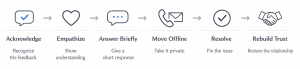
A strong response usually starts by naming the issue in broad terms. That tells readers you actually understood the complaint. Then it should show empathy, even if the business disagrees with part of the review. Empathy is not the same as admitting every allegation. It is a way of showing that the customer’s frustration was heard.
After that, the reply should offer one clear path forward. For example, instead of saying “Call us,” a better answer might say that a manager would like to review what happened and make it right, followed by a direct contact method. This keeps the public message reassuring while moving the detailed resolution into the right setting.
Google’s own help guidance supports this general approach by encouraging helpful replies and explaining that review responses are public-facing and policy-reviewed. Since replies may be seen by anyone evaluating the business, the goal should be calm accountability, not point-by-point combat.
A practical framework looks like this:
Acknowledge the concern
Empathize with the customer’s experience
Answer briefly without becoming defensive
Invite resolution through a specific next step
Close professionally with a standards-based message
Here is a clean example:
Hi [Name], thank you for your feedback. We’re sorry to hear your experience did not match the standard we aim to provide. We’d like the chance to look into what happened and address it properly. Please contact [name/department] at [phone/email] so we can review the details and work toward a resolution.
That type of reply protects conversions because it sounds responsible, measured, and human.
What should a negative review response include, and what should it leave out?
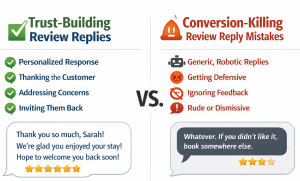
A good negative review response should include five elements: appreciation for the feedback, acknowledgment of the concern, a calm human tone, a brief statement of accountability, and a direct path to resolution. Those elements tell future customers that the business is responsive without sounding scripted.
It should also be short enough to stay readable. Prospects scanning a review thread do not want a legal brief. They want reassurance. If your reply turns into a long explanation, it often reads as defensiveness, even when the facts are on your side.
Just as important is what the response should leave out. Do not include personal information, order details, health information, payment specifics, or any fact pattern that exposes the customer publicly. Google’s help forum itself warns users not to share private or confidential information in public spaces, and review replies are publicly posted.
Businesses should also avoid:
- blame
- sarcasm
- legal threats
- accusations that the customer is lying
- copy-paste wording used on every review
- long excuses
- promises they cannot verify or fulfill
That last point matters because the FTC’s Consumer Reviews and Testimonials Rule, effective October 21, 2024, targets deceptive and unfair conduct involving reviews and testimonials and allows courts to impose civil penalties for knowing violations. Businesses should stay far away from anything that looks manipulative, misleading, or designed to distort how reviews are presented.
How fast should businesses respond to negative reviews?
Businesses should respond fast enough to show they are paying attention, but not so fast that the reply is emotional or sloppy. The right standard is prompt and composed. A same-day or next-business-day response is often ideal for most local businesses, especially when the complaint is visible on a major platform like Google.
That speed matters because owner response behavior is a trust signal. BrightLocal found that 37% of consumers view owner responses as a positive factor when evaluating reviews.
At the same time, speed should not come at the cost of judgment. If a review touches on billing, safety, employee conduct, or a fact dispute, the business should pause long enough to verify what happened. A rushed response can create legal, operational, or reputational problems that are harder to undo than the original complaint.
Google also notes that replies are reviewed for policy compliance before posting, which means businesses should expect public visibility and moderation, not treat review threads like private chats.
Why is moving a complaint offline important without sounding evasive?
Moving a complaint offline is important because most real resolutions require context that should not be posted publicly. Names, invoices, schedules, staff details, and account history rarely belong in a review thread. But businesses make a mistake when they move offline too abruptly and say nothing meaningful in public.
A public reply that only says “Please call us” can look like avoidance. It may also frustrate future readers who want some sign that the business took the issue seriously. The better move is to provide enough public acknowledgment to build confidence, then invite the reviewer into a private channel for the details.
A strong public-to-private handoff sounds like this: the business thanks the reviewer, expresses concern, states that the experience falls short of its standards, and offers a direct contact to investigate and resolve the matter. That approach tells prospects, “We do not ignore problems, but we also do not litigate them in public.”
That balance matters because Google makes your reply visible under the review, while the customer can still revise their review after reading your response. A strong public reply can therefore help both conversion protection and review recovery.
Are businesses making their negative reviews worse with the wrong tone?
Yes. Tone is where many review responses fail. The words may look technically fine, but the emotional signal underneath them tells prospects something else. A defensive response says, “We are hard to work with.” A cold corporate response says, “We do not really care.” A generic AI-ish response says, “You are getting the same answer as everyone else.”
That last risk is real. BrightLocal’s 2026 data found that 50% of consumers are put off by generic or templated review responses. So while templates can help teams move faster, they should never be pasted in untouched.
Here are a few common tone mistakes:
Defensive:
“We disagree with your version of events.”
Better:
“We’re sorry to hear you left frustrated, and we’d like to review what happened.”
Dismissive:
“Please contact support.”
Better:
“We’d like to learn more and help resolve this. Please contact our team at [contact].”
Passive-aggressive:
“We wish you had brought this to our attention sooner.”
Better:
“Thank you for sharing this feedback. We take concerns like this seriously.”
The goal is not to sound weak. It is to sound controlled. Controlled businesses feel safer to buy from.
What types of negative reviews need different response strategies?
Not every negative review should be handled the same way. A vague one-star post is not the same as a detailed service complaint, and neither is the same as an obviously fake review. Businesses should match the response style to the review type.
Service complaints need empathy and a clean resolution path.
Product complaints often need a quick explanation of support, replacement, or refund policy without getting too technical in public.
Billing disputes should be moved offline carefully because specifics can create privacy issues or escalate the conflict.
Misunderstandings should be clarified politely, without embarrassing the reviewer.
Recurring complaints should trigger internal action because repeated themes affect buyer trust more than any one review. BrightLocal found that consistency across reviews is the most important review factor for consumers.
Then there are fake, abusive, or policy-violating reviews. In those cases, the business may need to both respond and report. Google explicitly says that if you believe a review violates content policies, you can flag it. Google also maintains prohibited and restricted content policies for Business Profile content.
The practical rule is simple:
If the review is legitimate, respond and resolve.
If it is questionable, respond carefully and investigate.
If it appears policy-violating, flag it and avoid a heated public back-and-forth.
Can responding to negative reviews actually improve lead quality and customer trust?
Yes, a well-handled response can improve trust and sometimes even strengthen the business’s position with future leads. That sounds counterintuitive, but it makes sense when you remember how prospects read reviews. They are not just checking for bad experiences. They are checking how the business behaves when things go wrong.
BrightLocal’s latest survey shows that 85% of consumers are more likely to use a business after positive reviews, while 77% are deterred by negative reviews. The same study also found that 93% of consumers have made a purchase after reading reviews. In other words, review environments directly shape buying behavior.
A good reply can soften the impact of a negative review by showing accountability, speed, and professionalism. It can also filter out low-fit buyers and attract better-fit ones. Prospects who value responsiveness and maturity may trust a business more after seeing it handle criticism well than after seeing a suspiciously perfect profile with no tension at all.
The benefit is not that negative reviews become “good.” It is that your response can prevent one complaint from defining your brand.
How can businesses create a repeatable negative review response strategy for every location or team member?
Businesses should not leave review responses to improvisation. A repeatable strategy protects quality across locations, teams, and busy weeks. It also reduces the odds that someone responds emotionally from a phone between meetings.
A practical system starts with ownership. One person or team should monitor reviews daily, route sensitive issues appropriately, and maintain brand standards. Next comes triage: simple complaints can use approved response frameworks, while legal, safety, harassment, discrimination, or billing matters should go to a manager.
The strategy should also define:
- response-time goals
- brand voice guidelines
- what information is never shared publicly
- when to move offline
- when to flag a review
- who approves edge-case replies
This matters because consumers notice consistency. BrightLocal found that shoppers care most about whether review sentiment is backed up by other reviews, and they also notice whether the owner responds. A business that replies thoughtfully across its review profile looks more stable and trustworthy than one that responds randomly or only when angry.
For multi-location businesses in Indianapolis, consistency matters even more. Different managers should not sound like different brands. One location that replies thoughtfully and another that argues publicly can undermine the whole company’s credibility.
What does a high-converting negative review response template look like?
A high-converting template is not a script to paste blindly. It is a structure that helps your team respond quickly while still sounding human. The best templates are short, adaptable, and built around accountability.
General service complaint
Hi [Name], thank you for your feedback. We’re sorry to hear your experience did not meet expectations. We take concerns like this seriously and would appreciate the chance to learn more. Please contact [person/team] at [phone/email] so we can review what happened and work toward a resolution.
Delayed communication complaint
Hi [Name], thank you for bringing this to our attention. We understand how frustrating poor communication can be, and we’re sorry for the experience you had. Please reach out to [contact] so we can look into the timeline and help make this right.
Disputed experience
Hi [Name], we’re sorry to hear you left disappointed. We’d like to better understand the situation and review the details with our team. Please contact [contact] directly so we can investigate and respond appropriately.
Unverifiable or potentially fake review
Hi, we take customer feedback seriously, but we have not been able to identify this experience from the information provided. We would welcome the chance to look into it. Please contact [contact] with more details so we can review the matter. If this review does not reflect a genuine customer interaction, we will also follow the platform’s reporting process.
The important part is the customization. BrightLocal reports that half of consumers are put off by generic or templated responses, so even a strong template needs light editing to reflect the actual issue.
How should Indianapolis businesses balance local personality with professionalism in public replies?
Indianapolis businesses should sound like real local operators, not faceless call centers. But local personality should come through in warmth and clarity, not in overfamiliar language or public sparring. A business can sound neighborly without sounding casual about customer complaints.
That means using natural language, plain English, and a respectful tone. It also means avoiding canned phrases that feel imported from a national support script. A local brand should sound like it knows how to take responsibility, communicate clearly, and solve problems without theatrics.
For many Indianapolis service businesses, this balance matters because the purchase decision is trust-heavy. Prospects want to feel they are choosing a team that is competent, reachable, and grounded. A polished but human review response helps create that impression.
The safest formula is simple: warm opening, clear acknowledgment, brief ownership, direct next step, professional close. That feels local enough to be believable and polished enough to convert.
FAQ
Should every negative review get a response?
In most cases, yes. Consumers notice whether businesses respond, and BrightLocal found owner responses are a meaningful trust factor. Ignoring a negative review can make the complaint feel unanswered, even if it was unfair.
Can a business ask a customer to update or remove a review?
A business can ask a customer to contact them so the issue can be resolved, and since Google says customers can still change their review after reading a reply, improved experiences may lead to edits. But businesses should avoid pressure, incentives, or anything deceptive around reviews. The FTC’s reviews rule is aimed directly at deceptive review conduct.
What if the review is fake or posted by someone we cannot identify?
Respond briefly and professionally, invite the person to contact the business, and flag the review if you believe it violates Google’s content policies. Google explicitly provides a flagging process for reviews believed to violate policy.
How long should a negative review response be?
Usually short to medium length. It should be long enough to show you understood the issue and care about resolving it, but not so long that it becomes defensive or exposes too much information publicly.
Should businesses use AI to draft review replies?
AI can help with speed and consistency, but every reply should be reviewed and customized by a human. Consumers are put off by generic, templated responses, so unedited AI replies can hurt trust instead of improving it.
Can responding well to bad reviews help local SEO?
A thoughtful response strategy can support local visibility indirectly by improving trust signals, strengthening your review profile, and encouraging better ongoing engagement. Google’s help materials also state that helpful and positive replies can show that you’re responsive to customers.
Conclusion
Negative reviews do not automatically destroy conversions. Poor responses do. Indianapolis businesses that treat review replies as public trust signals rather than private disputes are in a much better position to protect leads, preserve credibility, and recover momentum.
A strong negative review response strategy is simple in principle: respond promptly, stay calm, acknowledge the issue, avoid defensiveness, move details offline, and never forget the real audience includes future customers. When your reply shows accountability without oversharing, you do more than manage reputation. You protect revenue.
Why QBall Digital is Your Ideal Choice for Negative Review Recovery?
QBall Digital understands that negative review recovery is not just about damage control. It is about protecting the path from search to click to lead. A review response that sounds polished but empty can hurt conversions just as much as no response at all, which is why strategy matters. QBall Digital helps businesses build response systems that support trust, local visibility, and buying confidence at the same time.
For Indianapolis businesses, that local-commercial balance is especially important. QBall Digital can help shape a negative review response strategy that feels human, fits your brand voice, and gives your team a repeatable framework for handling complaints without escalating them in public. Instead of reacting one review at a time, your business can respond with consistency, confidence, and a clearer conversion focus.
Ready to Protect Your Reputation and Conversions with QBall Digital?
If your business is getting negative reviews and you want a smarter way to respond without undermining trust, QBall Digital can help. Build a review response system that protects your reputation, reassures future customers, and supports stronger local conversion performance.