
Digital marketing in Indianapolis works best when it is built to create booked business, not just online activity. Many local companies invest in SEO, Google Ads, social media, or content, but still feel disappointed by the outcome because those tactics are not connected to a conversion-focused system. Google’s own guidance reinforces the core pieces behind that system: local visibility depends on relevance, distance, and prominence; paid targeting depends on smart location settings and ongoing performance checks; and conversions should be defined around meaningful business actions rather than surface metrics.
For a business serving Indianapolis, that means digital marketing has to do three jobs at once. It needs to help the company show up when nearby buyers are searching, make the business look trustworthy and easy to choose, and move those visitors toward a clear next step such as calling, submitting a form, or booking a consultation. When those pieces are aligned, marketing becomes a client-booking engine instead of a collection of disconnected tasks. This article lays out that playbook.
What Is Digital Marketing in Indianapolis, and What Should Businesses Expect From It?
Digital marketing in Indianapolis is the use of online channels to attract, engage, and convert people who are likely to buy from a local business. In practice, that includes local SEO, Google Ads, website optimization, content, reviews, email follow-up, and conversion tracking. The important point is that these channels should not be judged separately. They should be judged by whether they produce qualified local demand and turn that demand into conversations and revenue.
Businesses should also expect local digital marketing to be shaped by the way Google surfaces nearby options. Google states that local results are mainly based on relevance, distance, and prominence, and that complete business information, reviews, and overall business visibility can help a company stand out in local search. That matters because a business in Indianapolis is not competing only on budget. It is competing on how well it matches what nearby customers are trying to find and how credible it looks when they find it.
That is why “more traffic” is too small a goal. A better expectation is this: your marketing should attract the right local visitors, answer their questions quickly, reduce uncertainty, and make the next action feel obvious. When that happens consistently, digital marketing starts contributing to booked clients instead of just adding numbers to a dashboard.
How Does Digital Marketing in Indianapolis Turn Interest Into Booked Clients?
Digital marketing turns interest into booked clients by connecting visibility with conversion. A prospect sees a local listing, an ad, or a helpful page; clicks through; evaluates whether the business looks relevant and trustworthy; and then decides whether to take action. Google’s guidance across Business Profile, Ads, and Analytics makes it clear that visibility alone is not enough. The business also needs accurate local information, properly targeted campaigns, and conversion measurement tied to important actions.
The booking path is usually simple on the surface but fragile in practice. A person searches for a service in or near Indianapolis, sees a business that appears credible, lands on a page that clearly explains the offer, notices reviews or proof, and then calls or fills out a form. If any step is weak, bookings drop. The ad might be relevant but the page may be confusing. The page might look good but the call to action may be buried. The form might exist but the follow-up may be too slow. The real job of digital marketing is to remove those leaks.
A strong Indianapolis campaign usually follows one sequence: attract the right search intent, present the right service message, support that message with trust signals, and guide the prospect to one clear action. When that action is tracked properly, the business can improve the system rather than guessing which channel “feels” productive. That is the difference between activity and performance.
Why Do Some Indianapolis Businesses Generate Leads but Still Struggle to Book Clients?
Some businesses generate leads and still struggle to book clients because leads are not the same as buying intent. A form fill from the wrong audience, a low-quality click, or an inquiry from someone outside the service area can inflate activity while doing very little for revenue. Google Ads explicitly notes that location targeting relies on multiple signals and is not guaranteed to be perfectly accurate in every case, which is one reason businesses have to monitor real performance instead of assuming every lead is a fit.
Another common problem is that the website does not carry the conversion work. Google Search Central recommends a strong overall page experience, including good mobile presentation, secure delivery, and clear separation of main content from distracting elements. In practical terms, a local business page should make it easy for a visitor to understand what the company does, where it serves, why it is trustworthy, and how to contact it. When those basics are weak, lead quality and close rates often suffer even if traffic volume looks healthy.
There is also an operations issue. Marketing may succeed in generating interest, but the business loses momentum because no one responds quickly, qualifying steps are unclear, or follow-up is inconsistent. That point is partly operational inference, but it follows directly from Google’s emphasis on measuring meaningful actions rather than shallow engagement. If your tracking ends at the click or the form view, you cannot tell where bookings are being lost.
What Digital Marketing Channels Matter Most for Indianapolis Businesses That Want Faster Growth?
The most important channels for growth-focused Indianapolis businesses are usually local SEO, Google Ads, website conversion optimization, reviews, and lead follow-up. Those channels matter most because they line up closely with how local buyers discover, compare, and contact service providers. Google’s local guidance supports the SEO and reputation side of that equation, while its Ads and Analytics documentation supports the demand-capture and measurement side.
Local SEO is the long-game channel. It helps a business become visible for searches tied to services and geography. Google says complete Business Profile information improves the chance of showing up in relevant local results, and it identifies relevance, distance, and prominence as the main local ranking factors. That makes SEO especially valuable for businesses that want durable visibility in Indianapolis and nearby service areas.
Google Ads is the faster-demand channel. It allows advertisers to target selected geographies, including cities, areas within a country, and radius-based locations. That makes it useful for businesses that want to appear for high-intent searches now rather than waiting for organic visibility to grow over time. The caveat, again from Google, is that location targeting is based on multiple signals and should be monitored carefully.
Website optimization is what increases the value of both channels. Google’s page experience and mobile-first indexing documentation underscores that content should work well on mobile, remain accessible and equivalent across devices, and be presented in a way that supports users rather than distracting them. For a local service business, that means every important page should load smoothly, read clearly on mobile, and move the visitor toward one obvious next step.
How Does Local SEO Help Businesses Show Up for Indianapolis Searches That Actually Convert?
Local SEO helps businesses show up for converting searches by improving how well the business matches what nearby customers are trying to find. Google states that local results are mainly based on relevance, distance, and prominence. Relevance is about how well the profile matches the search, distance is about proximity to the searcher or inferred location, and prominence includes signals such as reviews and broader web visibility.
That makes a complete and accurate Google Business Profile a core asset. Google says businesses with complete and accurate information are more likely to show up in local search results. It also notes that responding to reviews can help a business stand out and that more reviews and positive ratings can help local ranking. For an Indianapolis company, this means local SEO is not only about adding a city term to a page title. It is about making the business easy for Google to understand and easy for searchers to trust.
The commercial value of local SEO comes from intent alignment. Someone searching for a service in Indianapolis is often closer to action than someone browsing broad educational content. A strong local SEO strategy therefore focuses on service pages, location relevance, review generation, internal linking, and business information accuracy. That recommendation is an inference from Google’s local ranking framework, but it is the practical way to compete for searches that are more likely to produce calls and consultations.
How Do Google Ads Help Indianapolis Businesses Capture High-Intent Leads Right Away?
Google Ads helps Indianapolis businesses capture high-intent demand by putting them in front of searchers who are already looking for a solution. Google documents that advertisers can target geographic locations such as countries, areas within a country, and radiuses around locations. For local service businesses, that flexibility makes paid search useful when the goal is to generate inquiries now rather than build visibility gradually.
Paid search works best when targeting, message, and landing page all match. A person searching for a local service expects a local-feeling result with clear service language and a direct path to contact. That is partly strategic inference, but it is supported by Google’s repeated emphasis on aligning campaign settings with business goals and measuring meaningful actions. If the campaign attracts clicks but not conversions, the issue is usually not just the ad platform. It is the path after the click.
It is also important to avoid overconfidence in geographic precision. Google states that location targeting is based on a variety of signals and that 100% accuracy is not guaranteed in every situation. For Indianapolis campaigns, that means smart advertisers review search terms, lead quality, service-area fit, and conversion data instead of assuming the map settings alone will solve targeting.
What Should a High-Converting Website Look Like for a Local Service Business in Indianapolis?
A high-converting website should make the business instantly understandable and easy to contact. Google’s page experience documentation says strong pages should display well on mobile devices, avoid intrusive elements, and make the main content easy to distinguish. Its mobile-first indexing guidance also explains that Google uses the mobile version of a site’s content for indexing and ranking, which raises the importance of mobile usability and content consistency.
For a local business, that means service pages should answer the visitor’s first questions fast: what do you do, who do you help, where do you work, why should I trust you, and how do I reach you? Those questions are not explicitly listed by Google, but they are a practical extension of people-first content and good page experience guidance. If your page hides its offer, loads slowly, or pushes the user through clutter before explaining the service, conversion rates usually suffer.
The best local pages are usually simple rather than clever. They feature clear headlines, visible contact actions, strong proof, useful service detail, and mobile-friendly layouts. Google recommends responsive design, equivalent mobile and desktop content, and meaningful headings across versions. Those technical recommendations translate directly into better lead-generation pages for Indianapolis businesses trying to convert local traffic into booked calls.
What Does a Client-Booking Funnel Look Like for Digital Marketing in Indianapolis?
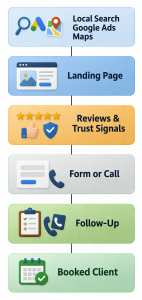
A client-booking funnel is the full path from discovery to booked appointment. At the top, a prospect becomes aware of the business through search, ads, maps, or helpful content. In the middle, the person evaluates fit and trust by reviewing the page, offer, local signals, and proof. At the bottom, the person takes a measurable action such as calling, submitting a form, or scheduling a meeting. Google Analytics documentation supports this framework by encouraging marketers to define important user interactions as key events and conversions.
What makes this a booking funnel instead of a generic marketing funnel is the emphasis on local action. The content has to reassure the visitor that the business serves their area, understands the problem, and provides a credible solution. The offer has to be easy to say yes to. The contact action has to be obvious. Then the business has to follow through. That last piece is an operational inference, but it is consistent with the logic behind cross-channel conversion measurement: the end goal is not traffic, it is a meaningful business outcome.
A useful way to think about the funnel is this: SEO and ads create opportunity, the website creates confidence, and follow-up creates momentum. If any one of those stages is weak, booked-client volume falls short of what the traffic should have produced.
How Can Businesses Measure Whether Their Digital Marketing Is Actually Working?
Businesses should measure digital marketing by tracking actions tied to business value. Google says a conversion is created from a Google Analytics event and provides a consistent way of measuring important actions across Google Analytics and Google Ads. It also shows a practical example: a lead-generation event is more useful than a scroll event when the goal is to understand who completed the form.
That means the best KPIs are usually qualified leads, booked appointments, phone calls, form submissions, landing-page conversion rate, cost per lead, and cost per booked appointment. Revenue-linked metrics such as customer acquisition cost and return on ad spend are even stronger when they can be measured reliably. Some of these metrics are business-side choices rather than platform requirements, but they follow directly from Google’s guidance to mark the interactions that matter to business success and use those actions for optimization.
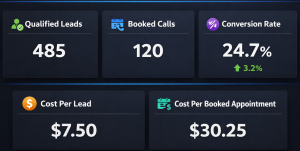
The biggest measurement mistake is stopping at traffic. Traffic can be useful context, but it is not proof of performance. A better reporting question is: which channels and pages are producing qualified local inquiries, and how many of those inquiries turn into booked conversations? Once that is visible, the business can improve the right parts of the funnel instead of guessing.
What Common Digital Marketing Mistakes Keep Indianapolis Businesses From Growing?
One common mistake is treating channels as isolated tactics. A business may run Google Ads without a dedicated landing page, work on SEO without strengthening its Business Profile, or collect traffic data without defining meaningful conversions. Google’s documentation across Business Profile, Ads, and Analytics points in the opposite direction: complete information, smart targeting, and conversion measurement are all connected.
Another mistake is underestimating mobile and page experience. Google uses the mobile version of site content for indexing and ranking, strongly recommends mobile-friendly pages, and advises site owners to think broadly about page experience rather than obsess over one narrow signal. For a local service business, that means poor mobile usability can hurt both search visibility and conversion performance.
A third mistake is creating content mainly for rankings instead of for decision-making. Google’s people-first content guidance says its systems are designed to prioritize helpful, reliable information created to benefit people, not content built primarily to manipulate rankings. For Indianapolis businesses, that means service pages and local content should answer real buyer questions, not just repeat a keyword.
How Should a Business Choose the Right Digital Marketing Strategy in Indianapolis?
The right strategy depends on how quickly the business needs leads, how competitive the market is, how large the service area is, and how valuable each client is. If the priority is immediate demand capture, Google Ads and conversion-focused landing pages often deserve early attention because they can be launched and measured quickly. If the priority is durable visibility and lower reliance on paid traffic over time, local SEO and Business Profile optimization become more important. That channel split is an inference, but it is strongly supported by Google’s location-targeting and local-ranking documentation.
A balanced strategy usually works best. SEO builds visibility and trust over time, while paid search captures bottom-of-funnel demand in the near term. Analytics and conversion setup connect the two by showing which channels are producing valuable actions. Google’s cross-channel conversion guidance is especially useful here because it reinforces that the same business outcome should be measurable across organic, paid, email, and social efforts.
For many Indianapolis service businesses, the practical question is not “SEO or PPC?” but “what combination gets us booked business now while building a stronger position later?” That is the strategic frame that leads to better budgeting and better expectations.
When Should a Business Hire a Digital Marketing Agency Instead of Handling It In-House?
A business should think about outside support when marketing activity is happening but growth is inconsistent, when ad spend is difficult to explain, or when internal bandwidth is too limited to manage SEO, paid media, website performance, and reporting together. Google’s own documentation does not tell businesses whether to hire an agency, but it does make clear that success depends on coordinated work across local visibility, campaign targeting, page experience, and conversion setup. For many teams, that coordination is the hard part.
An agency can add value when it brings structure, not just labor. The right partner should help the business define meaningful conversions, improve the website path to contact, strengthen local search visibility, and make paid traffic more accountable. If the agency cannot tie its work to measurable business outcomes, it is probably adding noise rather than solving the real problem. That conclusion is an inference from the source material, but it is exactly where the documentation points: measurable, people-first, conversion-aware execution wins.
FAQ
Is digital marketing worth it for local businesses in Indianapolis?
Yes, when it is tied to qualified local demand and measurable actions. Google’s local and conversion guidance supports the idea that visibility is most valuable when it is relevant to nearby searchers and connected to meaningful business outcomes.
Is SEO or PPC better for digital marketing in Indianapolis?
Neither is universally better. Local SEO supports long-term visibility through relevance, distance, and prominence, while Google Ads can target selected geographic areas and capture demand immediately. The strongest strategy often combines both.
How long does digital marketing take to produce results?
Paid search can begin generating measurable data quickly, while SEO usually builds momentum over time because it depends on stronger local relevance, prominence, and site quality. The exact timeline varies by competition, service category, budget, and conversion setup. This timing distinction is a strategic inference grounded in how Google documents local ranking and paid targeting systems.
What makes a local digital marketing campaign convert better?
Campaigns usually convert better when the targeting is accurate, the page experience is strong, the content is helpful, the local trust signals are visible, and the business tracks meaningful actions instead of vanity metrics. That combines Google’s guidance on local ranking, page experience, people-first content, and conversions.
Can small Indianapolis businesses compete with larger brands online?
Yes. Google’s local ranking system is not based on budget alone; it is based mainly on relevance, distance, and prominence. A smaller business that presents clear service information, earns strong reviews, and creates a better user experience can compete effectively for local demand.
Conclusion
Digital marketing in Indianapolis is most effective when it is treated as a booking system, not just a visibility project. The businesses that win are the ones that show up for the right searches, communicate value clearly, create trust fast, and track the actions that lead to revenue. Google’s own documentation supports that full-chain view: local ranking depends on relevance and prominence, paid targeting needs careful monitoring, mobile and page experience matter, and conversions should be defined around important business actions.
That is the real playbook. Get found by the right local audience. Give them a smooth, trustworthy path to contact. Measure what matters. Improve the weak points. When those steps are connected, digital marketing stops being a cost center and starts behaving like a growth asset.
Why QBall Digital Is Your Ideal Choice for Digital Marketing in Indianapolis?
QBall Digital helps businesses turn digital marketing into a measurable client-acquisition system instead of a collection of disconnected tactics. We look at the whole path, from local visibility and paid search targeting to landing-page performance and conversion tracking, so your marketing works as one coordinated engine. That approach fits the reality of how local growth happens: buyers search, compare, evaluate trust, and act only when the path feels clear.
We also focus on the numbers that matter most to business owners. That means qualified leads, booked calls, and real pipeline contribution rather than inflated reporting built around clicks and impressions alone. For Indianapolis businesses that want smarter growth, QBall Digital brings the strategy, execution, and accountability needed to turn digital attention into booked clients.
Ready to Build a Smarter Client-Booking System With QBall Digital?
If your business is ready to attract better local leads and convert more of them into booked conversations, QBall Digital can help you build a digital marketing strategy designed for visibility, conversion, and measurable growth. The goal is not just more traffic. The goal is more of the right traffic taking the right action at the right time.