
If your business serves the north side of the Indianapolis metro, “Local SEO Indianapolis” is a useful target keyword, but it is rarely the whole strategy. Searchers do not all behave the same way. Some use broad metro phrases, while others search with suburb names because they want a provider that feels closer, more relevant, or more established in their area. That is why a business trying to rank across Carmel, Fishers, and Westfield usually needs more than one generic Indianapolis page.
This matters because Google’s local results are shaped by relevance, distance, and prominence. In plain terms, that means a strong business can still perform differently from one suburb-related query to another, even within the same metro area. A smart local content strategy has to reflect that reality rather than forcing every audience into one catch-all page.
Most competing articles on this topic explain local SEO fundamentals well, but they stay broad. They cover things like Google Business Profile, reviews, citations, and local keywords, yet they do not really answer the question Indianapolis-area businesses care about most: should you target Carmel, Fishers, and Westfield together, or separately? That gap creates an opening for a more strategic approach.
What does “Local SEO Indianapolis” actually cover for businesses serving Carmel, Fishers, and Westfield?
“Local SEO Indianapolis” covers the parent market, not every search variation that matters within it. It is the metro-level topic that tells Google and users your business is relevant to the Indianapolis area, but suburb-level searches can still require their own supporting pages and signals when intent becomes more specific.
That distinction matters because local search is not just about what service you offer. It is also about where the searcher is, what place name they typed, and how close your business appears to their need. Someone searching “Local SEO Indianapolis” may still be in research mode. Someone searching for an agency in Carmel or Fishers is often further along and looking for a provider that feels directly connected to that area. That is why metro pages and suburb pages often serve different roles in the same funnel.
A practical way to think about it is this: Indianapolis is your authority hub, while Carmel, Fishers, and Westfield can become your relevance and conversion spokes. The hub establishes broad market coverage. The suburb pages help capture users who want a more localized answer.
Why should Carmel, Fishers, and Westfield be treated as separate keyword targets?
Carmel, Fishers, and Westfield should be treated as separate keyword targets when your business genuinely serves each area and can create pages with distinct value. The goal is not to swap city names into duplicate copy. The goal is to match each page to real differences in audience, competition, and buying expectations.
Those differences are easier to justify when the suburbs are not interchangeable. Carmel and Fishers are both large, affluent communities, but Carmel shows a higher median household income and higher bachelor’s-degree attainment in the Census QuickFacts data. Westfield is also affluent, but its more recent growth profile makes it feel different from the other two in terms of expansion and emerging local competition.
That has direct implications for content strategy. A page targeting Carmel can lean harder into authority, polish, and premium positioning. A page targeting Fishers can emphasize broad local demand and dependable lead flow. A page for Westfield can speak more to growth-stage visibility and building early local market presence. The keyword targeting stays tied to “Local SEO Indianapolis,” but the conversion framing becomes more precise.
How do search intents differ between Indianapolis-wide and suburb-specific local SEO queries?
Indianapolis-wide and suburb-specific queries differ mainly in specificity and urgency. Broad metro searches often signal research or comparison behavior, while suburb-modified searches tend to show stronger geographic preference and clearer commercial intent.
For example, a search like “Local SEO Indianapolis” often suggests the person wants to understand their options in the metro. A search like “SEO company Carmel” or “Google Business Profile optimization Fishers” usually reflects a more local, narrowed-down decision process. The user is not just asking who offers the service. They are asking who offers it for their area. Because Google considers local relevance and distance, the suburb name can materially change which businesses and pages feel most appropriate.
This is why one keyword cannot do all the work. The broad keyword helps you compete at the metro level, but suburb-modified queries often deserve their own page targets, internal links, FAQs, and examples.
What keyword cluster should support a “Local SEO Indianapolis” pillar page?
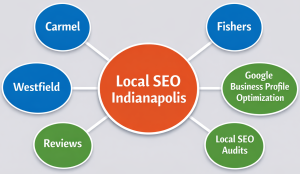
The best keyword cluster is a hub-and-spoke structure. Your pillar page targets “Local SEO Indianapolis,” while supporting pages target suburb-level and service-level variants that map to narrower intent.
A practical cluster could look like this:
- Pillar page: Local SEO Indianapolis
- Suburb pages: Local SEO Carmel, Local SEO Fishers, Local SEO Westfield
- Service pages: Google Business Profile optimization Indianapolis, local SEO audit Indianapolis, citation cleanup Indianapolis, review strategy Indianapolis
- Support articles: how to target multiple cities without duplicate content, Carmel vs Fishers vs Westfield keyword strategy, how GBP and landing pages work together, how to structure suburb pages for local SEO
This model works because it supports both discovery and depth. Google’s SEO documentation stresses making content easy to discover and using crawlable internal links with useful anchor text so search engines can find pages and understand relevance. A strong cluster does exactly that.
It also helps users move naturally from broad education to a more specific solution. Someone may start at your pillar page, compare suburb strategies, then click into the page that best matches their location or business model.
How do you decide whether to create one Indianapolis page or separate suburb pages?
You should create separate suburb pages only when each page can stand on its own. If the page adds no unique value and exists only to rank for a city name variation, it risks becoming thin or doorway-like content, which Google discourages.
A good suburb page usually has at least four things. First, it targets a real audience you actively serve. Second, it includes unique local framing, not recycled copy. Third, it connects to proof points such as examples, use cases, testimonials, or service differences. Fourth, it fits into a logical internal-linking structure instead of existing as an isolated SEO page.
A single Indianapolis page may be enough when your services are broad, your geographic targeting is limited, or you do not yet have the content resources to build high-quality suburb pages. But once you know leads or opportunities are coming from Carmel, Fishers, and Westfield, separate pages often become worthwhile because they let you answer different user questions and support different CTAs.
What should a Carmel local SEO page emphasize?
A Carmel local SEO page should emphasize authority, trust, and measurable business outcomes. The audience is likely to respond well to messaging that feels polished, strategic, and credible rather than generic or overly salesy.
Carmel stands out in the available Census data for its high median household income, high bachelor’s-degree attainment, and strong home values. That does not mean every business prospect behaves the same way, but it does suggest that positioning matters. A page for this market should communicate expertise, process clarity, and return on investment.
In practice, that means stronger proof elements. You would want copy that discusses local visibility in competitive categories, quality lead generation, reputation strength, and sustainable growth instead of vague “more traffic” language. You can also use more refined examples, especially for professional services, medical practices, legal firms, premium home services, and other higher-value service categories.
What should a Fishers local SEO page emphasize?
A Fishers local SEO page should emphasize broad local relevance and dependable lead generation. The message should be clear, practical, and focused on helping businesses improve visibility across a large, active suburban audience.
Fishers has a large population, strong household income, and high education levels, which makes it a valuable target for many local service businesses. It also has strong retail activity in the Census data, which supports the idea that local intent can be broad and commercially meaningful.
A well-built Fishers page should speak to outcomes like stronger map visibility, review growth, better local discovery, and consistent lead flow. This is also a good place to highlight Google Business Profile optimization, review acquisition practices, and category-specific visibility. Google’s own review guidance supports asking customers for genuine reviews and explicitly prohibits incentivized or misleading review tactics, so the page can credibly promote a compliant reputation strategy.
What should a Westfield local SEO page emphasize?
A Westfield local SEO page should emphasize growth opportunity and early visibility. The strongest angle is helping businesses establish a durable local presence in a market that is still expanding and evolving.
Westfield’s Census QuickFacts show faster recent population growth than Carmel and Fishers. That makes it especially useful for businesses thinking ahead rather than only reacting to established demand. In SEO terms, this can support messaging around building local relevance now, strengthening map visibility early, and creating suburb-specific content before the market becomes more saturated.
This does not mean Westfield is “easier” across the board. It means the value proposition is different. Businesses expanding into Westfield may care less about defending an entrenched reputation and more about gaining traction, capturing new local searches, and putting the right structure in place before competitors improve their own suburb targeting.
Can one Google Business Profile help you rank across Carmel, Fishers, and Westfield?
One Google Business Profile can help you rank across Carmel, Fishers, and Westfield, but it usually will not perform equally for every search. Google’s local ranking guidance explicitly says results are based on relevance, distance, and prominence, which means physical and geographic context still matter.
That is why GBP should be viewed as one part of the system, not the entire strategy. A well-optimized profile can help your business appear in Maps and local pack results beyond one immediate point on the map, especially when prominence is strong. But suburb-specific organic landing pages are often what help close the gap for searches where proximity or localized page relevance is weaker.
For service-area and hybrid businesses, Google also allows you to define service areas so customers can understand where you provide services. That supports discoverability, but it still does not replace the need for strong website pages when you want to rank for multiple suburb-specific queries.
How can you optimize suburb pages without creating duplicate content?
You optimize suburb pages without creating duplicate content by localizing substance, not just wording. Each page should answer the core question in a way that is genuinely useful for that suburb’s audience.
That means the differences need to go beyond the city name. Your Carmel page might highlight premium positioning, case-study style proof, and advanced local reputation strategy. Your Fishers page might focus more on broad local competition, reviews, and conversion consistency. Your Westfield page might highlight expansion, local presence building, and long-term visibility planning. Same service, different user concerns.
You can also differentiate pages with unique FAQs, different internal links, tailored intros, distinct examples, and suburb-specific calls to action. When you do that, the pages stop looking like cloned locations and start functioning like real decision pages. That is exactly the kind of difference Google’s anti-spam and quality guidance pushes site owners toward.
What internal linking structure works best for Indianapolis suburb local SEO?
The best internal linking structure is a central Indianapolis pillar supported by suburb pages and service pages that link in both directions. This helps users navigate logically and helps search engines understand which pages are related and which page serves as the primary authority hub.
A clean structure might look like this: the “Local SEO Indianapolis” pillar links to Carmel, Fishers, and Westfield pages; each suburb page links back to the pillar; each suburb page also links to related service pages such as Google Business Profile optimization or review strategy; and supporting blog posts link into the pillar and the most relevant suburb pages. That type of structure reinforces topic relationships without forcing everything onto one page.
Anchor text matters here too. Google recommends using crawlable links and helpful anchor text because links are a relevance signal and a discovery mechanism. In practice, that means your internal links should be descriptive and natural rather than vague.
Are suburb-comparison blog posts good for local SEO?
Yes, suburb-comparison blog posts are good for local SEO when they help users make a decision. They work best when they clarify how strategy should change by area rather than simply listing city names for SEO purposes.
This kind of article sits in a valuable middle position. It is more strategic than a beginner’s guide, but less conversion-heavy than a direct service page. That makes it useful for business owners who know they need local SEO but are not yet sure how to structure their geography targeting. It also creates strong internal linking opportunities because it can point readers to the pillar page, suburb pages, and service pages based on what they care about most.
In other words, a comparison post can attract qualified traffic and help search engines understand the relationship between your metro keyword and your suburb-level targets.
How do you measure whether a suburb keyword strategy is actually working?
A suburb keyword strategy is working when it improves visibility and conversions at the suburb level, not just when your overall traffic rises. Looking only at metro-level rankings can hide weak performance in specific areas.
The most useful performance indicators include rankings for suburb-modified queries, organic sessions to each suburb page, Google Business Profile insights, calls and form submissions by landing page, and conversion rates from users who enter through suburb-specific content. Search Console is also important because it helps you understand how your pages appear in Google Search and which queries are actually generating impressions and clicks.
The key is to measure by page and by geography. If your Indianapolis pillar page gains traffic but your Fishers or Westfield pages do not attract qualified visits, your architecture may still need work. Strong local SEO is not just broader visibility. It is better alignment between the right page, the right place, and the right searcher.
FAQ
Is “Local SEO Indianapolis” enough if my business mainly serves suburbs?
Not always. It is a strong parent keyword, but suburb-modified pages often become necessary when your customers search with city names like Carmel, Fishers, or Westfield and expect a more localized answer.
Should I build separate pages for Carmel, Fishers, and Westfield?
Yes, but only if each page can offer unique value. If the pages are thin or near-duplicates, they can create quality problems instead of ranking gains.
Can suburb pages hurt rankings if they are too similar?
Yes. Pages that exist mainly to rank for slight location variations without useful differences can look like doorway-style content, which Google discourages.
Which suburb should I target first?
Target the suburb where you already have the clearest combination of demand, proof, and business opportunity. If your company has stronger traction or more relevant examples in one area, start there and build outward.
Does Google Business Profile matter more than suburb landing pages?
Neither matters more in every case. GBP is critical for local pack visibility, but landing pages are often what strengthen organic relevance for suburb-specific searches. The best performance usually comes from using both together.
How many suburb pages are too many?
It becomes too many when quality drops. If you cannot create useful, differentiated pages with real purpose, adding more locations usually weakens the strategy rather than improving it.
Conclusion
The smartest way to target Local SEO Indianapolis is to treat Indianapolis as the hub and Carmel, Fishers, and Westfield as separate opportunities when the audience, intent, and conversion messaging differ. That structure aligns better with how local search actually works, because Google weighs relevance, distance, and prominence rather than treating one metro page as equally ideal for every nearby suburb.
For most businesses, the win is not creating more pages just to mention more places. The win is building fewer, better pages that reflect real search behavior. A strong pillar page, high-quality suburb pages, compliant Google Business Profile optimization, and a clear internal linking structure will usually outperform a generic citywide approach over time.
Why QBall Digital is Your Ideal Choice for Local SEO Indianapolis?
QBall Digital understands that local SEO in the Indianapolis area is not simply about ranking for one city term and hoping it covers every surrounding market. Businesses trying to win in Carmel, Fishers, and Westfield need a strategy that reflects how customers actually search, how Google actually ranks local results, and how different suburb audiences respond to different messages. That is where a smarter geographic content structure creates real value. Instead of repeating generic location copy, QBall Digital can help build pages that align with actual local intent and business goals.
What makes QBall Digital especially well suited for this work is the ability to connect search strategy with conversion strategy. A suburb page should not exist just to attract impressions. It should help the right visitor feel confident enough to take the next step. That means clear keyword mapping, thoughtful page positioning, Google Business Profile alignment, strong internal linking, and content that distinguishes Carmel, Fishers, and Westfield in useful ways. The result is a local SEO approach built not only for rankings, but for better leads and stronger long-term market coverage.
Ready to Grow Your Visibility Across Indianapolis, Carmel, Fishers, and Westfield with QBall Digital?
If your business needs a clearer path to ranking across the Indianapolis suburbs, QBall Digital can help you build a local SEO strategy around the places your customers actually search. The right structure can turn one broad keyword into a system that supports visibility, trust, and lead generation across the metro.