
Businesses in Indianapolis have more video advertising options than ever. The real question is not whether video works. It is which kind of video advertising fits your goals, budget, audience, and sales process.
For many local brands, the choice comes down to YouTube ads versus streaming TV ads on platforms such as Roku and Hulu. These channels can all put your message in front of the right people, but they do not behave the same way. YouTube is often stronger for flexible targeting, testing, and action-oriented campaigns, while streaming TV is often better for premium-screen visibility, household reach, and top-of-funnel awareness. Google says Video campaigns can reach people on YouTube, Google TV, and Google video partners, while Disney Campaign Manager positions Hulu and Disney+ inventory as self-serve streaming TV advertising, and Roku emphasizes measurable TV streaming across the customer journey.
If you are evaluating YouTube ads in Indianapolis, the smartest approach is to understand what each platform is built to do, then match that to your business goals. In some cases, YouTube is the clear first move. In others, Roku or Hulu can add reach and authority. And for many growing brands, the best answer is a blended strategy.
What are YouTube ads, and how do they help Indianapolis businesses reach local audiences?
YouTube ads are video campaigns run through Google Ads. They can appear on YouTube and, depending on campaign settings, across Google video partners. Google’s Video campaign documentation highlights that advertisers can choose different objectives, campaign subtypes, bidding approaches, and ad formats based on whether the goal is awareness, consideration, or action.
For Indianapolis businesses, that matters because YouTube can support both broad exposure and more performance-oriented outcomes. A local home services company might use YouTube to introduce its brand across Marion County, while a dental practice could use it to stay visible to people already researching providers nearby. Google also supports audience targeting for video campaigns using demographics, interests, placements, keywords, topics, and first-party data, which gives advertisers multiple ways to narrow who sees the ad.
That flexibility is why YouTube often works well for businesses that want more than passive visibility. It can be part awareness channel, part consideration channel, and part demand-support channel, especially when paired with search campaigns and landing pages built to convert.
What are Streaming TV ads, and how do Roku and Hulu fit into the picture?
Streaming TV ads are video ads shown inside ad-supported streaming content on connected TVs, streaming devices, and other supported screens. Instead of appearing beside search behavior or inside a video feed, they show up in a more TV-like viewing environment. Nielsen’s Gauge report has repeatedly shown how central streaming has become to U.S. viewing, with streaming representing a historically large share of TV usage. That shift is one reason local and regional advertisers are increasingly treating streaming as a serious media channel rather than an experimental one.
Roku and Hulu sit inside that broader streaming ecosystem, but they are not identical. Roku offers self-serve tools and audience targeting within defined locations, while Roku’s advertising materials emphasize measurement throughout the funnel. Disney Campaign Manager gives advertisers access to Hulu and Disney+ campaigns in one platform, with targeting by location, demographics, interests, and show genres.
For Indianapolis advertisers, streaming TV usually functions less like a click-first channel and more like a reach-and-recall channel. The value is often the viewing environment itself: larger screens, premium content, and a more immersive ad experience.
How are YouTube ads different from Roku and Hulu ads?
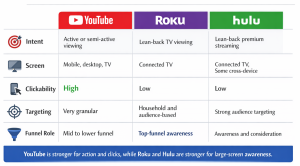
The biggest difference is viewer mindset. On YouTube, users are often browsing, researching, comparing, learning, or being entertained in a more active environment. On Roku and Hulu, viewers are usually leaning back and watching long-form content on a TV screen. That changes how targeting, creative, and performance should be judged. Google’s video ad products are built around a mix of objectives and engagement formats, while Roku and Disney position their streaming ad products around premium TV delivery, audience targeting, and measurement.
The second difference is how action happens. YouTube is generally better suited to campaigns where you want some combination of views, site traffic, leads, remarketing audiences, and measurable mid-funnel engagement. Streaming TV can contribute to action too, but the user journey is often less immediate. A viewer may see your ad on Hulu or Roku, remember your brand, and search for you later rather than clicking in the moment.
The third difference is how creative needs to work. A YouTube ad may need to earn attention quickly in a skippable environment, while a streaming TV ad can lean more into polish, pacing, and strong visual storytelling. Those are not small tactical differences. They affect script structure, calls to action, and how you evaluate results.
Why do some Indianapolis advertisers choose YouTube first?
Many Indianapolis businesses should start with YouTube because it is often easier to test, refine, and connect to direct business outcomes. Google’s targeting options for video campaigns let advertisers combine geography with audience signals such as interests, demographics, placements, and first-party data. That makes YouTube especially useful when a business wants local reach but also wants more control over who sees the message.
YouTube is also a natural fit when your video strategy needs to support search and lead generation. If someone sees your ad, then searches your brand, visits your site, or later converts through another campaign, YouTube can still play a meaningful role in the path to conversion. For businesses that already run Google Search or Performance Max, YouTube often becomes the most logical video extension because it fits inside the same broader Google Ads ecosystem.
That is why YouTube is often the smarter first investment for local service businesses, medical practices, law firms, education providers, and B2B companies that need both visibility and accountable media.
Why do some brands add Streaming TV ads on Roku or Hulu?
Brands tend to add Roku or Hulu when they want more premium-screen exposure and broader household awareness. Nielsen’s viewing data makes the strategic case simple: streaming is no longer a side channel in TV consumption. It is central to how audiences watch.
Roku and Hulu also appeal to advertisers that want TV-style presence without buying traditional linear TV. Roku highlights audience targeting within defined locations and measurement options, while Disney Campaign Manager makes streaming TV available with relatively accessible budgets and self-serve tools. Disney says campaigns can start at a minimum spend of $500 and can target by location, demo, interests, and genre.
For Indianapolis brands trying to build market presence, that can be powerful. A larger home services company, regional healthcare brand, or established multi-location business may benefit from showing up in a more premium living-room environment where the brand feels bigger and more memorable.
How does local targeting work for YouTube ads in Indianapolis?
Local targeting on YouTube works best when geography is paired with audience strategy. Google states that video campaigns support targeting by location and that location targeting works as an intersection with other targeting methods. In practice, that means you can focus on the Indianapolis area and then further narrow the campaign by audience type, demographics, placements, topics, or your own data.
That is useful for Indianapolis campaigns because not every local business needs the same level of reach. A downtown firm may want tighter geographic focus than a regional company serving the full metro. The key is to avoid thinking of geo-targeting as the whole strategy. Location tells the platform where to focus. It does not by itself make the ad relevant.
Strong local YouTube campaigns usually combine three things: a clearly defined service area, an audience layer that reflects likely buyers, and creative that feels relevant to the market. That is how “YouTube ads Indianapolis” becomes a real growth tactic instead of just a settings choice.
How does local targeting work for Streaming TV ads in Indianapolis?
Streaming TV platforms also offer local targeting, but the experience is usually more audience-and-reach oriented than click-oriented. Roku’s self-serve help center states that audience targeting works within the locations you define, and Disney Campaign Manager says advertisers can target Hulu viewers by location along with demo, interest, and genre signals.
For local brands, this means you can run streaming campaigns that focus on Indianapolis-area viewers rather than wasting spend on broad national exposure. The difference is that success is often measured more by reach, completion, recall, site lift, branded search lift, or downstream conversion patterns than by immediate clicks alone.
That makes streaming TV a better fit when your business needs broader market visibility or when your sales cycle depends on repeated exposure before a prospect takes action.
What creative works best for YouTube ads?
YouTube creative needs to communicate quickly and clearly. Google’s ABCDs guidance says effective YouTube ads are built around Attention, Branding, Connection, and Direction. In plain terms, that means you need a strong opening, visible branding, a relatable message, and a clear ask. Google’s help materials also emphasize adapting creative principles based on whether your objective is awareness, consideration, or action.
For Indianapolis advertisers, the best YouTube creative usually does a few things well. It introduces the problem fast. It shows the brand early. It gives the viewer one main message instead of five. And it ends with a CTA that matches the landing experience, whether that is booking, calling, requesting a quote, or learning more.
What tends to underperform is generic brand video that was never built for ad delivery. A strong YouTube ad is not just a nice-looking video. It is a conversion-aware message packaged for a skippable, fast-decision environment.
What creative works best for Roku and Hulu ads?
Streaming TV creative should feel more like premium television than social content. The viewer is often on a couch, on a larger screen, and watching long-form content. That means visual quality, pacing, and production value matter more. The ad still needs a clear message, but it does not need to rely on the same kind of fast interruption mechanics as YouTube.
Because Roku and Hulu campaigns are often stronger at awareness and recall, the creative should prioritize memorable branding, one clear value proposition, and a simple next step. That next step might not even be a direct click. It may be a brand search, a later site visit, or stronger familiarity when the prospect sees your paid search ad or display remarketing later.
In other words, streaming TV ads should not try to imitate YouTube ads too closely. The environment is different, and the best-performing creative usually respects that difference.
Can YouTube ads and Streaming TV ads work together in one Indianapolis campaign?
Yes, and that is often where the best strategy lives.
Streaming TV can build awareness and credibility at the household level. YouTube can reinforce the message in a more interactive environment and support consideration or action. Search campaigns can then capture the demand those video channels help create. Google’s Video campaigns are designed for multiple objectives, while Roku and Disney both emphasize measurable streaming delivery, which makes a full-funnel mix more practical than it used to be.
For example, an Indianapolis remodeling company could use Hulu or Roku to reach local households with premium brand video, then use YouTube to retarget or extend reach with more offer-driven creative, and finally rely on Google Search to capture branded and high-intent queries. Each channel does a different job. Together, they create a stronger path from awareness to inquiry.
How should a business choose between YouTube ads, Roku, and Hulu?
Choose YouTube first when you need flexibility, more granular testing, and stronger alignment with site traffic or lead generation. Choose Streaming TV when the goal is broader market reach, premium-screen visibility, and local brand growth. Choose both when your business needs scale and performance support at the same time.
Budget also matters, but not in the old all-or-nothing way. Disney Campaign Manager says campaigns can begin with a $500 minimum spend, and Roku has made self-serve streaming buying more accessible too. That does not mean every small business should jump into streaming immediately. It means the barrier is lower than many advertisers assume.
The better question is whether your business has the right ingredients: enough budget to generate meaningful reach, creative that fits the platform, and a measurement plan that does not judge every channel by the same last-click standard.
Are YouTube ads in Indianapolis worth it for lead generation?
Yes, when the campaign is structured around the real buying journey.
YouTube can be effective for lead generation because it sits close enough to intent-driven behavior to influence action, especially when paired with strong targeting, clear offers, and conversion-focused landing pages. Google’s Video campaign tools support action-oriented objectives as well as audience and geographic controls, giving local businesses room to tailor campaigns around real demand.
That said, the businesses that win with YouTube usually do not expect every lead to come directly from a click on the ad. They understand that video often assists conversions, increases branded search, and improves the performance of other channels. When expectations match how the platform works, YouTube becomes a strong lead-generation support channel for Indianapolis businesses.
Are Roku and Hulu ads worth it for local brand growth?
Often, yes.
If your goal is to look bigger, stay visible in your market, and build familiarity with local households, streaming TV can be a smart investment. Roku’s advertising materials focus on measurable streaming performance, and Disney positions Hulu as accessible streaming TV advertising for campaigns of different sizes. Combined with Nielsen’s evidence that streaming commands a major share of TV viewing, the case for local streaming TV is strong.
The biggest mistake is expecting Roku or Hulu to behave exactly like paid search. These channels are usually strongest when judged as awareness and consideration media that improve what happens later across branded search, direct traffic, and assisted conversions.
Conclusion
YouTube ads and streaming TV ads are both valuable, but they are not interchangeable. YouTube ads in Indianapolis are often the better first move for businesses that want flexibility, tighter testing, and stronger support for lead generation. Roku and Hulu ads are often better for premium visibility, household reach, and broader brand growth.
For many Indianapolis businesses, the smartest answer is not YouTube or streaming TV. It is knowing how to use each one for the job it does best.
Why QBall Digital is Your Ideal Choice for Video Advertising in Indianapolis?
QBall Digital is well positioned to help Indianapolis businesses make the right call because effective video advertising is rarely about choosing the trendiest platform. It is about matching channel, audience, geography, creative, and business objective in a way that produces measurable growth. A YouTube-heavy strategy may be right for one brand, while another may need a stronger streaming TV presence to build local awareness before performance channels can do their job.
What sets a strong partner apart is the ability to connect video advertising to the full paid media picture. QBall Digital can help businesses avoid the common mistake of treating YouTube, Roku, Hulu, and search as separate silos. When video strategy is planned around the full funnel, creative becomes more purposeful, targeting becomes more efficient, and the results are easier to scale.
Ready to Launch Smarter Video Ads with QBall Digital?
If your business is trying to decide between YouTube ads, Roku, Hulu, or a blended video strategy, QBall Digital can help you choose the option that fits your goals and market. The right plan starts with understanding what each channel is designed to do, then building creative and targeting around that reality.
FAQ
What is the difference between YouTube ads and Streaming TV ads?
YouTube ads run in Google’s video ad ecosystem and are often stronger for flexible targeting, testing, and action support. Streaming TV ads run inside ad-supported TV-style content on connected devices and are often stronger for premium awareness and household reach.
Can I target only Indianapolis with YouTube ads?
You can target the Indianapolis area and combine that location targeting with audience layers such as demographics, interests, placements, and your own data segments.
Can small businesses afford Roku or Hulu advertising?
Potentially, yes. Disney Campaign Manager says campaigns can launch with a $500 minimum spend, and Roku offers self-serve ad tools as well. Whether it is a smart investment depends more on your goals, creative, and measurement plan than on access alone.
Are YouTube ads better for leads than Streaming TV ads?
Often yes, especially when you need more direct action and tighter testing. Streaming TV can still drive business results, but it usually works more as an awareness and consideration channel than a pure click channel.
Do I need different video creative for YouTube and Hulu?
Usually, yes. YouTube creative should earn attention fast and work in a more skippable environment, while Hulu and other streaming TV creative should feel stronger on a larger screen and in a premium viewing context.
How do I know whether video ads are working?
Judge performance by the role of the platform. YouTube can be evaluated using views, engagement, traffic, and assisted conversions. Streaming TV may be better judged through reach, completion, lift in branded search, direct traffic, or downstream conversion patterns. Roku explicitly emphasizes measurement across the customer journey.