
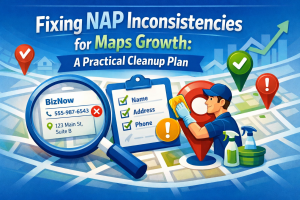
If your reviews look strong and your competitors still outrank you in the Map Pack, it’s tempting to assume you need “more SEO.” In reality, one of the most common reasons businesses stall in Google Maps is far less glamorous: Google isn’t confident that every mention of your business online refers to the same entity.
That confidence is built from consistency. And few things break it faster than inconsistent NAP—your Name, Address, and Phone number—spread across Google Business Profile, your website, data providers, and directories.
When those details don’t align, Google may treat your business as fragmented. Your authority doesn’t consolidate. Engagement splits. And your rankings can stay stubbornly flat, even when you’re doing everything else “right.”
What NAP inconsistencies really are (and what Google “counts” as inconsistent)
NAP inconsistencies are any variations in your business identity details that make you appear different from one source to another. Some variations are harmless formatting differences; others are identity-level conflicts.
The key is this: Google doesn’t evaluate NAP like a human scanning for typos. Google tries to reconcile signals at scale—across listings, webpages, maps apps, directories, and third-party databases. If your identity details conflict, the system may struggle to confidently unify everything into one profile.
This is why NAP problems often appear after normal business events: moving offices, adding a suite number, changing phone providers, rebranding, or rolling out call tracking. Each change creates opportunities for “old truth” and “new truth” to coexist online—sometimes for months or years.
Why NAP inconsistencies can keep you out of the Map Pack
Google explains local results through relevance, distance, and prominence. Most businesses focus on relevance (categories, services) and sometimes distance (proximity), but prominence is where NAP consistency quietly matters.
Prominence is partly built from how well Google can understand and trust your business as a real-world entity. If your identity data is inconsistent, several problems tend to follow:
First, your authority can get diluted. Mentions, links, and engagement signals may not roll up to a single entity cleanly if Google sees two versions of your business.
Second, duplicates can steal the signals you need. A duplicate listing—whether it’s a second Google Business Profile, a legacy directory listing, or an auto-generated map entry—can siphon clicks, calls, and direction requests. Even worse, it can collect reviews or engagement that should have strengthened your primary listing.
Third, ranking volatility increases. When Google isn’t sure which version of your business is “correct,” you may see unpredictable results across neighborhoods. You’ll show up in one part of town but disappear a few miles away, even though you haven’t changed anything.
If you’ve ever searched your brand name and seen multiple map results, or noticed reviews appearing on the wrong profile, you’ve likely experienced the real-world consequences of identity fragmentation.
The difference between “ranking blockers” and harmless noise
Not every inconsistency is equally dangerous. Some differences are essentially formatting variations. Others are identity-level issues that can create splits, duplicates, or confusion.
The most reliable way to think about severity is this: Anything that changes how your business is identified is high risk. Anything that changes only how it’s formatted is usually lower risk—unless it contributes to a duplicate.
Here’s how that plays out in practice.
Identity-level issues (often ranking blockers) typically include:
- The wrong phone number appearing as your “main” number in key places
- Address mismatches, missing suite numbers, or an old address still widely published
- Duplicates of your Google Business Profile or duplicates across major platforms
- Competing or outdated location pages tied to different NAP variants
- Rebrand remnants where old and new names are both heavily published
Formatting-level differences often include:
- “St.” vs “Street”
- Abbreviation choices
- Minor punctuation differences
Formatting differences aren’t automatically safe, but they rarely cause damage unless they’re part of a broader pattern that makes you look like a different entity—or triggers duplicates.
How to tell if NAP inconsistencies are the reason your Maps rankings won’t move
NAP issues don’t always show up as obvious errors. More often, they show up as symptoms—especially symptoms that don’t match the effort you’re putting in.
You might be dealing with NAP-driven clustering problems if your business experiences patterns like these:
You do a branded search and see more than one map result for your company name. Your ranking performance changes dramatically across small distances. Calls and direction requests drop after a move or phone change. Reviews appear on a listing you don’t control, or customers keep finding the wrong phone number even though your GBP looks correct.
These are the signs that matter because they point to entity confusion, duplicates, and split engagement—exactly the issues that suppress prominence.
How to audit NAP the right way (without turning it into a directory marathon)
A good audit isn’t “check every directory.” A good audit is structured, prioritized, and designed to find identity splits fast.
Start by establishing a canonical version of your NAP—your internal “source of truth.” Decide the exact business name format you’ll use, the precise address formatting (including suite/unit rules), and the phone number you want to serve as your identity anchor. Without this, you can’t fix consistency; you can only chase variations.
Next, audit the places that shape your identity most strongly: your Google Business Profile, your website, and the major platforms people actually use. If your website and GBP don’t match, you’re building inconsistency into the foundation.
Then, look for duplicates and near-duplicates. This step matters more than most people realize. A duplicate is not just an annoyance—it’s a competing identity record that can absorb your authority. Search your business name, phone number, and address (including old versions) and document anything that appears to represent the same business but with a different identity.
Finally, evaluate your highest-impact citations—meaning the listings that rank, drive leads, or influence downstream publishing. Many directories are irrelevant; some are highly influential. A strong audit focuses your effort where it actually changes outcomes.
How to fix NAP inconsistencies without making the situation worse
NAP cleanup can backfire if it’s done in the wrong order. The biggest mistake is bulk editing dozens of directories while duplicates and core identity conflicts still exist. That approach can propagate mixed signals further rather than consolidating them.
A safer, higher-performing sequence looks like this:
Begin with Google Business Profile and duplicates. Make sure your GBP identity is correct and stable, then eliminate or resolve duplicates properly. If Google has multiple competing representations of your business, nothing else will consolidate cleanly.
Then align your website. Your website should reflect your canonical NAP in prominent locations and on relevant pages, especially location pages. If your website contradicts your GBP, you’re asking Google to trust two different sources.
Next, correct the most influential external sources. Prioritize listings that are visible to customers and search engines, and those that tend to feed other systems. This is the part that produces the biggest consolidation effect.
Only after that should you clean long-tail and niche directories. They can still matter, but they rarely solve the core identity problem if you haven’t handled duplicates and top sources first.
Finally, treat NAP as something that needs maintenance. Businesses change, vendors change, platforms change. Without monitoring and governance, drift returns.
Call tracking: the most common way businesses accidentally create NAP problems
Call tracking is useful, and many businesses rely on it to prove ROI. The trouble starts when tracking numbers replace your real phone number everywhere and become part of your public identity.
The safest approach is to preserve a canonical phone number as your primary identity anchor. You can measure effectively without undermining identity by using tracking in controlled contexts—such as website sessions (via dynamic number insertion) or specific marketing channels—while keeping your public NAP consistent across core citations and your website’s permanent NAP placements.
If you’re using tracking in Google Business Profile, you want to be especially careful that tracking doesn’t leak into directories or become the number that gets replicated by third-party sources. The goal is measurement without changing the identity record that Google and the web use to recognize your business.
How long it takes for NAP fixes to impact Maps visibility
Some improvements can show up quickly—especially when duplicates are removed or GBP identity issues are corrected—because you’re directly changing the cluster Google relies on.
Other improvements depend on recrawling and reprocessing across external platforms. Directories refresh on different schedules, and Google’s understanding of the web’s business data updates over time, not instantly.
A practical expectation is that NAP cleanup often improves conversion behavior first (fewer wrong calls, better direction accuracy, fewer “I found the wrong address” issues) and then improves ranking stability as consolidation strengthens.
What a fix NAP inconsistencies service should include (if you want real ROI)
A real fix NAP inconsistencies service isn’t a spreadsheet of 100 directory edits. It’s an identity and authority consolidation project designed to help Google unify your presence, reduce duplicates, and stop signal leakage.
That means the service should start with a canonical NAP strategy and a prioritization plan, not “spray-and-pray” submissions. It should include duplicate discovery and resolution, because duplicates are the most common reason authority doesn’t consolidate. It should align your website and your Google Business Profile so the two strongest sources reinforce each other rather than conflict.
It should also address call tracking safely—because measurement is valuable, but not if it causes identity drift. And it should provide reporting tied to outcomes: fewer duplicates, higher accuracy on top sources, more calls and directions, and more stable visibility across your target area.
If the deliverable doesn’t connect to rankings, conversions, and stability, it’s busywork—not a service.
How to measure success after NAP cleanup (beyond rankings)
Rankings matter, but they’re not the only signal that your identity is consolidating. You’ll know NAP cleanup is working when customers stop finding the wrong phone number, direction requests increase, and brand searches show one clean result instead of multiple confusing variations.
You should also see fewer duplicate instances, fewer mismatched listings, and more consistent performance across neighborhoods. In other words, success looks like both improved visibility and fewer operational headaches.
Conclusion
NAP inconsistencies are rarely the flashiest SEO issue, but they’re one of the most common reasons strong businesses fail to break into the Map Pack. When identity signals don’t align, Google can’t confidently consolidate your authority, and your prominence suffers.
The fix isn’t “update more directories.” The fix is to stabilize your canonical NAP, eliminate duplicates, align GBP and your website, correct the most influential sources, and monitor so drift doesn’t return. When you do that, you stop bleeding trust signals—and you give Google what it needs to rank you consistently.
Why Qball Digital is Your Ideal Choice for fix NAP inconsistencies service?
Qball Digital approaches NAP cleanup as a consolidation project built around how local entities actually behave in Maps ecosystems. Instead of starting with a long list of directories, we start with the reality that rankings depend on trust and unification: one clean identity, one strong cluster, and a consistent set of signals that reinforce each other.
We also keep the work tied to ROI. Qball Digital prioritizes the fixes that move the needle first—duplicates, high-impact platforms, and website alignment—then supports the cleanup with monitoring so your visibility doesn’t degrade again over time. The result isn’t just “more consistent listings,” but a stronger foundation for calls, directions, and bookings from local search.
Book a Maps Visibility & NAP Cleanup Review with Qball Digital
If you suspect inconsistent listings or duplicates are holding you back, Qball Digital can identify where your entity is splitting, prioritize the corrections that matter, and execute a cleanup plan designed to consolidate trust signals and improve Maps performance. Book a review to get a clear, prioritized fix plan tied to measurable outcomes.
`